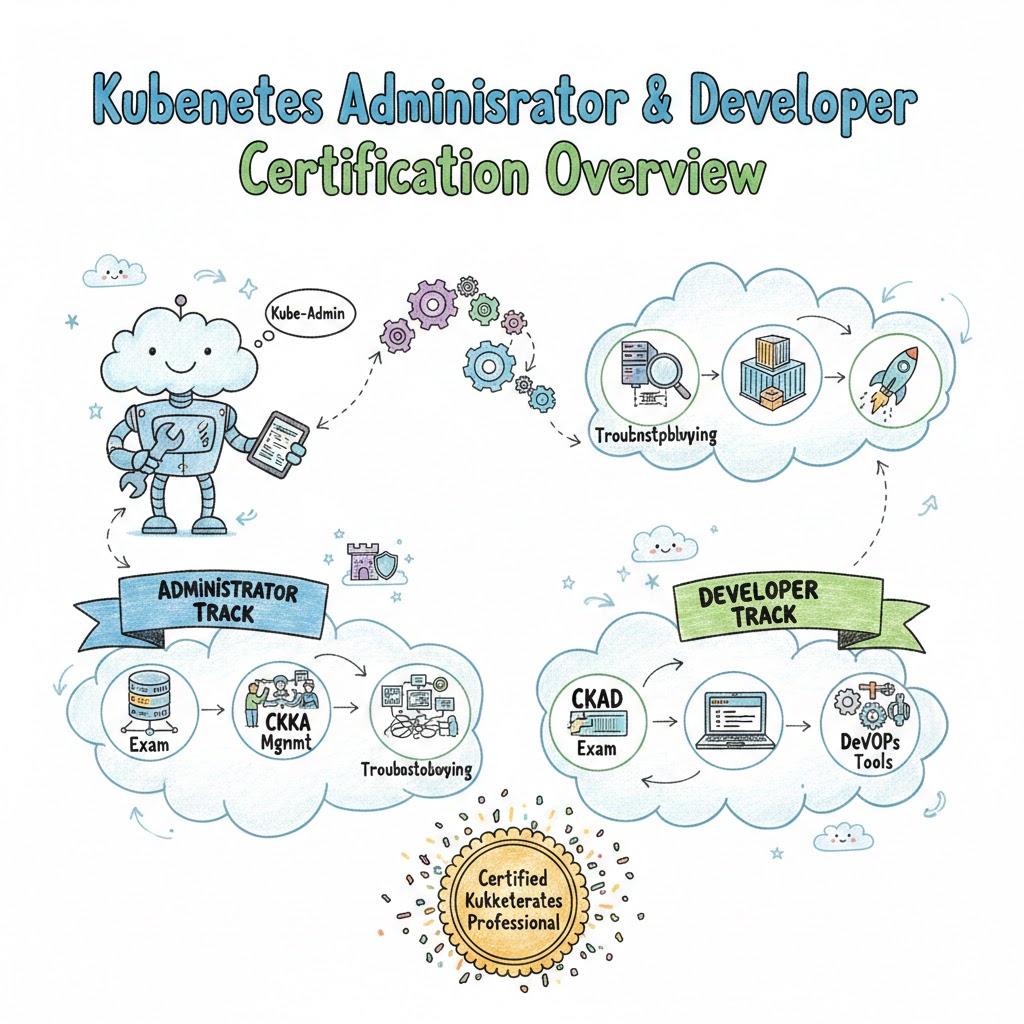
Introduction
Kubernetes has transformed the landscape of cloud-native development and DevOps. It is the most widely adopted container orchestration platform, allowing organizations to manage and scale their applications with unparalleled flexibility and efficiency. As companies increasingly shift to microservices architectures, the need for Kubernetes experts has surged. This makes Kubernetes certifications—specifically, the Kubernetes Certified Administrator & Developer (KCAD) and Kubernetes Certified Developer (KCD)—highly valuable for professionals aiming to gain a competitive edge in the cloud computing and DevOps job market.In this comprehensive guide, we’ll explore the Kubernetes Certified Administrator & Developer certifications, outlining who should pursue them, the essential skills they provide, and the best strategies for preparation. We’ll also discuss the real-world applications you’ll be able to handle after certification, and why Kubernetes is a game-changer for your career.
What Are Kubernetes Certified Administrator & Developer Certifications?
The Kubernetes Certified Administrator (KCA) and Kubernetes Certified Developer (KCD) certifications are specialized credentials designed for professionals who want to validate their expertise in managing Kubernetes clusters and deploying applications within the Kubernetes ecosystem.
- KCA (Kubernetes Certified Administrator) focuses on the operational aspects of Kubernetes, ensuring professionals can manage, monitor, and troubleshoot Kubernetes clusters effectively.
- KCD (Kubernetes Certified Developer) targets developers who need to understand how to deploy, scale, and monitor applications on Kubernetes, focusing on application deployment workflows and automation.
Kubernetes has become a standard for container orchestration, with companies from startups to enterprise-level organizations relying on it for efficient application deployment and scaling. These certifications not only help professionals gain deep knowledge of Kubernetes, but they also provide hands-on experience to work in a live Kubernetes environment.
Who Should Consider These Certifications?
These certifications are perfect for professionals who work with cloud infrastructure, containerization, and DevOps processes. Here’s a breakdown of the roles that would benefit most from the Kubernetes Administrator & Developer certifications:
- DevOps Engineers: DevOps engineers can leverage Kubernetes for automating infrastructure management, CI/CD pipelines, and scaling applications.
- Cloud Engineers: As cloud computing continues to evolve, cloud engineers need a strong understanding of Kubernetes for deploying applications in a highly scalable, efficient manner across cloud environments.
- Software Developers: Developers who are responsible for building containerized applications will find Kubernetes knowledge invaluable for optimizing application deployment and scaling processes.
- Platform Engineers: Professionals responsible for designing and maintaining the platform for hosting applications can benefit from mastering Kubernetes for optimal resource utilization and system scaling.
- Security Engineers: With Kubernetes handling large-scale containerized workloads, security engineers need to understand how to secure Kubernetes environments, containers, and associated resources.
In short, if your work revolves around deploying, managing, or scaling containerized applications, the Kubernetes Certified Administrator & Developer certifications are essential to validating your expertise and advancing your career.
Skills You’ll Gain
By pursuing the Kubernetes Certified Administrator & Developer certifications, you will acquire several key skills that are essential for anyone working with Kubernetes. These skills include:
- Kubernetes Architecture & Components: Understand the core components of Kubernetes, such as nodes, pods, deployments, and the control plane. You will also learn about Kubernetes clusters, how they are structured, and how they interact to manage workloads.
- Application Deployment: Learn how to deploy and manage containerized applications using Kubernetes. You’ll master concepts like Pods, Deployments, StatefulSets, and DaemonSets, all of which are integral to Kubernetes application management.
- Networking & Services: Gain the knowledge needed to manage networking within Kubernetes, including services, ingress controllers, and networking policies that allow applications to communicate securely within and outside the cluster.
- Persistent Storage: Kubernetes requires effective storage management for applications that need persistent data. You will learn to work with persistent volumes (PV) and persistent volume claims (PVC), as well as managing storage in cloud environments.
- Security Practices: Kubernetes security is a critical aspect of cloud-native architecture. Learn how to configure Role-Based Access Control (RBAC), secure secrets, and implement best practices for securing clusters and applications.
- Monitoring & Troubleshooting: You’ll be trained to monitor your Kubernetes clusters and applications, perform diagnostics, and troubleshoot common issues using tools like kubectl for inspecting logs and pod statuses.
Real-World Applications You’ll Be Able to Handle
Upon certification, you will be prepared to work on practical, real-world tasks that leverage Kubernetes for deploying, managing, and scaling containerized applications. Some of the real-world applications you’ll be able to confidently handle include:
- Cluster Setup & Management: Setting up and managing Kubernetes clusters in local or cloud environments (e.g., AWS, Azure, GCP).
- CI/CD Pipeline Integration: Integrating Kubernetes into Continuous Integration and Continuous Delivery pipelines for automated deployment and testing of containerized applications.
- Automated Scaling: Implementing Horizontal Pod Autoscaling (HPA) and Vertical Pod Autoscaling (VPA) for managing application load and scaling in Kubernetes environments based on traffic.
- Application Monitoring: Using tools like Prometheus, Grafana, and the ELK stack to monitor the health, performance, and logs of applications and infrastructure.
- Security Implementation: Configuring Kubernetes clusters securely using RBAC, Network Policies, PodSecurityPolicy, and managing secrets with tools like Vault.
- Cost and Resource Optimization: Managing Kubernetes resources and ensuring optimal usage of cloud services, reducing unnecessary spending on compute, memory, and storage.
How to Prepare for the Kubernetes Certification Exams
The exams for the Kubernetes Certified Administrator & Developer certifications are practical and require both theoretical knowledge and hands-on skills. Here’s how you can effectively prepare:
7–14 Days (Initial Exposure)
Start by familiarizing yourself with Kubernetes architecture and its basic components. Set up a local Kubernetes environment using tools like Minikube or Docker Desktop and practice basic commands using kubectl.
Focus Areas:
- Introduction to Kubernetes Architecture
- Setting up a Kubernetes Cluster
- Basic management using kubectl
- Pods, Deployments, and Services
30 Days (Intermediate Learning)
Deepen your understanding of Kubernetes by focusing on more advanced topics like persistent storage management, networking, and security. Hands-on practice is essential, so work with Persistent Volumes, Ingress Controllers, and Network Policies.
Focus Areas:
- Networking & Security (RBAC, Network Policies)
- Managing Persistent Storage
- Introduction to Helm for deploying applications
- Scaling and troubleshooting Kubernetes applications
60 Days (Advanced Learning)
Now that you’ve mastered the basics, it’s time to focus on troubleshooting, debugging, and optimizing Kubernetes clusters. You will also learn how to integrate Kubernetes with CI/CD tools and automate deployments.
Focus Areas:
- Debugging Kubernetes issues
- Advanced scaling and high-availability setups
- Integrating Kubernetes with CI/CD
- Monitoring Kubernetes clusters with Prometheus and Grafana
Common Mistakes to Avoid
While preparing for the certification exams, here are some common mistakes that candidates make:
- Skipping Hands-On Practice: Kubernetes is a practical skill. Reading about it is important, but hands-on practice is crucial to passing the exams.
- Skipping Core Concepts: Make sure you understand Kubernetes’ architecture and basic components before diving into more advanced topics.
- Not Focusing on Security: Security is a major component of Kubernetes, so don’t neglect RBAC, secrets management, and network policies.
- Ignoring Troubleshooting: Learning how to troubleshoot Kubernetes environments is critical. Don’t skip this part of the training.
Next Certifications After Kubernetes Certified Administrator & Developer
Once you have achieved Kubernetes certification, you can expand your expertise with additional certifications:
- Same Track:
- Certified Kubernetes Security Specialist (CKS): Focus on securing Kubernetes clusters and containerized applications.
- Cross Track:
- Certified DevOps Professional (CDP): Broaden your DevOps knowledge beyond Kubernetes with a focus on automation, tools, and cultural practices.
- Leadership:
- Certified Kubernetes Trainer (CKT): If you’re interested in training others and moving into leadership, this certification will qualify you to teach Kubernetes.
Choose Your Learning Path: Kubernetes Certifications for Different Roles
Kubernetes is a versatile tool that suits various roles in IT. Here’s a brief overview of the learning paths based on your career goals:
1. DevOps Path
Focus on automating infrastructure, deploying containerized applications, and integrating Kubernetes with CI/CD pipelines.
Ideal For: DevOps Engineers, Cloud Engineers.
2. DevSecOps Path
Learn how to secure Kubernetes clusters and integrate security throughout the deployment pipeline using best practices.
Ideal For: Security Engineers, DevSecOps Professionals.
3. SRE Path
Specialize in maintaining Kubernetes clusters for high availability, scalability, and performance in production environments.
Ideal For: Site Reliability Engineers, Operations Engineers.
4. AIOps/MLOps Path
Deploy and manage AI/ML applications on Kubernetes, integrating machine learning pipelines and scaling models.
Ideal For: Data Scientists, ML Engineers.
5. DataOps Path
Use Kubernetes to manage big data workflows and containerize data services like Apache Kafka, Spark, and Hadoop.
Ideal For: Data Engineers, DataOps Professionals.
6. FinOps Path
Optimize cloud resource costs by managing Kubernetes usage and ensuring efficient resource allocation.
Ideal For: FinOps Professionals, Cloud Cost Managers.
Role → Recommended Certifications
| Role | Recommended Certifications |
|---|---|
| DevOps Engineer | Kubernetes Certified Administrator & Developer, Certified DevOps Professional (CDP), Certified Kubernetes Security Specialist (CKS) |
| SRE | Kubernetes Certified Administrator & Developer, Certified Site Reliability Engineer (SRECP), Master in DevOps Engineering |
| Platform Engineer | Kubernetes Certified Administrator & Developer, Certified Kubernetes Developer (CKD), Certified DevOps Architect (CDA) |
| Cloud Engineer | Kubernetes Certified Administrator & Developer, AWS Certified Solutions Architect, Azure DevOps Solutions Expert |
| Security Engineer | Certified Kubernetes Security Specialist (CKS), Certified DevSecOps Professional (DSOCP), Certified Ethical Hacker (CEH) |
| Data Engineer | Kubernetes Certified Administrator & Developer, Certified DataOps Professional (DOCP), Google Professional Data Engineer |
| FinOps Practitioner | Certified FinOps Practitioner, Certified DevOps Professional (CDP), Kubernetes Certified Administrator & Developer |
| Engineering Manager | Master in DevOps Engineering, Certified DevOps Manager (CDM), Kubernetes Certified Administrator & Developer |
Comparison Table
| Aspect | Kubernetes Certified Administrator (KCA) | Kubernetes Certified Developer (KCD) |
|---|---|---|
| Target Audience | IT professionals responsible for managing Kubernetes clusters, ensuring their availability, and troubleshooting issues. | Developers who work on deploying and developing applications within Kubernetes environments. |
| Primary Focus | Cluster management, configuration, deployment, monitoring, and troubleshooting. | Application deployment, configuration, scaling, and monitoring within Kubernetes clusters. |
| Skills Covered | – Cluster setup and management – Resource scheduling – Troubleshooting – Persistent storage management – Cluster networking | – Application deployments – Scaling and managing services – Helm and kubectl usage – Configuration management – Application lifecycle management |
| Core Concepts | – Kubernetes architecture and components – Security & RBAC – Cluster maintenance – Logging and monitoring | – Containerized application development – Kubernetes deployment strategies – CI/CD with Kubernetes – Helm charts for managing applications |
| Difficulty Level | Moderate to High – Requires practical experience in managing and troubleshooting clusters. | Moderate – Requires proficiency in deploying and managing apps on Kubernetes. |
| Practical Exam Format | Performance-based: Solve real-world problems in a live Kubernetes cluster, such as setting up, configuring, and troubleshooting the cluster. | Performance-based: Tasks include deploying and managing applications, writing configurations, and automating app scaling. |
| Recommended Preparation Time | 30-60 days, depending on your prior knowledge and experience with Kubernetes. | 30-60 days, with a focus on application deployment and managing resources. |
| Prerequisites | Basic understanding of Linux, containers, and cloud computing concepts. | Understanding of containerization (Docker) and basic Kubernetes knowledge is helpful. |
| Cost | ~$300 USD for the exam. | ~$300 USD for the exam. |
| Ideal For | DevOps Engineers, Cloud Engineers, Kubernetes Administrators, Site Reliability Engineers (SRE). | Application Developers, Cloud Developers, DevOps Engineers interested in deploying and scaling applications in Kubernetes. |
| Best Next Certification | Certified Kubernetes Security Specialist (CKS), Certified DevOps Professional (CDP). | Certified Kubernetes Security Specialist (CKS), Certified DevOps Architect (CDA). |
| Career Outcomes | Kubernetes Administrator, Cloud Engineer, DevOps Engineer, Platform Engineer, Site Reliability Engineer (SRE). | Kubernetes Developer, Cloud Developer, DevOps Engineer, Platform Engineer, Cloud Architect. |
Top Institutions Offering Kubernetes Training & Certification
1. DevOpsSchool
DevOpsSchool offers one of the most comprehensive Kubernetes training programs in the industry, covering both Administrator and Developer paths. With expert instructors and extensive hands‑on labs, learners get practical experience in deploying, scaling, and securing real Kubernetes clusters. Their curriculum prepares you for certification and real‑world job scenarios.
2. Cotocus
Cotocus provides flexible Kubernetes training with a focus on practical understanding and implementation. Their courses include live sessions, practice exercises, and real use‑case discussions, making it suitable for both beginners and experienced professionals who want deeper expertise in Kubernetes administration and development.
3. ScmGalaxy
ScmGalaxy delivers structured Kubernetes courses with a strong emphasis on real‑world deployment and cluster management. Their training covers essential topics such as networking, persistent storage, and security within Kubernetes, helping learners build confidence for both certification and on‑job tasks.
4. BestDevOps
BestDevOps specializes in training professionals on how Kubernetes fits into DevOps workflows. Along with Kubernetes fundamentals, their sessions focus on CI/CD integration, automation, and container orchestration practices that are vital for modern DevOps environments.
5. DevSecOpsSchool
DevSecOpsSchool combines Kubernetes training with a strong security orientation. Students learn how to implement secure configurations, apply role‑based access control (RBAC), and protect Kubernetes environments from common threats. This makes it ideal for professionals focused on Kubernetes security practices.
6. SRESchool
SRESchool focuses on Kubernetes from a reliability and operations perspective. Their training prepares learners to manage high‑availability clusters, performance monitoring, troubleshooting, and scalability — all critical skills for Site Reliability Engineers working with production workloads.
7. AIOpsSchool
AIOpsSchool teaches Kubernetes within the context of AI and automation workflows. Training includes deploying and managing machine learning models on Kubernetes, automating operations with AI‑centric tools, and building scalable infrastructure for intelligent applications.
8. DataOpsSchool
DataOpsSchool offers Kubernetes training tailored to data engineering workloads. Learners explore how to build and deploy data pipelines, manage stateful workloads, and orchestrate big data tools using Kubernetes, equipping them for data‑centric roles.
9. FinOpsSchool
FinOpsSchool trains professionals on optimizing Kubernetes usage with a focus on cost efficiency. Courses cover resource monitoring, cost allocation, and cloud spend optimization in Kubernetes environments — essential skills for FinOps practitioners managing budget‑sensitive infrastructure.
FAQs on Kubernetes Certified Administrator & Developer
- What is the difficulty level of the Kubernetes exams?
The exams are moderately difficult, requiring both practical and theoretical knowledge. - How long does it take to prepare?
Typically, 30–60 days depending on your experience and learning pace. - What topics are covered?
Kubernetes architecture, networking, persistent storage, security, scaling, troubleshooting. - How much does the exam cost?
The exam costs around $300 USD for each certification. - What are the prerequisites?
Familiarity with Linux, containerization (Docker), and cloud computing is recommended. - What is the exam format?
The exam is practical and performance-based, where you solve real-world problems in a live Kubernetes environment. - Can I take both exams?
Yes, taking both certifications demonstrates comprehensive Kubernetes expertise. - What career opportunities open up after certification?
Roles like Kubernetes Administrator, Cloud Engineer, SRE, DevOps Engineer, and more.
FAQs About Kubernetes Certified Administrator & Developer Certification
1. What is the Kubernetes Certified Administrator & Developer certification?
These certifications validate your skills in managing Kubernetes clusters (Administrator) and deploying applications (Developer) on Kubernetes.
2. Who should pursue the Kubernetes certification?
Ideal for DevOps engineers, cloud engineers, developers, and security professionals working with Kubernetes.
3. How long does it take to prepare for the exams?
Preparation typically takes 30–60 days, depending on prior experience with Kubernetes.
4. What are the prerequisites for the exams?
No formal prerequisites, but familiarity with Linux, containerization, and cloud concepts is helpful.
5. What topics are covered in the exams?
The exams cover Kubernetes architecture, deployments, networking, security, persistent storage, and troubleshooting.
6. What is the exam format?
The exams are practical and performance-based, where you solve tasks in a live Kubernetes environment.
7. How much does the exam cost?
Each exam costs around $300 USD.
8. How long is the certification valid?
The certification is valid for 3 years.
9. What resources should I use to prepare?
Official Kubernetes documentation, online courses, hands-on practice with Kubernetes, and books like Kubernetes Up & Running.
10. How difficult are the exams?
The exams are moderately difficult and require hands-on experience with Kubernetes.
11. Can I take both the Administrator and Developer exams?
Yes, many professionals take both to demonstrate a comprehensive understanding of Kubernetes.
12. What career opportunities are available with Kubernetes certification?
Roles like Kubernetes Administrator, Cloud Engineer, DevOps Engineer, and Site Reliability Engineer (SRE).
Conclusion
Earning the Kubernetes Certified Administrator & Developer certification is a valuable step toward mastering container orchestration and enhancing your career in cloud-native technologies. Kubernetes has become a key skill for professionals in cloud computing, DevOps, and containerized application management, making this certification highly sought after.By completing these certifications, you demonstrate your ability to manage, deploy, and secure applications in Kubernetes environments, opening doors to roles such as Kubernetes Administrator, Cloud Engineer, and DevOps Engineer. With the right preparation, hands-on experience, and a clear focus on mastering Kubernetes’ core concepts, you will be equipped to tackle real-world challenges and significantly boost your career prospects in the growing field of cloud-native infrastructure.