Introduction
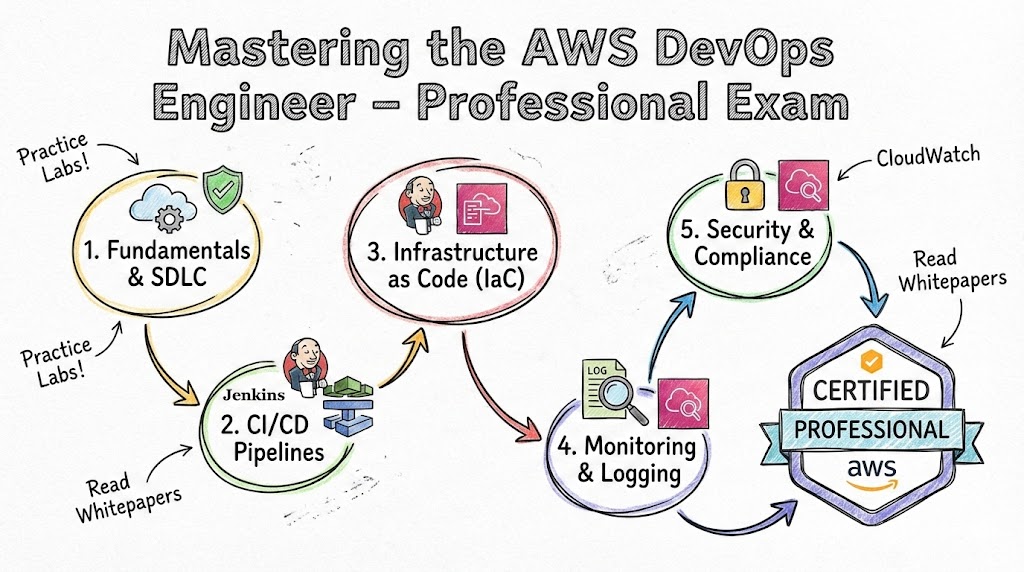
The AWS DevOps Engineer – Professional certification is a high-level credential from Amazon Web Services (AWS) that validates an individual’s ability to design, manage, and operate scalable, secure, and highly available systems in the cloud using AWS services. It is a coveted qualification for professionals seeking to specialize in the DevOps methodology, which is focused on automation, continuous integration, continuous delivery, and continuous monitoring.For engineers and managers looking to enhance their DevOps knowledge and skills, particularly in AWS environments, this certification opens new opportunities in cloud-based infrastructure management and software development lifecycle (SDLC) optimization. This guide will explore the certification’s requirements, the skills gained, preparation strategies, and more.
What is AWS DevOps Engineer – Professional?
The AWS Certified DevOps Engineer – Professional certification focuses on the best practices and tools used to manage the lifecycle of applications running on AWS. It covers topics such as automation, scaling, monitoring, and security. This certification is ideal for individuals working with AWS environments who want to prove their expertise in managing complex infrastructure and applications.
The certification is designed for professionals who already have foundational experience in AWS, as well as in DevOps practices like CI/CD, Infrastructure as Code (IaC), and monitoring. It builds on previous certifications like the AWS Certified Solutions Architect – Associate and AWS Certified SysOps Administrator – Associate. The focus is on proficiency in automation and operational excellence in the cloud.
Who Should Take It?
Ideal Candidates:
- DevOps Engineers: Individuals with experience in developing and operating applications, responsible for the end-to-end lifecycle of application development, deployment, and maintenance.
- System Administrators: Professionals looking to transition from traditional systems administration to a cloud-based DevOps role.
- Cloud Engineers: Those already working in cloud environments who want to refine their DevOps practices and automation skills within AWS.
- Software Engineers: Developers who want to understand the intricacies of deploying and managing software in AWS cloud environments.
- Engineering Managers: Professionals aiming to gain technical knowledge of AWS services to manage and support their teams in cloud deployments.
Skills You’ll Gain
Achieving the AWS DevOps Engineer – Professional certification equips you with a wide range of technical and practical skills. Some key skills you will develop include:
- Automation of AWS environments using tools like AWS CloudFormation, Terraform, and AWS CDK (Cloud Development Kit).
- Designing and implementing CI/CD pipelines using AWS services such as CodePipeline, CodeBuild, and CodeDeploy.
- Infrastructure as Code (IaC), a key DevOps practice, to automate the provisioning and management of AWS resources.
- Security best practices in the AWS cloud, ensuring compliance and data protection.
- Performance monitoring and logging with tools like AWS CloudWatch and CloudTrail to ensure high availability and performance.
- Cost optimization to manage cloud spending efficiently by using AWS services such as EC2 Auto Scaling and AWS Trusted Advisor.
Real-World Projects You Should Be Able to Do After It:
- Building CI/CD pipelines for a large-scale application using AWS CodePipeline and AWS Lambda.
- Automating infrastructure deployment by creating IaC templates with AWS CloudFormation or Terraform.
- Setting up automated monitoring and logging to track application performance and troubleshoot issues in production environments.
- Scaling cloud applications using AWS services like Elastic Load Balancing (ELB) and Auto Scaling Groups (ASG) based on traffic patterns.
- Implementing disaster recovery strategies for applications to ensure high availability and business continuity.
Comparison Table: AWS DevOps Engineer – Professional vs Other Related Certifications
| Feature | AWS DevOps Engineer – Professional | AWS Certified SysOps Administrator | Google Professional Cloud DevOps Engineer | Microsoft Certified: DevOps Engineer Expert |
|---|---|---|---|---|
| Track | DevOps | SysOps | DevOps | DevOps |
| Level | Professional | Associate | Professional | Expert |
| Target Audience | DevOps Engineers, Cloud Engineers, and System Admins | System Administrators | DevOps Engineers, Cloud Engineers | DevOps Engineers, Cloud Professionals |
| Prerequisites | Experience with AWS services, understanding of DevOps principles | Basic AWS experience | Intermediate to advanced AWS experience | Experience in DevOps and cloud computing |
| Skills Covered | Automation, CI/CD, IaC, Monitoring, Security, Cost Optimization | Cloud infrastructure management, Monitoring | CI/CD, Infrastructure management, Incident Response | CI/CD, Cloud Infrastructure, Monitoring, Security |
| Recommended Order | AWS Certified Solutions Architect – Associate, AWS Certified SysOps Administrator | AWS Certified Solutions Architect – Associate | AWS Certified Solutions Architect – Associate | Azure Fundamentals, Microsoft Certified: Azure Administrator |
| Exam Format | Multiple Choice and Multiple Response | Multiple Choice | Multiple Choice | Multiple Choice |
| Cost | $300 USD | $150 USD | $200 USD | $165 USD |
| Duration | 180 minutes | 130 minutes | 120 minutes | 150 minutes |
| Certificate Validity | 3 years | 3 years | 2 years | 2 years |
| Skills/Tools Tested | CodePipeline, CloudFormation, Terraform, EC2, IAM, CloudWatch, etc. | EC2, S3, IAM, CloudWatch | Kubernetes, Google Cloud Build, Cloud Operations | Azure DevOps, GitHub, Azure Pipelines |
Preparation Plan
7-14 Days (Quick Overview and Core Services)
In this initial phase, focus on learning the core AWS services such as EC2, S3, Lambda, IAM, and VPC. Begin with basic DevOps principles and gradually move to AWS-specific DevOps tools and best practices like automation, CI/CD pipelines, and infrastructure provisioning. Use AWS documentation and tutorials to get familiar with the platform.
30 Days (In-Depth Learning and Practice)
By this time, dive deeper into specific AWS DevOps services:
- CodePipeline: Learn to automate the build and deployment process for your applications.
- CloudFormation: Study how to define and provision AWS infrastructure using templates.
- CloudWatch: Learn how to set up monitoring and logging for your AWS resources.
- IAM: Understand how to manage access control securely.
At this stage, begin practicing on AWS Labs and Hands-on exercises.
60 Days (Advanced Practice and Mock Exams)
As you near the end of your preparation, focus on solving complex real-world problems. Start building comprehensive projects, like setting up a full CI/CD pipeline for a microservices application on AWS. Review AWS exam guides, take practice exams, and assess your readiness. Identify any weak spots and review those areas.
Common Mistakes to Avoid
To maximize your chances of passing the exam, here are some common pitfalls to avoid:
- Not gaining enough hands-on experience: The AWS DevOps Engineer – Professional exam is very practical. It’s not enough to only understand the theory. Practice with AWS services and tools is essential.
- Ignoring security and compliance, which are integral to the DevOps workflow on AWS.
- Skipping hands-on practice – theoretical knowledge alone won’t suffice for this certification.
- Neglecting the exam blueprint: Ensure you cover all domains outlined in the official exam guide.
Best Next Certification After This
Once you achieve the AWS Certified DevOps Engineer – Professional certification, here are some recommendations for next steps:
- Same track: AWS Certified Advanced Networking – Specialty
- Cross-track: AWS Certified Security – Specialty
- Leadership: AWS Certified Solutions Architect – Professional
Choose Your Path
The AWS Certified DevOps Engineer – Professional certification opens doors to several career paths. Based on your interests, you can choose to specialize in one of the following areas:
1. DevOps Path
Focus on automating development and operations to improve software delivery and cloud infrastructure management.
Recommended Certifications:
- AWS Certified DevOps Engineer – Professional
- Master in DevOps Engineering
Ideal Roles: DevOps Engineer, Automation Engineer
2. DevSecOps Path
Integrate security into the DevOps pipeline to ensure secure and compliant cloud applications.
Recommended Certifications:
- AWS Certified Security – Specialty
Ideal Roles: Security Engineer, DevSecOps Engineer
3. SRE (Site Reliability Engineering) Path
Ensure the reliability and availability of systems and services through monitoring, incident management, and scaling.
Recommended Certifications:
- Google Professional Cloud DevOps Engineer
Ideal Roles: Site Reliability Engineer, Cloud Operations Engineer
4. AIOps/MLOps Path
Use AI and machine learning to enhance system performance, anomaly detection, and automation in the cloud.
Recommended Certifications:
- AWS Certified Machine Learning – Specialty
Ideal Roles: AIOps Engineer, MLOps Engineer
5. DataOps Path
Focus on automating data pipelines and ensuring data quality and availability for processing.
Recommended Certifications:
- AWS Certified Data Analytics – Specialty
Ideal Roles: Data Engineer, DataOps Engineer
6. FinOps Path
Optimize cloud spending and manage financial operations within the cloud environment.
Recommended Certifications:
- FinOps Foundation Certified Practitioner
Ideal Roles: FinOps Practitioner, Cloud Financial Analyst
Role → Recommended Certifications
Here’s a quick look at how various roles map to certifications:
| Role | Recommended Certifications |
|---|---|
| DevOps Engineer | AWS Certified DevOps Engineer – Professional, Master in DevOps Engineering |
| SRE | Google Professional Cloud DevOps Engineer, AWS Certified SysOps Administrator |
| Platform Engineer | AWS Certified Solutions Architect – Associate, Google Cloud Architect |
| Cloud Engineer | AWS Certified Solutions Architect – Professional, Microsoft Azure Architect |
| Security Engineer | AWS Certified Security – Specialty, Certified Cloud Security Professional (CCSP) |
| Data Engineer | AWS Certified Data Analytics – Specialty, Google Cloud Data Engineer |
| FinOps Practitioner | FinOps Foundation Certified Practitioner, AWS Cloud Practitioner |
| Engineering Manager | AWS Certified Solutions Architect – Professional, Google Cloud Architect |
Top Training Institutions for AWS DevOps Engineer – Professional
1. DevOpsSchool
Overview: DevOpsSchool is one of the leading platforms offering comprehensive AWS DevOps training. Their AWS DevOps Engineer course is specifically designed for professionals who want to gain expertise in AWS services and DevOps practices.
Key Features:
- Hands-on labs with real AWS environments.
- Extensive course materials and study resources.
- Mock exams and personalized mentorship.
- Focus on CI/CD pipelines, automation, and monitoring in AWS.
Ideal for: Those looking for thorough, practical training with strong support from instructors.
2. Cotocus
Overview: Cotocus offers an in-depth AWS DevOps Engineer program that includes instructor-led sessions, case studies, and real-time project work. Their training emphasizes automation, continuous delivery, and security integration within AWS environments.
Key Features:
- Real-world project-based learning.
- CI/CD pipeline setup using AWS tools like CodePipeline and CodeDeploy.
- Deep dive into cloud security practices in DevOps.
- Regular doubt-solving sessions with experienced instructors.
Ideal for: Professionals wanting a balance of practical work and theoretical knowledge in AWS DevOps.
3. ScmGalaxy
Overview: ScmGalaxy provides a detailed AWS DevOps Engineer course that covers everything from cloud automation to monitoring and scaling. Their training approach includes practical hands-on labs and project work designed to give students a robust understanding of AWS DevOps services.
Key Features:
- Emphasis on real-world use cases and problem-solving.
- Hands-on labs on AWS services like EC2, Lambda, and CloudFormation.
- Mock exams and comprehensive review sessions.
- Continuous access to course material even after completion.
Ideal for: Learners who want a practical, project-driven approach to AWS DevOps training.
4. BestDevOps
Overview: BestDevOps offers AWS DevOps certification training with a focus on continuous integration, continuous delivery, and automation practices using AWS tools. Their courses are designed for professionals who need a deep understanding of AWS DevOps in a cloud environment.
Key Features:
- Detailed, exam-focused training with in-depth coverage of AWS tools.
- Hands-on training with a focus on automation and deployment.
- Real-life scenario-based projects to practice skills.
- 24/7 access to lab environments and instructors for support.
Ideal for: Those looking to get AWS DevOps certified with a solid foundation in automation and CI/CD best practices.
5. DevSecOpsSchool
Overview: DevSecOpsSchool focuses on the intersection of security and DevOps. Their AWS DevOps course integrates security principles into the DevOps pipeline, covering topics like compliance, monitoring, and security in AWS environments.
Key Features:
- Comprehensive training on integrating security into AWS DevOps workflows.
- Focus on IAM, encryption, and compliance best practices in AWS.
- Project-based learning with a focus on security automation.
- Guidance on building secure CI/CD pipelines.
Ideal for: Professionals wanting to combine DevOps expertise with advanced security practices.
6. SRESchool
Overview: SRESchool focuses on Site Reliability Engineering (SRE) while offering an in-depth training program that also covers AWS DevOps. The course is designed to build expertise in both reliability engineering and cloud-based DevOps practices, helping professionals create high-performing and reliable systems on AWS.
Key Features:
- Detailed coverage of SRE practices like monitoring, incident management, and postmortems.
- Hands-on labs on AWS tools for managing cloud operations and infrastructure.
- Continuous monitoring and scaling strategies using AWS.
Ideal for: Professionals aiming to specialize in both DevOps and site reliability engineering in AWS environments.
7. AIOpsSchool
Overview: AIOpsSchool provides a unique AIOps/MLOps training track within DevOps, focusing on using AI and machine learning for cloud automation and monitoring. This is ideal for those who want to integrate AI capabilities within their DevOps pipelines to predict issues, optimize workflows, and automate responses in AWS environments.
Key Features:
- AI-driven automation and monitoring in AWS environments.
- Real-time anomaly detection and predictive analytics.
- Use of AWS AI services for DevOps operations.
- Hands-on labs with machine learning models in a DevOps pipeline.
Ideal for: Learners interested in machine learning and AI-driven automation within the DevOps lifecycle.
8. DataOpsSchool
Overview: DataOpsSchool specializes in DataOps, helping professionals automate data workflows within cloud environments. The AWS DevOps Engineer course here includes lessons on building efficient data pipelines, handling large-scale data, and ensuring data integrity in DevOps processes.
Key Features:
- Focus on automating and managing data pipelines using AWS services.
- Coverage of AWS Data Analytics services like Kinesis and Redshift.
- Practical labs on integrating data workflows with CI/CD pipelines.
Ideal for: Professionals looking to specialize in managing data workflows within AWS DevOps.
9. FinOpsSchool
Overview: FinOpsSchool focuses on cloud cost management and optimization, offering a comprehensive program on integrating financial operations into AWS DevOps practices. The course is designed to teach professionals how to optimize cloud spending while maintaining efficient DevOps practices.
Key Features:
- Training on AWS cost management tools like AWS Cost Explorer and AWS Trusted Advisor.
- Practical exercises on optimizing cloud resources and budgets.
- Focus on collaboration between finance and DevOps teams to track and control cloud expenses.
Ideal for: Professionals interested in managing cloud costs and financial operations alongside their DevOps practices.
FAQs
1. How difficult is the AWS DevOps Engineer – Professional exam?
This exam is considered challenging. It requires both theoretical knowledge and hands-on experience with AWS services, particularly in DevOps automation, monitoring, and security.
2. How long should I study for this certification?
Typically, 30 to 60 days of study are recommended, depending on your prior experience with AWS.
3. What topics are covered in the exam?
The exam covers automation of AWS environments, CI/CD pipelines, infrastructure as code (IaC), monitoring, logging, and security best practices.
4. What are the prerequisites?
It’s recommended to have experience with AWS services like EC2, IAM, CloudFormation, and S3, as well as basic knowledge of DevOps tools and principles.
5. How much does the exam cost?
The exam fee is $300 USD. You can retake the exam if needed at a discounted fee.
6. How can I register for the exam?
You can register through the official AWS certification website.
7. What is the passing score for the exam?
AWS does not disclose exact scores, but you will need to score at least 750 out of 1000 to pass.
8. Is the exam available online?
Yes, you can take the exam online via an AWS-approved proctoring service.
9. What are the key benefits of this certification?
This certification will enhance your career prospects, provide deep expertise in AWS DevOps tools, and showcase your ability to manage cloud environments efficiently.
10. How does this certification benefit my career?
It validates your ability to automate infrastructure, implement CI/CD pipelines, and optimize cloud environments, which are crucial skills for high-demand roles in cloud computing and DevOps.
11. How long is the certification valid?
The AWS DevOps Engineer – Professional certification is valid for 3 years. After that, you’ll need to recertify.
12. How does the AWS DevOps certification compare to other certifications?
The AWS DevOps certification is one of the most recognized and respected credentials in the cloud space, often considered more challenging and specific compared to others like Microsoft Azure’s DevOps certifications.
FAQs
1. How difficult is the AWS DevOps Engineer – Professional exam?
The AWS DevOps Engineer – Professional exam is considered advanced and challenging. It requires both in-depth theoretical knowledge and hands-on experience with AWS services, especially in areas like CI/CD, automation, security, and cloud monitoring. Candidates need to be proficient in cloud-based DevOps practices to succeed.
2. How long should I prepare for the AWS DevOps Engineer – Professional exam?
On average, it takes 30 to 60 days of focused preparation, depending on your prior experience with AWS and DevOps. If you’re already working in a related role, you may be able to study for a shorter period. However, if you’re new to DevOps or AWS, you’ll need additional time to grasp the fundamentals.
3. What are the prerequisites for taking the AWS DevOps Engineer – Professional exam?
While there are no formal prerequisites, it is recommended that candidates have experience with AWS services like EC2, IAM, CloudFormation, and S3. Additionally, previous knowledge of the AWS Certified Solutions Architect – Associate and AWS Certified SysOps Administrator – Associate exams is highly beneficial.
4. What is the passing score for the exam?
AWS does not disclose an exact passing score, but generally, candidates need a score of around 750 out of 1000 to pass the exam. The exam is graded on a scale of 100 to 1000, and a score of 750 is considered sufficient for certification.
5. What is the exam format?
The exam consists of 75 multiple-choice questions and multiple-response questions. You’ll have 180 minutes to complete the exam. It is important to practice mock exams and review AWS services in-depth to improve your exam-taking skills.
6. Can I take the AWS DevOps Engineer – Professional exam online?
Yes, the exam is available for online proctored testing. You can take the exam from the comfort of your home or office, provided you have a stable internet connection and a private space where you can focus.
7. How much does the AWS DevOps Engineer – Professional exam cost?
The exam fee is $300 USD. If you need to retake the exam, AWS provides a discounted re-sit fee. Make sure to take the time to properly prepare, as retaking the exam can be costly.
8. How long is the AWS DevOps Engineer – Professional certification valid?
The certification is valid for 3 years. After three years, you will need to recertify to keep your certification up to date with the latest AWS services and DevOps practices.
Conclusion
The AWS Certified DevOps Engineer – Professional certification is a powerful and highly respected credential in the cloud computing and DevOps world. By achieving this certification, you’ll demonstrate your expertise in automating, securing, and managing AWS environments using best practices for DevOps, monitoring, scaling, and cost optimization.This certification provides professionals with the opportunity to advance their careers by gaining in-depth knowledge of AWS services and cloud-based DevOps practices. Whether you’re a DevOps Engineer, Cloud Engineer, or System Administrator, AWS DevOps expertise is highly in demand in today’s job market.