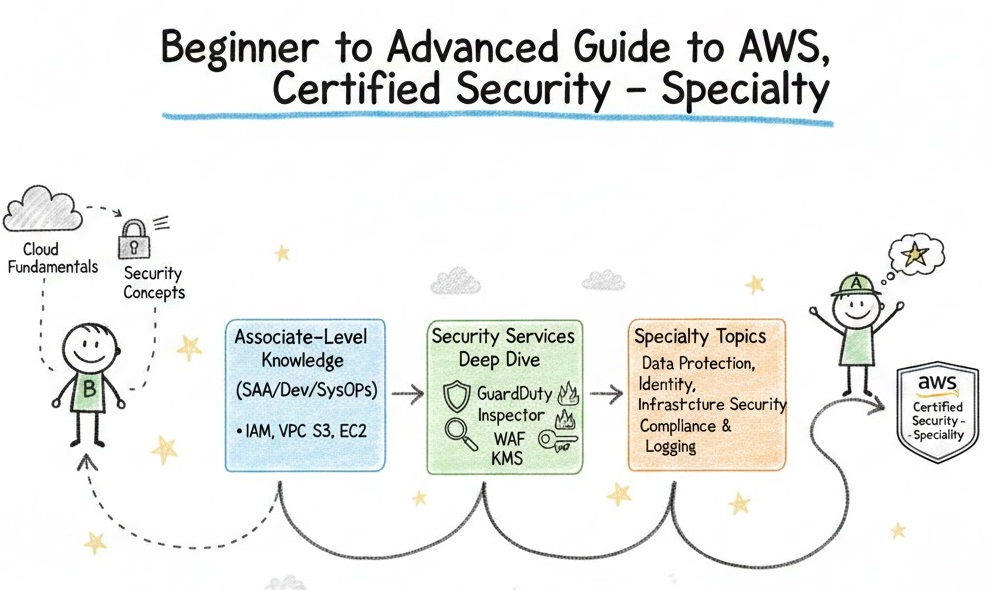
Introduction
In the digital age, where cloud technologies are becoming the backbone of businesses, securing cloud environments is more important than ever. The AWS Certified Security – Specialty certification is designed to help professionals demonstrate their proficiency in securing workloads on Amazon Web Services (AWS). For engineers, IT managers, and cloud security professionals, this certification represents an advanced-level understanding of AWS security concepts, tools, and services.This guide will walk you through everything you need to know about the AWS Certified Security – Specialty certification, from what it covers and who should take it, to the skills you’ll gain, preparation strategies, and how it can advance your career.
What is AWS Certified Security – Specialty?
The AWS Certified Security – Specialty certification focuses on securing AWS workloads. It validates your ability to implement and manage security measures, detect potential security threats, and ensure compliance with various regulatory standards in a cloud environment.
As AWS is one of the most widely used cloud service providers globally, this certification equips you with a deep understanding of how to secure the infrastructure, data, applications, and services hosted on AWS. It covers topics such as identity and access management, data protection, infrastructure security, incident response, and compliance.
Who Should Take the AWS Certified Security – Specialty?
This certification is ideal for individuals who:
- Work in cloud security roles and want to deepen their expertise in securing AWS environments.
- Are already familiar with AWS services and seek a specialized certification focused on security.
- Aspire to move into cloud security positions such as cloud security architects, engineers, or security analysts.
If you have prior AWS experience or certifications like AWS Certified Cloud Practitioner or AWS Certified Solutions Architect – Associate, this certification will allow you to further specialize in security.
Skills You’ll Gain
By earning the AWS Certified Security – Specialty certification, you will gain expertise in:
- Securing Data: Implement encryption, manage security keys using AWS Key Management Service (KMS), and protect sensitive data at rest and in transit.
- Identity and Access Management (IAM): Configure users, roles, and permissions effectively using IAM, along with implementing multi-factor authentication (MFA).
- Securing Networking: Implement secure network architectures using Virtual Private Cloud (VPC), Security Groups, Network Access Control Lists (NACLs), and VPN.
- Incident Response: Identify security threats and implement appropriate response strategies using AWS tools like CloudTrail, CloudWatch, and GuardDuty.
- Compliance and Risk Management: Apply AWS security best practices and industry standards to achieve compliance with regulations like GDPR, HIPAA, and PCI DSS.
Real-World Projects You Should Be Able to Do After It
After obtaining the AWS Certified Security – Specialty certification, you will be able to apply your skills to real-world projects such as:
- Designing secure cloud infrastructures: Design a VPC with public and private subnets, secure applications, and create a robust access control mechanism.
- Implementing security logging and monitoring systems: Set up CloudWatch and GuardDuty for detecting anomalous activities and ensuring the integrity of your AWS environment.
- Managing access and identity policies: Define IAM policies and roles for users and services to ensure the least privilege and enforce security controls.
- Conducting security audits: Use AWS Config and CloudTrail to review configuration settings, detect vulnerabilities, and audit security practices.
- Developing incident response plans: Create workflows for identifying, responding to, and remediating security incidents in AWS environments.
Preparation Plan
7–14 Days Plan:
- Understand AWS Security Best Practices: Read AWS whitepapers and documentation on cloud security fundamentals. Familiarize yourself with IAM, KMS, and VPC.
- Explore Hands-On Labs: Leverage AWS Free Tier to experiment with various security features like IAM, Security Groups, and VPCs.
- Review the AWS Security Specialty Exam Guide: Go through the exam guide and ensure you understand the exam domains and the tools required for each.
30 Days Plan:
- Deep Dive into AWS Security Services: Study advanced AWS security services such as AWS Shield, GuardDuty, AWS Macie, and AWS WAF.
- Take Practice Exams: Complete mock exams and practice tests to identify areas where you need improvement.
- Complete Security Labs: Build a small AWS infrastructure, secure it using best practices, and simulate security monitoring and incident response.
60 Days Plan:
- Intensive Study and Practice: Spend your final month reviewing difficult concepts, practicing hands-on exercises, and addressing any gaps in your knowledge.
- Join Security Forums: Participate in AWS security forums and communities to learn from others’ experiences.
- Review All AWS Whitepapers: AWS whitepapers are a valuable resource to understand the in-depth theoretical aspects of security.
- Perform Full-Scale Simulations: Set up a production-like environment, configure IAM, VPCs, encryption, and logging, and perform vulnerability scans using AWS tools.
Common Mistakes
- Overlooking Hands-On Labs: A common mistake is focusing solely on theoretical knowledge without practicing on the AWS platform.
- Skipping AWS Whitepapers: AWS whitepapers are essential for understanding security principles, compliance, and recommended practices.
- Not Mastering IAM and VPC: These are fundamental components of AWS security, and many exam questions are based on these services.
- Ignoring CloudWatch and GuardDuty: These tools are vital for monitoring and incident response, which are major focus areas in the exam.
Best Next Certification After AWS Certified Security – Specialty
- AWS Certified Solutions Architect – Professional (same track): As you specialize in AWS security, advancing to architecture will deepen your understanding of security architecture.
- Certified Cloud Security Professional (CCSP) (cross-track): This certification focuses on cloud security across multiple platforms and can broaden your expertise beyond AWS.
- AWS Certified DevOps Engineer – Professional (leadership track): After becoming proficient in security, learn how to integrate security in a DevOps pipeline.
Choose Your Path
1. DevOps
DevOps focuses on the integration of development and IT operations, and cloud security plays a key role in automating and securing these processes. With AWS Certified Security – Specialty, you’ll be equipped to implement secure infrastructure automation and monitor cloud-based deployments.
- Skills to Focus On: Continuous integration (CI), continuous delivery (CD), security automation, cloud monitoring.
- Next Steps: AWS Certified DevOps Engineer – Professional, AWS Certified Solutions Architect – Professional.
2. DevSecOps
DevSecOps is the practice of integrating security into the DevOps pipeline, ensuring security is not an afterthought but a continuous process. With your knowledge of AWS security, you can build secure pipelines, automate security testing, and enforce security policies in the software development lifecycle.
- Skills to Focus On: Security automation in CI/CD, vulnerability scanning, compliance-as-code.
- Next Steps: Certified Kubernetes Security Specialist (CKS), AWS Certified DevOps Engineer – Professional.
3. SRE (Site Reliability Engineering)
SRE combines software engineering and operations to build scalable, reliable systems. Security is integral to ensuring systems are protected from vulnerabilities while maintaining performance and uptime. AWS Certified Security – Specialty gives you the foundation to secure and optimize large-scale systems.
- Skills to Focus On: Incident response, network security, infrastructure automation.
- Next Steps: Google Professional Cloud Security Engineer, AWS Certified SysOps Administrator – Associate.
4. AIOps/MLOps
AIOps (Artificial Intelligence for IT Operations) and MLOps (Machine Learning Operations) focus on automating IT operations and the deployment of AI and machine learning models. Security is paramount in protecting data and models in cloud environments, and your AWS security knowledge will help you safeguard AI/ML workloads.
- Skills to Focus On: Data security, model protection, secure AI/ML pipeline automation.
- Next Steps: AWS Certified Machine Learning – Specialty, Certified Information Systems Security Professional (CISSP).
5. DataOps
DataOps focuses on the automated end-to-end pipeline for managing and securing data in cloud environments. By integrating security controls into data pipelines, you’ll ensure data is securely managed, stored, and transferred across the cloud infrastructure. AWS Certified Security – Specialty is crucial for securing DataOps workflows.
- Skills to Focus On: Data security, encryption, secure data pipelines, compliance management.
- Next Steps: AWS Certified Big Data – Specialty, Certified Data Privacy Solutions Engineer (CDPSE).
6. FinOps
FinOps is the practice of managing cloud financial operations, where you monitor cloud costs, optimize spending, and ensure security in financial processes. AWS Certified Security – Specialty will help you secure financial data and optimize cloud security in your FinOps practices.
- Skills to Focus On: Cloud cost management, cost-optimized security practices, budgeting with security controls.
- Next Steps: AWS Certified Cloud Practitioner, AWS Certified Solutions Architect – Associate.
Role → Recommended Certifications
| Role | Recommended Certifications |
|---|---|
| DevOps Engineer | AWS Certified DevOps Engineer – Professional, AWS Certified Security – Specialty |
| SRE | AWS Certified SysOps Administrator – Associate, AWS Certified Security – Specialty |
| Platform Engineer | AWS Certified Solutions Architect – Professional, AWS Certified Security – Specialty |
| Cloud Engineer | AWS Certified Solutions Architect – Associate, AWS Certified Security – Specialty |
| Security Engineer | AWS Certified Security – Specialty, Certified Cloud Security Professional (CCSP) |
| Data Engineer | AWS Certified Big Data – Specialty, AWS Certified Security – Specialty |
| FinOps Practitioner | AWS Certified Cloud Practitioner, AWS Certified Security – Specialty |
| Engineering Manager | AWS Certified Solutions Architect – Professional, AWS Certified Security – Specialty |
Certifications Table
| Certification | Track | Level | Who it’s for | Prerequisites | Skills Covered | Recommended Order |
|---|---|---|---|---|---|---|
| AWS Certified Security – Specialty | Security | Specialty | Security Engineers, Cloud Architects | AWS Certified Cloud Practitioner | Identity and Access Management, Data Protection, Incident Response, Compliance | AWS Certified Cloud Practitioner → Security |
Top Institutions Offering Training & Certification for AWS Certified Security – Specialty
- DevOpsSchool
DevOpsSchool offers live, instructor-led training tailored for professionals looking to specialize in AWS security. Their program includes hands-on labs, real-world case studies, and expert guidance, making it ideal for anyone looking to pass the AWS Certified Security – Specialty exam. - Cotocus
Cotocus provides a comprehensive AWS Security course, focusing on both theoretical knowledge and hands-on experience with AWS security services. They offer flexible training options, including self-paced learning and live sessions. - ScmGalaxy
ScmGalaxy’s AWS security training covers key security aspects of AWS, including IAM, VPC, encryption, and more. Their trainers ensure a deep dive into security features, preparing candidates for the certification exam. - BestDevOps
BestDevOps specializes in AWS and DevSecOps training, offering specialized courses for AWS security with practical labs that help students gain practical, real-world experience. - DevSecOpsSchool
DevSecOpsSchool offers a blend of cloud security and DevSecOps principles, making it the ideal choice for professionals who want to integrate security into their DevOps pipelines while preparing for the AWS Certified Security – Specialty certification. - SRESchool
With a focus on AWS security and Site Reliability Engineering, SRESchool offers in-depth training to ensure students are well-prepared to manage and secure cloud-based applications.
FAQs on AWS Certified Security – Specialty
1. How difficult is the AWS Certified Security – Specialty exam?
The exam is considered challenging, with a mix of theoretical knowledge and practical scenarios. Preparing for the exam requires a solid understanding of AWS services and security features.
2. What is the duration of the AWS Certified Security – Specialty exam?
You have 170 minutes to complete the exam, which consists of 65 multiple-choice questions.
3. Is the AWS Certified Security – Specialty suitable for beginners?
While it’s not meant for absolute beginners, those with experience in AWS and basic security knowledge can successfully prepare for the exam.
4. How much does the AWS Certified Security – Specialty exam cost?
The exam costs $300 USD, though this may vary by region.
5. How long is the AWS Certified Security – Specialty certification valid?
The certification is valid for three years, after which it will need to be renewed.
6. Can I take the exam if I am not currently working in security?
Yes, but it’s recommended that you have a solid understanding of AWS and cloud security concepts.
7. What are the best resources for preparing for the exam?
AWS’s official study guide, practice exams, and whitepapers are excellent resources. Additionally, hands-on labs and training courses from reputable institutions can help.
8. Can I retake the exam if I fail?
Yes, you can retake the exam, but you must wait 14 days before attempting again.
FAQs
1. How difficult is the AWS Certified Security – Specialty exam?
The AWS Certified Security – Specialty exam is considered advanced and requires both theoretical knowledge and hands-on experience with AWS security services. However, with the right preparation, it is achievable. Candidates should have a strong foundation in AWS services and security concepts.
2. How long should I study for the AWS Certified Security – Specialty exam?
The study time can vary depending on your existing knowledge. Typically, 30 to 60 days of focused study is recommended for those with prior AWS experience. Beginners may need more time to grasp foundational AWS concepts.
3. Do I need to have prior certifications to take the AWS Certified Security – Specialty exam?
While there are no strict prerequisites, AWS recommends having experience with AWS security services and the AWS Certified Cloud Practitioner or AWS Certified Solutions Architect – Associate certifications as a strong foundation.
4. What topics are covered in the AWS Certified Security – Specialty exam?
Key topics include identity and access management (IAM), data protection, infrastructure security, incident response, logging and monitoring, and compliance within AWS environments.
5. How many questions are on the AWS Certified Security – Specialty exam?
The exam consists of 65 multiple-choice and multiple-response questions.
6. What is the passing score for the AWS Certified Security – Specialty exam?
The passing score for the exam is 750 out of 1000.
7. How much does the AWS Certified Security – Specialty exam cost?
The exam costs approximately $300 USD, though pricing can vary depending on your location.
8. How long is the AWS Certified Security – Specialty exam?
You have 170 minutes to complete the exam.
9. Can I retake the exam if I fail?
Yes, if you fail the exam, you can retake it after a 14-day waiting period.
10. How long is the AWS Certified Security – Specialty certification valid?
The certification is valid for three years, after which you must recertify to stay current.
11. What are the best resources for preparing for the exam?
AWS offers official whitepapers, practice exams, and training resources. Additionally, hands-on labs, training courses, and study groups can provide valuable preparation for the exam.
12. How can this certification help my career?
AWS Certified Security – Specialty is a recognized credential in the cloud security industry. It demonstrates your ability to design and implement security controls in AWS environments, making you an attractive candidate for roles such as cloud security engineer, AWS security architect, or security operations manager.
Conclusion
The AWS Certified Security – Specialty certification is a valuable credential for professionals looking to specialize in cloud security. In today’s cloud-first world, businesses are constantly looking for experts who can safeguard their cloud infrastructures, manage risks, and ensure compliance. This certification helps you stand out by showcasing your expertise in securing AWS environments.Preparing for this exam will deepen your understanding of AWS security services, including identity and access management (IAM), encryption, monitoring, and incident response. While the certification is challenging, it opens doors to a wide range of advanced security roles within cloud environments, particularly with AWS.