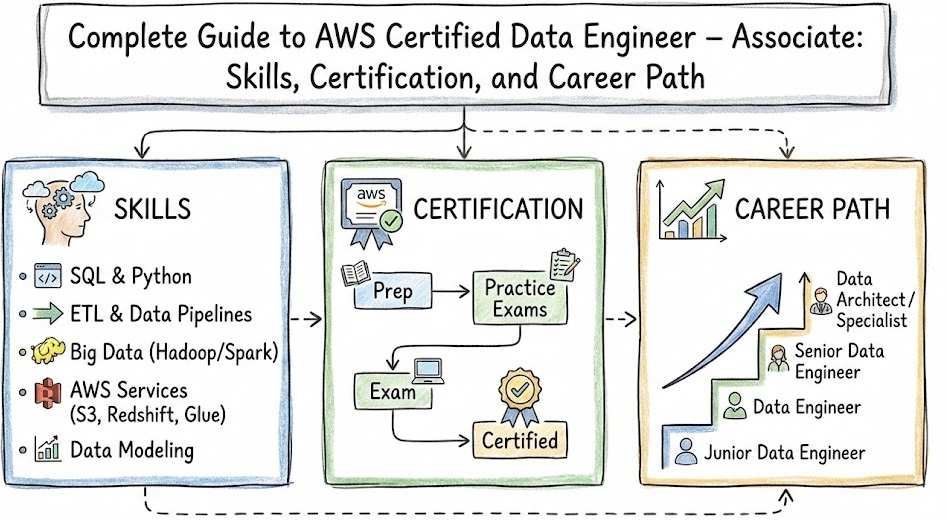
Introduction
The AWS Certified Data Engineer – Associate certification is one of the most sought-after credentials in cloud data engineering. With businesses increasingly relying on cloud infrastructure for their data processing and storage needs, this certification allows professionals to prove their expertise in managing data solutions in the AWS cloud environment.This guide will cover everything you need to know about the certification, including what it entails, the skills you’ll acquire, the best preparation strategies, and the career benefits it offers.
What is AWS Certified Data Engineer – Associate?
The AWS Certified Data Engineer – Associate is a certification offered by Amazon Web Services (AWS) to validate the skills and knowledge required to build and maintain data architectures on AWS. This certification is specifically designed for professionals working in data engineering roles, such as cloud data engineers and data architects, who need to manage large volumes of data with the help of AWS’s cloud infrastructure.
AWS offers a range of services like Amazon S3, Redshift, Glue, and EMR, which are vital tools for building data lakes, data pipelines, and data storage solutions. The certification demonstrates your capability to manage and utilize these services effectively to support data-driven decisions.
Key Points to Know:
- AWS services: Focus on S3 for storage, Redshift for data warehousing, and Glue for ETL processes.
- Real-World Use: Practical knowledge of integrating these tools into large-scale data solutions is critical.
Who Should Take This Certification?
The AWS Certified Data Engineer – Associate certification is ideal for:
- Data Engineers: Professionals who are responsible for building data pipelines, data warehouses, and maintaining data quality across organizations.
- Cloud Engineers: Those focusing on cloud infrastructure, specifically on AWS data services.
- Software Engineers: Developers looking to deepen their knowledge in cloud-based data solutions.
- Database Administrators: Professionals who want to specialize in cloud data management systems.
Even if you’re transitioning from traditional on-premise database management to cloud-based data engineering, this certification helps you build a solid foundation in AWS’s cloud-native data solutions.
What You Should Know: Experience with AWS and basic knowledge of data engineering concepts will make the exam easier. However, AWS provides foundational learning resources for beginners.
Skills You’ll Gain
By earning the AWS Certified Data Engineer – Associate certification, you’ll gain practical, in-demand skills that are essential in cloud data engineering roles. Some of the skills include:
- Design and Implement Data Lakes: Create scalable, secure, and cost-effective data lakes using Amazon S3 and AWS Glue.
- Build and Manage Data Pipelines: Automate and streamline data flow using services like AWS Glue, Kinesis, and Lambda.
- ETL (Extract, Transform, Load) Operations: Efficiently manage data extraction, transformation, and loading processes using AWS services.
- Data Warehousing: Use Amazon Redshift to design, configure, and optimize cloud-based data warehouses for analytics.
- Big Data Processing: Implement big data solutions using Amazon EMR, Hadoop, and Spark for large-scale data analysis.
- Security and Compliance: Implement encryption, secure data access, and manage IAM roles for access control.
Why It Matters: These skills are critical for building data solutions that can scale with your organization’s data demands while ensuring security and cost optimization.
Real-World Projects You Should Be Able to Do After It
Here are some of the real-world applications you’ll be able to handle after completing the certification:
- Data Lake Implementation: Set up a comprehensive data lake on AWS S3, organize datasets, implement data governance, and enable data analytics.
- ETL Pipelines: Develop end-to-end ETL pipelines that extract data from multiple sources, transform it into usable formats, and load it into data warehouses or other storage solutions.
- Data Warehousing: Design and optimize an AWS Redshift data warehouse, connecting it to various data sources and optimizing query performance.
- Real-Time Data Processing: Implement real-time data processing using Amazon Kinesis, such as streaming data from IoT devices for immediate analysis.
- Cost-Effective Data Solutions: Optimize the costs of data storage and processing by choosing the right AWS services, monitoring usage, and scaling according to needs.
Why This Matters: The real-world applications of these skills directly impact how companies handle their data—making them faster, more reliable, and cost-efficient.
Preparation Plan
7–14 Days Preparation Plan
For individuals with basic cloud knowledge:
- Week 1: Focus on understanding AWS core data services like S3, Redshift, and DynamoDB. Set up simple storage systems and explore how data is stored and retrieved.
- Week 2: Learn about AWS Glue, Kinesis, and EMR. Work on small projects where you set up data pipelines using AWS Glue and process big data on EMR.
30 Days Preparation Plan
- Week 1–2: Deep dive into AWS data services and understand how to combine them into data solutions.
- Week 3: Focus on hands-on labs for creating data lakes and managing large datasets.
- Week 4: Work on sample projects, practice the exam, and test your knowledge.
60 Days Preparation Plan
- Week 1–4: Cover all modules, focusing on practical implementation.
- Week 5–6: Take mock exams, review your weak areas, and revisit any topics that need extra attention.
Common Mistakes to Avoid
- Skipping Hands-on Practice: Don’t just read—make sure to work on hands-on labs and projects. Cloud certifications rely heavily on practical knowledge.
- Ignoring AWS Pricing Models: Be aware of the costs associated with the services you’ll use. Misunderstanding pricing can lead to unexpectedly high costs in production environments.
- Rushing Through Content: Data engineering involves complex topics. Avoid cramming and focus on learning concepts thoroughly.
- Not Reviewing the Exam Blueprint: Always go through the official AWS exam guide to make sure you understand the domains covered.
- Not Using Real-World Examples: Apply the concepts to practical scenarios and not just theory.
Best Next Certification After This
After completing the AWS Certified Data Engineer – Associate certification, you can consider the following certifications to enhance your expertise:
- AWS Certified Data Analytics – Specialty: This will help deepen your knowledge in data analytics and is an excellent follow-up for someone specializing in data engineering.
- AWS Certified Solutions Architect – Associate: If you’re looking to broaden your cloud architecture knowledge beyond data engineering, this certification is a great option.
- AWS Certified DevOps Engineer – Professional: This is an advanced certification focusing on the integration of development and operations practices, particularly useful for those looking to combine data engineering and DevOps practices.
Choose Your Path
As an AWS Certified Data Engineer – Associate, you can explore various specialized career tracks that align with your interests and goals. Here are some potential learning paths:
1. DevOps
- Focus on automation, continuous integration, and delivery in cloud environments.
- Learn tools like Jenkins, Kubernetes, and Docker, and integrate them with AWS data services.
- Ideal for those who want to bridge the gap between development and operations while managing scalable data systems.
2. DevSecOps
- Specialize in securing cloud infrastructures throughout the software development lifecycle.
- Dive into AWS security services and practices, such as IAM, encryption, and compliance.
- Perfect for those who want to ensure security within cloud-native data architectures.
3. Site Reliability Engineering (SRE)
- Focus on ensuring the reliability and scalability of cloud infrastructure.
- Learn how to implement monitoring, incident management, and disaster recovery.
- Best suited for individuals interested in maintaining high availability and performance for cloud-based systems.
4. AIOps/MLOps
- Dive into the intersection of machine learning, AI, and cloud operations.
- Explore AWS services that facilitate AI/ML workflows and automate cloud operations.
- Ideal for professionals seeking to implement data-driven, AI-powered solutions in cloud environments.
5. DataOps
- Focus on improving data pipeline efficiency and ensuring smooth data flow across the organization.
- Learn to integrate AWS tools like Glue, Lambda, and Redshift for optimized data processing.
- Suitable for individuals aiming to streamline data operations and enhance collaboration between data teams.
6. FinOps
- Specialize in financial operations for cloud environments, focusing on cost optimization.
- Master tools for managing and forecasting cloud expenses while leveraging AWS data solutions.
- Perfect for those who want to balance financial and technical responsibilities in cloud infrastructure management.
Role → Recommended Certifications
| Role | Recommended Certifications |
|---|---|
| DevOps Engineer | AWS Certified DevOps Engineer – Professional, AWS Certified SysOps Administrator |
| SRE | AWS Certified DevOps Engineer – Professional, AWS Certified Solutions Architect |
| Platform Engineer | AWS Certified Solutions Architect, AWS Certified Data Engineer |
| Cloud Engineer | AWS Certified Solutions Architect – Associate, AWS Certified Developer – Associate |
| Security Engineer | AWS Certified Security – Specialty, AWS Certified Solutions Architect |
| Data Engineer | AWS Certified Data Engineer – Associate, AWS Certified Big Data – Specialty |
| FinOps Practitioner | AWS Certified Solutions Architect – Associate, AWS Certified Cloud Practitioner |
| Engineering Manager | AWS Certified Solutions Architect – Professional, AWS Certified DevOps Engineer |
AWS Data Engineering Tools Comparison
| AWS Tool | Use Case | Key Features | Pricing | Best For |
|---|---|---|---|---|
| Amazon S3 | Data Lake Storage | Scalable object storage, security features, lifecycle management | Pay-as-you-go (storage cost) | Storing large volumes of unstructured and structured data |
| Amazon Redshift | Data Warehousing | Columnar storage, fast query performance, fully managed, scalable | Pay-as-you-go (storage + queries) | Data warehousing, analytics, and reporting for big data |
| AWS Glue | ETL (Extract, Transform, Load) | Serverless ETL, data catalog, data transformation | Pay-as-you-go (usage based) | Automating ETL processes, data integration |
| Amazon EMR | Big Data Processing | Managed Hadoop framework, supports Spark, Hive, Presto, and other tools | Pay-as-you-go (per instance usage) | Big data processing, analysis, and machine learning workloads |
| Amazon Kinesis | Real-Time Data Streaming | Real-time data collection, processing, and analysis | Pay-as-you-go (data throughput) | Real-time streaming, IoT data collection, logs, and event-driven applications |
| AWS Lambda | Serverless Compute | Run code without provisioning or managing servers, scales automatically | Pay-as-you-go (based on usage) | Running event-driven serverless applications |
| Amazon RDS | Relational Database as a Service | Managed relational databases (MySQL, PostgreSQL, SQL Server, Oracle) | Pay-as-you-go (per usage) | Relational databases with automatic scaling, backups, and patches |
| AWS IAM | Identity and Access Management | Manage access permissions securely and in a granular way | Free (per user + usage costs) | Managing permissions, users, and access control |
| AWS CloudTrail | Monitoring and Security Auditing | Track AWS API calls and resource usage across AWS services | Free (with usage costs for logging) | Security auditing, compliance, and monitoring for AWS resources |
FAQs
1. What is the difficulty level of the AWS Certified Data Engineer – Associate exam?
The exam is moderately challenging, requiring both theoretical understanding and practical skills in AWS data services.
2. How long does it take to prepare for the exam?
Preparation time varies, but most candidates take around 30–60 days with consistent study.
3. What are the prerequisites for this certification?
Basic knowledge of AWS and experience working with cloud technologies is recommended.
4. What is the cost of the AWS Certified Data Engineer – Associate exam?
The exam costs $150 USD.
5. Can I take the exam online?
Yes, the exam can be taken online or at an AWS testing center.
6. How long is the certification valid for?
The certification is valid for three years.
7. What is the format of the exam?
The exam is multiple choice with a time limit of 170 minutes.
8. How can this certification benefit my career?
It enhances your qualifications, opening up data engineering and cloud architecture roles.
Top Institutions for AWS Certified Data Engineer – Associate Training
If you’re preparing for the AWS Certified Data Engineer – Associate certification, choosing the right training partner is crucial for success. Below are some of the top institutions that offer structured training, hands-on labs, mentorship, and exam preparation support tailored to this certification:
1. DevOpsSchool
DevOpsSchool offers structured AWS cloud training focused on real‑world data engineering scenarios. Their curriculum covers AWS data services, ETL pipelines, data lakes, and big data processing. You’ll get instructor‑led classroom sessions, hands‑on exercises, and dedicated support to help you bridge the gap between theory and practical implementation.
2. Cotocus
Cotocus provides AWS certification programs with a strong emphasis on cloud data workflows and pipeline automation. Their trainers focus on real use cases and industry patterns, helping you learn how to design, deploy, and optimize data solutions on AWS. They also include practice tests and project work to reinforce learning.
3. Scmgalaxy
Scmgalaxy delivers AWS data engineering and cloud certification courses with practical labs and exam‑centric training. Their training approach emphasizes building real AWS environments, understanding service integration, and gaining confidence through mock exams.
4. BestDevOps
BestDevOps offers comprehensive AWS implementation courses that cover data engineering fundamentals through advanced solutions. Their learning path includes data storage, data processing, analytics services, and hands‑on cloud labs. With access to expert mentors, candidates can clarify concepts and practice real scenarios.
5. DevSecOpsSchool
DevSecOpsSchool combines data engineering training with embedded security practices. In addition to AWS core data services, they guide you on securing data pipelines, configuring IAM roles, and integrating security best practices into cloud data workflows — an advantage for exam preparation and real‑world readiness.
6. SRESchool
SRESchool focuses on reliability, performance, and operational excellence in cloud environments. Their AWS programs cover data engineering topics within the broader context of maintaining highly available data systems. You’ll learn how to handle monitoring, error handling, and maintenance tasks in AWS data workloads.
7. AIOpsSchool
AIOpsSchool bridges the gap between cloud operations and intelligent automation. While training for AWS Certified Data Engineer – Associate, you’ll also explore how AI/ML workflows are integrated into data platforms. Their curriculum includes real‑time data processing, event streaming, and automation frameworks.
8. DataOpsSchool
DataOpsSchool specializes in data‑centric operational excellence. Their AWS data engineering path focuses deeply on automated pipelines, orchestration tools, quality checks, and continuous integration for data solutions. If your goal is to build modern data operations with AWS, this is a strong choice.
9. FinOpsSchool
FinOpsSchool adds a financial management perspective to AWS data engineering. In addition to data services, you’ll learn how to forecast costs, optimize storage and processing fees, and apply budgeting controls. This is particularly useful if your role involves optimizing cloud spend in data platforms.
FAQs
1. What is the difficulty level of the AWS Certified Data Engineer – Associate exam?
The AWS Certified Data Engineer – Associate exam is moderately challenging. It tests both theoretical knowledge and practical skills in AWS data services. It is designed for professionals with hands-on experience working with AWS and data solutions.
2. How long should I prepare for the AWS Certified Data Engineer – Associate exam?
Preparation time varies based on your prior experience. Generally, 30–60 days of consistent study should be sufficient. If you’re already familiar with AWS services, you may require less time.
3. What are the prerequisites for this certification?
While there are no formal prerequisites, it is recommended that you have a basic understanding of AWS, SQL, data engineering concepts, and experience working with cloud-based data storage solutions.
4. What topics are covered in the exam?
The exam covers topics such as data storage management (Amazon S3), data warehousing (Amazon Redshift), data processing (AWS Glue), and security practices (IAM). You’ll also be tested on the integration and management of big data solutions using AWS services.
5. Is hands-on practice necessary for this certification?
Yes, hands-on practice is essential. AWS services like S3, Redshift, Glue, and Kinesis require practical implementation to understand their real-world applications. Try building your own data pipelines and working with data lakes in a sandbox environment.
6. Can I take the AWS Certified Data Engineer – Associate exam online?
Yes, you can take the exam online through AWS’s secure online proctoring system or in person at a testing center.
7. How much does the AWS Certified Data Engineer – Associate exam cost?
The exam costs $150 USD. Additional fees may apply for re-takes if needed.
8. How long is the AWS Certified Data Engineer – Associate exam?
The exam duration is 170 minutes. You’ll need to manage your time effectively, as the exam includes multiple-choice questions and multiple-answer questions.
9. How many questions are on the exam?
There are 65 questions in the exam, testing both theoretical knowledge and practical application of AWS data services.
10. What resources should I use to prepare for the exam?
AWS provides training through its website, including free whitepapers, hands-on labs, and practice exams. Many third-party providers, such as online learning platforms, also offer dedicated courses for the AWS Certified Data Engineer – Associate exam.
11. What is the best study strategy for the AWS Certified Data Engineer – Associate exam?
The best strategy is a combination of reading theory, taking hands-on labs, and solving practice questions. Focus on AWS core services, practice implementing solutions in the cloud, and take timed mock exams to simulate the actual test conditions.
12. What is the next certification I should pursue after completing this one?
After completing the AWS Certified Data Engineer – Associate, you could pursue the AWS Certified Data Analytics – Specialty for advanced knowledge in analytics or the AWS Certified Solutions Architect – Associate to broaden your cloud architecture expertise.
Conclusion
The AWS Certified Data Engineer – Associate certification is an excellent investment for professionals looking to advance their careers in cloud-based data engineering. By completing this certification, you will gain proficiency in essential AWS data services like Amazon S3, Redshift, Glue, and Kinesis, all while developing the skills necessary to build scalable, secure, and cost-effective data solutions.Whether you’re a data engineer, cloud architect, or software developer, this certification provides a clear pathway to deepen your understanding of cloud data systems. It opens doors to exciting roles in data engineering, data architecture, and cloud data management, offering an edge in today’s competitive job market.