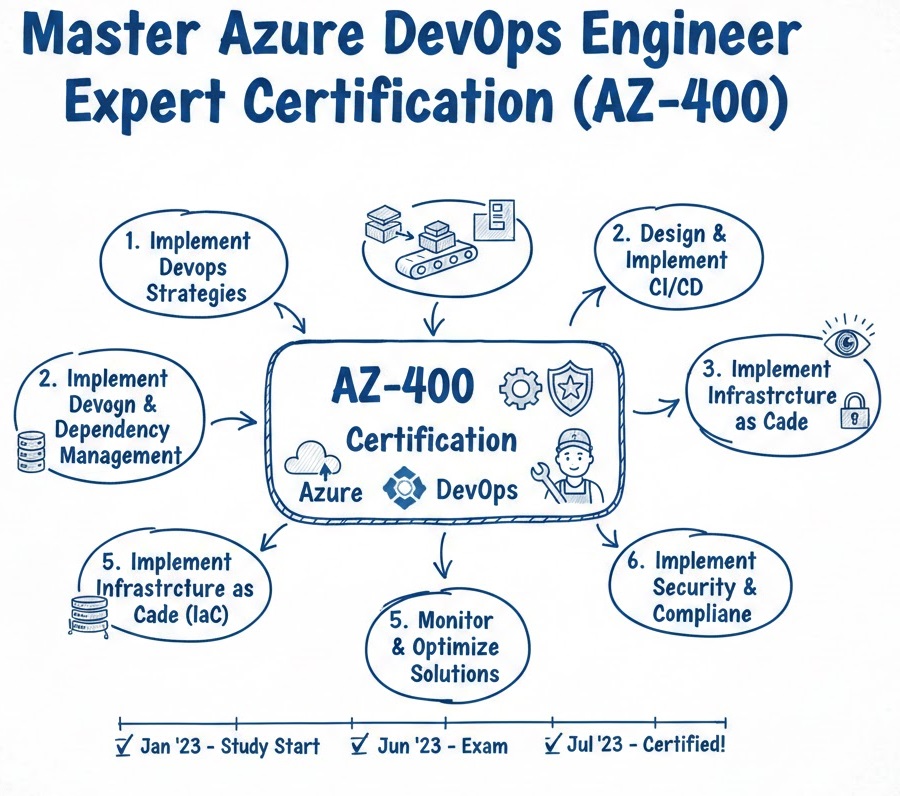
Introduction
DevOps is more than just a buzzword—it’s a methodology that integrates development and operations teams to improve the speed, quality, and reliability of software delivery. Azure DevOps is a suite of tools from Microsoft that enables organizations to automate their processes, reduce manual work, and ensure faster delivery cycles.The Azure DevOps Engineer Expert (AZ-400) certification is one of the most sought-after credentials in the industry for professionals who want to demonstrate their expertise in DevOps practices using Azure technologies. This certification is crucial for anyone looking to enhance their career in cloud engineering, software development, or IT operations. In this guide, we will cover everything you need to know about the AZ-400 certification, including preparation strategies, common mistakes, the skills you will gain, and career paths after certification.
What is the Azure DevOps Engineer Expert (AZ-400) Certification?
The Azure DevOps Engineer Expert (AZ-400) certification is specifically designed to assess your skills in implementing DevOps practices using Microsoft Azure’s tools and services. This certification focuses on several key areas such as continuous integration and delivery (CI/CD), infrastructure automation, version control, and security practices.
Azure DevOps includes a range of tools such as Azure Pipelines, Azure Repos, Azure Artifacts, and Azure Test Plans, which are essential in automating the software delivery lifecycle. The certification covers the use of these tools to automate manual processes, integrate systems, and ensure smooth collaboration between development and operations teams.
The AZ-400 certification helps professionals establish themselves as experts in managing the DevOps lifecycle using the Azure cloud platform, an area of increasing demand as organizations globally shift to cloud-native architectures.
Who Should Take the AZ-400 Certification?
This certification is tailored for professionals who are directly involved in DevOps processes and have experience working with Azure services. The following groups of people would benefit the most from taking this certification:
- DevOps Engineers: Those working in DevOps roles aiming to prove their expertise in cloud-based DevOps practices using Azure.
- Cloud Engineers: Professionals working in cloud environments looking to advance their careers by understanding how DevOps can be implemented on Azure.
- Platform Engineers: Engineers who maintain and manage the infrastructure necessary for DevOps processes, including servers, networks, and platforms.
- Software Engineers: Developers working on cloud applications who want to understand the CI/CD pipelines, version control, and automated testing.
- IT Operations Professionals: Those involved in the deployment and operations of software, and who wish to embrace DevOps practices to automate and streamline the process.
If you have basic experience with Azure and want to enhance your skills in DevOps practices, this certification will help you prove your expertise in the field.
Skills You’ll Gain
The AZ-400 exam covers a wide range of skills that are necessary for working as a DevOps engineer in a cloud-based environment. Upon completing the certification, you will gain the following key skills:
- Continuous Integration & Continuous Delivery (CI/CD)
You will learn how to design, implement, and manage automated build and release pipelines that enable fast and reliable software delivery. - Source Control Management
Proficiency in version control using Git and GitHub is critical. You will be able to manage codebases, collaborate with teams, and ensure version control in an Azure environment. - Infrastructure as Code (IaC)
Using Terraform, ARM Templates, and Azure CLI, you will learn how to provision, configure, and manage infrastructure in an automated and repeatable way. - Monitoring & Logging
You will develop skills in configuring Azure Monitor, Application Insights, and Log Analytics to monitor the health of your applications and infrastructure and ensure performance optimization. - Security in DevOps
Security is integrated into the DevOps pipeline through DevSecOps practices. You will learn to automate security practices such as vulnerability assessments and compliance checks. - Collaboration with Teams
DevOps emphasizes collaboration between development and operations teams. You will understand how to integrate tools such as Azure DevOps Boards to facilitate project management and team collaboration. - Containerization & Orchestration
With the rise of containers, learning Docker and Kubernetes within Azure is essential for DevOps engineers. You will learn how to deploy and manage containerized applications using Azure Kubernetes Service (AKS).
Real-World Projects You’ll Be Able to Do
Once you complete the AZ-400 certification, you will be able to confidently undertake several real-world projects, such as:
- Setting Up CI/CD Pipelines
Build end-to-end CI/CD pipelines using Azure Pipelines to automate the build, test, and deployment processes for applications. - Containerization of Applications
Deploy applications in containers using Docker and orchestrate them using Azure Kubernetes Service (AKS). - Infrastructure as Code (IaC) Automation
Automate the provisioning of Azure resources with Terraform, Azure Resource Manager (ARM) templates, or Azure CLI. - Integrating Version Control with CI/CD
Integrate Git repositories (e.g., GitHub or Azure Repos) into the CI/CD pipeline to manage source code and deploy changes automatically. - Monitoring and Troubleshooting Azure Applications
Set up Azure Monitor, Log Analytics, and Application Insights to ensure the application is running smoothly and optimize its performance. - Implementing Security and Compliance in CI/CD
Integrate automated security checks, vulnerability assessments, and compliance testing in the CI/CD pipeline.
Preparation Plan: How to Get Ready for the AZ-400 Exam
There are several preparation plans you can follow based on the amount of time you have available. Let’s break it down:
7-14 Day Preparation Plan
If you’re pressed for time, here’s a condensed study plan:
- Day 1-3: Understand the basics of DevOps and the Azure DevOps tools.
- Day 4-7: Study version control, repositories, and Git integrations.
- Day 8-10: Learn about CI/CD pipelines and build automations.
- Day 11-13: Focus on infrastructure as code and automation tools (Terraform, ARM templates).
- Day 14: Practice exams and review key concepts.
30-Day Preparation Plan
For a more balanced approach:
- Week 1: Learn the DevOps principles and explore Azure DevOps fundamentals.
- Week 2: Focus on continuous integration, version control, and GitHub.
- Week 3: Dive into containers, Kubernetes, and IaC (Terraform, ARM templates).
- Week 4: Study monitoring tools, DevSecOps practices, and prepare with practice exams.
60-Day Preparation Plan
For a comprehensive preparation:
- Week 1-2: Master the fundamentals of Azure DevOps and DevOps tools.
- Week 3-4: Focus on the continuous integration and delivery pipelines.
- Week 5-6: Study containers, Kubernetes, and automation tools in-depth.
- Week 7-8: Review monitoring, logging, security practices, and do mock tests.
Common Mistakes to Avoid
- Skipping hands-on practice: Theory is important, but real-world experience is key to understanding DevOps tools and services.
- Overlooking security: Security is a vital aspect of DevOps, and you should integrate security practices (DevSecOps) into your workflow from the start.
- Not following a structured study plan: Without a clear study path, it can be easy to get lost or overwhelmed. Stick to a schedule and focus on one area at a time.
Best Next Certification After This
After completing the AZ-400 certification, here are a few suggestions for further certifications that can help enhance your career:
- Same Track: Azure Solutions Architect Expert (AZ-303/AZ-304)
- Cross-Track: Kubernetes Certified Administrator (CKA)
- Leadership: Certified Cloud Security Professional (CCSP)
These certifications will build on the skills you’ve acquired and help you further specialize in DevOps, cloud security, or Kubernetes management.
Choose Your Path: 6 Learning Paths
The Azure DevOps Engineer Expert (AZ-400) certification is an excellent starting point for a rewarding career in cloud and DevOps engineering. However, after obtaining this certification, you may want to further specialize in specific areas based on your career interests and goals. Here are six learning paths you can follow after the AZ-400 certification to enhance your expertise:
1. DevOps
DevOps focuses on automating the entire software delivery lifecycle, from development to production. By adopting DevOps practices, organizations can accelerate their software release cycles, improve collaboration between development and operations teams, and enhance product quality.
- Key Areas to Learn:
- Continuous integration and continuous delivery (CI/CD)
- Automation of software development and deployment
- Infrastructure as Code (IaC)
- Monitoring and troubleshooting production environments
- Certifications to Consider:
- Microsoft Certified: Azure DevOps Engineer Expert (AZ-400)
- Docker Certified Associate
- Certified Kubernetes Administrator (CKA)
2. DevSecOps
DevSecOps integrates security into the DevOps pipeline, ensuring that security is embedded throughout the development and deployment process. With the increasing number of cyber threats, DevSecOps is becoming essential for ensuring secure application delivery.
- Key Areas to Learn:
- Secure software development practices
- Automated security testing and compliance checks
- Threat detection and response
- Secure containerization and infrastructure
- Certifications to Consider:
- Certified DevSecOps Professional (CDP)
- Certified Cloud Security Professional (CCSP)
- AWS Certified Security Specialty
3. SRE (Site Reliability Engineering)
Site Reliability Engineering (SRE) focuses on maintaining high availability, performance, and scalability in production environments. SRE combines software engineering with systems administration to ensure that services remain reliable and scalable.
- Key Areas to Learn:
- Reliability engineering principles
- Monitoring and incident management
- Load balancing and autoscaling
- Automation of operational tasks
- Certifications to Consider:
- Google Cloud Certified – Professional Cloud Architect
- Certified Kubernetes Administrator (CKA)
- Certified SRE Professional (Site Reliability Engineering)
4. AIOps/MLOps
AIOps (Artificial Intelligence for IT Operations) and MLOps (Machine Learning Operations) involve using machine learning and AI to automate operations, optimize processes, and predict issues in the software delivery pipeline. These learning paths are ideal for professionals interested in integrating AI and ML into their DevOps workflows.
- Key Areas to Learn:
- Using AI and ML to monitor and optimize software delivery
- Predictive analytics for incident response
- Automation of routine tasks through machine learning
- AI/ML pipelines in DevOps
- Certifications to Consider:
- Microsoft Certified: Azure AI Engineer Associate
- Google Professional Machine Learning Engineer
- AWS Certified Machine Learning Specialty
5. DataOps
DataOps focuses on applying DevOps principles to data engineering, ensuring the seamless and continuous delivery of high-quality data across organizations. With DataOps, teams can automate and manage data pipelines, integrate data quality checks, and ensure that data systems remain agile.
- Key Areas to Learn:
- Data pipeline automation and orchestration
- Ensuring data quality and security
- Data governance and compliance
- Continuous integration and delivery for data
- Certifications to Consider:
- Microsoft Certified: Azure Data Engineer Associate
- Google Professional Data Engineer
- AWS Certified Data Analytics – Specialty
6. FinOps
FinOps is the practice of managing cloud financial operations, helping organizations optimize cloud spending while maintaining operational efficiency. With the increasing costs of cloud resources, FinOps ensures cost visibility, accountability, and optimization in cloud environments.
- Key Areas to Learn:
- Cloud financial management best practices
- Cost optimization techniques for cloud resources
- Budgeting and forecasting for cloud expenditures
- Integrating FinOps into DevOps workflows
- Certifications to Consider:
- FinOps Certified Practitioner
- AWS Certified Cloud Practitioner
- Google Cloud Digital Leader
Role → Recommended Certifications
The following table outlines recommended certifications based on specific roles in DevOps, cloud engineering, and related fields:
| Role | Recommended Certifications |
|---|---|
| DevOps Engineer | AZ-400 (Azure DevOps Engineer Expert), Docker Certified Associate, Kubernetes Certified Associate (CKA) |
| SRE | Certified Kubernetes Administrator (CKA), Google Cloud Professional Cloud Architect, Site Reliability Engineering Professional Certification |
| Platform Engineer | Azure Solutions Architect Expert (AZ-303/AZ-304), AWS Certified Solutions Architect – Associate, Kubernetes Certified Administrator (CKA) |
| Cloud Engineer | Microsoft Certified: Azure Solutions Architect Expert (AZ-303/AZ-304), AWS Certified Solutions Architect – Professional |
| Security Engineer | Certified Cloud Security Professional (CCSP), CompTIA Security+, Certified Information Systems Security Professional (CISSP) |
| Data Engineer | Azure Data Engineer Associate (DP-200/DP-201), Google Professional Data Engineer, AWS Certified Data Analytics – Specialty |
| FinOps Practitioner | FinOps Certified Practitioner, AWS Certified Cloud Practitioner, Google Cloud Digital Leader |
| Engineering Manager | Certified ScrumMaster (CSM), Certified DevOps Leader (DOL), Project Management Professional (PMP) |
Comparison Table: Key Azure DevOps Engineer Expert Tools and Services
| Tool/Service | Purpose | Key Features | Best For | Integration |
|---|---|---|---|---|
| Azure Pipelines | Automates builds and releases | Continuous integration and delivery (CI/CD) pipelines, YAML and classic editors | Developers, DevOps Engineers | GitHub, Azure Repos, Docker, Kubernetes |
| Azure Repos | Source code management (version control) | Git repositories, pull requests, code reviews, branching strategies | Software Developers, Platform Engineers | GitHub, Azure Pipelines |
| Azure Artifacts | Manages packages (e.g., Maven, npm) | Package management, version control for dependencies | Developers, DevOps Engineers | Azure Pipelines, Azure DevOps, Maven, npm |
| Azure Test Plans | Manual and automated testing | Test case management, running manual and automated tests | QA Engineers, Developers | Azure Pipelines, GitHub, Azure Repos |
| Azure Kubernetes Service (AKS) | Manages containerized applications at scale | Simplified Kubernetes management, automatic scaling, integrated CI/CD | DevOps Engineers, Platform Engineers | Azure DevOps, Docker, Helm |
| Terraform | Infrastructure as Code (IaC) | Declarative configuration files for automating infrastructure deployment | Cloud Engineers, DevOps Engineers | Azure, AWS, Google Cloud, Kubernetes |
| Azure CLI | Command-line interface for Azure | Manage Azure resources from the command line | Cloud Engineers, DevOps Engineers | Azure Pipelines, GitHub, Kubernetes |
| Azure Monitor | Monitoring and diagnostics for applications and infrastructure | Performance metrics, logs, alerts, and application insights | Cloud Engineers, DevOps Engineers, IT Operations Teams | Azure Pipelines, Application Insights, Azure Repos |
| Azure DevOps Boards | Agile project management | Work item tracking, backlogs, sprints, kanban boards, reporting | Project Managers, DevOps Engineers, Engineering Teams | Azure Pipelines, Azure Repos |
| Azure Security Center | Unified security management | Threat protection, compliance management, security policies | Security Engineers, DevSecOps | Azure Pipelines, Azure Repos, GitHub, Kubernetes |
FAQs on Azure DevOps Engineer Expert (AZ-400)
1. How long does it take to prepare for the AZ-400 exam?
Preparation can take anywhere from 30 to 60 days, depending on your experience and how much time you can dedicate to studying.
2. Is hands-on experience required?
Yes, hands-on experience is essential to understanding how Azure DevOps tools work in real-world scenarios.
3. What are the prerequisites for the AZ-400 certification?
Experience with Azure and understanding of basic DevOps principles are recommended.
4. What tools are covered in the exam?
Tools like Azure Pipelines, Azure Repos, Terraform, and Azure Kubernetes Service (AKS) are covered in the exam.
5. How do I register for the exam?
You can register for the AZ-400 exam through the Microsoft certification portal.
6. How much does the AZ-400 exam cost?
The exam typically costs around $165 USD, but it may vary based on location.
7. What is the passing score for the AZ-400 exam?
You need a score of 700 out of 1000 to pass the exam.
8. Can I take the AZ-400 exam more than once?
Yes, you can retake the exam after a 24-hour waiting period, with a maximum of 5 attempts.
Next Certifications to Take
After obtaining the AZ-400 certification, consider these:
- Same Track: Azure Solutions Architect Expert (AZ-303/AZ-304)
- Cross-Track: Kubernetes Certified Administrator (CKA)
- Leadership: Certified Cloud Security Professional (CCSP)
Institutions Offering Azure DevOps Engineer Expert (AZ‑400) Training
- DevOpsSchool
DevOpsSchool is a widely recognized DevOps training organization focused on cloud and DevOps skills. Their AZ‑400 program covers the full exam curriculum, including CI/CD, Azure Pipelines, Infrastructure as Code (IaC), and DevOps automation practices. Training includes hands‑on labs, real case studies, live instructor sessions, and mock exams to build confidence before certification. - Cotocus
Cotocus provides end‑to‑end Azure DevOps training with strong industry alignment. Their AZ‑400 preparation includes live workshops, scenario‑based exercises, and deployment examples using real applications. Formal exam strategy sessions and question pattern reviews are included to help learners understand what to expect. - ScmGalaxy
ScmGalaxy focuses on bridging the gap between theoretical knowledge and real‑world implementation. Their Azure DevOps training emphasizes hands‑on use of pipelines, version control integration, automated testing, and container deployments using Azure services. Students also get exposure to group labs and expert Q&A sessions. - BestDevOps
BestDevOps delivers intensive and practical Azure DevOps training tailored for both beginners and experienced engineers. The program emphasizes CI/CD best practices, DevOps tooling, collaboration workflows, and Azure‑specific services. Dedicated exam preparation sessions and review quizzes help strengthen core concepts. - DevSecOpsSchool
DevSecOpsSchool extends traditional DevOps training by embedding security into the DevOps lifecycle — an increasingly critical skill for Azure DevOps professionals. Their curriculum covers secure pipeline design, vulnerability scanning automation, compliance enforcement, and DevSecOps architecture patterns aligned with Azure DevOps tools. - SRESchool
While Site Reliability Engineering (SRE) is a distinct discipline, SRESchool offers courses that align closely with DevOps and Azure practices. Training emphasizes reliability, performance engineering, automated operations, monitoring, and system resilience — all skills that directly support success in AZ‑400 exam objectives and on‑the‑job readiness. - AIOpsSchool
AIOpsSchool specializes in applying artificial intelligence and automation into DevOps workflows. Their AZ‑400 training includes modules on automated anomaly detection, predictive alerting, event correlation, and intelligent pipeline integration — empowering engineers to build future‑ready DevOps capabilities. - DataOpsSchool
DataOpsSchool focuses on the intersection of DevOps principles and data engineering practices. Their training covers automated data pipeline delivery, continuous testing for analytics workflows, and monitoring frameworks — valuable for engineers working on data‑intensive applications in Azure DevOps environments. - FinOpsSchool
FinOpsSchool trains engineers to optimize cloud costs and financial performance while implementing DevOps practices. Their programs are valuable for AZ‑400 candidates who must understand how DevOps processes affect cloud spend and cost optimization — especially in enterprise scenarios.
FAQs
- What is the difficulty level of the AZ-400 exam?
The AZ-400 exam is considered moderately difficult. It tests both theoretical knowledge and practical skills in using Azure DevOps tools and processes. Preparation with hands-on experience is highly recommended. - How much time should I spend preparing for the AZ-400 exam?
Preparation typically takes anywhere from 30 to 60 days depending on your existing knowledge and experience with Azure DevOps practices. - Is hands-on experience required to pass the AZ-400 exam?
Yes, hands-on experience is crucial for passing the AZ-400 exam. Azure DevOps tools and concepts need to be practiced to understand how they work in real-world scenarios. - What are the prerequisites for the AZ-400 exam?
It’s recommended that candidates have experience with Azure and basic DevOps concepts, preferably having passed the AZ-104: Azure Administrator certification or having similar experience in cloud administration and software engineering. - What are the main topics covered in the AZ-400 exam?
The exam covers topics such as continuous integration and delivery (CI/CD), version control management, infrastructure as code (IaC), security in DevOps, containerization, and application monitoring. - Can I take the AZ-400 exam if I haven’t completed any other certifications?
Yes, while it’s recommended to have foundational knowledge of Azure and DevOps principles, there is no mandatory prerequisite certification for the AZ-400 exam. - How do I register for the AZ-400 exam?
You can register for the AZ-400 exam via the official Microsoft certification portal. Make sure to create a Microsoft account, select your exam, and schedule it at a Pearson VUE test center or online. - What is the passing score for the AZ-400 exam?
The passing score for the AZ-400 exam is typically 700 out of 1000. It’s important to aim for a higher score as it helps ensure you’ve fully mastered the content. - How long is the AZ-400 certification valid?
The AZ-400 certification is valid for two years. Microsoft periodically updates the exam content, and recertification is required to stay current with new Azure DevOps features. - What are the benefits of obtaining the AZ-400 certification?
By earning the AZ-400 certification, you validate your expertise in Azure DevOps, which can open career opportunities in DevOps engineering, cloud engineering, and platform engineering. It’s a highly regarded certification for professionals seeking to demonstrate their advanced skills in DevOps practices. - Are there any official study materials for the AZ-400 exam?
Yes, Microsoft offers official learning paths through Microsoft Learn, and you can find practice exams and study guides that cover all topics included in the exam. Additionally, online courses from training providers like DevOpsSchool or ScmGalaxy provide in-depth coverage. - What is the next certification I should pursue after the AZ-400?
After completing the AZ-400, you can pursue the Azure Solutions Architect Expert (AZ-303/AZ-304) certification to deepen your expertise in designing and managing Azure solutions. If you’re looking to focus on containers, the Certified Kubernetes Administrator (CKA) is a good cross-track certification.
Conclusion
The Azure DevOps Engineer Expert (AZ-400) certification is a highly valuable credential for any IT professional looking to master DevOps practices in the Azure cloud environment. As organizations increasingly adopt cloud-based infrastructures, there’s a growing need for skilled professionals who can implement and manage CI/CD pipelines, automate processes, and ensure smooth collaboration between development and operations teams.By preparing for the AZ-400 exam, you’ll gain the knowledge and skills required to design, implement, and manage DevOps practices using Azure tools. With the right preparation and hands-on practice, you can confidently pass the exam and earn a certification that will help propel your career forward.