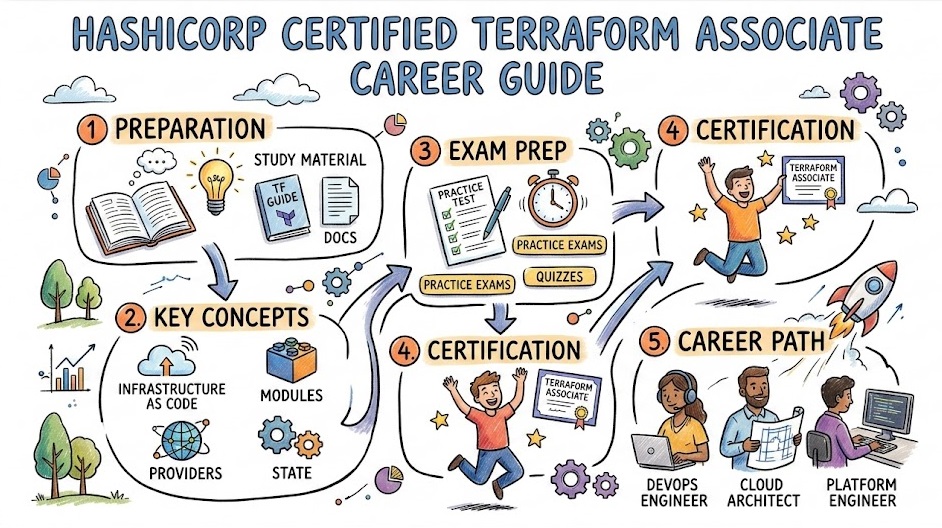
Terraform has become one of the most important tools in modern infrastructure automation. Teams use it to create cloud resources, manage environments, standardize deployments, and reduce manual work. When organizations want repeatable, version-controlled infrastructure, Terraform is usually part of the conversation. The DevOpsSchool certification page describes Hashicorp Certified Terraform Associate as a foundational certification for cloud engineers working in operations, IT, or development, and its training coverage includes Terraform workflow, providers, state, variables, modules, workspaces, backends, and troubleshooting.For working engineers and managers, this certification is not just about passing an exam. It is about proving that you understand how infrastructure as code works in real projects. It shows that you can read Terraform configurations, understand the plan and apply cycle, manage state carefully, and work with reusable modules in a practical way. The same DevOpsSchool page positions the program as a 3-day course with about 15 hours of instructor-led learning, delivered in online, classroom, and corporate formats.
Why this certification matters
Infrastructure is no longer built ticket by ticket. Modern teams are expected to create environments quickly, recover consistently, and manage changes safely. Terraform supports this way of working because it lets teams describe infrastructure in code, review that code, and apply it with a consistent workflow. DevOpsSchool’s Terraform Associate page explains Terraform as an open-source, CLI-based infrastructure as code tool that can manage both low-level components such as compute, storage, and networking, and higher-level services such as DNS and SaaS features.For managers, the value is clear. Standardized infrastructure reduces operational drift, lowers rework, and improves team productivity. For engineers, the value is just as real. Terraform experience is useful across cloud roles, platform work, DevOps practices, release engineering, and reliability engineering. Even if a job title does not explicitly mention Terraform, many cloud and automation roles expect you to understand IaC basics.
What is Hashicorp Certified Terraform Associate?
Hashicorp Certified Terraform Associate is a foundational Terraform certification focused on core concepts, basic workflows, and practical infrastructure-as-code skills. DevOpsSchool describes it as a certification that validates understanding of basic concepts and skills associated with Terraform, especially for cloud engineers involved in operations, IT, or development.
It is best understood as an entry-to-mid foundation credential for people who want to prove that they can work with Terraform safely and productively. It does not mean you are already an architect for every complex multi-cloud platform. It means you understand the base language, the workflow, and the real-world usage patterns well enough to contribute meaningfully.
Certification snapshot
| Certification | Track | Level | Who it’s for | Prerequisites | Skills covered | Recommended order |
|---|---|---|---|---|---|---|
| Hashicorp Certified Terraform Associate | Infrastructure as Code / Cloud Automation | Foundational | DevOps engineers, cloud engineers, platform engineers, software engineers, SREs, and managers who want practical IaC knowledge | Basic Linux/Unix understanding, CLI familiarity, text editor usage, and some exposure to systems, deployments, or automation, as listed by DevOpsSchool | Terraform workflow, providers, resources, variables, outputs, data sources, functions, provisioners, state, remote backends, workspaces, modules, console, tags, troubleshooting, and Terraform Cloud topics covered in the DevOpsSchool agenda | Start here if you are new to Terraform; then move into a same-track advanced cloud/platform path or a broader DevOps engineering path |
Provider overview
The provider for this learning path is DevOpsSchool. On the certification page, DevOpsSchool presents the Terraform Associate training as instructor-led, live, and interactive, with course formats including online, classroom, and corporate options. The page also lists a 3-day duration and approximate 15-hour learning plan.This matters because the right training environment can save time. Terraform looks easy at first, but many learners get stuck when they move from simple resource creation to state handling, modules, remote backends, variable precedence, and troubleshooting. A guided path can help reduce that confusion.
What you learn in this certification
The DevOpsSchool agenda is broad enough to give a solid foundation. It covers the core journey from Terraform basics to real deployment patterns. According to the published curriculum, learners are exposed to topics such as Infrastructure as Code, declarative vs imperative approaches, Terraform providers and registry, init, plan, apply, show, state handling, resource lifecycle, HCL syntax, variables, outputs, locals, data sources, functions, provisioners, templates, workspaces, remote backends, state locking, modules, Terraform console, tags, Terraform Cloud, and multi-provider CI/CD use cases.
That means this certification is not only about theory. It is about understanding how Terraform behaves across the lifecycle of writing, validating, planning, applying, updating, and maintaining infrastructure code.
Mini-section: Hashicorp Certified Terraform Associate
What it is
Hashicorp Certified Terraform Associate is a foundational certification for validating your knowledge of Terraform basics, infrastructure as code workflow, and the practical building blocks needed to automate infrastructure safely. It is designed for professionals who want to show that they understand how Terraform works in real environments.
Who should take it
- DevOps engineers starting or strengthening their IaC journey
- Cloud engineers managing AWS, Azure, GCP, or hybrid resources
- SREs who want reproducible infrastructure practices
- Platform engineers building self-service internal platforms
- Software engineers moving toward cloud-native delivery
- Engineering managers who want better visibility into IaC adoption
- Operations engineers transitioning from manual provisioning
- Consultants and trainers who need a recognized Terraform baseline
Skills you’ll gain
- Understanding of Infrastructure as Code concepts
- Terraform CLI workflow and command usage
- Provider and resource fundamentals
- HCL syntax and configuration structure
- Working with variables, outputs, and locals
- Understanding data sources and Terraform functions
- Managing state and understanding state risks
- Using workspaces for multiple environments
- Working with remote backends and state locking
- Using and creating Terraform modules
- Basic troubleshooting and common error handling
- Understanding how Terraform fits into CI/CD and team workflows
Real-world projects you should be able to do after it
- Provision a basic cloud environment with compute, storage, and networking
- Build repeatable dev, test, and prod environments using variables and workspaces
- Create reusable Terraform modules for common infrastructure patterns
- Configure remote state storage for team collaboration
- Import and manage existing infrastructure gradually
- Create standard tags and outputs for enterprise visibility
- Integrate Terraform steps into a CI/CD pipeline
- Troubleshoot state, provider, and variable-related issues
- Build a small multi-resource environment using data sources and outputs
- Apply change control with
planreview before deployment
Preparation plan
7–14 days
- Good for learners who already use Terraform occasionally
- Revise Terraform workflow, HCL basics, state, variables, modules, and workspaces
- Practice writing, planning, applying, and destroying sample infrastructure daily
- Focus on weak areas like remote backends and state locking
30 days
- Best for most working professionals
- Week 1: IaC basics, Terraform basics, providers, resources
- Week 2: Variables, outputs, locals, data sources, functions
- Week 3: State, workspaces, remote backends, troubleshooting
- Week 4: Modules, templates, small projects, mock review
60 days
- Best for beginners or career switchers
- Month 1: Build fundamentals and small hands-on labs
- Month 2: Build real mini-projects, revise concepts deeply, and practice common scenarios repeatedly
- Add notes, cheat sheets, and project-based revision
Common mistakes
- Learning commands without understanding state
- Memorizing syntax without doing labs
- Ignoring variable precedence and environment design
- Treating modules as advanced and skipping them
- Not practicing remote backend concepts
- Using copy-paste examples without understanding provider behavior
- Forgetting to review
planoutput carefully - Not learning the difference between data sources and managed resources
- Underestimating troubleshooting practice
- Preparing only from theory and not from execution experience
Best next certification after this
The best next step depends on your role. If you want a broader engineering path, a DevOps engineering master program is a strong next move because the DevOpsSchool master page positions it as a path that combines DevOps, DevSecOps, and SRE concepts for broader real-world readiness.
Core concepts you must understand before taking the exam
Infrastructure as Code
Infrastructure as Code means defining infrastructure in files rather than building it manually through consoles. This improves repeatability, auditability, and collaboration. Terraform makes this model practical because you can version infrastructure, review changes, and apply them consistently.
Declarative approach
Terraform is mainly declarative. You describe the desired state, and Terraform works out what actions are needed. This is a major shift for engineers who come from shell scripting or manual provisioning.
Providers and resources
Providers connect Terraform to platforms such as AWS, Azure, GCP, or other APIs. Resources represent the actual items you want Terraform to manage, such as virtual machines, networks, buckets, security groups, or DNS records.
State
State is one of the most important exam and real-world topics. It stores Terraform’s view of managed infrastructure. If you understand state poorly, you can still write code, but you will struggle in team environments and long-term maintenance.
Variables and outputs
Variables let you make configuration reusable and environment-aware. Outputs let you expose important values, such as IP addresses, bucket names, or resource identifiers, to users and downstream automation.
Modules
Modules are the foundation of reusable Terraform design. Once teams move beyond single files, modules become essential for standardization and scale.
Remote backends and locking
Local state works for early learning, but team environments usually need remote state and locking. These help prevent corruption, conflicting changes, and poor collaboration.
Exam and learning value for different audiences
For engineers
Terraform Associate gives engineers a strong base in infrastructure automation. It helps you speak clearly about providers, modules, state, and environment design. That makes you more useful in DevOps, cloud, and platform projects.
For managers
Managers do not always need to write Terraform daily, but they should understand what good IaC looks like. This certification helps managers evaluate delivery maturity, team capability, and the operational risks of unmanaged infrastructure.
For career switchers
If you come from Linux administration, software development, testing, support, or operations, Terraform can be a great bridge into cloud and DevOps work. The concepts are practical, visible, and widely used.
Choose your path
Here are six practical learning paths built around Terraform Associate.
1. DevOps path
Start with Terraform Associate to build infrastructure automation basics. Then expand into CI/CD, configuration management, containers, and deployment automation. This path is ideal for people who want to connect provisioning with delivery pipelines.
Best fit: DevOps Engineer, Release Engineer, Automation Engineer
2. DevSecOps path
Begin with Terraform Associate so you understand how infrastructure is created. Then move into policy, secrets handling, secure baselines, compliance automation, and infrastructure security scanning.
Best fit: Security Engineer, DevSecOps Engineer, Cloud Security Engineer
3. SRE path
Use Terraform Associate as your base for reproducible environments and controlled changes. After that, move into reliability engineering, observability, SLIs, SLOs, incident management, and production resilience.
Best fit: SRE, Platform Reliability Engineer, Operations Lead
4. AIOps / MLOps path
Terraform helps create repeatable environments for ML platforms, model pipelines, compute resources, and supporting cloud services. After Terraform Associate, focus on automation, platform orchestration, monitoring, and model operations.
Best fit: MLOps Engineer, AI Platform Engineer, AIOps Engineer
5. DataOps path
Data platforms often need repeatable provisioning for storage, processing, orchestration, and secure pipelines. Terraform Associate gives you the infrastructure layer for reliable data platform delivery.
Best fit: Data Engineer, Data Platform Engineer, Analytics Infrastructure Engineer
6. FinOps path
Infrastructure cost control depends on visibility and standardization. Terraform helps teams create tagged, governed, predictable environments. After Terraform Associate, move into cost monitoring, cloud usage optimization, and budget governance.
Best fit: FinOps Practitioner, Cloud Cost Analyst, Engineering Finance Partner
Role → Recommended certifications mapping
| Role | Why Terraform Associate fits | Recommended starting certification | Recommended next step |
|---|---|---|---|
| DevOps Engineer | Terraform is central to IaC and cloud automation | Hashicorp Certified Terraform Associate | Broader DevOps engineering path |
| SRE | Reliable environments need reproducible infrastructure | Hashicorp Certified Terraform Associate | SRE-focused reliability learning |
| Platform Engineer | Internal platforms depend on reusable modules and automation | Hashicorp Certified Terraform Associate | Platform, Kubernetes, and CI/CD expansion |
| Cloud Engineer | Terraform is widely used across cloud provisioning work | Hashicorp Certified Terraform Associate | Cloud architecture or advanced automation |
| Security Engineer | Secure infrastructure starts with controlled provisioning | Hashicorp Certified Terraform Associate | DevSecOps and cloud security path |
| Data Engineer | Modern data platforms depend on repeatable cloud resources | Hashicorp Certified Terraform Associate | DataOps and platform automation path |
| FinOps Practitioner | Tagging, governance, and standardized resources improve cost control | Hashicorp Certified Terraform Associate | FinOps and cloud governance path |
| Engineering Manager | Helps assess automation maturity and delivery discipline | Hashicorp Certified Terraform Associate | Leadership-oriented DevOps or cloud transformation learning |
7-day, 14-day, 30-day, and 60-day study roadmap
Fast-track 7-day plan
Day 1: Terraform basics, providers, resources, workflow
Day 2: HCL syntax, variables, outputs, locals
Day 3: Data sources, functions, resource lifecycle
Day 4: State, state risks, remote backend basics
Day 5: Workspaces, modules, templates
Day 6: Small project and troubleshooting drills
Day 7: Full revision and practice review
This route works only if you already have hands-on Terraform experience.
Balanced 14-day plan
Spend the first week on fundamentals and the second week on project-based revision. Each day should include reading, writing configurations, planning changes, applying them, and explaining your own reasoning.
Practical 30-day plan
This is the best path for most professionals with jobs. Study 45–90 minutes per day, with one deeper session on weekends. Build at least two mini-projects:
- a basic cloud environment
- a reusable environment with variables, modules, and remote state
Deep 60-day plan
Use this if you are new to cloud or automation. Move slowly, but practice consistently. Focus on understanding, not speed. By the end, you should be able to explain why state matters, when to use modules, how variable precedence affects behavior, and why teams use remote backends.
Real-world project ideas after certification
A certification becomes valuable when it changes what you can build. After Terraform Associate, you should work on projects such as:
- Provisioning a VPC, subnet, security group, and compute instance
- Creating storage buckets with consistent naming and tags
- Building reusable modules for networking or compute
- Creating separate environment files for dev, test, and prod
- Managing remote state for a small team
- Using outputs to integrate with downstream deployment tools
- Automating infrastructure rollout in a CI/CD workflow
- Setting policies around naming, tags, and standard variables
- Creating cloud infrastructure for an application demo platform
- Building a small disaster recovery or environment recreation exercise
These projects help move you from exam-ready to job-ready.
Common learner mistakes in detail
1. Focusing only on commands
Many learners think Terraform is just init, plan, and apply. That is not enough. You need to understand how state and resource dependencies drive behavior.
2. Avoiding state topics
State is where many professionals struggle. Yet state is one of the reasons Terraform is powerful. If you skip it, your understanding remains shallow.
3. Ignoring module design
In real projects, teams do not want hundreds of repeated resource blocks. They want reusable, maintainable modules.
4. Studying without practice
Terraform is not a theory-only tool. You must run code, read plans, see errors, and correct them.
5. No environment strategy
Beginners often create one large configuration with weak environment separation. Learn when to use variables, workspaces, and different state strategies.
6. Poor troubleshooting habits
You should get comfortable reading error messages, checking provider configuration, validating syntax, and reviewing state-related issues.
Next certifications to take after Terraform Associate
The user asked for three options: same track, cross-track, and leadership. Based on the broad DevOpsSchool master page, which presents a larger engineering path across DevOps, DevSecOps, and SRE, these are sensible next-step categories.
1. Same track option
Move deeper into cloud automation, platform engineering, and advanced infrastructure design. After Terraform Associate, stay close to infrastructure automation by strengthening cloud architecture, modules, multi-environment strategy, and team-scale Terraform operations.
Best for: Cloud Engineer, Platform Engineer, DevOps Engineer
2. Cross-track option
Use Terraform as your base and expand into DevSecOps or SRE. This is a strong move because infrastructure automation becomes much more valuable when paired with security controls or reliability practices.
Best for: Security Engineer, SRE, DevOps professional moving broader
3. Leadership option
Move into a broader DevOps engineering or transformation path. The DevOpsSchool master page positions its master program as a broad certification path spanning DevOps, DevSecOps, and SRE for larger role readiness. That makes leadership-oriented progression sensible for managers, architects, and technical leads who want to guide platform and delivery transformation.
Top Institutions That Help with Training cum Certifications for HashiCorp Certified Terraform Associate
1. DevOpsSchool
DevOpsSchool is one of the strongest options for HashiCorp Certified Terraform Associate preparation because it offers focused Terraform training, hands-on labs, and certification-oriented learning for engineers, administrators, architects, and consultants. Its training approach is practical and industry-focused, which helps learners understand how Terraform works in real cloud and infrastructure projects. This makes it a solid choice for both exam preparation and real-job readiness.
2. Cotocus
Cotocus is a useful choice for learners who want to build a broader DevOps and cloud foundation around Terraform. It supports professionals who are not only preparing for the certification but also looking to strengthen their real-world cloud automation skills. For working professionals, Cotocus can be helpful because it connects certification learning with practical career growth.
3. ScmGalaxy
ScmGalaxy is known as a training and consulting-focused platform in the areas of DevOps, cloud, and automation. For candidates preparing for the HashiCorp Certified Terraform Associate, it fits well as part of a broader technical learning journey. It is especially useful for learners who want to improve their understanding of infrastructure, automation, and cloud operations together.
4. BestDevOps
BestDevOps is another strong institution for Terraform learners because it focuses on practical, job-oriented training. It helps candidates move from beginner-level understanding to certification-level readiness in a structured way. This makes it useful not only for passing the exam but also for applying Terraform concepts in real infrastructure and DevOps environments.
5. DevSecOpsSchool
DevSecOpsSchool is a good option for professionals who want to take Terraform learning toward secure infrastructure and compliance-driven automation. It is especially valuable for learners who want to understand how infrastructure as code fits into cloud security, governance, and DevSecOps practices. For security-focused engineers, this can be a strong next-step learning platform after Terraform basics.
6. SRESchool
SRESchool is helpful for professionals who want to connect Terraform knowledge with reliability engineering and stable production systems. It is a useful choice for engineers planning to work in SRE, platform reliability, or operations-focused roles. Terraform skills become even more valuable when combined with reliability, scalability, and service management practices.
7. AIOpsSchool
AIOpsSchool is a strong option for learners who want to grow beyond infrastructure automation and move toward intelligent operations. After learning Terraform, professionals can use this platform to understand how automation connects with monitoring, analytics, and AI-driven operational practices. It is a useful path for engineers who want to work at the intersection of automation and smart operations.
8. DataOpsSchool
DataOpsSchool is valuable for professionals who want to use Terraform skills in data platform, analytics, and pipeline environments. It supports learners who need repeatable and scalable infrastructure for data-driven systems. This makes it a strong option for data engineers and platform teams who want to combine infrastructure automation with modern data operations.
9. FinOpsSchool
FinOpsSchool is a useful institution for professionals who want to connect Terraform-based automation with cloud cost control and financial accountability. It is especially relevant for teams that want to build infrastructure in a more cost-aware and governance-driven way. For learners interested in cloud efficiency, budgeting, and usage optimization, this can be a smart specialization path.
Career outcomes after this certification
Terraform Associate alone does not guarantee a senior role. But it can absolutely improve your profile. It shows that you understand one of the most common IaC tools in the industry. For many employers, that signals readiness for cloud automation, environment provisioning, and platform collaboration.
Possible outcomes include:
- stronger shortlisting for DevOps and cloud roles
- better confidence in interviews
- improved credibility for internal project transitions
- faster onboarding to cloud automation work
- better foundation for platform, SRE, and DevSecOps growth
The certification is especially useful when combined with:
- cloud hands-on work
- Git and CI/CD understanding
- Linux and shell basics
- container or Kubernetes exposure
- some production troubleshooting experience
Frequently asked questions about learning path, sequence, value, and career outcomes
1. Is Hashicorp Certified Terraform Associate difficult?
It is moderate for beginners and manageable for professionals with some cloud or automation exposure. The difficult part is not the syntax. The difficult part is understanding state, modules, and how Terraform behaves in real projects.
2. How much time do I need to prepare?
If you already use Terraform lightly, 7–14 days may be enough. For most working professionals, 30 days is more comfortable. For complete beginners, 60 days is safer.
3. Do I need coding experience?
You do not need to be a full-time software developer. Basic comfort with CLI, configuration files, and technical reasoning is enough to start.
4. Do I need cloud experience before taking it?
Cloud exposure helps a lot, but it is not mandatory if you are willing to learn with examples. Still, basic cloud concepts make Terraform more meaningful.
5. Is Terraform Associate worth it for managers?
Yes, especially for engineering managers and technical leaders responsible for delivery maturity, infrastructure standardization, or cloud transformation.
6. Should I take Terraform before Kubernetes or after?
If your work involves infrastructure setup, Terraform first often makes sense. If your role is deeply application-platform focused, Kubernetes may also be a strong early choice. The better answer depends on your job path.
7. Is this certification enough to get a DevOps job?
Not by itself. It is a strong foundation, but jobs usually also expect Linux, Git, CI/CD, and some cloud understanding.
8. What roles benefit the most from Terraform Associate?
DevOps Engineer, Cloud Engineer, Platform Engineer, SRE, Security Engineer, and Data Platform Engineer all benefit strongly.
9. What is the biggest mistake learners make?
They memorize commands but do not understand state, variables, or reusable design. That leads to weak real-world performance.
10. Can software engineers benefit from this certification?
Yes. Software engineers working in cloud-native systems often need to understand infrastructure patterns even if they do not own the full platform.
11. What comes after Terraform Associate?
A deeper cloud/platform path, a DevSecOps path, an SRE path, or a broader DevOps engineering program are all logical next moves.
12. Does this certification help in internal promotions?
It can help when your organization values automation maturity, cloud standards, and visible skill development. It is especially useful when supported by real project contributions.
8 focused FAQs on Hashicorp Certified Terraform Associate
1. What is Hashicorp Certified Terraform Associate in simple words?
It is a foundational certification that proves you understand Terraform basics, how infrastructure as code works, and how to use Terraform in practical cloud automation work.
2. Who should take Hashicorp Certified Terraform Associate?
It is a good fit for DevOps engineers, cloud engineers, software engineers, SREs, platform engineers, and technical managers who want a strong Terraform foundation.
3. What are the main skills covered?
Key areas include providers, resources, HCL, variables, outputs, data sources, state, remote backends, workspaces, modules, templates, and troubleshooting.
4. Is Hashicorp Certified Terraform Associate good for beginners?
Yes, it is one of the better starting points for people entering infrastructure automation, provided they are ready to practice hands-on.
5. How long does training usually take?
The referenced DevOpsSchool page presents the training as a 3-day program with approximately 15 hours of instructor-led coverage.
6. What should I study first before starting?
Start with basic cloud concepts, Linux/CLI familiarity, and the idea of Infrastructure as Code. Then move into Terraform workflow and hands-on labs.
7. What is the best next step after this certification?
That depends on your goal. Broader DevOps engineering, SRE, DevSecOps, or cloud/platform specialization are all strong next steps.
8. Does this certification help in real projects?
Yes. It helps you build, review, standardize, and maintain infrastructure more reliably, especially in team environments where consistency matters.
Conclusion
Hashicorp Certified Terraform Associate is a smart certification for professionals who want a practical, respected foundation in infrastructure as code. It gives engineers a clear entry point into Terraform, while also helping managers understand how modern infrastructure automation works in real teams. The DevOpsSchool curriculum shows that this learning path is not limited to theory; it covers the workflow, state, variables, modules, workspaces, remote backends, and troubleshooting topics that matter in day-to-day delivery.If your goal is to become stronger in cloud automation, DevOps, SRE, DevSecOps, DataOps, AIOps/MLOps, or FinOps, Terraform Associate is a practical and valuable place to begin. Start with the basics, practice consistently, build a few real projects, and then choose your next path with intention. A certification is most powerful when it becomes part of a larger engineering journey, not just a badge on a profile.