Introduction
Security is no longer a separate step at the end of the software lifecycle; it must live inside every build, commit, pipeline, and deployment. For modern teams, DevSecOps is the practical way to make this happen without slowing delivery.Certified DevSecOps Professional is designed to help engineers and managers learn how to integrate security into CI/CD, cloud, containers, and day‑to‑day delivery workflows. This guide will walk you through what the certification is, who should take it, the skills you gain, learning paths, preparation plans, and how it supports your long‑term career.
What is Certified DevSecOps Professional?
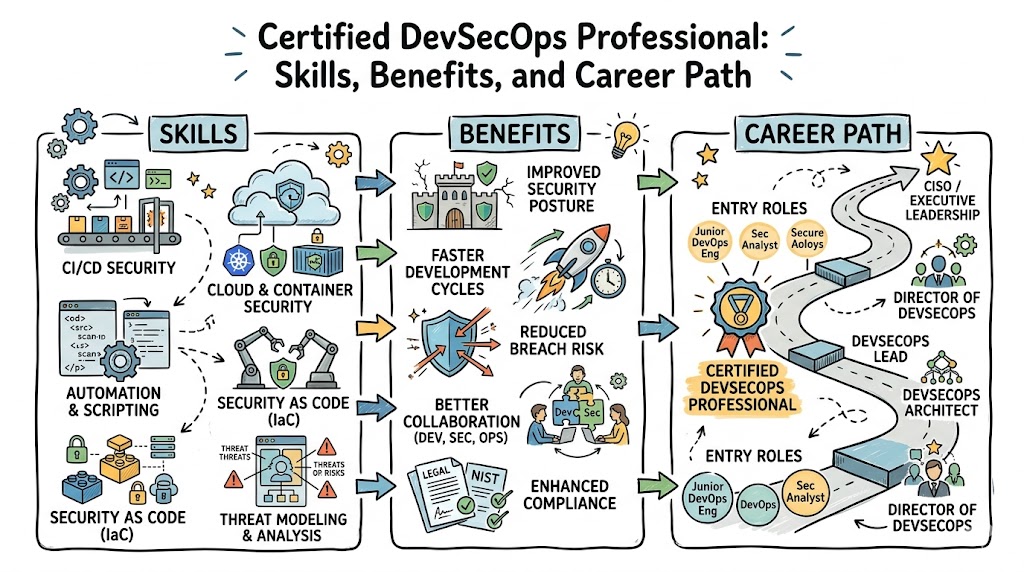
Certified DevSecOps Professional is a role‑focused certification that proves you can embed security practices, tools, and automation across the full DevOps lifecycle. It is aligned with real projects such as securing CI/CD pipelines, container platforms, and infrastructure as code in cloud environments.
This certification focuses on practical skills: implementing security controls, integrating scanners into pipelines, handling vulnerabilities, and driving cultural change so security becomes a shared responsibility across teams.
What this certification covers
What it is
Certified DevSecOps Professional validates your ability to design and run secure CI/CD pipelines, automate security testing, and build a continuous security culture across development and operations. It connects concepts like DevOps, application security, and cloud security into one practical skill set.
Who should take it
- Software / DevOps / Platform Engineers who want to move into DevSecOps roles
- Security Engineers who want to work closer with DevOps and CI/CD teams
- SREs and Cloud Engineers who manage production systems and want stronger security skills
- Engineering Managers who need to lead secure delivery initiatives and governance
Skills you’ll gain
- DevSecOps fundamentals, principles, and culture building
- CI/CD security: integrating security checks into build, test, and deploy stages
- Application security basics (SAST, DAST, SCA, secrets scanning)
- Container and Kubernetes security concepts (image scanning, runtime policies)
- Infrastructure as Code security for common tools and cloud platforms
- Vulnerability management workflows and governance
- Monitoring and incident handling in a DevSecOps environment
Real‑world projects you should be able to do after it
- Design a secure CI/CD pipeline that runs SAST, DAST, and dependency scans on every change
- Set up security scanning for container images and Kubernetes deployments
- Configure basic Infrastructure as Code policies and checks for cloud resources
- Build a simple vulnerability triage and remediation workflow integrated with issue trackers
- Implement basic security monitoring dashboards and alerts for critical services
Preparation plan
You can choose a preparation window based on your current background and free time.
7–14 day fast‑track plan
Best for: experienced DevOps / security professionals who already work with CI/CD and cloud.
- Day 1–3: Review DevOps and security basics, threat models, secure SDLC concepts
- Day 4–6: Focus on CI/CD security, pipeline design, and integrating scanners
- Day 7–10: Hands‑on practice with container and IaC security scenarios
- Day 11–14: Mock scenarios, review notes, and focus on exam‑style tasks
30 day balanced plan
Best for: working engineers with limited daily time.
- Week 1: Fundamentals of DevSecOps, culture, and SDLC checkpoints
- Week 2: CI/CD security, application security tooling, secrets management
- Week 3: Container, Kubernetes, and cloud/IaC security basics
- Week 4: End‑to‑end projects, revision, and practice assessments
60 day deep‑dive plan
Best for: people who are new to DevOps or security.
- Phase 1 (Weeks 1–3): DevOps foundations, Linux and basic cloud, version control, CI/CD basics
- Phase 2 (Weeks 4–6): DevSecOps, security tools, pipelines, IaC concepts, governance and metrics
Common mistakes
- Treating DevSecOps as “just tools” without focusing on culture and shared responsibility
- Learning scanner commands but not understanding how to triage and fix vulnerabilities
- Ignoring cloud and container security and only focusing on application code
- Skipping hands‑on practice and only reading documentation
- Not aligning security work with developer workflows and delivery speed
Best next certification after this
After Certified DevSecOps Professional, common next steps are:
- A more advanced DevOps / SRE / architecture‑oriented program like “Master in DevOps Engineering (MDE)” to broaden your coverage of DevOps, DevSecOps, and SRE practices.
- A focused SRE or reliability certification if your role involves production SLIs, SLOs, and incident management.
- A leadership‑oriented DevSecOps / security management certification (for example a manager‑level DevSecOps program) if you are moving into engineering leadership.
Certification table
Below is a reference table for the Certified DevSecOps Professional in the broader learning landscape.
If you want, we can later expand this into a multi‑row table covering DevSecOps Foundation, Practitioner, Master, and related DevOps/SRE certifications, but I am keeping it focused as per your main title.
Choose your path: 6 learning paths
In this section, we align Certified DevSecOps Professional with six common learning paths.
1. DevOps path
For professionals focused on CI/CD, automation, and platform engineering, DevSecOps becomes a critical layer that keeps automation safe.
Typical sequence:
- DevOps Foundation / entry‑level DevOps program
- DevOps Practitioner or equivalent hands‑on engineering program
- Certified DevSecOps Professional to embed security into your existing DevOps skills
- Master in DevOps Engineering (MDE) to unify DevOps, DevSecOps, and SRE at an architect level
2. DevSecOps path
This is the core path for security‑minded engineers who want to own the “secure pipeline” and security automation journey.
Typical sequence:
- DevSecOps Foundation certification (principles, culture, and fundamentals)
- DevSecOps Practitioner certification (applied tooling and implementations)
- Certified DevSecOps Professional as the main project‑oriented credential
- DevSecOps Master certification for advanced and large‑scale implementations
3. SRE path
SREs are responsible for reliability, but resilience now includes security hardening, safe rollouts, and secure incident response.
Typical sequence:
- SRE Foundation certification (concepts like SLIs, SLOs, error budgets)
- SRE Practitioner (implementing SRE practices in real systems)
- Certified DevSecOps Professional to add security‑aware pipelines and operational security
- SRE Master for deep production engineering and reliability leadership
4. AIOps / MLOps path
For data and ML teams, secure pipelines mean protecting models, data, and environments while still iterating fast.
Typical sequence:
- MLOps or AIOps Foundation certification (ML lifecycle, monitoring, automation)
- MLOps/AIOps Practitioner certification (production model deployments, data pipelines)
- Certified DevSecOps Professional to integrate security into ML CI/CD and data workflows
- MLOps/AIOps Master for advanced, large‑scale model operations
5. DataOps path
Data engineers and analytics engineers need secure data pipelines, safe transformations, and controlled access to critical datasets.
Typical sequence:
- DataOps Foundation certification (data pipeline principles and DevOps mindset)
- DataOps Practitioner certification (or equivalent)
- Certified DevSecOps Professional to apply DevSecOps principles to data tools, ETL/ELT, and orchestration
- DataOps Master for complex data platforms
6. FinOps path
FinOps professionals must balance cloud cost, performance, and risk. Security incidents directly impact cost and compliance.
Typical sequence:
- FinOps / cloud cost‑management foundation certification
- Practitioner‑level FinOps program (tooling and governance)
- Certified DevSecOps Professional to understand how security and DevOps decisions affect cost and risk
- Advanced FinOps / cloud governance programs for leadership roles
Role → Recommended certifications
Below is a simple mapping between roles and recommended certifications, including Certified DevSecOps Professional.
| Role | Recommended certifications (in order) |
|---|---|
| DevOps Engineer | DevOps Foundation → DevOps Practitioner → Certified DevSecOps Professional → Master in DevOps Engineering (MDE) |
| SRE | SRE Foundation → SRE Practitioner → Certified DevSecOps Professional → SRE Master |
| Platform Engineer | DevOps Foundation → DevOps Practitioner → Certified DevSecOps Professional → cloud/platform architect‑level program |
| Cloud Engineer | Cloud platform associate/professional level → DevOps/CI/CD training → Certified DevSecOps Professional |
| Security Engineer | Security / AppSec fundamentals → DevSecOps Foundation → Certified DevSecOps Professional → DevSecOps Master |
| Data Engineer | DataOps / data engineering fundamentals → DevOps/CI basics → Certified DevSecOps Professional |
| FinOps Practitioner | FinOps basics → cloud cost management course → Certified DevSecOps Professional (to link cost and security) |
| Engineering Manager | DevOps/Agile leadership course → Certified DevSecOps Professional → DevSecOps/DevOps leadership programs |
Next certifications to take
Using the same idea as in the Master in DevOps Engineering program, you can think in three directions.
1. Same track
- DevSecOps Practitioner or Master certification to go deeper into advanced pipelines, governance, and large‑scale implementations.
- Additional hands‑on DevSecOps courses focused on specific stacks (containers, Kubernetes, cloud‑native security).
2. Cross‑track
- DevOps architect‑oriented program such as Master in DevOps Engineering (MDE) to combine DevOps, DevSecOps, and SRE.
- SRE certifications to strengthen reliability, observability, and incident response, which heavily complement DevSecOps skills.
3. Leadership
- DevSecOps or security management program focused on governance, metrics, and organizational change.
- Engineering or platform‑lead oriented training to manage teams that implement DevSecOps at scale.
Top institutions for Certified DevSecOps Professional training
Below are top institutions that provide training and guidance for DevOps, DevSecOps, and related certifications.
DevOpsSchool
DevOpsSchool is a long‑standing training provider with a wide portfolio of DevOps, DevSecOps, SRE, cloud, and data‑related courses. Their programs are designed around real‑world projects, hands‑on labs, and job role alignment so that you can directly apply what you learn in your current organization.
Cotocus
Cotocus focuses on specialized DevOps and cloud transformations, including security‑aware engineering practices. They often work with enterprises and individuals to design learning journeys that connect DevOps, DevSecOps, SRE, and cloud adoption.
Scmgalaxy
Scmgalaxy originally started with source control and build‑release trainings and now covers a wide range of DevOps and security topics. Their courses emphasize CI/CD, automation, and configuration management, which creates a strong base before you add DevSecOps‑specific skills.
BestDevOps
BestDevOps acts as a hub for DevOps and DevSecOps resources, trainings, and community knowledge. It highlights practical workshops, curated content, and learning programs that help engineers and managers stay current with modern delivery and security practices.
devsecopsschool
devsecopsschool focuses specifically on DevSecOps training and certifications, including the Certified DevSecOps Professional program itself. Their content is shaped around secure SDLC, CI/CD security, container and cloud security, and leadership aspects of DevSecOps adoption.
sreschool
sreschool is specialized in Site Reliability Engineering (SRE) training, covering reliability, observability, and incident response. Many SRE programs are integrated with DevOps and DevSecOps themes, which makes it a strong complement to a DevSecOps certification.
aiopsschool
aiopsschool targets AIOps and intelligent operations, combining automation, monitoring, and analytics. For learners interested in how AI and automation support secure and resilient systems, AIOps training from this institution can be a useful addition to DevSecOps skills.
dataopsschool
dataopsschool focuses on DataOps, data‑pipeline automation, and analytics workflows. This is highly relevant for people working on data platforms who want to apply DevSecOps principles like controlled changes, secure pipelines, and governance to data systems.
finopsschool
finopsschool deals with the financial operations side of cloud and platform management. Its trainings help you understand cost, governance, and value, which connect well with DevSecOps when you must justify security investments and optimize secure architectures.
FAQs on learning path and career
1. Is Certified DevSecOps Professional difficult?
It is challenging if you are completely new to DevOps and security, but manageable for working engineers who already know CI/CD, Git, and basic cloud concepts. Difficulty mainly comes from needing both conceptual understanding and hands‑on practice.
2. How long does it take to prepare?
With prior DevOps experience, many professionals can prepare in 2–4 weeks using a focused plan. If you are new to CI/CD or security, plan 6–8 weeks to build foundations and then practice DevSecOps topics.
3. Do I need to be a security expert before starting?
No, you do not need to be a full security specialist before you start. You should, however, know basic web application concepts, Linux, and DevOps ideas like pipelines, automation, and monitoring.
4. What is the ideal sequence with other DevOps certifications?
A common sequence is DevOps Foundation → DevOps Practitioner → Certified DevSecOps Professional → advanced architect‑level programs like Master in DevOps Engineering. This builds wide DevOps skills first and then adds security depth.
5. How does this certification help my career?
It opens roles such as DevSecOps Engineer, Senior DevOps Engineer with security focus, Security Automation Engineer, or security‑aware SRE. Many organizations now look for people who can bridge DevOps and security, making this skillset highly visible.
6. Is this certification useful for managers?
Yes, especially for engineering, platform, or security managers responsible for delivery and governance. It helps you understand what good DevSecOps looks like so you can lead teams, design programs, and measure impact.
7. Can I do it if I am a developer?
Yes, developers benefit directly because they learn how security fits into coding, testing, and deployment workflows. It also helps you collaborate better with security and operations teams.
8. What if I come from a pure security background?
If you already know security but lack DevOps/CI/CD experience, this certification helps you become more “DevOps‑native” and understand how to embed controls into pipelines. It can shift you from traditional security roles into DevSecOps engineer or security automation roles.
9. Is hands‑on practice mandatory?
Hands‑on practice is strongly recommended because DevSecOps is about implementing pipelines and controls, not just naming tools. Lab‑style practice with CI/CD, scanners, containers, and IaC will make the exam and real‑world work much easier.
10. How does Certified DevSecOps Professional relate to SRE?
SRE focuses on reliability, but modern reliability also includes security controls, least privilege, and safe rollouts. Certified DevSecOps Professional gives SREs the security toolkit needed to keep systems both reliable and safe.
11. Can this certification help with cloud‑specific roles?
Yes, because cloud delivery is now the default for most teams, and DevSecOps practices are directly applied to cloud CI/CD, infrastructure as code, and container platforms. Cloud engineers with DevSecOps skills are often preferred for senior roles.
12. What should I do after passing the certification?
After passing, focus on applying the concepts in at least one real project at work, such as securing a pipeline or adding a vulnerability management flow. Then consider the next certification in the same track, a cross‑track like SRE, or a leadership‑oriented program.
FAQs specifically on Certified DevSecOps Professional
1. What is Certified DevSecOps Professional in simple words?
It is a certification that proves you can build and manage secure CI/CD pipelines and apply security in every stage of modern software delivery.
2. Who is the Certified DevSecOps Professional best suited for?
It is best for DevOps, security, SRE, cloud, and platform engineers, as well as managers who lead secure delivery initiatives.
3. What are the main topics covered?
It covers DevSecOps concepts, CI/CD security, application security tooling, container and cloud security basics, vulnerability management, and governance ideas.
4. How much experience do I need before attempting it?
Having 1–2 years of experience in DevOps, development, or operations, with exposure to CI/CD and basic cloud, is usually sufficient to start preparing seriously.
5. Is the exam more theoretical or practical?
The emphasis is on practical capability: designing secure workflows and understanding how to apply tools in pipelines, rather than just definitions.
6. How should I practice for the exam?
Set up a small CI/CD lab, integrate at least one SAST, DAST, and dependency scanner, experiment with container image scanning, and document a simple vulnerability management workflow.
7. What kind of roles can I apply for after this certification?
You can target roles like DevSecOps Engineer, Security Automation Engineer, Senior DevOps Engineer (Security), or security‑oriented SRE/Platform Engineer.
8. How does it fit into a long‑term career plan?
It gives you a solid mid‑career pivot or upgrade into security‑aware engineering roles and sets you up for advanced DevOps, DevSecOps, SRE, or leadership certifications.
Conclusion
Certified DevSecOps Professional is a powerful step for working engineers and managers who want to make security a built‑in part of software delivery instead of an afterthought. It connects DevOps, security, cloud, and operations into one practical, project‑oriented skill set that is directly relevant to today’s teams.By following a clear preparation plan, choosing the right learning path, and mapping this certification to your current role, you can move into high‑impact positions such as DevSecOps Engineer, secure DevOps lead, or engineering manager for secure delivery. Combined with training from specialized institutions focused on DevOps, SRE, data, AI, and FinOps, this certification can anchor your long‑term career in secure, modern engineering practices.