Introduction
The Certified Site Reliability Professional is a comprehensive framework designed to bridge the gap between traditional software engineering and modern systems operations. This guide is crafted for engineers and technical leaders who aim to master the art of building scalable and highly reliable distributed systems. As the industry shifts toward cloud-native architectures, understanding the principles of reliability has become a non-negotiable requirement for career growth. By following this guide, professionals can navigate the complexities of modern infrastructure and make informed decisions about their technical specialization.
In today’s fast-paced digital economy, a Certified Site Reliability Professional plays a critical role in ensuring that services remain available, performant, and efficient. This career path is not just about learning a specific toolset; it is about adopting a mindset that treats operations as a software problem. Whether you are a Site Reliability Engineer or a developer looking to broaden your impact, this certification provides the structured roadmap needed to excel in high-stakes production environments. This guide will break down the value, structure, and strategic advantages of pursuing this professional designation.
What is the Certified Site Reliability Professional?
The Certified Site Reliability Professional represents a standard of excellence for engineers who manage the intersection of code and infrastructure. It exists to validate a professional’s ability to apply software engineering practices to solve operational challenges, such as automation, monitoring, and incident response. Unlike theoretical courses, this program emphasizes real-world, production-focused learning, ensuring that practitioners can handle the pressures of maintaining large-scale systems. It aligns perfectly with modern enterprise practices like Continuous Integration, Continuous Deployment, and Infrastructure as Code.
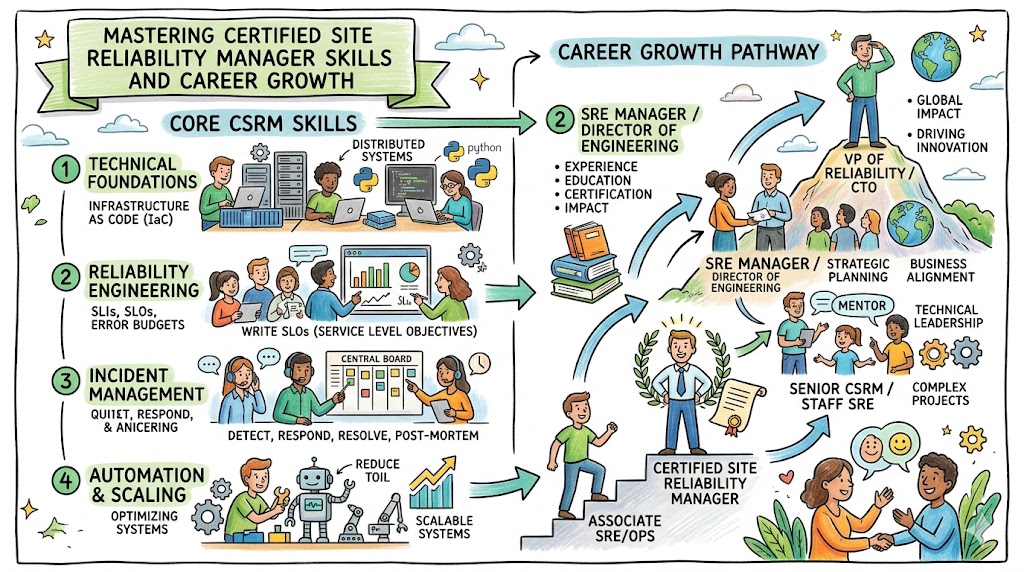
By focusing on the practical application of SRE principles, the certification ensures that graduates are prepared for the day-to-day realities of a high-performance engineering team. It moves beyond basic administration tasks to cover advanced topics like error budgets, service level objectives, and toil reduction. This alignment with modern engineering workflows makes it a vital asset for organizations looking to improve their system stability while maintaining a high velocity of feature delivery.
Who Should Pursue Certified Site Reliability Professional?
This certification is designed for a wide range of technical roles, including DevOps engineers, cloud architects, and backend developers who want to specialize in systems reliability. Security professionals and data engineers also benefit significantly, as the core principles of observability and automation are universal across all modern technical domains. It serves as a bridge for traditional system administrators who wish to evolve into cloud-native roles, providing them with the necessary coding and automation skills.
In the global market, and specifically within India’s booming tech sector, there is an immense demand for professionals who can manage complex distributed systems. Beginners with a strong foundation in Linux and networking can use this as a launchpad, while experienced engineers use it to formalize their expertise and move into senior or staff-level positions. Engineering managers also find value here, as it provides the language and framework needed to lead SRE teams effectively.
Why Certified Site Reliability Professional is Valuable and Beyond
The demand for reliability expertise is driven by the increasing complexity of microservices and multi-cloud environments, ensuring long-term career longevity for those who hold this certification. As enterprises continue to migrate mission-critical workloads to the cloud, the need for individuals who can guarantee uptime and performance is at an all-time high. This certification helps professionals stay relevant even as specific tools change, because it teaches the underlying principles that govern all scalable systems.
Investing time in this path provides a significant return on career investment, often leading to roles with higher responsibility and better compensation. It signals to employers that an engineer possesses the discipline to manage production environments responsibly and the technical skill to automate away manual tasks. As AI and machine learning become more integrated into operations, the foundational SRE skills gained here will remain the bedrock of successful infrastructure management.
Certified Site Reliability Professional Certification Overview
The program is delivered via the SRE School platform and is hosted on the SRE School website. The certification is structured to provide a logical progression from foundational concepts to advanced architectural strategies, using a performance-based assessment approach. This ensures that candidates are not just memorizing facts but are capable of performing tasks in a simulated production environment. The ownership of the program lies with industry experts who have practical experience in managing hyperscale infrastructures.
The assessment structure is designed to be rigorous yet practical, testing a candidate’s ability to diagnose issues, implement automation, and define reliability metrics. By maintaining a focus on industry-standard tools and methodologies, the program stays current with the evolving tech landscape. It provides a clear framework for professional development, allowing engineers to track their progress and identify specific areas for technical improvement.
Certified Site Reliability Professional Certification Tracks & Levels
The certification is divided into three primary levels: Foundation, Professional, and Advanced. The Foundation level introduces the core vocabulary and concepts, while the Professional level dives deep into implementation details and tool chains. The Advanced level is reserved for those who architect large-scale reliability strategies and lead organizational change. This tiered approach allows professionals to enter at a level that matches their current experience and grow over time.
Specialization tracks are also available to align with specific career goals, such as SRE for FinOps, SRE for Security, or SRE for AI-driven operations. These tracks show how reliability principles apply to different niches within the broader engineering ecosystem. By aligning these levels with common career milestones, the program provides a clear map for moving from an individual contributor to a technical leader or specialized architect.
Complete Certified Site Reliability Professional Certification Table
| Track | Level | Who it’s for | Prerequisites | Skills Covered | Recommended Order |
| Core SRE | Foundation | Junior Engineers / Students | Basic Linux & Networking | SLOs, SLIs, Error Budgets, Toil | 1st |
| Core SRE | Professional | DevOps & SREs | 2+ Years Experience | Monitoring, Incident Response | 2nd |
| Platform | Advanced | Architects & Leads | Professional Level Cert | Scalability, Distributed Systems | 3rd |
| Operations | Specialty | Cloud Engineers | Foundation Level | Automation, IaC, Cloud Native | 2nd (Optional) |
Detailed Guide for Each Certified Site Reliability Professional Certification
What it is
This certification validates a fundamental understanding of Site Reliability Engineering principles and the core vocabulary used in modern operations. It confirms that a candidate understands the difference between traditional operations and the SRE model.
Who should take it
It is suitable for junior developers, system administrators, and recent graduates who want to enter the SRE field. It is also beneficial for project managers who need to understand the technical constraints of the teams they lead.
Skills you’ll gain
- Defining Service Level Indicators (SLIs) and Service Level Objectives (SLOs).
- Understanding and calculating Error Budgets.
- Identifying and reducing operational Toil.
- Grasping the basics of incident management and post-mortems.
- Knowledge of automation culture and its importance.
Real-world projects you should be able to do
- Create a basic reliability dashboard for a web application.
- Draft a sample Service Level Agreement based on business requirements.
- Conduct a mock blameless post-mortem for a service outage.
Preparation plan
- 7–14 days: Review official course materials and familiarize yourself with the core SRE handbook concepts.
- 30 days: Engage with community forums, take practice exams, and set up a basic monitoring stack on your local machine.
- 60 days: Deep dive into case studies of major outages and practice writing SLOs for different types of technical architectures.
Common mistakes
- Focusing too much on specific tools rather than the underlying SRE principles.
- Underestimating the importance of the cultural and psychological aspects of SRE.
- Neglecting the mathematical logic behind error budget calculations.
Best next certification after this
- Same-track option: Certified Site Reliability Professional – Professional
- Cross-track option: Certified DevSecOps Professional
- Leadership option: Engineering Management Foundation
Choose Your Learning Path
DevOps Path
The DevOps path focuses on the seamless integration of development and operations through continuous delivery and automation. Engineers on this path learn to build robust CI/CD pipelines and manage infrastructure as code to support rapid software releases. It emphasizes the cultural shift toward shared responsibility and the technical skills required to maintain deployment velocity without sacrificing quality.
DevSecOps Path
The DevSecOps path integrates security practices directly into the SRE and DevOps workflows. This ensures that reliability and security are built into the system from the start rather than being added as an afterthought. Professionals learn to automate security testing, manage secrets securely, and respond to security incidents using SRE principles of observability and post-mortem analysis.
SRE Path
The SRE path is the core journey for those dedicated to system reliability, scalability, and performance. It focuses heavily on managing production environments, optimizing distributed systems, and using software engineering to solve operational hurdles. This path is ideal for those who enjoy troubleshooting complex technical issues and designing systems that can withstand massive traffic spikes.
AIOps Path
The AIOps path explores the use of artificial intelligence and machine learning to enhance IT operations. It covers how to use algorithmic analysis to detect anomalies, predict potential failures, and automate incident resolution at scale. This is a forward-looking path for SREs who want to leverage data science to manage increasingly complex and noisy environments.
MLOps Path
The MLOps path focuses on the specific reliability challenges associated with deploying and maintaining machine learning models in production. It bridges the gap between data science and SRE, ensuring that ML pipelines are scalable, reproducible, and monitored effectively. Professionals on this path manage the lifecycle of models, including versioning, deployment, and performance monitoring.
DataOps Path
The DataOps path applies SRE and DevOps principles to data management and analytics pipelines. It focuses on improving the quality, speed, and reliability of data delivery within an organization. By implementing automated testing and monitoring for data workflows, engineers ensure that data remains a trustworthy asset for business decision-making.
FinOps Path
The FinOps path combines SRE principles with financial management to optimize cloud spending and maximize business value. It involves creating visibility into cloud costs, implementing automated scaling to reduce waste, and aligning engineering activities with financial goals. This path is essential for organizations looking to scale their cloud presence efficiently and sustainably.
Role → Recommended Certified Site Reliability Professional Certifications
| Role | Recommended Certifications |
| DevOps Engineer | Foundation + Professional |
| SRE | Foundation + Professional + Advanced |
| Platform Engineer | Professional + Advanced |
| Cloud Engineer | Foundation + Specialty Track |
| Security Engineer | Foundation + DevSecOps Specialization |
| Data Engineer | Foundation + DataOps Specialization |
| FinOps Practitioner | Foundation + FinOps Specialization |
| Engineering Manager | Foundation + Leadership Track |
Next Certifications to Take After Certified Site Reliability Professional
Same Track Progression
Once the Foundation and Professional levels are achieved, the natural next step is the Advanced level. This involves mastering complex architectural patterns, such as multi-region failover and global load balancing. Deep specialization in a specific cloud provider’s reliability tools (like AWS Resilience Hub or Google Cloud Operations Suite) can also complement the core SRE certification.
Cross-Track Expansion
Engineers often benefit from expanding their skills into adjacent areas like security or data operations. Taking a DevSecOps certification after SRE provides a more holistic view of system health, encompassing both uptime and integrity. This broadening of skills makes an engineer more versatile and valuable in small, cross-functional teams where individuals must wear multiple hats.
Leadership & Management Track
For those looking to move away from individual contributor roles, a transition into technical leadership is a common path. Certifications in engineering management or agile leadership can help an SRE professional apply their systems-thinking skills to human organizations. Understanding how to build and scale a reliability culture within a large company is a high-level skill that bridges the gap between tech and business.
Training & Certification Support Providers for Certified Site Reliability Professional
DevOpsSchool provides a robust environment for learners seeking to master SRE concepts through guided instruction and extensive documentation. Their approach focuses on delivering hands-on labs that simulate real-world production issues, allowing students to practice their skills in a safe yet challenging setting. They offer various formats to suit different learning styles, ensuring that every professional can find a path that works for them.
Cotocus is known for its specialized training programs that cater to enterprise-level requirements in the SRE and DevOps space. They emphasize the integration of modern tools with proven methodologies, helping teams transform their operational capabilities. Their curriculum is designed to be practical, focusing on the immediate application of skills to solve business-critical reliability challenges.
Scmgalaxy acts as a comprehensive resource hub for community-driven learning and technical tutorials in the reliability domain. It offers a wealth of information ranging from basic automation scripts to advanced architectural patterns. By fostering a collaborative environment, it helps professionals stay updated with the latest trends and peer-reviewed best practices in the SRE ecosystem.
BestDevOps focuses on delivering high-quality, curated content that helps engineers navigate the complex landscape of modern operations. Their training modules are structured to provide a clear progression of skills, making it easier for candidates to prepare for professional certifications. They prioritize clarity and practical utility, ensuring that learners can see the direct impact of their studies on their daily work.
Devsecopsschool specializes in the intersection of security and reliability, providing targeted training for the modern DevSecOps professional. Their programs emphasize the “shift left” philosophy, teaching engineers how to integrate security checks into every stage of the lifecycle. This specialized focus is invaluable for organizations operating in highly regulated industries or those with a high security risk profile.
Sreschool is the primary hosting and delivery platform for the Certified Site Reliability Professional program, offering a direct path to certification. They provide the most aligned and up-to-date materials specifically designed for this certification track. Their platform is built by SREs for SREs, ensuring that the content is technically accurate and focused on what truly matters in production.
Aiopsschool addresses the growing need for intelligent automation by offering training focused on artificial intelligence for IT operations. They help SREs transition into the world of algorithmic monitoring and automated remediation. Their curriculum covers the data science basics needed to understand how AI can be applied to improve system reliability and reduce human intervention.
Dataopsschool focuses on the reliability of data pipelines, applying SRE principles to the world of big data and analytics. They provide the tools and techniques necessary to ensure that data delivery is as consistent and reliable as software delivery. This training is essential for data engineers who want to bring a higher level of discipline and automation to their workflows.
Finopsschool provides the specialized knowledge required to manage the financial aspects of cloud-native infrastructure. They teach SREs how to treat cost as a first-class metric, similar to latency or error rates. By bridging the gap between engineering and finance, they enable professionals to build systems that are both technically excellent and economically viable.
Frequently Asked Questions (General)
- How difficult is the Certified Site Reliability Professional exam?The exam is designed to be challenging but fair, focusing on practical application rather than rote memorization. If you have hands-on experience and have studied the core SRE principles, you will find it manageable.
- How much time does it take to get certified?Depending on your experience level, it typically takes between 30 to 60 days of focused study to feel fully prepared for the foundation level.
- Are there any prerequisites for the foundation level?While there are no hard prerequisites, a basic understanding of Linux systems, networking, and at least one programming language is highly recommended.
- What is the ROI of this certification?Professionals often see immediate benefits in terms of job opportunities and salary increases, as SRE remains one of the highest-paying roles in tech.
- Should I take the DevOps or SRE track first?It depends on your goal; if you want to focus on delivery, choose DevOps. If you want to focus on systems and reliability, start with SRE Foundation.
- Is this certification recognized globally?Yes, the principles taught are industry standards used by major tech companies worldwide, from Silicon Valley to Bangalore.
- How often do I need to recertify?Certifications typically remain valid for two to three years, after which you can renew by passing a higher-level exam or completing continuing education.
- Does this certification cover specific tools like Kubernetes?While it covers the concepts used by tools like Kubernetes, it focuses on the principles that apply across all orchestration platforms.
- Can I pass using only free online resources?While possible, the structured curriculum and labs provided by official partners significantly increase your chances of success and deep understanding.
- Is there a coding requirement for the exam?The professional level and above may require you to understand or write scripts (Python or Go) to solve automation problems.
- How does this differ from a standard Cloud Architect cert?A Cloud Architect focuses on designing the environment, while an SRE focuses on the ongoing operations, reliability, and automation of that environment.
- Are there group discounts for enterprise teams?Most training providers offer corporate packages for teams looking to standardize their reliability practices across the organization.
FAQs on Certified Site Reliability Professional
- What is the primary focus of the Certified Site Reliability Professional Foundation?The primary focus is establishing a shared language and understanding of SRE principles like SLOs, SLIs, and toil reduction. It ensures all team members approach operations with a software engineering mindset.
- Is the Certified Site Reliability Professional – Foundation exam lab-based?The foundation level focuses more on conceptual understanding and situational judgment, while the professional levels introduce more hands-on, lab-based tasks to verify technical proficiency.
- How does this certification help with career progression?It provides a formal validation of your skills, making it easier to transition into specialized SRE roles or move into senior engineering positions that require high-level system ownership.
- Can managers benefit from the Foundation level?Absolutely. It provides managers with the framework to measure team performance through reliability metrics rather than just feature output, leading to healthier engineering cultures.
- What is the passing score for the certification?The passing score is typically set at 70%, ensuring that candidates have a solid grasp of both the theoretical and practical aspects of the curriculum.
- Are there official practice tests available?Yes, official practice tests are provided through the SRE School platform to help candidates gauge their readiness and identify areas for improvement.
- Does the certification cover blameless post-mortems?Yes, the cultural shift toward blamelessness is a core component of the foundation level, as it is essential for building a resilient engineering organization.
- Is Python required for the Foundation level?While not strictly required for the foundation, having a basic understanding of any scripting language will help you understand the automation concepts discussed in the course.
Conclusion
The Certified Site Reliability Professional offers a structured, credible path for those ready to make that leap. It is not a magic bullet that will instantly solve all production issues, but it provides the disciplined framework and technical toolkit necessary to tackle them systematically.If you are looking for a way to differentiate yourself in a crowded market and want to focus on the long-term stability of the systems you build, this certification is worth the investment. It rewards curiosity, technical rigor, and a commitment to continuous improvement. My advice as a mentor is to focus on the principles first—tools will come and go, but the ability to manage reliability is a skill that will serve you for the rest of your career.