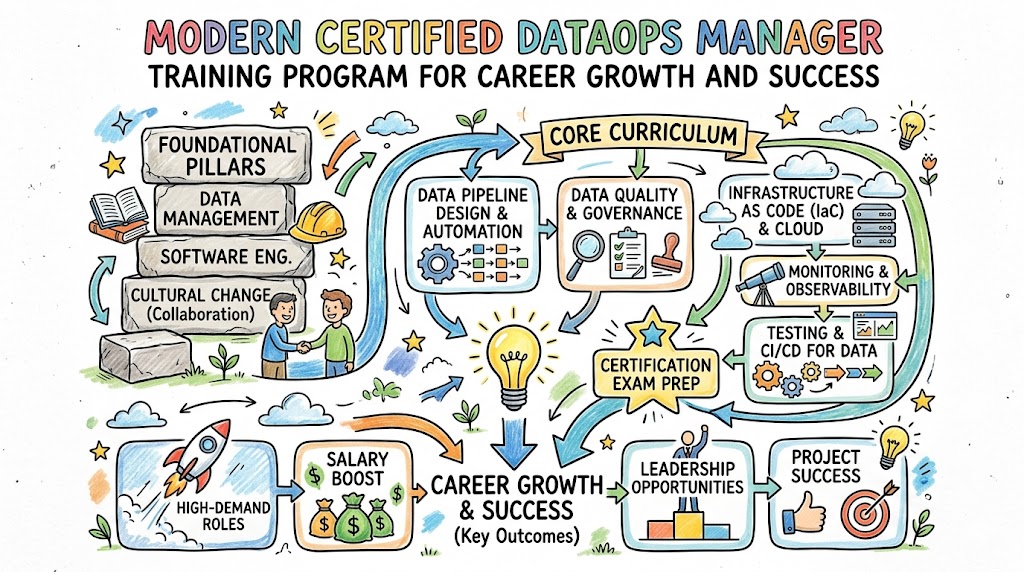
Introduction
The CDOM – Certified DataOps Manager certification is becoming an important learning path for professionals working with modern cloud platforms, enterprise automation, analytics pipelines, and operational data systems. Organizations today are handling large volumes of data across multiple environments, and they need engineers who understand how to manage these systems efficiently, reliably, and securely.This guide is written for DevOps professionals, cloud engineers, platform teams, automation specialists, managers, and data professionals who want practical clarity about DataOps careers and certifications. It helps readers understand where DataOps fits inside modern engineering environments and why operational data management has become a critical enterprise skill.DataOps also connects closely with cloud-native engineering, automation workflows, CI/CD pipelines, observability, governance, and scalable infrastructure operations. Professionals planning careers in DevOps, platform engineering, or becoming a Site Reliability Engineer can benefit greatly from understanding DataOps principles and operational practices.
What is the CDOM – Certified DataOps Manager?
CDOM – Certified DataOps Manager is a professional certification focused on operational data management, workflow automation, pipeline reliability, governance, observability, and scalable enterprise data operations. The certification is designed to validate practical understanding of how modern organizations manage operational data ecosystems.The certification exists because businesses today depend heavily on continuous data delivery for analytics, reporting, AI systems, cloud applications, and operational intelligence. Managing data manually is no longer practical in large enterprise environments where reliability, automation, and scalability are critical.Unlike purely academic certifications, CDOM focuses on production-oriented implementation knowledge. Professionals learn how to work with operational pipelines, monitoring systems, automation frameworks, orchestration platforms, and enterprise governance models used in real engineering environments.
Who Should Pursue CDOM – Certified DataOps Manager?
This certification is useful for professionals working in DevOps, cloud engineering, platform operations, analytics engineering, infrastructure automation, and enterprise data operations. It is especially valuable for engineers who manage operational workflows and enterprise-scale systems.Beginners entering the operational engineering field can use this certification to build a structured understanding of DataOps practices, automation workflows, monitoring systems, governance models, and scalable operational processes.Experienced professionals benefit because the certification helps strengthen real-world operational thinking. It improves understanding of orchestration, reliability engineering, pipeline automation, cloud-native workflows, and enterprise operational governance.
Why CDOM – Certified DataOps Manager is Valuable in Modern Engineering Careers
Enterprise organizations are investing heavily in operational automation, cloud-native platforms, analytics systems, and AI-driven workflows. These systems depend on reliable data operations, which is why DataOps professionals are increasingly in demand across industries.One of the biggest advantages of this certification is that it teaches operational principles instead of only focusing on specific tools. Technologies may change over time, but automation practices, governance models, monitoring systems, reliability engineering, and scalable workflows remain important long-term skills.Professionals with DataOps knowledge are valuable because they can improve operational efficiency, reduce deployment risks, strengthen governance controls, and support scalable enterprise data systems. This makes the certification relevant across multiple technical domains.
CDOM – Certified DataOps Manager Certification Overview
The CDOM certification program is delivered through DataOpsSchool and hosted on the DataOpsSchool platform. The learning structure focuses on practical operational engineering, automation workflows, governance implementation, and enterprise-ready DataOps practices.The certification includes multiple levels that help professionals move from foundational understanding toward advanced operational expertise. Candidates learn about workflow orchestration, pipeline reliability, monitoring systems, governance automation, observability, and cloud-native operational environments.The assessment process is designed around implementation-focused learning instead of theoretical memorization. Candidates are expected to understand how operational systems behave in real production environments where scalability, reliability, and collaboration are essential.
CDOM – Certified DataOps Manager Certification Tracks & Levels
Foundation-level certifications introduce candidates to operational data workflows, pipeline management, governance basics, cloud-native concepts, and automation fundamentals. These certifications are suitable for professionals beginning their DataOps journey.Professional-level certifications focus on enterprise implementations, orchestration systems, observability, operational reliability, governance workflows, and automation scalability. Candidates are expected to apply operational concepts in production-like environments.Advanced certifications emphasize architecture-level thinking, enterprise operational governance, strategic automation, operational leadership, and large-scale reliability engineering. These certifications are suitable for senior professionals and architects.
Complete CDOM – Certified DataOps Manager Certification Table
| Track | Level | Who it’s for | Prerequisites | Skills Covered | Recommended Order |
|---|---|---|---|---|---|
| DataOps Foundation | Beginner | Freshers and junior engineers | Basic scripting and cloud understanding | Pipeline basics, automation concepts, governance | Start Here |
| Certified DataOps Manager | Intermediate | DevOps and Data professionals | Automation and infrastructure familiarity | Monitoring, orchestration, reliability workflows | After Foundation |
| Advanced DataOps Engineering | Advanced | Senior engineers and architects | Production operations experience | Enterprise automation and observability | After Intermediate |
| Cloud Data Operations | Intermediate | Cloud engineers | Cloud fundamentals | Cloud-native operational workflows | Parallel Learning |
| Data Reliability Engineering | Advanced | SRE and platform teams | Monitoring and operational experience | Reliability and observability engineering | After CDOM |
| AI Data Operations | Intermediate | AI and analytics professionals | ML workflow familiarity | AI operational workflows and governance | Specialized Track |
Detailed Guide for Each CDOM – Certified DataOps Manager Certification
What it is
This certification validates the ability to manage operational data systems, automation workflows, enterprise pipeline reliability, governance controls, and scalable operational environments.The certification focuses on practical implementation knowledge used in modern enterprise engineering ecosystems.
Who should take it
The certification is ideal for DevOps Engineers, Platform Engineers, Cloud Engineers, Data Engineers, Analytics Engineers, and professionals managing operational workflows.It is also suitable for engineering managers who supervise automation, governance, and operational data delivery systems.
Skills you’ll gain
- Enterprise pipeline management
- Workflow orchestration
- Monitoring and observability
- Automation lifecycle management
- Governance and compliance awareness
- Cloud-native operational practices
- Reliability engineering fundamentals
- Operational troubleshooting approaches
Real-world projects you should be able to do
- Design automated operational pipelines
- Implement enterprise monitoring workflows
- Build governance automation systems
- Create scalable cloud-native workflows
- Improve reliability across operational environments
- Manage orchestration pipelines in distributed systems
Preparation plan
7–14 Days
Focus on DataOps terminology, automation basics, governance concepts, monitoring fundamentals, and operational workflows.
30 Days
Practice orchestration workflows, operational troubleshooting, observability systems, cloud automation, and CI/CD pipeline implementation.
60 Days
Build enterprise-style operational projects involving automation, governance, reliability workflows, monitoring systems, and production-grade orchestration environments.
Common mistakes
- Studying only theory without implementation practice
- Ignoring monitoring and reliability engineering
- Focusing only on tools instead of operational principles
- Avoiding real-world troubleshooting exercises
- Underestimating governance and collaboration workflows
Best next certification after this
Same-track option
Advanced DataOps Engineering
Cross-track option
Cloud Reliability Engineering
Leadership option
Engineering Management certifications
Choose Your Learning Path
DevOps Path
Professionals in DevOps roles benefit from DataOps because operational data systems are deeply connected with CI/CD workflows, automation pipelines, infrastructure orchestration, and deployment reliability.DataOps strengthens automation thinking and operational visibility. Engineers become better at managing distributed systems where infrastructure, data, and applications operate together.This path is highly useful for engineers responsible for cloud-native deployment environments and enterprise operational automation.
DevSecOps Path
DevSecOps professionals require strong governance and operational visibility because enterprise environments must maintain compliance, policy enforcement, and secure operational workflows.DataOps helps security-focused engineers improve governance automation, audit readiness, operational visibility, and pipeline security management across distributed systems.This learning path is valuable for organizations handling regulated enterprise data environments and operational compliance requirements.
SRE Path
SRE professionals benefit greatly from DataOps because operational reliability depends heavily on observability, monitoring systems, incident management, and scalable automation practices.DataOps strengthens operational troubleshooting, reliability engineering, governance workflows, and system visibility within enterprise operational ecosystems.This path is useful for professionals responsible for uptime, operational performance, and large-scale reliability management.
AIOps Path
AIOps professionals work with operational intelligence systems that require strong automation, monitoring, orchestration, and operational governance capabilities.DataOps knowledge improves operational consistency and helps teams manage AI-driven workflows more efficiently across enterprise environments.This path is suitable for professionals working with automated operational intelligence systems and scalable enterprise operations.
MLOps Path
MLOps professionals require operational workflow expertise because machine learning systems depend heavily on reliable pipelines, governance, orchestration, and operational monitoring.DataOps principles improve operational discipline across model lifecycle management, deployment reliability, and cloud-native ML environments.This path is highly useful for AI-focused teams building enterprise-grade machine learning operational platforms.
DataOps Path
The DataOps path focuses deeply on operational excellence, governance automation, workflow orchestration, pipeline reliability, observability, and scalable enterprise operations.Professionals following this path become specialists in operational data lifecycle management and enterprise workflow optimization.This learning route is ideal for engineers seeking operational leadership positions in cloud-native enterprise environments.
Role → Recommended CDOM – Certified DataOps Manager Certifications
| Role | Recommended Certifications |
|---|---|
| DevOps Engineer | DataOps Foundation, CDOM |
| SRE | CDOM, Data Reliability Engineering |
| Platform Engineer | Advanced DataOps Engineering |
| Cloud Engineer | Cloud Data Operations |
| Security Engineer | DevSecOps and Governance Certifications |
| Data Engineer | CDOM, Advanced DataOps Engineering |
| FinOps Practitioner | Cloud Data Operations |
| Engineering Manager | CDOM and Leadership Certifications |
Next Certifications to Take After CDOM – Certified DataOps Manager
Same Track Progression
Professionals who want deep operational specialization should continue learning advanced automation, enterprise governance, reliability engineering, orchestration, and large-scale operational architecture practices.This progression helps engineers become enterprise operational specialists capable of managing distributed and cloud-native operational ecosystems.
Cross-Track Expansion
Cross-track learning allows professionals to expand into cloud engineering, DevSecOps, SRE, MLOps, AIOps, and FinOps operational domains.Broad technical exposure helps professionals understand enterprise systems more holistically and improves architectural decision-making capabilities.
Leadership & Management Track
Leadership-focused professionals should strengthen skills related to operational governance, engineering management, platform strategy, automation leadership, and enterprise operational transformation.These skills help professionals transition from technical implementation roles into strategic engineering leadership positions.
Training & Certification Support Providers for CDOM – Certified DataOps Manager
DevOpsSchool
DevOpsSchool provides practical engineering training focused on automation, cloud-native operations, DevOps practices, monitoring systems, and operational workflows. The learning structure is designed for professionals who want implementation-oriented technical growth rather than only theoretical certification preparation. Engineers benefit from real-world project discussions, operational troubleshooting exposure, and structured mentoring approaches. The platform supports learning across multiple operational domains including cloud engineering, automation, orchestration, governance, and enterprise infrastructure practices. Professionals preparing for operational certifications often benefit from the practical and enterprise-focused learning style used within the training ecosystem.
Cotocus
Cotocus focuses on enterprise consulting, operational automation, cloud infrastructure management, and scalable engineering practices. The organization supports professionals interested in understanding how modern enterprise operational systems are implemented and maintained. The learning approach emphasizes practical execution, collaboration workflows, governance understanding, and automation maturity. Engineers gain exposure to enterprise operational thinking, scalability practices, and production-oriented implementation methodologies. Professionals preparing for operational certifications can benefit from the implementation-focused engineering culture and structured operational learning approach provided by the organization.
Scmgalaxy
Scmgalaxy provides technical learning support across automation systems, DevOps workflows, CI/CD pipelines, version control practices, and operational engineering environments. The platform helps engineers strengthen operational understanding through implementation-driven learning methodologies. Professionals can improve practical knowledge related to collaboration systems, deployment automation, workflow management, and enterprise engineering operations. The training structure is aligned with modern operational expectations where automation reliability and scalable workflows are important. Engineers preparing for DataOps and operational certifications benefit from practical workflow-oriented learning experiences.
BestDevOps
BestDevOps focuses on enterprise operational engineering, cloud-native automation, infrastructure workflows, scalability practices, and practical implementation learning. The platform supports professionals who want operational engineering exposure beyond theoretical certification preparation. Engineers can improve understanding of cloud operations, automation systems, orchestration workflows, governance practices, and enterprise operational reliability. The learning approach emphasizes hands-on exposure and operational maturity. Professionals preparing for DataOps certifications often benefit from the implementation-oriented methodology used across the training ecosystem.
Devsecopsschool
Devsecopsschool specializes in secure operational engineering, governance automation, compliance workflows, security integration, and enterprise operational protection practices. The platform helps professionals understand how security and operational engineering work together in modern enterprise environments. Engineers can strengthen operational governance awareness, compliance thinking, automation security understanding, and secure pipeline management skills. The training structure is highly relevant for professionals managing enterprise operational environments where governance and compliance are important operational requirements.
Sreschool
Sreschool focuses on operational reliability, monitoring systems, observability practices, incident management, and scalable reliability engineering methodologies. The platform supports engineers responsible for maintaining operational stability and enterprise system reliability. Professionals preparing for DataOps certifications benefit because operational reliability overlaps strongly with DataOps principles. The learning environment emphasizes troubleshooting, visibility, scalability, governance, and operational discipline. Engineers gain practical exposure to enterprise operational reliability practices used in modern distributed environments.
Aiopsschool
Aiopsschool specializes in operational intelligence, AI-driven automation, observability systems, machine learning operational workflows, and enterprise automation ecosystems. The platform helps professionals understand how AI technologies integrate into operational engineering practices. Engineers benefit from practical exposure to operational analytics, automation intelligence, monitoring systems, and scalable operational workflows. The learning structure aligns with modern enterprise operational requirements where intelligent automation and operational visibility are becoming increasingly important.
Dataopsschool
Dataopsschool focuses directly on enterprise DataOps engineering, workflow orchestration, automation systems, governance models, observability, and operational scalability practices. The platform is highly aligned with production-oriented operational learning. Engineers can improve practical understanding of pipeline management, governance automation, cloud-native workflows, operational troubleshooting, and scalable enterprise data operations. The learning methodology emphasizes implementation-focused engineering practices that prepare professionals for real operational environments instead of theory-only certification preparation.
Finopsschool
Finopsschool specializes in cloud financial operations, infrastructure optimization, governance visibility, operational budgeting, and enterprise cloud cost management practices. Operational engineers increasingly require financial awareness because enterprise cloud environments involve significant infrastructure and operational spending. The platform helps professionals understand governance controls, operational optimization, cost visibility, and cloud operational accountability. Engineers working in DataOps and cloud operational environments benefit from understanding financial operational management principles and optimization practices.
Frequently Asked Questions (General)
1. Is CDOM suitable for beginners?
Yes. Beginners with basic cloud and scripting understanding can gradually build operational DataOps knowledge through structured learning.
2. How much preparation time is normally required?
Preparation time depends on experience level. Most professionals require consistent practical learning and hands-on implementation practice.
3. Do I need deep coding experience?
No. Basic scripting and automation understanding are sufficient initially for most foundational operational workflows.
4. Is this certification focused on practical implementation?
Yes. The certification emphasizes operational workflows and enterprise implementation practices instead of theoretical memorization alone.
5. Is DataOps useful for DevOps Engineers?
Yes. Both domains overlap heavily in automation, monitoring, orchestration, reliability, and operational governance.
6. Does CDOM help cloud professionals?
Absolutely. Modern cloud environments rely heavily on scalable operational data workflows and automation systems.
7. Can managers benefit from this certification?
Yes. Managers gain better operational understanding related to governance, scalability, automation maturity, and workflow reliability.
8. Is DataOps important for AI and ML systems?
Yes. AI and ML environments depend on operationally reliable and scalable data workflows.
9. Does the certification include observability concepts?
Yes. Monitoring, observability, alerting, and operational visibility are important parts of DataOps engineering.
10. Can this certification improve long-term career growth?
Yes. Operational engineering expertise remains highly valuable across multiple enterprise technology domains.
11. Is cloud knowledge mandatory before starting?
Basic cloud familiarity helps, but professionals can learn cloud operational concepts gradually during preparation.
12. Is CDOM relevant globally?
Yes. Organizations worldwide are investing heavily in operational automation and scalable enterprise data systems.
FAQs on CDOM – Certified DataOps Manager
1. How is CDOM different from traditional Data Engineering certifications?
Traditional Data Engineering certifications often focus more on transformation pipelines and analytics systems. CDOM focuses strongly on operational reliability, governance workflows, orchestration systems, monitoring practices, automation maturity, and enterprise operational management.
2. Can infrastructure professionals transition into DataOps roles?
Yes. Infrastructure and cloud engineers already understand operational systems, automation workflows, and scalability practices, making the transition into DataOps much smoother.
3. Does CDOM include governance and compliance concepts?
Yes. Governance, audit readiness, operational visibility, access controls, and compliance awareness are important operational topics covered within DataOps practices.
4. Is DataOps useful for platform engineering teams?
Very useful. Platform teams often manage orchestration systems, automation pipelines, governance workflows, observability systems, and enterprise operational environments closely aligned with DataOps principles.
5. Can CDOM help professionals working with AI platforms?
Yes. AI platforms require scalable operational data workflows, monitoring systems, governance controls, and orchestration pipelines that align closely with DataOps practices.
6. Is hands-on implementation necessary for certification success?
Absolutely. Practical implementation experience is critical because operational engineering skills develop primarily through real-world workflow exposure and troubleshooting practice.
7. What is the biggest operational skill gained through CDOM?
One of the most valuable skills gained is the ability to manage scalable operational workflows reliably across distributed enterprise environments.
8. Can CDOM support leadership career growth?
Yes. Operational understanding helps professionals move toward architecture, governance, engineering management, and enterprise operational leadership positions.
Conclusion
CDOM – Certified DataOps Manager is a practical certification for professionals who want strong operational engineering capabilities in modern enterprise environments. The certification is valuable because it teaches operational thinking instead of only focusing on individual technologies or tools.Professionals who understand DataOps principles become more capable of handling enterprise-scale automation, governance, monitoring, orchestration, and reliability challenges. These operational skills are increasingly important as organizations continue expanding cloud-native and distributed operational systems.The certification becomes even more valuable when candidates combine structured learning with real implementation experience. Building automation workflows, troubleshooting operational pipelines, improving observability systems, and understanding enterprise governance practices create stronger long-term career outcomes.