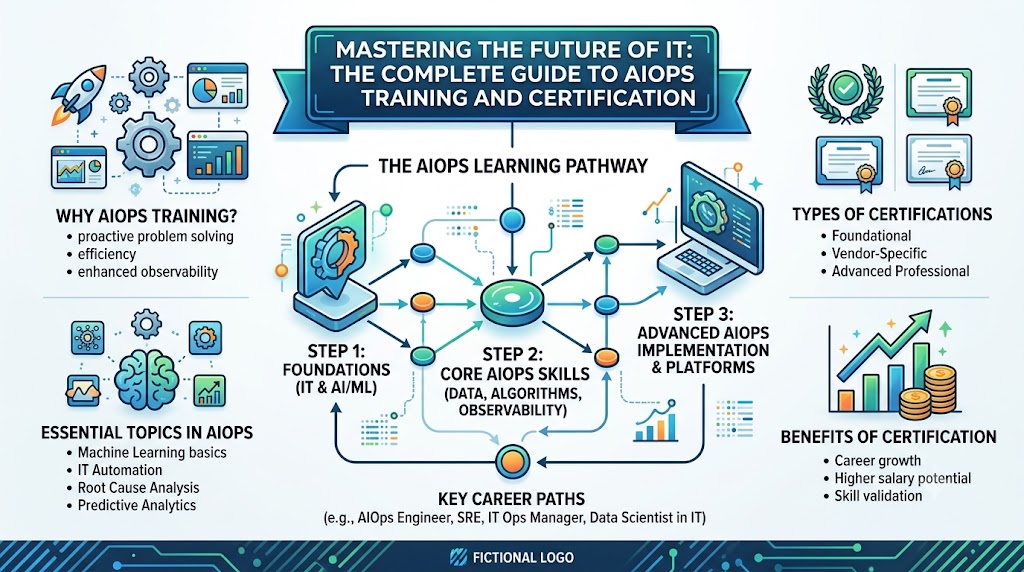
The digital landscape has transformed at a breakneck pace. Modern IT environments are no longer simple server rooms; they are sprawling, distributed ecosystems powered by hybrid clouds, ephemeral microservices, and complex container orchestrators. For technology professionals, this transition represents the next great career milestone. Learning how to navigate this domain requires more than just reading manuals; it demands structured, practical, and expert-led guidance. This is precisely why AIOpsSchool has emerged as the premier global destination for those seeking to master AI for IT Operations, observability, and modern automation.
What Is AIOps?
At its simplest, AIOps—or Artificial Intelligence for IT Operations—is the application of machine learning, data science, and big data analytics to automate and optimize IT operational workflows. It is not a single tool, but a discipline that bridges the gap between massive streams of IT telemetry and actionable, intelligent insights.Historically, IT operations relied on rule-based systems. If “X” happens, then “Y” must be the fix. In today’s dynamic environments, these static rules break constantly. AIOps evolved to replace these rigid frameworks with intelligent systems capable of learning from historical data, recognizing patterns, and predicting potential failures. Enterprises are adopting AIOps to reduce noise, accelerate root cause analysis (RCA), and ultimately ensure that their digital services remain resilient under any condition.
What Is AIOpsSchool?
AIOpsSchool is an industry-leading learning platform specifically designed to empower engineers, architects, and IT leaders with the skills needed to dominate the AIOps, SRE, and MLOps domains. Unlike generic training platforms, AIOpsSchool focuses exclusively on the intersection of AI and IT operations.
The platform provides a comprehensive learning ecosystem that includes:
- Structured Training Programs: Carefully curated paths that guide learners from fundamental concepts to advanced enterprise architecture.
- Certification Guidance: Specialized AIOps Foundation Certification paths that validate expertise and enhance professional credibility.
- Practical Implementation: A heavy emphasis on hands-on labs, real-world scenario analysis, and tool-agnostic operational strategies.
- Career Ecosystem: A focused approach to career development, preparing professionals for high-demand roles in an AI-first job market.
Why AIOps Is Important in Modern IT Operations
Modern infrastructure is notoriously difficult to manage manually. Consider the challenges:
- Cloud-Native Environments: Ephemeral containers appear and disappear in seconds, making static inventory tracking impossible.
- Microservices Complexity: A single user request may traverse dozens of services; identifying which one failed requires advanced tracing.
- Alert Fatigue: IT teams are often bombarded with thousands of false-positive alerts, drowning out the few that truly matter.
- Operational Efficiency: AIOps enables automated remediation, freeing up SREs and DevOps engineers to focus on building new features rather than maintaining the status quo.
Who Should Learn AIOps?
AIOps is a force multiplier for a wide range of roles:
- DevOps Engineers: Use AIOps to bring intelligence into CI/CD pipelines and production deployments.
- SRE Engineers: Leverage predictive analytics to maintain SLOs and streamline incident response.
- Cloud Engineers: Automate resource scaling and cost optimization using intelligent operational models.
- IT Operations Teams: Move away from manual monitoring to dynamic, automated event correlation.
- Monitoring Specialists: Evolve from traditional dashboards to observability-driven insights.
- Automation Engineers: Enhance scripts with self-healing capabilities guided by AI decision-making.
- Technology Leaders: Drive digital transformation and enterprise-grade operational excellence.
- Students and Beginners: Build a future-proof foundation in one of the most high-growth sectors of tech.
Key Features of AIOps Training Programs
AIOpsSchool provides a robust framework for mastery. Key program features include:
- Structured Learning Path: A logical progression from “what” to “how,” covering everything from basic monitoring to advanced AI models.
- Practical Labs: Sandbox environments where you can practice anomaly detection and event correlation.
- Enterprise Scenarios: Case studies based on actual, large-scale company challenges.
- Tool Demonstrations: Deep dives into how different classes of tools (observability, log analytics, etc.) integrate into an AIOps strategy.
- Incident Management Workflows: Training on how to replace war-room culture with automated incident intelligence.
AIOps Certification: Why It Matters
Earning an AIOps Foundation Certification is more than just a credential; it is a signal to employers that you possess the specialized knowledge to solve modern infrastructure challenges. It demonstrates that you can navigate the complex ecosystem of AI-driven tools, understand the underlying machine learning models, and apply them effectively to business problems. In a competitive job market, this professional credibility often serves as the deciding factor for high-level technical roles.
AIOps Course Curriculum Components
The curriculum is designed to be comprehensive and modular:
- Introduction to AIOps: Foundations of intelligent operations.
- Machine Learning Basics: Understanding how models interpret IT data.
- Event Correlation: Sorting through signal-to-noise.
- Anomaly Detection: Setting behavioral baselines.
- Root Cause Analysis: Moving from guess-work to precision diagnostics.
- Automation & Remediation: Building self-healing systems.
- Observability & Telemetry: Making data visible and meaningful.
- Predictive Analytics: Forecasting performance trends.
AIOps Tools and Technologies
| Tool Category | Purpose | Benefits | Typical Use Cases |
| Monitoring Tools | Real-time tracking | Instant awareness | Server uptime, CPU usage |
| Observability Platforms | Deep visibility | End-to-end tracing | Microservices debugging |
| Log Analytics | Pattern recognition | Identifying anomalies | Security & performance audits |
| Event Management | Alert correlation | Reduces alert fatigue | Centralizing incident data |
| Automation Solutions | Remediation | Faster resolution | Auto-scaling, patching |
| AI/ML Components | Intelligent analysis | Predictive forecasting | Capacity planning |
AIOps Use Cases in Real Enterprises
AIOps isn’t theoretical; it’s an operational imperative. Real-world applications include:
- Noise Reduction: Automatically grouping 500 alerts into one incident ticket.
- Root Cause Analysis: Instantly identifying that a failed database connection is the cause of a frontend latency issue.
- Predictive Maintenance: Noticing disk performance patterns that suggest failure 24 hours before it happens.
- Automated Remediation: Automatically restarting a crashed microservice without manual intervention.
AIOps for SRE Teams
For Site Reliability Engineers (SREs), AIOps is a game-changer. By automating the “toil” of incident response, SRE teams can focus on improving service reliability rather than constantly resetting services. AIOps allows SREs to set smarter SLOs (Service Level Objectives) and receive alerts only when user impact is imminent.
AIOps vs DevOps: Comparison
| Area | DevOps | AIOps | Business Impact |
| Scope | Development + Operations | Intelligent Operations | Efficiency & Reliability |
| Core focus | Speed & Collaboration | Automation & Analytics | Faster time-to-market + Less downtime |
| Approach | Process-oriented | Data-driven | Improved ROI |
AIOps vs MLOps: Comparison
| Area | AIOps | MLOps | Primary Goal |
| Focus | IT Infrastructure | ML Model Lifecycle | Ensuring uptime vs. Model accuracy |
| Entities | Logs, Metrics, Traces | Data, Models, Pipelines | Stability vs. Model Performance |
How Anomaly Detection Works in AIOps
Anomaly detection moves away from manual “greater-than” thresholds. Instead, it uses machine learning to create a Behavioral Baseline. The system “learns” the normal cyclical nature of your traffic (e.g., higher traffic at 10 AM, lower at 3 AM). When the system observes data that falls outside the learned pattern—even if the numbers remain technically within a safe range—it detects an anomaly and triggers an alert. This allows for the identification of issues long before they hit traditional threshold limits.
Root Cause Analysis in AIOps
Traditional RCA is plagued by human bias and incomplete data. AIOps solves this via:
- Dependency Mapping: Automatically discovering service links.
- Automated RCA: Using graph analysis to determine where a fault originated versus where it is merely symptomatic.
- Faster Resolution: Providing developers with a clear “point of origin,” reducing time spent in war rooms.
Observability and AIOps
Observability provides the data that AIOps needs to be effective. While monitoring asks “Is the system up?”, observability asks “Why is the system behaving this way?”. By feeding high-fidelity metrics, logs, and traces into AIOps engines, organizations gain total visibility into the operational state of their entire stack.
Real-World Learning Scenarios
- DevOps Adoption: A team integrates AIOps into their Jenkins pipeline to auto-roll back builds if the anomaly detection system flags unusual error rates post-deployment.
- Enterprise Automation: A global retail firm uses AIOps to predict capacity needs for Black Friday, scaling infrastructure automatically based on predictive forecasting.
Career Opportunities After Learning AIOps
Professionals with AIOps skills are in high demand. Roles include:
- AIOps Engineer: Developing and maintaining intelligent monitoring systems.
- SRE Engineer: Architecting resilient, self-healing platforms.
- Platform Engineer: Building scalable infrastructure with built-in AI/ML intelligence.
- Technical Consultant: Helping enterprises navigate their transition to AI-driven operations.
Common Mistakes Beginners Make
- Ignoring Fundamentals: Trying to build AI models without understanding basic monitoring.
- Tooling Obsession: Focusing on “which tool” instead of “which operational problem am I solving?”
- Skipping Observability: Expecting AI to work miracles on low-quality data.
- Neglecting Workflow: Failing to build the processes that interpret the AI’s findings.
Tips for Successfully Learning AIOps
- Start with the Fundamentals: Ensure you understand traditional monitoring.
- Master Observability: You cannot optimize what you cannot see.
- Practice Automation: Learn how to translate an “alert” into a “script.”
- Follow Structured Paths: Use the curriculum provided by AIOpsSchool to avoid information overload.
- Think Proactively: Constantly ask: “How could this incident have been prevented?”
AIOps Training Features Comparison
| Feature | Purpose | Learning Benefit | Career Value |
| Structured Path | Organization | Clarity | Efficient growth |
| Practical Labs | Experience | Skill retention | Demonstrable capability |
| Industry Cases | Context | Real-world readiness | Higher interview success |
Future of AIOps
The future is Autonomous Operations. We are evolving toward self-healing infrastructure where AI doesn’t just suggest a fix; it identifies, executes, and validates the resolution. Enterprises that adopt these practices today are positioning themselves to dominate in the coming decade of machine-assisted IT.
Frequently Asked Questions (FAQs)
- What is AIOps Training?
It is structured education focused on using AI to manage IT infrastructure. - Why is AIOps Certification important?
It validates your technical expertise in a rapidly growing niche. - Is AIOps only for large enterprises?
No, it scales from small startups to global corporations. - What tools should I learn?
Focus on platforms that offer observability and log analytics. - How do I get started with AIOps?
Enroll in a certified program at AIOpsSchool. - Does AIOps replace humans?
No, it removes repetitive work, allowing humans to focus on strategy. - What is the difference between AIOps and DevOps?
DevOps focuses on flow; AIOps focuses on operational intelligence. - Can beginners learn AIOps?
Yes, with the right structured path, anyone can start. - What is the best way to learn AIOps?
Combining theory with hands-on lab practice. - How long is an AIOps course?
It varies, but foundational mastery is achievable in weeks. - What is anomaly detection?
Using ML to find unusual patterns in IT data. - How does AIOps improve RCA?
By correlating events to find the source. - Is observability part of AIOps?
Yes, it is the data foundation for AIOps. - What is the demand for AIOps engineers?
Extremely high due to cloud-native complexity. - Does AIOps help with security?
Yes, by detecting anomalous access or performance patterns.
Featured Snippet Opportunities
- What is AIOps? AIOps (Artificial Intelligence for IT Operations) combines big data and machine learning to automate IT operations, improve incident resolution, and increase system reliability.
- What is AIOps Training? A structured learning process covering the use of AI/ML tools to manage, monitor, and automate IT infrastructure performance.
- Why is AIOps important? It reduces alert fatigue, speeds up incident resolution, and manages the complexity of cloud-native environments at scale.
Final Recommendation
The transition to AI-driven IT operations is not a matter of “if” but “when.” The professionals who thrive in this new environment will be those who invest in structured, practical training today. Whether you are an SRE, a DevOps engineer, or a technical leader, mastering AIOps will empower you to build, maintain, and scale systems with unprecedented efficiency.Don’t let the complexity of modern IT slow your career growth. Leverage the expert-led curriculum and certification programs at AIOpsSchool to gain the skills that organizations are desperate to hire. The future of IT is autonomous, intelligent, and proactive—start your training now and lead the transformation.