Introduction
Heart disease remains one of the most significant health challenges worldwide, yet many cardiac emergencies can have better outcomes if identified early. Recognizing the warning signs of a heart attack is not just medical knowledge—it is a life-saving skill. Far too often, individuals delay seeking help because they assume their discomfort is caused by something minor, like indigestion or muscle strain.Time is the most critical factor during a cardiac event. Every minute counts when the heart muscle is deprived of oxygen. By learning to identify the classic and subtle symptoms of a heart attack, you can take immediate action that might save a life. This guide is designed to empower you with the knowledge to distinguish between common discomforts and true emergencies. For further trusted information on cardiovascular wellness and preventive steps, visit AskDoctorLive.
Understanding a Heart Attack
A heart attack, or myocardial infarction, occurs when the flow of blood to the heart muscle is severely reduced or blocked. This is usually caused by the buildup of plaque in the coronary arteries. When a plaque rupture occurs, a blood clot forms, cutting off the oxygen supply to a portion of the heart. If this flow is not restored quickly, that section of the heart muscle begins to suffer damage.
It is important to distinguish a heart attack from sudden cardiac arrest. While a heart attack is a “plumbing” problem where blood flow is blocked, cardiac arrest is an “electrical” problem where the heart suddenly stops beating. Both are emergencies, but they require different immediate responses.
HEART ATTACK OVERVIEW TABLE
| Aspect | Description |
| Medical Condition | Myocardial Infarction (Heart Attack) |
| Main Cause | Blocked coronary artery (usually by plaque/clot) |
| Common Symptoms | Chest pressure, pain, shortness of breath, nausea |
| Emergency Level | Critical – Immediate medical attention required |
| Immediate Action | Call emergency services (911 or local emergency number) |
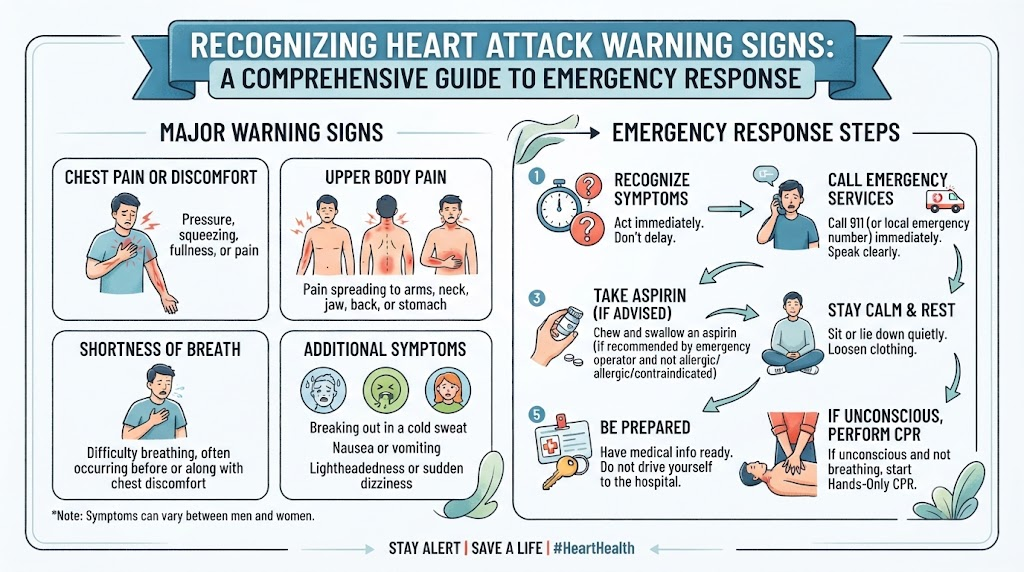
Early Warning Signs of a Heart Attack
Symptoms can appear suddenly or develop slowly over hours, days, or even weeks. Not every heart attack involves the dramatic, crushing chest pain often portrayed in movies.
Chest Pain or Pressure
The most common symptom is discomfort in the center or left side of the chest that lasts more than a few minutes or goes away and comes back.
Tightness or Squeezing Sensation
Many describe this as an uncomfortable pressure, squeezing, fullness, or “an elephant sitting on the chest.”
Pain Spreading to Arm, Shoulder, Neck, Jaw, or Back
Discomfort can radiate away from the chest. It may feel like a dull ache or sharp pain in one or both arms, the neck, or the jaw.
Shortness of Breath
You may feel winded or unable to catch your breath, even while resting.
Cold Sweats
Breaking into a cold, clammy sweat for no apparent reason is a classic, often ignored warning sign.
Nausea or Vomiting
Some people experience stomach discomfort that mimics indigestion or the flu.
Dizziness or Lightheadedness
A sudden feeling of unsteadiness or fainting can indicate the heart is struggling to pump effectively.
Unusual Fatigue
Feeling exhausted or “wiped out” for days or weeks before an event is a common, subtle indicator.
Anxiety or Feeling That Something Is Wrong
An overwhelming sense of impending doom is reported by many patients.
HEART ATTACK WARNING SIGNS TABLE
| Symptom | Description | Seek Emergency Care? |
| Chest Pain | Pressure, squeezing, or fullness | Yes, immediately |
| Shortness of Breath | Difficulty breathing at rest/exertion | Yes, immediately |
| Jaw Pain | Aching in jaw or teeth | Yes, immediately |
| Arm Pain | Pain or numbness in arms | Yes, immediately |
| Cold Sweats | Clammy skin without activity | Yes, immediately |
| Nausea | Stomach upset or vomiting | Yes, immediately |
| Fatigue | Sudden, severe exhaustion | Yes, immediately |
| Dizziness | Lightheadedness or vertigo | Yes, immediately |
Symptoms That May Differ in Women
Women are somewhat more likely than men to experience “atypical” symptoms. They may not always report intense chest pain. Instead, they might notice:
- Unusual fatigue that makes daily tasks impossible.
- Pain in the upper back or between the shoulder blades.
- Sharp, stabbing pain in the jaw or neck.
- Sudden shortness of breath without physical exertion.
- Nausea or lightheadedness that feels like a stomach issue.
Symptoms in Older Adults and People with Diabetes
Older adults and those with diabetes may experience “silent” heart attacks. Due to nerve damage from diabetes or age-related changes, they might feel very little pain. They may only experience sudden weakness, confusion, or a vague feeling that something is wrong. Any persistent, unexplained change in physical state should be evaluated by a medical professional.
Risk Factors for Heart Attack
Understanding your personal risk profile is a major step in prevention.
HEART ATTACK RISK FACTORS TABLE
| Risk Factor | Why It Increases Risk | Modifiable? |
| High Blood Pressure | Damages artery walls over time | Yes |
| Smoking | Constricts vessels, damages lining | Yes |
| Diabetes | High blood sugar damages vessels | Yes |
| High Cholesterol | Causes plaque buildup | Yes |
| Obesity | Increases strain on heart/metabolism | Yes |
| Stress | Triggers inflammatory hormones | Yes |
What to Do During a Suspected Heart Attack
If you or someone else experiences symptoms:
- Call Emergency Services: Do not wait to see if the pain goes away.
- Stay Calm: Panic increases the workload on your heart.
- Rest: Sit or lie down in a comfortable position.
- Avoid Driving: Let professionals handle transport.
- Follow Directions: The emergency dispatcher will give you vital instructions.
EMERGENCY RESPONSE TABLE
| Situation | Recommended Action |
| Chest Pain | Call emergency services immediately |
| Difficulty Breathing | Remain upright and call for help |
| Collapse | Call emergency services and begin CPR if trained |
| Waiting for Ambulance | Keep calm, loosen tight clothing |
| Unconscious Person | Call emergency services and start chest compressions |
How Doctors Diagnose a Heart Attack
Doctors use several tools to evaluate heart health in an emergency:
- ECG (Electrocardiogram): Records electrical activity of the heart.
- Blood Tests: Check for cardiac biomarkers (proteins released when heart muscle is damaged).
- Echocardiogram: Uses ultrasound to visualize heart movement.
- Angiography: Uses dye and X-rays to locate blockages in arteries.
- Cardiac CT: Provides detailed imaging of the heart structure.
DIAGNOSTIC TESTS TABLE
| Test | Purpose | Detects |
| ECG | Immediate rhythm assessment | Heart rhythm & electrical damage |
| Blood Tests | Enzyme measurement | Cardiac tissue injury |
| Echocardiogram | Structural imaging | Pump function/valve issues |
| Angiography | Visualizing arteries | Specific blockages/vessel health |
| Cardiac CT | Advanced imaging | Calcium deposits/plaque buildup |
How to Reduce Heart Attack Risk
Adopting a heart-healthy lifestyle is a continuous commitment.
HEART-HEALTH HABITS TABLE
| Healthy Habit | Benefit |
| Balanced Diet | Reduces plaque-building fats & sodium |
| Exercise | Strengthens heart muscle |
| No Smoking | Improves blood flow & oxygenation |
| BP Control | Prevents arterial damage |
| Stress Management | Reduces cardiac strain |
Future of Heart Attack Detection
Technology is making it easier to monitor heart health. AI can now analyze ECGs faster than ever, and wearable devices (like smartwatches) provide real-time heart rate monitoring, helping users identify concerning trends before they become emergencies.
FUTURE OF HEART CARE TABLE
| Innovation | Potential Benefit |
| AI ECG Analysis | Faster, more accurate detection |
| Wearable Devices | Real-time alerts for arrhythmias |
| Remote Monitoring | Continuous data for high-risk patients |
| Smart Health Apps | Improved lifestyle and medication adherence |
| Predictive Analytics | Identifying risk before symptoms appear |
FAQs
- What are the first warning signs?
Usually pressure or pain in the center of the chest. - Can it start slowly?
Yes, it can begin as mild discomfort that gradually worsens. - Are symptoms different in women?
Yes, women often report fatigue, back pain, or nausea. - Can indigestion mimic it?
Yes, this is a common reason people delay calling for help. - What if pain lasts only a few minutes?
It is still an emergency; do not wait. - Can young adults have heart attacks?
Yes, though risk increases with age. - What are silent heart attacks?
Events with little or no typical symptoms. - How can I reduce risk?
Manage BP, cholesterol, and maintain a healthy weight. - Should I call 911 immediately?
Yes, never drive yourself. - When should I see a doctor after mild symptoms?
Immediately. - Do I need to take aspirin?
Only if instructed by emergency dispatch. - Are panic attacks similar?
They can be, but you must treat chest pain as a heart attack until proven otherwise. - Is family history a factor?
Yes, it is a significant risk factor. - How long does a heart attack last?
It varies; the longer the blockage, the more damage. - Does stress cause heart attacks?
Chronic stress contributes to high blood pressure and other risks.
Final Thoughts
Recognizing the warning signs of a heart attack is the most important step in surviving one. Never be embarrassed to seek help for symptoms that feel “wrong.” It is always better to be evaluated and sent home than to wait and face a life-threatening crisis. By staying informed, managing your health markers, and knowing your emergency plan, you are taking active control of your future.For more reliable information on heart health, prevention strategies, and expert medical education, visit AskDoctorLive to continue your journey toward a healthier, more informed life.