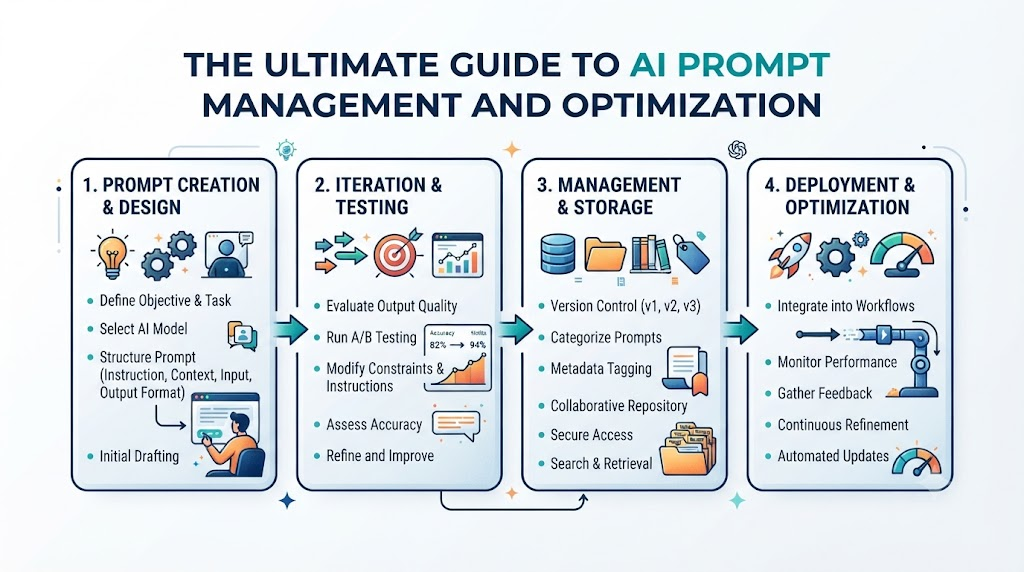
As artificial intelligence becomes deeply integrated into everyday business operations, creative workflows, and software development, the difference between mediocre results and exceptional output comes down to one critical skill: AI prompt management. Today, millions of users query models like ChatGPT, Claude, and Gemini daily. However, relying on ad-hoc prompts stored in scattered notes documents, chat histories, or mental notes creates severe operational bottlenecks. You will learn the core tenets of prompt engineering, how to build reusable prompt libraries, methods for optimizing and testing instruction sets, and how dedicated platforms like Promptosia empower individuals and teams to treat their prompts as valuable, high-yielding digital assets.
WHAT IS AN AI PROMPT MANAGEMENT TOOL?
Definition
An AI prompt management tool is a dedicated software platform designed to create, organize, test, optimize, version, and store artificial intelligence prompts in a centralized repository. Rather than viewing prompts as temporary search queries, a prompt management platform treats them as reusable code-like assets that can be organized with variables, metadata, and execution histories.
       [ Prompt Engineering Framework ]
                      │
  ┌───────────────────┼───────────────────┐
  ▼                   ▼                   ▼
Context          Instructions         Variables
  │                   │                   │
  └───────────────────┼───────────────────┘
                      ▼
            [ Promptosia Platform ]
                      │
  ┌───────────────────┼───────────────────┐
  ▼                   ▼                   ▼
Optimize            Version            Deploy
Why Prompt Management Matters
In modern generative AI workflows, consistency is key. A single altered word in a complex prompt can shift a model’s output from a brilliant strategic analysis to a generic summary. Systematic prompt management ensures that when you or your team discover an instruction set that yields ideal results, that asset is permanently captured, standardized, and made instantly accessible across your entire enterprise.
Common Prompt Challenges
- Prompt Loss: High-performing prompts get buried in endless AI chat logs.
- Inconsistent Quality: Team members use varying instruction quality, leading to unpredictable business outcomes.
- Lack of Versioning: Modifying an existing prompt often accidentally destroys its original, successful dynamic.
- Siloed Knowledge: Individual power-users craft incredible prompts, but colleagues are unable to discover or leverage them.
Benefits of Organized Prompt Libraries
By building a centralized AI prompt library, organizations achieve higher operational efficiency. Stored prompts eliminate redundant drafting, reduce token usage costs, ensure brand voice compliance, and allow rapid onboarding of new team members into AI-augmented workflows.
UNDERSTANDING PROMPT ENGINEERING
What Prompt Engineering Is
Prompt engineering is the strategic practice of structuring, refining, and designing text inputs to guide generative AI models toward producing precise, high-quality, and contextually accurate outputs. It combines technical logic, domain expertise, and natural language communication.
Prompt Components
Effective prompts rely on structured architecture rather than vague requests. According to research documentation from leading research labs like OpenAI Documentation and Anthropic Documentation, well-engineered prompts generally contain five key structural elements:
+-----------------------------------------------------------------------+
|                         STRUCTURE OF A PROMPT                         |
+-----------------------------------------------------------------------+
| 1. Role / Persona   :: Defines the AI's professional identity.        |
| 2. Context          :: Provides background information and constraints.|
| 3. Instructions     :: Specific action steps to be performed.         |
| 4. Variables        :: Dynamic parameters replaced during execution.  |
| 5. Output Formatting:: Expected output format (JSON, Markdown, etc.). |
+-----------------------------------------------------------------------+
- Role / Persona: Defines who the AI should act as (e.g., “Act as a Senior Cyber Security Auditor”).
- Context: Background information, target audience details, or reference documentation required to formulate a accurate answer.
- Instructions: Precise, step-by-step commands outlining what the AI must do and what it must strictly avoid.
- Variables: Dynamic placeholders (e.g.,
{{product_name}}or{{target_audience}}) that permit a single prompt template to scale across infinite use cases. - Output Formatting: Explicit constraints on response structure, such as JSON schemas, markdown headers, bulleted lists, or word count ceilings.
For developer-focused guidelines on constructing system instructions, consult Google AI Documentation.
Example: Basic vs. Engineered Prompt
- Basic Prompt:“Write an email selling software to a manager.”
- Engineered Prompt:“Act as an Enterprise SaaS Sales Specialist. Write a cold outreach email to a
{{job_title}}in the{{industry}}sector. The goal is to schedule a 15-minute demo for our data security platform. Highlight pain points related to{{pain_point}}. Keep the tone professional yet approachable, under 150 words, and end with a direct call to action.”
When executed inside a dedicated prompt engineering platform, this structured model dramatically improves response accuracy.
BUILDING AN ORGANIZED AI PROMPT LIBRARY
As your enterprise builds hundreds of custom prompts, flat lists and document files quickly fall apart. A robust platform uses a deliberate structure to maintain asset visibility.
                  [ Central Prompt Repository ]
                                │
        ┌───────────────────────┴───────────────────────┐
        ▼                                               ▼
[ Category: Marketing ]                        [ Category: Engineering ]
   ├── Tag: Email                                  ├── Tag: Python
   ├── Tag: Copywriting                            ├── Tag: Code-Review
   └── Collection: Q3 Campaign                     └── Collection: Security-Audits
- Categories: High-level domains (e.g., Engineering, Marketing, Legal, HR) that segregate prompts by business functional area.
- Tags: Flexible, searchable descriptors (e.g.,
#cold-email,#python-refactor,#json-output) for cross-categorical discovery. - Variables: Dynamic inputs that turn static text strings into versatile, repeatable prompt applications.
- Search: Advanced filtering capabilities, allowing users to query prompts by performance metrics, execution type, or author.
- Prompt Collections: Groupings of curated prompts designed to execute multi-step AI workflows sequentially.
- Prompt Reusability: Designing inputs with adaptable structures so team members can repurpose a single prompt across multiple campaigns or technical tasks.
Using an intuitive AI prompt organizer streamlines team workflows by cutting down on search time, letting teams spend their energy on execution instead of organization.
AI PROMPT OPTIMIZATION
Prompt optimization is the process of iteratively polishing raw instructions to eliminate vagueness, enforce strict guardrails, and maximize the signal-to-noise ratio in model responses.
Optimization Principles
[ Raw Prompt ] ──► ( Clarify Goals ) ──► ( Add Guardrails ) ──► [ Optimized Prompt ]
- Improving Prompt Clarity: Replace ambiguous verbs like “write a good report” with definitive instructions like “generate a 3-paragraph executive summary detailing key financial metrics.”
- Better Instructions: Frame directives positively by explicitly telling the model what to do, paired with strict guardrails on what to avoid.
- Output Consistency: Define precise boundaries, formatting rules, and structural examples (few-shot prompting) to ensure uniform output every time.
- Role Definition: Assigning a specific expert persona grounds the model’s latent knowledge base into the appropriate tone, vocabulary, and analytical perspective.
- Context Enhancement: Provide pertinent background data or style guides to ground the AI’s generation process.
- Reducing Ambiguity: Prune unnecessary fluff words, vague adjectives, and conflicting rules that confuse language models.
By leveraging an integrated AI prompt optimizer, users can automatically detect logical gaps, expand simple prompts into comprehensive instruction sets, and elevate generation quality instantly.
AI PROMPT ANALYSIS
Evaluating why a prompt succeeds or fails requires systemic diagnostic analysis. Rather than guessing why an output hallucinated, modern prompt engineering platforms break down prompt syntax into measurable vectors.
           ┌──────────────────────────────────────────────┐
           │              PROMPT ANALYSIS SCORES          │
           ├──────────────────────────────────────────────┤
           │ Clarity      : [██████████████████░░]  88%   │
           │ Context      : [██████████████░░░░░░]  70%   │
           │ Structure    : [████████████████████] 100%   │
           │ Safety/Guard : [████████████████░░░░]  80%   │
           └──────────────────────────────────────────────┘
An advanced AI prompt analyzer checks for:
- Prompt Structure: Verification of logical order, persona assignment, and clear demarcation of inputs versus commands.
- Goal Identification: Determining if the prompt clearly states its core intent.
- Variable Detection: Identifying unbound parameters or missing system variables.
- Output Expectations: Ensuring formatting schemas (JSON, tables, lists) are clear.
- Safety Considerations: Screening for potential jailbreak triggers, security leaks, or policy violations.
- Prompt Quality Evaluation: Assigning quantitative scores to help engineers evaluate an asset before pushing it to production workflows.
PROMPT QUALITY CHECKING
Quality control is the bridge between amateur experimentation and enterprise-grade deployment. A reliable prompt quality checker uses multi-point evaluation frameworks to validate prompts against key criteria:
+------------------+---------------------------------------------------------+
| EVALUATION CRITERIA | DESCRIPTION                                            |
+------------------+---------------------------------------------------------+
| Clarity          | Are commands explicit, readable, and free of jargon?   |
| Context          | Is sufficient background data supplied for accuracy?    |
| Structure        | Are instructions ordered logically with visual breaks? |
| Reusability      | Are dynamic variables leveraged for maximum utility?   |
| Safety           | Are guardrails established against unintended outputs?  |
| Practical Value  | Does the prompt yield useful, production-ready outputs? |
+------------------+---------------------------------------------------------+
Automated scoring systems quantify these metrics, providing actionable advice on how to improve weak instructions before deploying them across large teams.
VERSION CONTROL FOR AI PROMPTS
Prompts evolve over time. As base LLMs undergo fine-tuning or version updates, existing prompts may require recalibration. Without dedicated version control, tracking changes across teams quickly becomes chaotic.
Using a specialized prompt version control tool offers critical advantages:
- Why Version History Matters: Prevents permanent overwrites and keeps a clear record of modifications over time.
- Prompt Evolution: Allows users to trace how a prompt changed from a basic draft into an enterprise-ready instruction set.
- Team Collaboration: Enables multiple contributors to iterate on prompt code without overriding core workflows.
- Tracking Improvements: Measures performance variations between original versions and revised iterations.
- Managing Experiments: Allows quick rollbacks to stable previous versions if new changes trigger unexpected model hallucinations.
TESTING AI PROMPTS
You cannot improve what you do not measure. Testing prompts across multiple AI models (such as GPT-4o, Claude 3.5 Sonnet, and Gemini 1.5 Pro) ensures that your instructions remain effective regardless of the underlying foundation model.
                        ┌──► Model A (GPT-4o)   ──► Output A ──┐
                        │                                      │
[ Master Test Prompt ] ─┼──► Model B (Claude 3.5)─► Output B ──┼──► [ Evaluation Matrix ]
                        │                                      │
                        └──► Model C (Gemini 1.5)─► Output C ──┘
By using an integrated AI prompt testing tool, users can execute:
- Comparing Outputs: Run identical prompts across different model providers side-by-side to determine which LLM delivers the highest accuracy for a given task.
- Measuring Consistency: Test a single prompt multiple times across variable temperatures to verify stability.
- A/B Prompt Testing: Run subtle variations of an instruction set in parallel to pinpoint which phrasing yields superior outcomes.
- Prompt Experiments: Test novel structural methods against established baseline prompts in controlled test suites.
- Community Evaluation: Gather feedback from peers to rate prompt performance, using interactive benchmark tools like Prompt Duels.
REUSABLE AI PROMPT TEMPLATES
Structuring prompts into dynamic, reusable templates allows organizations to streamline repetitive tasks across key operational areas:
+--------------------+--------------------------------------------------------------------------------------+
| DEPARTMENT         | TEMPLATE APPLICATION                                                                 |
+--------------------+--------------------------------------------------------------------------------------+
| Writing            | Outlines, long-form SEO articles, style editing, content summaries.                 |
| Coding             | Refactoring, unit test creation, docstring generation, bug diagnosis.                |
| Marketing          | Copywriting, ad variation testing, email sequences, social media repurposing.        |
| Customer Support   | Triage protocols, response drafting, sentiment analysis, escalation summaries.       |
| Research           | Literature summaries, data extraction, methodology cross-examinations.               |
| Education          | Curriculum planning, automated quiz generation, personalized learning roadmaps.      |
| Business Strategy  | Competitive matrix generation, SWOT analyses, executive brief summaries.             |
| Productivity       | Meeting transcripts to action items, task prioritizations, daily plan summaries.     |
+--------------------+--------------------------------------------------------------------------------------+
Storing these curated assets in a accessible repository of reusable AI prompt templates turns institutional knowledge into scalable, automated workflows.
PROMPTOSIA FOR DIFFERENT USER TYPES
Different professions require distinct prompt architectures. Promptosia serves as an adaptable ecosystem tailored to diverse user roles:
Writers
Draft blog posts, outline novels, refine prose style, and eliminate writer’s block using stored, highly tuned creative prompts that maintain a consistent voice.
Developers
Store complex system prompts, automate code reviews, generate unit tests, convert code across languages, and build contextual documentation fast.
Marketers
Streamline multi-channel campaign creation, optimize sales copy for target demographics, generate meta tags, and adapt brand messaging seamlessly.
Students
Create custom study tutors, transform dense lecture notes into flashcards, summarize academic papers, and build study guides tailored to individual learning styles.
Researchers
Synthesize vast datasets, standardize qualitative coding schemas, extract key literature findings, and structure citations with minimal friction.
Educators
Draft lesson plans, create differentiated learning assignments, design rubric frameworks, and automate administrative communication.
Businesses
Enforce enterprise-wide AI compliance, maintain brand tone across teams, streamline operational templates, and cut onboarding times for new hires.
Content Creators
Generate video scripts, write engaging social media captions, summarize podcast episodes, and turn core content into multi-platform campaigns.
Agencies
Maintain client-specific prompt libraries, deliver uniform AI deliverables across creative teams, and speed up turnaround times for client projects.
AI Professionals
Benchmark prompt performance across foundational models, run detailed optimization tests, version system prompts, and manage enterprise AI assets securely.
BEST PRACTICES FOR PROMPT MANAGEMENT
To maximize your return on generative AI investments, implement these core operational habits:
[ Capture ] ──► [ Categorize ] ──► [ Parameterize ] ──► [ Test & Iterate ] ──► [ Version ]
- Save Successful Prompts: The moment a prompt delivers exceptional results, save it to your prompt library immediately.
- Organize by Category: Use intuitive categories and clear tags so your team can quickly find stored prompts.
- Use Descriptive Titles: Replace generic names like “Email Prompt” with clear, functional titles like “B2B SaaS Cold Outreach Email – Enterprise Scale”.
- Add Variables: Convert static strings into dynamic frameworks by adding parameters like
{{target_audience}}or{{key_benefits}}. - Test Regularly: Re-benchmark critical prompts whenever provider models update to catch unexpected changes in output quality.
- Maintain Version History: Keep clear change logs so you can track performance improvements and revert to stable versions when needed.
- Improve Continuously: Refine existing prompts as new techniques (like chain-of-thought or few-shot prompting) emerge.
- Document Successful Workflows: Attach clear usage notes and real-world execution examples to your saved prompts so team members know how to use them effectively.
COMMON PROMPT ENGINEERING MISTAKES
Avoid these frequent pitfalls to keep your generative AI assets reliable and accurate:
- Vague Instructions: Asking an LLM to “make this better” leads to unpredictable outputs. Always define clear criteria for improvement.
- Missing Context: Expecting the AI to guess domain-specific nuances, target audiences, or strict operational parameters without supplying background details.
- Overly Long Prompts: Cluttering instructions with redundant fluff confuses attention mechanisms and wastes valuable context tokens.
- Poor Formatting: Wall-of-text prompts confuse LLMs. Use clear markdown headers, line breaks, and list formats to separate directions.
- Lack of Testing: Deploying prompts directly into production without validating them across diverse scenarios or edge cases.
- No Version Tracking: Modifying production prompts directly without saving backups, leading to broken workflows when changes fail.
- Ignoring Prompt Optimization: Relying on simple, unrefined drafts instead of optimizing structure for maximum clarity and precision.
COMPARISON: MANUAL STORAGE VS. PROMPTOSIA
| Feature | Manual Prompt Storage (Notes/Docs) | Promptosia Platform |
| Organization | Unstructured text, easily lost in nested folders | Systematized categories, custom tags, and collections |
| Version Control | Manual file copies, prone to accidental overwrites | Automated version history with instant rollback |
| Searchability | Basic text search, slow and inefficient | Metadata filtering, variable tags, and deep semantic search |
| Testing | Manual copy-pasting between individual AI tabs | Built-in multi-model comparison and side-by-side evaluation |
| Quality Analysis | Subjective trial-and-error guessing | Automated clarity, structural, and quality scoring systems |
| Collaboration | Disjointed file sharing and uncoordinated updates | Centralized team sharing, collections, and usage standards |
| Asset Portability | Static text strings requiring manual edit steps | Dynamic dynamic templates with variable replacement inputs |
THE FUTURE OF PROMPT ENGINEERING
Prompt engineering is shifting from basic text crafting into a systematic software discipline. Key emerging trends shaping the space include:
- AI-Assisted Prompt Optimization: Machine-learning algorithms that analyze user intent and automatically reframe prompts for maximum performance.
- Enterprise Collaboration: Specialized platforms where teams co-author, audit, and manage prompts with granular permission controls.
- Prompt Standardization & Portability: Universal standards (such as Prompt Passports) that allow prompts to run reliably across different LLMs without manual readjustments.
- Workflow Automation: Seamlessly chaining prompts into automated agentic pipelines that run complex business tasks end-to-end.
- Reusable Digital Assets: Treating high-performing prompt systems as valuable, tradeable intellectual property within structured marketplaces.
Organizations interested in learning more about enterprise AI standards can explore technical resources on Microsoft Learn AI and Hugging Face Documentation.
HOW PROMPTOSIA HELPS USERS BUILD BETTER PROMPTS
Promptosia bridges the gap between chaotic AI usage and organized, high-performing prompt management. By providing a unified hub for your prompt lifecycle, Promptosia transforms how teams work with generative AI:
+-----------------------------------------------------------------------------------+
|                            THE PROMPTOSIA ECOSYSTEM                               |
+-----------------------------------------------------------------------------------+
|  [ Central Repository ] ──► Organize by Categories, Tags, & Variable Systems     |
|  [ Prompt Optimizer   ] ──► Automatically Polish Clarity, Structure, & Directives |
|  [ Prompt Analyzer    ] ──► Audit Quality Scores & Guardrails Pre-Deployment     |
|  [ Version Control    ] ──► Track Revision History & Revert Changes Instantly     |
|  [ Prompt Testing     ] ──► Run Parallel Outputs Across Diverse LLM Models        |
|  [ Community Hub      ] ──► Discover, Challenge, & Share Best Practices         |
+-----------------------------------------------------------------------------------+
- Centralized Prompt Library: Store, organize, and categorize all your prompts in one clean, searchable repository.
- AI-Assisted Optimization: Refine rough draft ideas into enterprise-ready prompts with automated optimization tools.
- Deep Prompt Analysis: Audit your prompt structure, identify missing variables, and get quality scores before deploying prompts to production.
- Seamless Version Management: Track every edit, review historical changes, and roll back to previous prompt iterations effortlessly.
- Multi-Model Testing: Evaluate prompt outputs across different AI models side-by-side to ensure consistent performance.
- Community Sharing & Learning: Explore public prompt libraries, join Prompt Duels to benchmark prompt variations, and adopt proven community frameworks.
- Continuous Improvement: Rely on structured analytics, community feedback, and performance tracking to keep your prompt portfolio performing at its best.
FREQUENTLY ASKED QUESTIONS (FAQ)
1. What is an AI prompt management tool?
An AI prompt management tool is a centralized platform designed to help users create, organize, test, optimize, version, and store AI prompts. Instead of losing high-performing prompts in scattered notes or chat logs, a management tool treats prompts as structured digital assets. It provides capabilities like variable mapping, tag categorization, quality scoring, and side-by-side model testing to ensure reliable AI outputs.
2. Why should I save and organize my AI prompts?
Saving and organizing AI prompts prevents lost work, eliminates repetitive drafting, and ensures consistent output quality across your workflows. When you craft a prompt that delivers ideal results, storing it in a structured library allows you to reuse it instantly, adapt it using dynamic variables, and share it across your team—saving time and reducing API token costs over time.
3. What is prompt engineering and why is it important?
Prompt engineering is the practice of designing, refining, and structuring text inputs to help generative AI models deliver accurate, targeted, and contextually relevant outputs. It is essential because language models rely heavily on the clarity, structure, and context of the input. Well-engineered prompts minimize hallucinations, improve consistency, and unlock higher performance from existing AI tools.
4. How does AI prompt optimization work?
AI prompt optimization analyzes raw, unrefined prompt drafts and applies structural best practices to improve performance. It refines ambiguous language, establishes clear personas, structures step-by-step instructions, inserts required safety guardrails, and sets precise output formats. This automated refining process turns simple requests into clear, comprehensive, high-performing prompts.
5. Why is prompt testing across different AI models necessary?
Different AI models (like GPT-4o, Claude 3.5 Sonnet, and Gemini 1.5 Pro) interpret text prompts differently based on their unique training architectures and system guidelines. Testing your prompts across multiple models ensures that your instructions produce high-quality, reliable results regardless of which foundation model is processing the query.
6. What is prompt version control and why do I need it?
Prompt version control tracks the change history of your prompts over time, recording every edit, optimization, and parameter adjustment. It allows you to trace performance changes, collaborate with team members without overwriting work, and immediately roll back to a stable prior draft if a new edit causes unexpected model hallucinations or poor outputs.
7. How does an AI prompt analyzer improve output quality?
An AI prompt analyzer evaluates the structural integrity of your prompt before you execute it. It checks for core elements like persona definition, background context, dynamic variable syntax, instruction clarity, and safety parameters. By highlighting missing components and providing a quality score, it helps you fix weaknesses before running the prompt.
8. What key structural elements make up a high-quality prompt?
A high-quality prompt typically includes five core components: a clear Role/Persona (who the AI should be), detailed Context (background details), explicit Instructions (what to do and what to avoid), dynamic Variables (adaptable inputs), and strict Output Formatting guidance (such as JSON, tables, or markdown headers).
9. Can teams collaborate on building a shared prompt library?
Yes, modern prompt management platforms like Promptosia offer team collaboration features. Teams can build shared prompt repositories, establish client-specific collections, set up brand guidelines, review version histories, and grant team access to high-performing prompts—ensuring brand alignment and consistent output across the entire organization.
10. Who can benefit from using Promptosia?
Promptosia is designed for anyone who uses generative AI regularly, including writers, software developers, digital marketers, researchers, educators, students, agencies, and enterprise businesses. Whether you are an individual managing a personal collection of prompts or a team standardizing enterprise AI workflows, Promptosia provides the infrastructure needed to build, refine, and scale your AI prompt management system.
CONCLUSION
As generative artificial intelligence transforms industries, success depends on how effectively you guide these systems. Relying on loose notes, unorganized chat logs, and manual trial-and-error is no longer a viable way to work. Treating your prompts as valuable intellectual assets is the key to unlocking consistent, reliable, and high-quality AI outputs.By adopting systematic AI prompt management, you can transform unstructured text strings into reusable, dynamic templates. Establishing structured libraries, utilizing automated prompt optimization, conducting diagnostic analyses, maintaining clear version histories, and running multi-model tests ensures your workflows remain efficient, adaptable, and performant over the long term.