Introduction
Managing enterprise cash flow manually is quickly becoming an unsustainable operational burden. In today’s fast-paced business environment, finance teams frequently struggle with delayed customer payments, error-prone manual invoicing, fragmented payment gateways, and tedious end-of-month reconciliations. When collection workflows rely on spreadsheets and disjointed tools, outstanding receivables accumulate rapidly, placing unnecessary strain on working capital and obstructing predictable growth.In this comprehensive guide, you will learn how end-to-end invoice-to-cash automation operates, how built-in tax compliance protects your margin, and how platforms like PayManagerPro empower finance, accounting, and operations teams to accelerate collections while maintaining strict governance and complete audit transparency.
What is Invoice and Payment Management Software?
At its core, invoice and payment management software is a centralized platform designed to automate the entire lifecycle of customer billing, collection, and ledger reconciliation. Instead of relying on separate systems for generating bills, sending reminders, collecting funds, and matching bank entries, an integrated payment management solution unites these functions under a single operational architecture.
The typical workflow begins when a sale or service milestone is achieved. The platform generates a standardized, compliant digital invoice and immediately provisions interactive payment mechanisms, such as dynamic links or QR codes. When the customer completes the transaction, the software captures real-time data from integrated payment gateways, matches the receipt against the specific open invoice, updates customer balances, and posts ledger entries directly into connected accounting systems or Enterprise Resource Planning (ERP) frameworks.
Key components include:
- Automated Billing Engine: Generates customized, error-free invoices automatically.
- Multi-Channel Payment Provisioning: Issues instant payment links across email, SMS, and messaging platforms.
- Unified Gateway Aggregation: Consolidated tracking across card networks, net banking, and UPI platforms.
- Smart Reconciliation Ledger: Automatically matches settlement files against open receivables.
By eliminating manual data entry across these operational touchpoints, enterprises minimize transaction costs, reduce human error, and achieve real-time visibility into business-wide liquidity.
Why Modern Businesses Need Automated Payment Management
Relying on manual billing and collection routines creates structural inefficiencies that directly weaken financial performance. As transaction volumes grow, traditional accounting routines quickly become overwhelmed by volume and complexity.
Manual Invoicing & Collections ──► Fragmented Gateway Logs ──► Delayed Reconciliation ──► Poor Cash Flow Visibility
                                                                                                  │
                                                                                                  ▼
Automated Payment Platform   ──► Instant Payment Links     ──► Real-Time Matching    ──► Optimized Working Capital
Modern organizations prioritize automated payment management for several key reasons:
- Optimized Cash Flow and Liquidity: Automated delivery of invoices and instant digital collection links reduce Days Sales Outstanding (DSO), ensuring funds hit bank accounts days or weeks faster.
- Complete Payment Visibility: Centralized dashboards eliminate blind spots by tracking unpaid, partially paid, and overdue bills in real time.
- Dramatic Reduction in Administrative Overhead: Automating repetitive follow-ups and ledger entry frees accounting personnel to focus on strategic financial planning and value-add analysis.
- Enhanced Customer Experience: Clients receive clear, professional billing notifications with direct, frictionless payment options embedded directly into their preferred channels.
Key Features of PayManagerPro
Designed for scaling mid-market enterprises and growing modern businesses, PayManagerPro provides a robust suite of tools engineered to streamline receivables and payment collection.
Core Capabilities
- Compliant GST Invoicing: Generate professional invoices fully aligned with Indian GST regulations, complete with automatic tax split calculations.
- Sequential Invoice Numbering: Maintain strict compliance using customized, automated sequential invoice numbering schemes.
- Dynamic Payment Links: Issue secure, branded payment links via WhatsApp and email directly from the billing interface.
- Centralized Collection Dashboard: Monitor incoming funds, gateway performance, and outstanding balances through a consolidated, real-time interface.
- Multi-Gateway Integrations: Unify collection processing across top payment aggregators without managing disjointed portal credentials.
- Advanced Financial Reports: Access detailed real-time analytics regarding collection aging, gateway costs, and cash trends.
- Automated Reconciliation: Match incoming settlement files with outstanding open invoices automatically using customizable matching rules.
- RESTful APIs: Seamlessly connect billing and collection engine capabilities directly into proprietary software or custom workflows.
- Maker-Checker Approval Workflows: Implement strict internal governance controls by requiring supervisor review for high-value bills, adjustments, or refunds.
- Comprehensive Audit Logs: Track every user action, invoice modification, and status change with immutable, timestamped audit records.
For detailed pricing plans or custom enterprise deployments, explore our Pricing page or consult our comprehensive Help Center.
GST Invoice Software in India
Navigating India’s dynamic indirect tax structure requires precise billing technology. Under guidelines set by the GST Council and monitored via the Central Board of Indirect Taxes and Customs (CBIC), businesses must generate compliant invoices containing precise tax parameters to safeguard Input Tax Credit (ITC) eligibility for their enterprise customers.
Standardized GST invoice software must accurately process and display:
- Tax Splits: Automated separation of Central GST (CGST) and State GST (SGST) for intra-state transactions, or Integrated GST (IGST) for inter-state business.
- HSN/SAC Codes: Automatic application of correct Harmonized System of Nomenclature (HSN) codes for goods or Services Accounting Codes (SAC) for services.
- Mandatory Invoice Fields: Correct inclusion of supplier and buyer Goods and Services Tax Identification Numbers (GSTIN), place of supply, tax breakdown, and physical/digital signature fields.
- Compliance Reports: Instant creation of detailed transaction logs designed to streamline monthly and quarterly tax return filings (such as GSTR-1 and GSTR-3B).
Integrating tax calculations directly into the initial billing process protects enterprises from costly filing errors, tax audit penalties, and customer disputes.
Payment Link Management
Traditional payment processing often fails when customers are required to execute manual bank transfers via NEFT or RTGS, leading to collection delays and manual tracking nightmares. Modern payment link management platform capabilities bridge this gap by enabling instant, dynamic link generation.
Key operational features include:
- Multi-Channel Distribution: Deliver instant payment links directly via email, direct SMS, or messaging applications like WhatsApp for maximum visibility.
- Partial Payment Support: Provide clients with flexible terms, allowing structured partial payments or milestone installments while accurately tracking balance amounts.
- Configurable Expiration Windows: Set custom validity periods on dynamic links to encourage prompt settlement and enforce dynamic pricing agreements.
- Real-Time Status Tracking: Gain immediate visibility when a payment link is created, opened, attempted, or successfully settled.
To learn more about link delivery configuration, visit our dedicated Payment Links module guide.
Automated Payment Collection
Maximizing collection efficiency requires providing buyers with their preferred payment channels while centralizing administrative processing. An enterprise payment collection management software framework aggregates diverse payment modes into a single, unified settlement stream.
Supported collection modalities include:
- Unified Payments Interface (UPI): Enable instant, zero-friction mobile collections via dynamic QR codes and intent links governed under guidelines set by the National Payments Corporation of India (NPCI).
- Credit and Debit Cards: Accept domestic and international card payments seamlessly across major payment networks.
- Net Banking: Support direct bank account debits across all major retail and corporate banking institutions.
- Digital Wallets: Offer convenience through leading consumer digital wallet integrations.
By consolidating disparate payment rails into a single operational interface, businesses optimize transaction approval rates while simplifying financial tracking.
Invoice Payment Tracking
Maintaining real-time visibility over unpaid balances is fundamental to effective capital management. Without dedicated invoice payment tracking software, collection teams waste valuable time manually combing through bank statements to identify defaulted or overdue accounts.
Effective tracking functionality incorporates:
- Overdue Balances Management: Instant identification of outstanding receivables categorized by client, contract, or business division.
- Collection Ageing Analytics: Group unpaid balances into standard intervals (30, 60, 90+ days) to assess portfolio health and credit risk exposure.
- Automated Dunning Reminders: Schedule customizable, polite follow-up messages delivered automatically via email or messaging applications prior to and following due dates.
Automating customer communications minimizes late payments while allowing credit managers to focus attention on high-risk accounts.
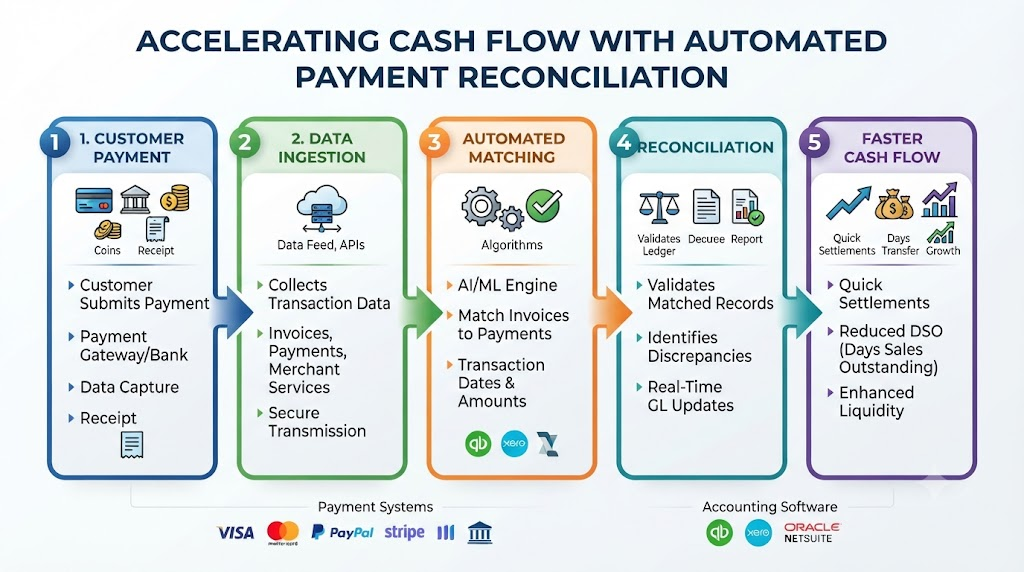
Automated Payment Reconciliation
Reconciling payment gateway settlements against internal accounting records is historically one of the most tedious tasks for finance departments. Enterprise collection flows generate vast volumes of individual transaction entries, merchant discount rate (MDR) deductions, and batched bank deposits that must be meticulously matched.
Bank & Gateway Settlement Files ──┐
                                  ├──► Smart Matching Engine ──► Matched Entries (Auto-Posted)
Open Invoice Receivables Ledger ──┘                                  │
                                                                     ▼
                                                              Exceptions Queue (Manual Review)
Using automated payment reconciliation software, businesses streamline this complex process through:
- Settlement Matching: Automatically correlating gateway settlement payout files against open invoice records using unique payment reference numbers (UTRs).
- Exception Handling: Segregating fee discrepancies, chargebacks, or unassigned transactions into dedicated review queues for rapid resolution.
- Immutable Audit Trails: Maintaining clear, timestamped records for every matched ledger entry to satisfy internal corporate controllers and external financial auditors.
Automated reconciliation guarantees financial ledger accuracy, reduces end-of-month close timelines from days to hours, and prevents balance sheet discrepancies. Discover how this works on our Reconciliation overview page.
Accounts Receivable Automation
Transitioning from traditional accounting routines to complete accounts receivable automation software removes friction across every phase of customer billing and collection.
The automated receivables workflow operates across five distinct phases:
- Invoice Creation: Automatic generation of structured, compliant invoices upon trigger events or contract schedules.
- Smart Reminder Dispatch: Automated delivery of notifications paired with dynamic, embedded payment links.
- Multimodal Collection: Seamless capture of customer payments across UPI, cards, and net banking channels.
- Instant Matching: Real-time correlation of incoming settlement data against open receivables accounts.
- Ledger Updates & Reporting: Instant updating of client account balances and creation of executive receivables reports.
This systematic process maximizes operational efficiency while minimizing collection cycle times across enterprise client bases.
Invoice-to-Cash Automation
To fully realize the performance benefits of digital transformation, organizations must replace fragmented tools with complete invoice to cash automation software.
┌─────────┐     ┌──────────────┐     ┌────────────┐     ┌────────────┐     ┌────────────────┐     ┌─────────┐
│ Invoice │ ──► │ Payment Link │ ──► │ Collection │ ──► │ Settlement │ ──► │ Reconciliation │ ──► │ Reports │
└─────────┘     └──────────────┘     └────────────┘     └────────────┘     └────────────────┘     └─────────┘
The unified end-to-end invoice-to-cash lifecycle flows logically across six operational steps:
- Invoice Generation: The billing system prepares a fully validated invoice containing appropriate tax line items and payment terms.
- Payment Link Delivery: An interactive payment link is attached automatically and transmitted across the client’s preferred communication channel.
- Collection Processing: The customer pays via their chosen digital payment method; funds are captured securely through integrated processing gateways.
- Bank Settlement: The payment gateway batches the received funds and settles the net amount into the enterprise corporate bank account.
- Automated Reconciliation: The system compares gateway payout summaries with open billing records, automatically matching transactions and posting fee adjustments.
- Financial Reporting Update: Analytics dashboards update instantly, reflecting accurate cash positions, updated aging reports, and balance sheets.
Unifying these six stages into a continuous digital process removes manual handoffs, eliminating administrative drag and accelerating capital flow.
Enterprise Payment Management
Large enterprises and rapidly growing mid-market companies face complex organizational structures that simple billing software cannot support. An enterprise payment management platform must accommodate multi-entity operations while maintaining strict governance standards established by corporate management guidelines and corporate governance bodies like the Ministry of Corporate Affairs (MCA).
Enterprise-grade architectures deliver:
- Multi-Branch and Multi-Unit Management: Centralized administration across diverse geographical offices, subsidiary divisions, and distinct legal entities within a single master instance.
- Granular Role-Based Access Controls (RBAC): Define customizable access permissions to ensure team members interact only with data relevant to their specific functions.
- Maker-Checker Governance: Mandate dual-authorization workflows for sensitive actions, such as manual invoice adjustments, credit notes, or refund processing.
- Centralized Business Intelligence: Aggregate collection, tax, and receivables performance metrics across all business units into a master executive dashboard.
Explore our Dashboard features to see how enterprise visualization transforms strategic planning.
Security & Compliance
Financial software infrastructure must adhere to rigorous security guidelines to protect business data, preserve client privacy, and meet strict regulatory mandates set by bodies like the Reserve Bank of India (RBI).
Key security measures incorporated within modern payment platforms include:
- Data Encryption: Application of industry-standard encryption protocols for data in transit (TLS 1.3) and at rest (AES-256).
- Granular Access Logs: Detailed record-keeping of every platform login, data export, invoice modification, and system transaction.
- API Security: Protected API endpoints utilizing secure token authorization protocols to prevent unauthorized access.
- Financial Governance Standards: Complete adherence to national tax mandates, accounting standards, and financial reporting guidelines.
Maintaining stringent security protocols protects enterprise reputations while ensuring seamless audit readiness.
Integration Capabilities
A modern billing platform must not operate in isolation. It should function as an interconnected operational engine that communicates effortlessly across an enterprise’s broader technology stack.
                     ┌──────────────────────────────────┐
                     │          PayManagerPro           │
                     └────────────────┬─────────────────┘
                                      │
       ┌──────────────────────────────┼──────────────────────────────┐
       ▼                              ▼                              ▼
┌──────────────┐              ┌──────────────┐              ┌────────────────┐
│   Gateways   │              │   ERPs/CRMs  │              │ Accounting     │
│  (Razorpay,  │              │  (Salesforce,│              │  (Tally, Zoho, │
│ Paytm, etc.) │              │ SAP, Oracle) │              │  QuickBooks)   │
└──────────────┘              └──────────────┘              └────────────────┘
Core integration vectors include:
- Payment Gateways: Pre-built, direct connections to leading payment aggregators including Razorpay, Cashfree, and Paytm.
- ERP Systems: Seamless data synchronization with major enterprise suites such as SAP, Oracle, and Microsoft Dynamics.
- Accounting Platforms: Native data exchange with standard accounting platforms like Tally, Zoho Books, and QuickBooks.
- CRM Solutions: Direct connectivity with platforms like Salesforce and HubSpot to align sales pipelines with billing operations.
Developers can explore robust developer tools and endpoint documentation via our API page.
Industries That Can Use PayManagerPro
Flexible payment platforms adapt to the specialized operational requirements of diverse industry sectors:
- Manufacturing: Automate multi-tier distributor invoicing, track milestone payment schedules, and streamline high-volume B2B collection matching.
- Healthcare: Manage patient billing, streamline insurance co-pay processing, and maintain compliant transaction audit trails across hospital branches.
- Education: Automate recurring tuition collection, simplify fee installment management, and issue instant payment links to parents.
- Logistics & Supply Chain: Accelerate freight billing, collect payments upon delivery verification, and settle partner accounts faster.
- Retail & E-Commerce: Centralize multi-channel store collections, automate gateway reconciliation, and streamline customer refunds.
- SaaS & Technology: Manage recurring subscription billing, automate plan upgrade invoicing, and reduce churn with proactive payment links.
- Agencies & Marketing: Simplify milestone-based client retainer billing, track project payments, and send automatic payment reminders.
- Financial Services: Automate loan processing fees, streamline interest billing, and maintain strict regulatory compliance logs.
- Professional Services: Enable legal, accounting, and consulting firms to bill client hours accurately and collect retainers online.
Manual Process vs PayManagerPro
Transitioning from manual workflows to modern invoice and payment management software delivers transformational improvements across every operational metric:
| Operational Metric | Manual Process | PayManagerPro Platform |
| Invoice Creation | Manual spreadsheet entries; prone to formatting & tax errors | Automated, compliant template generation in seconds |
| Payment Collections | Manual bank transfers; friction-heavy manual follow-ups | Dynamic payment links delivered via WhatsApp & email |
| Payment Reconciliation | Hours spent matching bank entries against billing sheets | Automated settlement matching with exception flags |
| Financial Reporting | Delayed end-of-month manual report consolidation | Real-time visual analytics and instant executive reports |
| Error Rate | High risk of human error, miscalculations, & lost logs | Near-zero operational errors via automated controls |
| Time to Settle (DSO) | Slow collection cycles lasting 45–90 days | Dramatically accelerated collections and faster cash flow |
Business Benefits
Deploying a comprehensive payment and billing solution delivers immediate operational return on investment (ROI):
- Accelerated Cash Flow: Digital payment links and automated reminders result in faster customer settlements and reduced DSO.
- Reduced Operational Expenditures: Eliminating tedious manual data entry lowers administrative labor costs significantly.
- Minimized Processing Errors: Automated tax calculations and standardized billing templates eliminate costly manual accounting mistakes.
- Enhanced Decision Making: Real-time visibility into collection performance empowers financial leaders to make informed capital allocation decisions.
- Improved Client Relationships: Professional, transparent billing paired with convenient payment methods fosters trust and long-term customer satisfaction.
Learn more about our mission to optimize enterprise finance on our About Us page.
Best Practices for Payment Management
To maximize the impact of payment automation technology, finance leaders should implement these proven operational strategies:
- Standardize Invoicing Terms: Clearly define payment due dates, accepted payment channels, and late fee structures across all customer contracts.
- Automate Dunning Schedules: Configure non-intrusive reminder sequences to send 3 days before due dates, on the due date, and at structured intervals post-due date.
- Incentivize Digital Modes: Direct customers toward low-cost, high-speed payment options like UPI and instant bank transfers via dynamic links.
- Reconcile Daily: Run automated reconciliation routines daily rather than waiting until month-end to ensure real-time ledger accuracy.
- Audit Access Rights Regularly: Review user permission matrices periodically to enforce proper internal segregation of duties.
Common Mistakes in Invoicing and Collections
Failing to address common billing pitfalls can undermine operational efficiency and lead to financial leakage.
Avoid these frequent mistakes:
- Relying on Manual Spreadsheet Tracking: Spreadsheets lack real-time synchronization, version control, and granular security controls, introducing high error risks.
- Inconsistent Payment Follow-Ups: Inconsistent collection outreach signals lax credit enforcement, encouraging clients to delay payments.
- Issuing Non-Compliant Invoices: Omitting required GST details or incorrect tax codes leads to delayed payments and customer disputes regarding Input Tax Credit (ITC).
- Delayed Payment Reconciliation: Postponing reconciliation leaves unapplied cash sitting unallocated, distorting financial statements and client credit balances.
- Single Gateway Reliance: Depending on a single payment aggregator exposes operations to downtime risks if that provider experiences outage issues.
Future of Digital Payment Management
The landscape of B2B payment management is evolving rapidly, driven by technological innovation and shifting enterprise expectations.
Key trends shaping the future include:
- AI-Driven Reconciliation: Advanced machine learning models will automatically resolve complex, multi-variable matching exceptions without human intervention.
- Hyper-Personalized Collection Strategies: Predictive analytics will evaluate buyer payment behavior to recommend optimal collection times, delivery channels, and payment terms.
- Embedded Corporate Finance: Seamless integration of working capital loans, invoice discounting, and supply chain finance options directly within billing platforms.
- Universal Real-Time Settlements: Continued global migration toward instant, 24/7 cross-border and domestic payment networks.
Adopting an agile, cloud-native payment infrastructure ensures your business remains equipped to leverage these emerging financial technologies seamlessly.
Frequently Asked Questions
1. What is invoice and payment management software?
Invoice and payment management software is a centralized digital solution designed to automate customer billing, payment collection, gateway integration, and accounting ledger reconciliation. By replacing manual administrative tasks with automated workflows, the software accelerates cash collections, reduces human error, and provides real-time visibility into an enterprise’s financial health and cash flow position.
2. How does PayManagerPro improve enterprise cash flow?
PayManagerPro accelerates cash flow by delivering instant dynamic payment links to customers via channels like WhatsApp and email, paired with automated reminder workflows. By providing clients with direct, friction-free payment options and following up automatically on outstanding balances, the platform significantly reduces Days Sales Outstanding (DSO) and ensures receivables are collected faster.
3. Is PayManagerPro compliant with Indian GST requirements?
Yes. PayManagerPro generates fully compliant GST invoices that adhere to mandates established by the GST Council and CBIC. The software automatically calculates CGST, SGST, and IGST breakdowns, manages HSN/SAC codes, enforces sequential numbering, and generates comprehensive tax reports designed to simplify monthly filing routines like GSTR-1 and GSTR-3B.
4. Can I integrate PayManagerPro with my existing ERP or accounting system?
Yes. PayManagerPro features robust RESTful APIs and pre-built integration connectors that allow seamless data synchronization with leading ERP platforms (such as SAP and Oracle) and accounting software (such as Tally, Zoho Books, and QuickBooks). This ensures invoices, collections, and reconciliation entries sync automatically across your primary ledgers.
5. What payment methods can my customers use via PayManagerPro payment links?
Through integrated multi-gateway processing, PayManagerPro enables your customers to complete payments using a wide variety of modes, including UPI ( dynamic QR codes and intent flows), major credit and debit cards, net banking across top commercial banks, and digital wallets. This ensures maximum convenience for your buyers.
6. How does automated payment reconciliation work?
Automated payment reconciliation matches incoming gateway payout and bank settlement files directly against open invoices in your system using unique transaction reference numbers (UTRs). PayManagerPro automatically identifies matching entries, flags fee deductions or discrepancies for review, and updates your receivables ledger without requiring manual data entry.
7. What is the difference between accounts receivable automation and invoice-to-cash automation?
Accounts receivable automation focuses specifically on managing unpaid customer balances, sending reminders, and processing incoming collections. Invoice-to-cash automation represents a broader end-to-end framework that encompasses the entire financial lifecycle—from initial invoice creation and dynamic link delivery through to collection processing, settlement matching, ledger reconciliation, and executive financial reporting.
8. Does PayManagerPro support multi-branch enterprise structures?
Yes. PayManagerPro is engineered for enterprise operations, allowing organizations to manage multiple business units, subsidiary branches, and distinct legal entities within a centralized platform. It provides role-based access control, maker-checker approval workflows, and aggregated reporting capabilities across all enterprise locations.
9. How secure is customer payment and invoice data on PayManagerPro?
PayManagerPro employs bank-grade security controls, including TLS 1.3 encryption for data in transit and AES-256 encryption for data at rest. The platform maintains immutable, timestamped audit logs for all platform activities, enforces secure API authentication, and aligns with national data protection standards and RBI financial guidelines.
10. Can I customize invoice templates and payment link branding?
Yes. PayManagerPro allows businesses to fully customize invoice templates with corporate logos, branded colors, specific payment terms, and custom notes. Furthermore, payment links and collection pages can be customized to maintain brand consistency and deliver a seamless, professional customer experience.
Conclusion
Managing enterprise billing, collections, and receivables manually is a resource-intensive burden that slows growth and clouds financial visibility. As transaction volumes expand, organizations relying on disconnected spreadsheets and manual accounting routines inevitably experience higher operational costs, frequent human errors, and delayed cash flow.Adopting an integrated invoice and payment management software platform like PayManagerPro transforms your financial infrastructure into an efficient, automated growth engine. By consolidating GST-compliant invoice generation, dynamic payment link distribution, multi-gateway collection tracking, and smart reconciliation into a single platform, enterprises eliminate operational bottlenecks and dramatically lower Days Sales Outstanding (DSO).