Introduction
Selecting the right digital ecosystem is among the most consequential operational choices a modern enterprise can make. As the global software marketplace overflows with thousands of cloud platforms, specialized automation suites, and generative artificial intelligence engines, finding the exact match for your organization’s workflow grows increasingly complex. Navigating this vast landscape demands rigorous research, objective analysis, and structured evaluation methodologies rather than trusting flashy marketing campaigns. Organizations require dependable, vendor-neutral insights to streamline purchasing cycles, protect operational budgets, and drive long-term return on investment. This guide examines how structured software evaluation transforms technology procurement, highlights crucial software categories, outlines proven selection frameworks, and establishes TrueReviewNow as your ultimate destination for objective reviews, comprehensive comparisons, and expert technology recommendations.
What Is Structured Software Evaluation?
Structured software evaluation is a methodical, evidence-based discipline employed by executive leaders, IT directors, and procurement specialists to assess, benchmark, and procure digital assets. Rather than selecting applications based on aesthetic appeal or aggressive sales pitches, this disciplined approach investigates foundational software architecture, functional scalability, security compliance, and long-term viability.
Core Dimensions of Modern SaaS Assessment
Evaluating cloud applications requires analyzing multiple interconnected pillars. Decision-makers must look past user interfaces to examine API availability, encryption standards, role-based access governance, and multi-tenant infrastructure integrity. Understanding how a platform handles automated backups, disaster recovery protocols, and uptime guarantees ensures operational resilience across distributed teams.
Moving Beyond Marketing Hype to Feature-Driven Facts
Software vendors frequently advertise revolutionary capabilities that may not reflect day-to-day operational realities. A rigorous evaluation framework cuts through promotional language by demanding empirical verification. Reviewing independent benchmark reports, sandbox trial environments, and detailed feature matrices enables leaders to confirm whether a platform genuinely satisfies their workflow demands without introducing technical debt.
Why Reliable Business Software Reviews Matter
In an era where software subscription costs scale rapidly, depending on verified peer reviews and objective product breakdowns protects enterprises from expensive implementation failures. Unfiltered user feedback and professional critiques illuminate hidden limitations, customer support responsiveness, and real-world performance bottlenecks.
Mitigating Financial and Operational Risks
Investing in enterprise applications without comprehensive vetting frequently leads to abandoned software licenses, broken data pipelines, and frustrated end-users. Trusted reviews expose integration hurdles, restrictive pricing tiers, and steep learning curves prior to financial commitment. This proactive risk management protects capital and prevents unexpected workflow disruptions.
Accelerating Time-to-Value for Growing Teams
When organizations deploy software supported by clear documentation and comprehensive guides, the onboarding timeline shrinks significantly. Teams achieve proficiency faster, adopt standardized workflows more smoothly, and extract measurable value from their digital investments without enduring protracted trial-and-error phases.
Essential Software Categories for Modern Enterprises
Modern business operations span diverse functional domains, each requiring specialized technological support. Understanding the distinctions between core software categories ensures leadership teams allocate capital efficiently across departments.
Project Management and Collaboration Platforms
Effective cross-functional coordination relies on dependable project management solutions. These applications organize tasks, track milestones, manage resource allocation, and facilitate asynchronous communication across remote or hybrid teams. Evaluating these platforms involves examining Kanban boards, Gantt charts, time-tracking utilities, and real-time document co-authoring capabilities.
Customer Relationship Management (CRM) Solutions
CRM platforms serve as the central nervous system for sales, marketing, and customer success operations. Modern systems incorporate automated lead scoring, pipeline forecasting, email campaign integration, and customer interaction history. Choosing the right CRM requires balancing customizability with user-friendliness, ensuring sales representatives adopt the platform rather than bypassing it.
Advanced AI Tools, MLOps, and LLM Gateways
As artificial intelligence reshapes enterprise workflows, organizations are rapidly adopting specialized machine learning and generative AI infrastructure. MLOps tools streamline model training, deployment, and monitoring, while LLM gateways manage API routing, rate limiting, and prompt security. Evaluating these advanced systems requires deep technical scrutiny regarding latency, token costs, and data privacy compliance.
Comparative Evaluation: Software Architecture Models
SaaS vs. On-Premise Software
| Features | SaaS (Cloud-Hosted) | On-Premise Software |
| Advantages | Rapid deployment, lower upfront costs, automatic updates, global accessibility. | Complete data control, customized security policies, offline operational capability. |
| Limitations | Ongoing subscription dependency, restricted deep source-code customization. | High capital expenditure, intensive maintenance overhead, manual upgrade cycles. |
| Best Use Cases | Dynamic remote teams, startups, fast-scaling businesses with agile workflows. | Highly regulated industries with strict on-site data residency mandates. |
| Ideal Business Size | Small, medium, and enterprise organizations seeking agility. | Large enterprises with dedicated internal IT and infrastructure teams. |
| Pricing Model | Recurring subscription (Monthly or Annual SaaS tiers). | Perpetual licensing with recurring maintenance and support fees. |
Open-Source vs. Commercial Software
| Features | Open-Source Software | Commercial (Proprietary) Software |
| Advantages | No licensing fees, high flexibility, transparent code, community-driven innovation. | Dedicated vendor support, polished user experience, built-in security compliance. |
| Limitations | Requires internal technical expertise for maintenance, potential security auditing needs. | High licensing costs, vendor lock-in, restricted modification rights. |
| Best Use Cases | Custom development environments, tech-forward startups, research institutions. | Standardized business operations, finance, HR, and customer support workflows. |
| Ideal Business Size | Tech-centric businesses with skilled engineering teams. | Organizations of all sizes seeking turnkey operational solutions. |
| Pricing Model | Free core software with paid enterprise support tiers. | Tiered per-user or flat-rate enterprise subscriptions. |
AI Tools vs. Traditional Software
| Features | AI-Powered Software | Traditional Rule-Based Software |
| Advantages | Predictive insights, automated unstructured data processing, continuous self-learning. | High predictability, strict deterministic logic, zero hallucination risk. |
| Limitations | Requires large training datasets, potential output variance, higher compute costs. | Rigid automation rules, unable to adapt to unstructured inputs without reprogramming. |
| Best Use Cases | Content generation, predictive customer analytics, intelligent workflow routing. | Standard accounting, basic data record-keeping, deterministic workflow triggers. |
| Ideal Business Size | Data-driven enterprises seeking competitive automation advantages. | Traditional businesses prioritizing stable, repeatable operational rules. |
| Pricing Model | Consumption-based (per-token or API call) plus base subscription. | Flat per-user or tiered seat-based licensing. |
Software Evaluation Framework
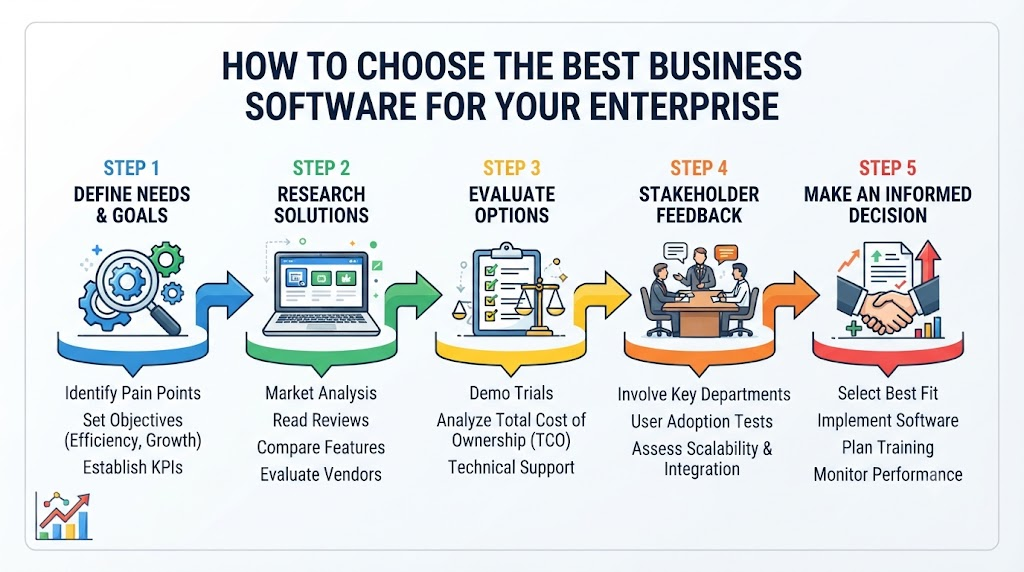
To maintain consistency during product assessments, technology leaders rely on a structured evaluation framework that scores potential solutions across key performance indicators.
Performance, Scalability, and Security Metrics
Software must perform reliably under peak operational loads. Evaluators must assess database query speeds, concurrent user capacity, and cloud infrastructure redundancy. Simultaneously, robust security audits verify compliance with industry standards such as SOC 2, GDPR, and ISO 27001, ensuring sensitive corporate and customer data remains protected against unauthorized access.
Total Cost of Ownership (TCO) and ROI Analysis
Beyond initial subscription sticker prices, TCO calculations incorporate employee training hours, data migration expenses, integration development costs, and premium support add-ons. Comparing these expenses against projected productivity gains and revenue enhancements ensures that the software delivers a positive and measurable return on investment.
Best Practices for Software Procurement
Strategic software procurement minimizes friction during deployment and maximizes long-term user adoption. Implementing proven industry best practices ensures alignment between organizational goals and technological capabilities.
Engaging Cross-Functional Stakeholders Early
Software decisions should never be made in isolation by executive leadership. Involving end-users, IT administrators, financial controllers, and security officers during the initial evaluation phase guarantees that all operational perspectives are addressed before contracts are signed.
Conducting Proof-of-Concept (PoC) Trials
Before committing to annual enterprise contracts, organizations should execute structured PoC trials. Testing applications with real company datasets under live working conditions reveals hidden workflow bottlenecks, user interface friction points, and actual vendor support responsiveness.
Expert Tips for Long-Term Software Management
Selecting software is only the first step; maintaining optimal utilization over time requires proactive governance and continuous performance tracking.
Monitoring License Utilization and Redundancies
Organizations frequently accumulate dormant software licenses over time. Periodic license audits identify underutilized accounts, allowing IT managers to reallocate or cancel redundant subscriptions, thereby optimizing operational expenditure.
Establishing Vendor Performance SLAs
Enterprise software agreements should incorporate clear Service Level Agreements (SLAs) regarding system uptime, customer support response times, and data security breach notifications. Holding vendors accountable to rigorous performance metrics ensures reliable operational support.
Common Buying Mistakes to Avoid
Awareness of common procurement pitfalls prevents costly missteps and ensures sustainable technology integration.
Prioritizing Cost Over Long-Term Scalability
Choosing the cheapest software option often backfires when rapid business growth causes the platform to experience performance bottlenecks, forcing a disruptive and expensive migration shortly after adoption.
Overlooking Integration and API Complexities
Failing to verify how seamlessly a new application connects with existing tech stacks creates data silos. Comprehensive API documentation and native integrations are vital for maintaining unified data workflows across departments.
Frequently Asked Questions
- What are business software reviews, and why are they critical?
Business software reviews provide detailed evaluations of digital applications, highlighting core features, pricing models, advantages, and drawbacks. They are critical because they deliver objective insights, helping companies avoid poor investments and select tools that align precisely with their operational objectives and budgetary limits. - How should a startup identify the best software solutions?
Startups can choose ideal software by defining specific business goals, establishing clear financial limits, evaluating user experience, testing free trial versions, and reading reliable product comparisons. Prioritizing adaptable tools ensures smooth scaling without introducing unnecessary technical complexity. - What differentiates SaaS models from on-premise infrastructure?
SaaS applications reside in the cloud, are accessed via web browsers, and operate on recurring subscription models, ensuring rapid deployment and automated patches. On-premise solutions are installed locally on corporate servers, requiring dedicated internal management while granting total data sovereignty. - Why are AI applications revolutionizing modern corporate workflows?
AI applications transform operations by automating manual tasks, analyzing massive data volumes instantly, forecasting market trends, and generating unstructured content. They boost productivity, minimize human errors, and allow teams to focus on strategic planning and complex problem-solving. - In what ways does TrueReviewNow streamline technology research?
TrueReviewNow offers objective software reviews, detailed product comparisons, buying guides, and expert recommendations across various technology sectors. It helps decision-makers bypass marketing noise to evaluate software features, pricing structures, and real-world performance with absolute confidence. - What criteria matter most when comparing project management tools?
When comparing project management platforms, examine task arrangement views (Kanban, Gantt, list), time-tracking capabilities, collaboration features, mobile app performance, third-party integrations, and pricing scalability. The chosen platform should match your team’s workflow style and communication cadence. - How is the total cost of ownership (TCO) calculated for software?
Calculating TCO involves combining initial subscription fees, deployment costs, data migration expenses, employee training hours, custom integration development, and ongoing maintenance fees. This thorough financial assessment reveals the genuine long-term economic impact of your digital investment. - What frequent errors do organizations make during software procurement?
Frequent mistakes include selecting applications based purely on lowest cost, ignoring scalability thresholds, overlooking API integration requirements, skipping security and compliance audits, failing to involve end-users in testing phases, and neglecting to define clear business requirements upfront. - Why does data governance matter during software selection?
Data governance ensures that corporate data remains accurate, secure, compliant with regulatory mandates, and accessible only to verified personnel. Choosing software equipped with strong data governance features prevents data breaches, maintains audit readiness, and preserves client trust. - What is an LLM gateway, and why do modern enterprises deploy them?
An LLM gateway is a specialized management layer that routes, secures, and optimizes application traffic moving toward large language models. Enterprises use LLM gateways to control API expenditure, enforce rate limits, mask sensitive data, and monitor model performance across multiple AI vendors.
Conclusion
Navigating the contemporary software ecosystem requires a strategic, data-driven approach that prioritizes empirical facts over promotional marketing. By establishing structured evaluation frameworks, analyzing total costs of ownership, engaging cross-functional stakeholders, and conducting thorough proof-of-concept trials, organizations can secure digital solutions that foster sustainable growth. Unbiased reviews and comprehensive comparisons serve as essential navigational tools, ensuring technology investments deliver maximum operational value. TrueReviewNow remains dedicated to delivering trustworthy, expert-led insights that empower business leaders to make informed, confident software purchasing decisions in a dynamic digital world.