Introduction
Navigating the financial and regulatory landscape in India requires precise planning, continuous record-keeping, and strict adherence to evolving statutory mandates. Whether you are an individual managing personal tax obligations, an early-stage startup founder attempting to register a private limited company, or an established enterprise scaling operations, managing compliance without professional support can quickly become overwhelming.This comprehensive guide breaks down the core functions of modern accounting and compliance services, outlines essential statutory frameworks, BestCaNow and digital advisory models, and provides actionable frameworks to help you find a chartered accountant suited to your exact business needs.
Understanding the Role of Modern Accounting and Compliance
Modern financial advisory extends far beyond simple book-keeping and annual tax returns. A qualified Chartered Accountant helps businesses structure their operations efficiently, optimize cash flow, mitigate audit risks, and maintain full compliance with regulatory bodies like the Ministry of Corporate Affairs (MCA) and the Income Tax Department.
       ┌─────────────────────────────────────────────────────────┐
       │                Core Compliance Framework                │
       └────────────────────────────┬────────────────────────────┘
                                    │
       ┌────────────────────────────┼────────────────────────────┐
       ▼                            ▼                            ▼
┌──────────────┐             ┌──────────────┐             ┌──────────────┐
│  Taxation    │             │  Corporate   │             │ Audit & Risk │
│ & Regulatory │             │ Structure    │             │ Governance   │
├──────────────┤             ├──────────────┤             ├──────────────┤
│ • Income Tax │             │ • MCA & ROC  │             │ • Statutory  │
│ • GST Returns│             │ • Filings    │             │ • Internal   │
│ • TDS / TAN  │             │ • LLP / Pvt  │             │ • Tax Audits │
└──────────────┘             └──────────────┘             └──────────────┘
For growing businesses, financial governance acts as the bedrock for attracting investment, securing bank credit, and scaling operations without legal friction. Attempting to manage corporate taxation, Registrar of Companies (ROC) filings, and audit readiness without domain expertise often leads to severe penalties, interest charges, or operational delays.
Primary Services Offered by Chartered Accountants
Professional financial practice encompasses several specialized domains:
1. Taxation and Revenue Advisory
- Direct Taxation: Income tax filing for individuals, firms, and corporations, corporate tax planning, Tax Deducted at Source (TDS) compliance, and representation during tax assessments or appeal proceedings.
- Indirect Taxation (GST): GST registration, monthly/quarterly return filing (GSTR-1, GSTR-3B, GSTR-9), input tax credit (ITC) reconciliation, and audit representation. Search queries like finding a “GST consultant near me” reflect the demand for local expertise in handling complex indirect tax structures.
2. Corporate Law and Company Formation
- Business Incorporation: Structuring entities as Sole Proprietorships, Partnerships, Limited Liability Partnerships (LLPs), or Private Limited Companies.
- ROC Compliance: Annual filings (MGT-7, AOC-4), maintaining statutory registers, director identification numbers (DIN), and recording board resolutions to satisfy MCA mandates.
3. Auditing and Assurance Services
- Statutory Audits: Independent examination of financial books to ensure compliance with Companies Act provisions.
- Tax Audits: Examinations under Section 44AB of the Income Tax Act for businesses crossing designated turnover thresholds.
- Internal Audits: Evaluating internal controls, operational efficiency, and risk mitigation systems.
Comparison 1: Online CA Consultation vs In-Person Consultation
Choosing between digital financial services and traditional physical advisory depends on your operational model, geographic location, and communication preferences.
| Features | Online CA Consultation | In-Person CA Consultation |
| Primary Workflow | Cloud-based document sharing, video calls, digital sign-offs | Physical document submission, face-to-face meetings |
| Turnaround Time | Faster turnaround due to automated digital intake | Dependent on office hours and physical appointments |
| Geographic Flexibility | High; work with experts anywhere across India | Limited to local service providers in your city |
| Cost Efficiency | Lower overheads; flexible pay-per-consultation plans | Higher retainers due to physical infrastructure costs |
| Best Use Cases | Digital startups, remote founders, freelancers, NRIs | Manufacturing units, complex inventory audits, physical asset checks |
| Limitations | Requires basic digital literacy and document scanning | Geographic restriction, potential travel delays |
Business Structure Comparison: Sole Proprietorship vs LLP vs Private Limited Company
Choosing the right legal entity during initial business formation sets the foundation for liability protection, tax efficiency, and fundraising capabilities.
| Features | Sole Proprietorship | Limited Liability Partnership (LLP) | Private Limited Company (Pvt Ltd) |
| Legal Status | Unincorporated entity (No separate legal identity) | Separate legal entity under LLP Act, 2008 | Separate legal entity under Companies Act, 2013 |
| Liability | Unlimited personal liability | Limited to partner contributions | Limited to equity shareholdings |
| Compliance Load | Minimal (Basic Income Tax & GST) | Moderate (Form 8 & Form 11 filings) | High (Board meetings, ROC filings, Statutory Audit) |
| Fundraising Ability | Minimal; dependent on personal credit | Moderate; limited to internal partner loans | High; can issue shares to VCs, Angel Investors, and ESOPs |
| Cost Considerations | Lowest setup and maintenance cost | Moderate setup and annual compliance cost | Higher formation fees and recurring statutory audit fees |
Tailored Financial Solutions for Key Segments
1. Startups and Early-Stage Businesses
Startups require strategic guidance beyond routine bookkeeping. A specialized “CA for startups” assists with capitalization tables, ESOP structuring, DPIIT recognition for tax exemptions, seed-stage valuation reports, and investor due diligence. Engaging seasoned advisory early prevents cap-table messiness and compliance bottlenecks during funding rounds.
2. MSMEs and Small Business Enterprises
Micro, Small, and Medium Enterprises (MSMEs) form the backbone of the commercial economy. They rely on local financial advisors for cash flow management, working capital loan documentation, MSME Udyam registration, GST reconciliation, and timely tax audit execution. Securing an “income tax consultant near me” helps regional business owners meet strict filing deadlines without disrupting daily operations.
3. Non-Resident Indians (NRIs)
NRI taxation involves complex cross-border considerations, including Double Taxation Avoidance Agreements (DTAA), Foreign Exchange Management Act (FEMA) guidelines, handling NRE/NRO accounts, TDS on property sales under Section 195, and repatriation of Indian funds. Engaging an experienced “NRI tax consultant in India” ensures foreign income is correctly reported while preventing double tax liabilities.
Comparison 3: Internal Audit vs Statutory Audit
Understanding the differences between statutory and internal financial evaluations helps businesses allocate governance resources effectively.
| Features | Internal Audit | Statutory Audit |
| Primary Objective | Evaluate internal processes, fraud risks, and operational efficiency | Verify accuracy and fairness of published financial statements |
| Mandate | Optional for small firms; mandatory for specified listed/large companies | Mandatory for all Companies registered under the Companies Act |
| Scope of Work | Defined by management based on operational priorities | Defined by statutory law and accounting standards |
| Reporting Authority | Audit Committee or Board of Directors | Shareholders and Public Regulatory Authorities |
| Cost Considerations | Scalable based on internal risk review scope | Fixed audit fees based on firm size and regulatory complexity |
| Key Advantage | Early identification of operational bottlenecks and leakage | Enhances public, investor, and creditor trust in financial reports |
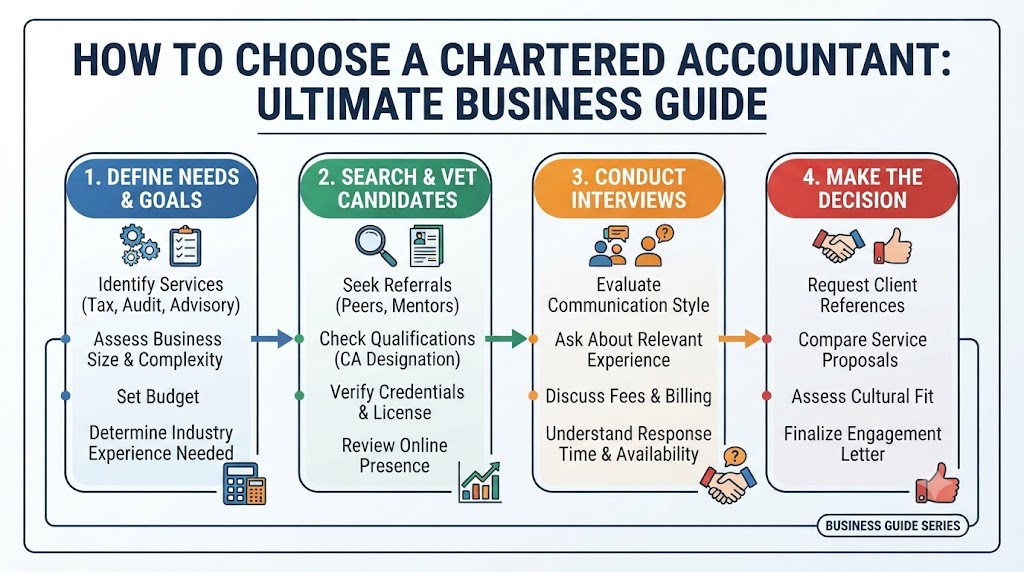
Framework for Selecting the Right Financial Partner
Selecting the right professional requires evaluating qualifications, domain expertise, communication clarity, and technological adoptability.
       ┌─────────────────────────────────────────────────────────┐
       │             Partner Selection Evaluation                │
       └────────────────────────────┬────────────────────────────┘
                                    │
       ┌────────────────────────────┼────────────────────────────┐
       ▼                            ▼                            ▼
┌──────────────┐             ┌──────────────┐             ┌──────────────┐
│  Credentials │             │ Industry     │             │ Tech &       │
│  & Standing  │             │ Experience   │             │ Workflow     │
├──────────────┤             ├──────────────┤             ├──────────────┤
│ • ICAI No.   │             │ • Sector Fit │             │ • Cloud Tools│
│ • Firm COP   │             │ • Scale Fit  │             │ • Security   │
│ • History    │             │ • Specialism │             │ • SLA Speed  │
└──────────────┘             └──────────────┘             └──────────────┘
- Verify Credentials: Ensure the professional holds a valid Certificate of Practice (COP) issued by the Institute of Chartered Accountants of India (ICAI).
- Industry-Specific Experience: Confirm the firm has worked with clients in your vertical (e.g., e-commerce, real estate, manufacturing, SaaS).
- Tech Stack & Cloud Capabilities: Determine if they utilize modern accounting platforms, secure cloud storage, and automated document exchange tools.
- Transparent Retainer Models: Discuss fee structures upfront to avoid unexpected billing charges for routine advisory.
Best Practices for Financial & Tax Compliance
- Maintain Digital Records: Move from paper receipts to digital cloud document management for immediate audit readiness.
- Reconcile Books Monthly: Perform monthly bank reconciliations and GST Input Tax Credit (ITC) matches via GSTR-2B instead of waiting for year-end reviews.
- Separate Personal and Business Accounts: Never mix personal expenses with corporate entity accounts to preserve liability protection and clean ledger lines.
- Track Statutory Tax Deadlines: Maintain a shared compliance calendar detailing advance tax due dates, TDS deposit schedules, and GST filing windows.
- Document Inter-Company and Cross-Border Transfers: Retain clear transfer pricing documentation, agreement terms, and foreign inward remittance certificates (FIRC) for all international transactions.
Expert Tips for Business Owners
- Plan Taxes Proactively, Not Reactively: Meet with your tax advisor in Q3 of the financial year to assess taxable projections and implement legitimate tax-saving strategies before March 31st.
- Prioritize Compliance Over Low Retainer Costs: Selecting a compliance provider purely based on lower pricing often results in missed filings, late fees, and flawed filings that cost more to correct later.
- Conduct Periodic Internal Reviews: Even if your firm falls below mandatory statutory audit thresholds, conduct periodic internal health checks to verify internal financial controls.
- Formalize All Commercial Contracts: Ensure agreements with vendors, freelancers, and clients clearly detail GST clauses, payment timelines, and TDS deduction terms upfront.
- Establish Clear Communication SLAs: Agree on response times for urgent tax notices, payroll clarifications, and monthly reporting deliverables.
Common Compliance Mistakes to Avoid
| Common Mistake | Operational Risk / Penalty | Practical Prevention Solution |
| Delaying Income Tax or GST Filings | Accumulation of mandatory late fees, daily interest charges, and potential block on e-way bill generation | Set up automated reminders and keep digital ledgers updated on a weekly basis |
| Inaccurate Input Tax Credit Claims | Tax demand notices from tax authorities, interest on mismatched ITC under Section 50, and potential penalties | Periodically reconcile purchase ledgers against GSTR-2B before filing monthly returns |
| Improper Worker Classification | Penalties under labor codes, incorrect TDS deductions (194C vs 194J), and retroactive payroll demands | Consult a financial expert to draft clear agreements for independent contractors versus employees |
| Ignoring MCA/ROC Filings | Disqualification of corporate directors, heavy daily late fines on Form AOC-4/MGT-7, and striking off of the company | Retain dedicated corporate law compliance services to manage secretarial records continuously |
| Selecting Advisors Purely on Low Price | Poor service quality, missed tax deadlines, unauthorized filings, and lack of audit representation support | Evaluate professionals based on certified credentials, domain specialization, and industry reviews |
The Future of Digital Accounting and Financial Discovery
The accounting sector in India is experiencing a digital transformation. Cloud accounting platforms, automated invoicing systems, electronic tax portals, and digital consultation platforms are replacing traditional manual paper workflows.
Modern platforms streamline the discovery process, allowing businesses to find verified professionals tailored to their precise geographic and domain requirements. Whether you are searching for local “audit services near me” or seeking a specialized online CA consultation for cross-border tax advisory, centralized discovery networks allow you to compare verified profiles, assess domain expertise, and book targeted professional consultations efficiently.
Why Use BestCaNow for Finding Chartered Accountants?
Navigating thousands of independent financial practices to find the right partner can be time-consuming. BestCaNow simplifies this process by connecting individuals, startups, NRIs, and growing enterprises with qualified, verified financial professionals across India.
- Verified Professional Profiles: Discover curated profiles of certified Chartered Accountants, tax consultants, and financial advisors.
- Domain-Specific Matching: Filter professionals by precise specializations, including GST compliance, startup advisory, corporate law, NRI taxation, or statutory auditing.
- Pan-India Coverage: Easily locate an “income tax consultant near me” for face-to-face meetings or connect with top-tier consultants nationwide through online CA consultation options.
- Transparent Selection: Compare expertise, practice focus areas, and consultation options before committing to retainers.
- Streamlined Discovery: Eliminate back-and-forth phone calls by accessing an organized directory created to simplify business compliance sourcing.
Frequently Asked Questions (FAQs)
1. What credentials should I verify before hiring a Chartered Accountant in India?
Always verify that the individual holds an active membership certificate and a valid Certificate of Practice (COP) issued by the Institute of Chartered Accountants of India (ICAI). You can confirm their standing through the official ICAI member portal using their unique membership number.
2. How does an online CA consultation differ from traditional in-person services?
An online CA consultation relies on cloud platforms, video calls, and digital document exchange, enabling fast turnaround times and national access to specialists. In-person services involve physical visits, making them suitable for businesses requiring local physical document verification or physical inventory audits.
3. Why is engaging a specialized startup CA important for early-stage companies?
Startups face specific regulatory obligations, including cap-table management, valuation certificates for funding, DPIIT tax exemption approvals, and ESOP structuring. A specialized startup CA understands venture ecosystems, helping founders stay investment-ready while avoiding compliance gaps.
4. When is a business required to register for GST in India?
GST registration is mandatory if your aggregate turnover exceeds ₹40 Lakhs for goods (₹20 Lakhs for special category states) or ₹20 Lakhs for services (₹10 Lakhs for special category states). Registration is also compulsory for inter-state sellers and e-commerce operators regardless of turnover.
5. What are the tax implications for NRIs selling property in India?
When an NRI sells property in India, the buyer must deduct Tax Deducted at Source (TDS) under Section 195—typically at 20% plus surcharge and cess on long-term capital gains. NRIs can apply for a lower TDS deduction certificate from the tax department to prevent excess tax withholding.
6. What is the difference between a statutory audit and a tax audit?
A statutory audit is mandated by the Companies Act, 2013, to review a company’s overall financial health for its shareholders. A tax audit is required under Section 44AB of the Income Tax Act for entities whose business turnover exceeds specific statutory limits to verify taxable income accuracy.
7. How can I locate a qualified GST consultant near me?
You can find qualified GST consultants using structured directories like BestCaNow. Filter search criteria by location and indirect taxation specialization to compare verified professionals equipped to handle GST registration, monthly return reconciliation, and assessment representation.
8. What compliance documents are required for private limited company registration?
Key documents include identity and address proofs (PAN card, Aadhaar, Passport, or Voter ID) for all proposed directors, utility bills and NOC for the registered business address, Digital Signature Certificates (DSC), and drafted Memorandum and Articles of Association (MOA/AOA).
9. What happens if a company misses its annual ROC filing deadlines?
Missing ROC filing deadlines for forms like AOC-4 and MGT-7 results in mandatory daily late fees (typically ₹100 per day per form). Long-term non-compliance can lead to director disqualification, severe fines, and potential striking off of the company by the Registrar.
10. Can a small business switch from an in-house accountant to an external CA firm?
Yes. Many businesses transition to external CA firms to lower fixed payroll costs and access specialized expertise. The external firm reviews existing books, establishes cloud-based workflows, and assumes oversight of tax, payroll, and statutory filing obligations.
11. What is the role of an income tax consultant during a tax notice or audit?
An income tax consultant analyzes notices issued by the Income Tax Department, drafts structured legal responses, gathers necessary documentary evidence, and represents your case during assessment proceedings or appeals to safeguard your interests.
12. How often should a small business reconcile its accounting books?
Small businesses should reconcile their bank statements, cash books, and sales/purchase ledgers monthly. Additionally, GST Input Tax Credit (ITC) should be reconciled monthly against GSTR-2B to identify vendor filing mismatches early and protect your tax credits.
13. What is the basic cost structure for retaining chartered accountant services?
Costs vary based on the firm’s experience, business size, transaction volume, and service scope. Retainer fees for basic monthly tax compliance start lower, while specialized services like statutory audits, corporate restructuring, or funding valuations are billed on a project basis.
14. Are digital signatures mandatory for corporate tax filings and ROC submissions?
Yes. Class-3 Digital Signature Certificates (DSC) are mandatory for company directors and authorized signatories to sign e-forms on the Ministry of Corporate Affairs (MCA) portal, file corporate income tax returns, and validate official statutory submissions.
15. How does BestCaNow help me choose the right financial advisor?
BestCaNow offers a centralized platform where you can search, filter, and compare qualified Chartered Accountants and financial practices based on location, service vertical, and professional credentials, making it easy to book direct, tailored consultations.
Conclusion
Managing financial operations, statutory compliance, and strategic tax planning requires precision, continuous monitoring, and proven expertise. As regulatory frameworks become increasingly digitized and strictly enforced, attempting to navigate tax filings, ROC compliances, and audit readiness without qualified professional oversight introduces operational risks and potential financial penalties.
Engaging a certified Chartered Accountant empowers individuals, startup founders, MSMEs, and NRI investors to maintain accurate financial records, optimize tax liabilities, and make informed business decisions. Whether you require local face-to-face assistance for complex corporate restructuring or seek the speed and convenience of an online CA consultation, taking a structured approach to finding the right financial advisor is essential for long-term growth and legal peace of mind.