Introduction
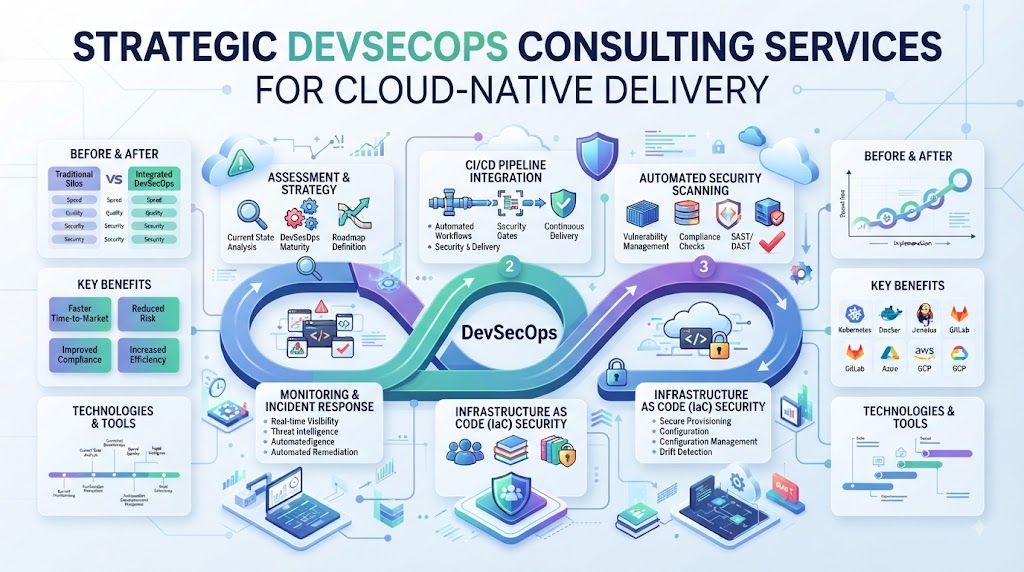
Modern engineering teams deliver code faster than ever before. With rapid release cycles and microservice architectures, software development moves at breakneck speeds. However, this speed often introduces critical vulnerability gaps. Traditional security models—where security checks occur right before production deployment—create severe bottlenecks and developer frustration. When security remains isolated from development workflows, critical flaws slip into production environments unnoticed.Integrating security directly into automated software delivery pipelines transforms how teams manage software risk. Professional DevSecOps Consulting Services enable organizations to systematically embed security practices into every phase of the development lifecycle. Rather than stopping release pipelines, security becomes a seamless continuous process.
What Is DevSecOps?
DevSecOps stands for Development, Security, and Operations. It is a modern cultural and technical practice that integrates security as a shared responsibility throughout the entire software lifecycle.
Definition of DevSecOps
DevSecOps embeds security controls directly into continuous integration and continuous delivery (CI/CD) workflows, transforming security from a reactive gate into a proactive, continuous capability.
DevOps vs. DevSecOps
Traditional DevOps emphasizes rapid feature delivery, deployment automation, and operational agility. DevSecOps expands this philosophy by embedding automated security testing, vulnerability management, and compliance checks into those exact same delivery workflows.
+-------------------------------------------------------------------+
|                        Traditional DevOps                         |
|   [Plan] -> [Code] -> [Build] -> [Test] -> [Release] -> [Deploy]  |
+-------------------------------------------------------------------+
                                                              | (Manual Audit)
                                                              v
                                                       [Security Gate] (Bottleneck)

                                   VS.

+-------------------------------------------------------------------+
|                            DevSecOps                              |
|   [Plan] -> [Code] -> [Build] -> [Test] -> [Release] -> [Deploy]  |
|     |         |         |         |         |            |        |
|  (Threat)  (SAST/    (SCA/     (DAST)    (IaC/        (Runtime    |
|   Model)    Secrets)  SBOM)              Container)   Security)   |
+-------------------------------------------------------------------+
Why Security Must Shift Left
“Shifting left” means identifying and resolving security flaws early in the development cycle. Fixes applied during initial coding cost a fraction of the time and resources required to remediate vulnerabilities discovered in production.
Security Throughout the SDLC
Security measures apply across source code repositories, build systems, artifact repositories, deployment scripts, cloud platforms, and runtime environments.
Role of Automation
Automation ensures security policies execute consistently without relying on manual audits. Automated scanning tools quickly check code commits, container images, and infrastructure code, giving developers immediate feedback.
What Are DevSecOps Consulting Services?
Modern engineering architectures require specialized expertise to integrate security tools effectively without degrading developer velocity. Modern DevSecOps Consulting Services guide organizations through the technical and organizational transition toward shift-left security.
DevSecOps Strategy
Consultants help organizations define practical security strategies, clear governance frameworks, and measurable risk-reduction milestones aligned with business goals.
Security Integration
Consultants configure security tools directly into version control platforms, build servers, and delivery pipelines to create smooth, non-disruptive feedback loops for engineering teams.
CI/CD Security
Securing build automation platforms prevents malicious pipeline tampering, unauthorized code injections, and unapproved deployment executions.
Cloud Security
Experts align identity governance, network boundaries, data encryption, and access permissions with leading security baselines like NIST Cybersecurity Framework.
Application Security
Advisors help teams identify logic flaws, code defects, and API vulnerabilities across web applications and microservices.
Infrastructure Security
Consultants enforce automated compliance and baseline security checks on Infrastructure as Code (IaC) templates before cloud resources deploy.
Container Security
Engineers secure container base images, build context, runtime privileges, and registry storage policies.
Continuous Security Monitoring
Consultants set up real-time telemetry, threat detection, and automated alerting across continuous integration and runtime production environments.
DevSecOps Implementation Services
Adopting security practices requires structured technical integration. Dedicated DevSecOps Implementation Services help engineering organizations operationalize security tools across automated pipelines.
Implementation teams configure key capabilities:
- Static Application Security Testing (SAST): Analyzes raw source code for security weaknesses during early commit stages.
- Dynamic Application Security Testing (DAST): Evaluates running applications for runtime vulnerabilities and structural flaws.
- Software Composition Analysis (SCA): Scans open-source libraries and dependencies for known security vulnerabilities.
- Secrets Scanning: Detects hardcoded passwords, API tokens, and private cryptographic keys embedded in source repositories.
- Container Scanning: Scans container image layers for outdated packages and vulnerable components.
- IaC Security: Enforces security checks on Terraform, CloudFormation, and Ansible scripts to prevent cloud misconfigurations.
- Policy as Code: Implements automated, version-controlled compliance guardrails across infrastructure environments.
- Vulnerability Management: Aggregates and correlates security findings into unified triage dashboards.
- Security Gates: Enforces automated quality guardrails that stop dangerous builds from advancing toward production.
- Automated Compliance Checks: Validates system configurations continuously against regulatory frameworks.
Practical CI/CD Pipeline Example: When a software engineer submits a code change via pull request, automated SAST tools check the code for syntax security issues. Simultaneously, SCA scans open-source dependencies, and secrets detectors evaluate commits. If security gates pass, the CI/CD platform builds a container image, scans its layers, runs IaC checks, and deploys the feature to a testing environment where automated DAST tests execute seamlessly.
DevSecOps Managed Services
Maintaining secure delivery pipelines requires ongoing operational oversight, policy updates, and triage assistance. DevSecOps Managed Services provide continuous, expert operational management for organizations seeking sustained security coverage.
Managed security operations cover continuous technical responsibilities:
- Security Pipeline Monitoring: Continuous surveillance of automated build tools, security scanners, and deployment pipelines.
- Vulnerability Management: Ongoing classification, risk assessment, and correlation of security alerts generated across environments.
- Security Policy Updates: Routine adjustments to security scanning rulesets to minimize false positives and capture emerging threats.
- Remediation Support: Expert guidance to assist engineering teams in quickly resolving complex vulnerability reports.
- Continuous Security Improvement: Ongoing adjustments to pipeline security guardrails based on evolving development practices.
- Security Monitoring: Comprehensive logging and real-time observability across production workloads.
- Incident Support: Rapid technical response assistance when pipeline anomalies or security events occur.
- Compliance Support: Continuous evidence collection for industry regulations and security standards.
Organizations benefit from managed support when internal teams lack dedicated security engineers or need focused operational support for complex cloud environments.
DevSecOps Training
Building a durable security culture requires educating engineering teams. Structured DevSecOps Training programs equip developers and operations engineers with the technical skills needed to write secure code and maintain hardened delivery systems.
Training initiatives focus on key operational technical domains:
- Secure SDLC Practices: Writing secure source code and applying defense-in-depth principles early in the lifecycle.
- CI/CD Pipeline Hardening: Securing build agents, access controls, and release workflows against unauthorized access.
- Cloud Security Engineering: Applying least-privilege identity access management (IAM) policies and structural resource limits.
- Container Security Practices: Designing minimal, secure container images and running non-root service workloads.
- Kubernetes Security: Securing cluster components, applying pod security standards, and configuring network policies.
- Automated Security Testing: Selecting, configuring, and operating SAST, DAST, and dependency security scanners.
- Security Automation Techniques: Converting manual policy guidelines into version-controlled Policy-as-Code automation.
- Vulnerability Analysis: Interrogating vulnerability reports, determining true business risk, and executing efficient fixes.
Addressing security early through effective education reduces vulnerability volume before code ever hits testing environments.
Corporate DevSecOps Training
Scalable enterprise adoption requires continuous upskilling across multiple technical domains. Customized corporate training programs align technical practices across diverse organizational groups.
Multi-Team Alignment
Enterprise training brings distinct teams onto a unified security framework:
- Development Teams: Focus on secure coding guidelines, threat modeling, and immediate remediation workflows.
- DevOps Teams: Learn to integrate security tools directly into automated CI/CD automation without slowing build pipelines.
- Security Teams: Adapt from manual risk auditors into automated tool enablers and platform advisors.
- Cloud & Infrastructure Teams: Master Infrastructure as Code security scanning and continuous cloud compliance automation.
- Platform Engineering Teams: Learn to build secure, paved-road developer platforms embedded with default security controls.
- SRE Teams: Integrate runtime security observability and automated incident response into reliability practices.
Practical Learning Frameworks
Effective enterprise education utilizes interactive methods:
- Hands-on Technical Labs: Real-world exercises practicing vulnerability discovery and remediation in live pipeline sandboxes.
- Customized Curriculum: Educational content built around the organization’s existing cloud infrastructure and toolstack.
- Real-World Attack Scenarios: Simulating realistic supply chain attacks and CI/CD security breaches to teach defense techniques.
- Tool-Based Instruction: Direct training on the specific scanners, dashboards, and security platforms deployed in production.
DevSecOps Assessment Services
Before introducing tools, organizations need a clear picture of their existing security posture. Professional assessment evaluations evaluate delivery pipelines, cloud infrastructure, and operational practices to establish baseline maturity.
Key focus areas during an assessment include:
+-----------------------------------------------------------------------+
|                 DEVSECOPS ASSESSMENT SCOPE MATRIX                     |
+--------------------------+--------------------------------------------+
| Assessment Area          | Core Technical Focus                       |
+--------------------------+--------------------------------------------+
| Pipeline Security        | CI/CD posture, secret storage, permissions |
| Code Security            | SAST/SCA coverage, developer workflows     |
| Cloud Infrastructure     | IAM roles, baseline policies, network rules|
| Container & Kubernetes   | Image baselines, RBAC, admission control   |
| Security Automation      | Automated gates, threshold policies, IaC   |
+--------------------------+--------------------------------------------+
An assessment produces a detailed gap analysis and an actionable transformation roadmap. This clear guidance helps organizations prioritize security investments based on actual business risk rather than guesswork.
Cloud Security Consulting Services
Modern application pipelines deploy directly to public cloud platforms like AWS, Microsoft Azure, and Google Cloud Platform (GCP). Expert Cloud Security Consulting Services align cloud infrastructure configurations with modern security standards.
Cloud infrastructure security involves key technical controls:
- Identity and Access Management (IAM): Enforcing strict least-privilege permissions and multi-factor authentication across services.
- Cloud Configuration Management: Monitoring infrastructure settings continuously to eliminate public storage buckets and exposed interfaces.
- Network Security & Segmentation: Isolating cloud workloads using virtual private networks, subnets, and security groups.
- Workload Security: Hardening virtual machines, serverless functions, and cloud services against exploit attempts.
- Infrastructure as Code Security: Verifying Terraform, Bicep, and CloudFormation scripts for compliance prior to deployment.
- Secrets Management: Storing cryptographic keys and database credentials safely using enterprise key management vaults.
- Logging and Observability: Centralizing telemetry logs across cloud accounts to ensure rapid threat visibility, following guidelines from OWASP Top 10 Security Risks.
Kubernetes Security Consulting Services
Container orchestration platforms like Kubernetes require specialized security controls across cluster architectures, container engines, and network layers. Dedicated consultancy services secure modern cloud-native runtime environments against container breaches.
Key Kubernetes security pillars include:
- Role-Based Access Control (RBAC): Restricting cluster access based on strict role privileges.
- Network Policies: Setting up network isolation rules between namespaces and microservices.
- Admission Control Enforcers: Using tools like Open Policy Agent (OPA) Gatekeeper or Kyverno to enforce runtime cluster policies.
- Secrets Management: Protecting Kubernetes secrets with envelope encryption and external vault integrations.
- Container Image Security: Verifying image signatures using tools like Cosign to prevent untrusted deployments.
- Pod Security Standards: Preventing privileged execution modes and restricting container root permissions.
- Runtime Threat Protection: Monitoring container process executions and system calls for anomalous behavior.
Practical Kubernetes Security Scenario: Imagine a cluster running critical financial APIs. A consultant configures admission controllers to block untrusted container images, applies strict pod security standards to stop root executions, and isolates microservices using network policies. If an attacker compromises a pod, strict RBAC permissions and network rules isolate the breach, preventing lateral movement across the cluster.
Software Supply Chain Security Services
Modern applications rely heavily on open-source libraries, container images, and third-party dependencies. Software supply chain security services give organizations complete visibility into external software assets and third-party code risks.
Supply chain security focuses on crucial technical controls:
- Open-Source Dependency Management: Tracking, auditing, and managing external software libraries across codebases.
- Software Composition Analysis (SCA): Continuously identifying known vulnerabilities within open-source code packages.
- Software Bill of Materials (SBOM): Generating detailed component inventories following standards like SPDX or CycloneDX.
- Artifact Integrity Verification: Signing code artifacts and container images using cryptographic tools to confirm authenticity.
- CI/CD Hardening: Protecting build environments, build agents, and release systems against unauthorized manipulation, aligned with frameworks like SLSA (Supply-chain Levels for Software Artifacts).
- Repository Management: Maintaining private artifact registries with strict access and security controls.
Penetration Testing Services
While automated security tools run continuous checks, human expertise remains necessary to identify complex, multi-stage logic flaws. Professional penetration testing complements automated security pipelines by simulating realistic, real-world attack scenarios.
Penetration testing covers key digital assets:
- Web Applications & APIs: Testing for authorization flaws, cross-site scripting, and business logic bypasses.
- Cloud Infrastructure: Identifying misconfigurations, privilege escalation pathways, and lateral movement risks.
- Kubernetes Clusters: Testing cluster access permissions, namespace boundaries, and container escape points.
- CI/CD Pipelines: Evaluating build system access controls, agent isolation, and secret exposures.
+-----------------------------------------------------------------+
|              COMPLEMENTARY SECURITY DEFENSE LAYER               |
+--------------------------------+--------------------------------+
| Automated Scanning (SAST/SCA)  | Continuous, fast checks for    |
|                                | known code flaws & CVEs        |
+--------------------------------+--------------------------------+
| Penetration Testing            | Expert human testing for logic |
|                                | flaws & multi-stage breaches   |
+--------------------------------+--------------------------------+
Automated tools excel at identifying known software bugs instantly, while human penetration testers excel at uncovering novel, complex exploitation risks. Together, they create a robust, layered security posture.
DevSecOps Security Toolchain
A modern security strategy integrates specialized tools across the entire software delivery lifecycle.
| Security Domain | Primary Focus | Common Technologies & Frameworks |
| Code Security | Source code static analysis | SonarQube, Checkmarx, Semgrep |
| Application Security | Runtime behavior & API testing | OWASP ZAP, Burp Suite |
| Dependency Security | Open-source vulnerability scanning | Snyk, OWASP Dependency-Check |
| Secret Detection | Exposed API keys & credentials | GitGuardian, Trufflehog |
| Container Security | Layer vulnerability scanning | Trivy, Grype, Clair |
| Infrastructure Security | Infrastructure as Code validation | Checkov, tfsec, KICS |
| Supply Chain Security | Asset inventory & artifact signing | Syft, Cosign, In-Toto |
| Runtime Security | Cluster behavior & anomaly detection | Falco, Tracee, GuardDuty |
Benefits of DevSecOps Consulting
Partnering with experienced consultants accelerates security adoption and lowers overall risk across digital platforms.
Key operational benefits include:
- Faster Bug Detection: Identifying security flaws during active coding rather than during production deployment.
- Reduced Vulnerability Exposure: Systematically eliminating security misconfigurations before applications launch.
- Rapid Remediation Workflows: Providing developers with clear fix instructions right in their existing git interfaces.
- Hardened Delivery Pipelines: Securing build and deployment tools against external attack vectors.
- Robust Cloud Governance: Enforcing automated security baselines consistently across multi-cloud environments.
- Clear Compliance Visibility: Automating standard compliance evidence gathering for audit reviews.
- Enhanced Engineering Efficiency: Eliminating tedious manual security audits through automated security testing gates.
- Improved Culture: Building seamless collaboration between development teams, operational staff, and security units.
DevSecOps Implementation Process
A structured, phased approach ensures smooth technical transitions while preserving team productivity.
  +-----------------------------------------------------------------+
  |                  DEVSECOPS ADOPTION ROADMAP                     |
  +-----------------------------------------------------------------+
  | Step 1: Assess Environment    -> Analyze existing pipeline gaps |
  | Step 2: Identify Security Gaps -> Benchmark risk vulnerabilities|
  | Step 3: Define Requirements   -> Set tooling & governance goals |
  | Step 4: Build Roadmap         -> Outline phased rollout steps   |
  | Step 5: Integrate into CI/CD  -> Automate SAST, SCA, & Secrets  |
  | Step 6: Secure Cloud & IaC    -> Apply Policy-as-Code checks    |
  | Step 7: Secure Containers     -> Enforce K8s runtime protection |
  | Step 8: Continuous Monitoring -> Refine alerts & response steps |
  +-----------------------------------------------------------------+
Step 1: Assess the Current Environment
Review existing software development processes, delivery tools, cloud configurations, and team workflows.
Step 2: Identify Security Gaps
Map current system flaws, untracked dependencies, missing security controls, and pipeline vulnerabilities.
Step 3: Define Security Requirements
Establish clear security policies, compliance goals, and risk thresholds for engineering teams.
Step 4: Build the DevSecOps Roadmap
Create a realistic implementation plan that prioritizes high-impact security improvements.
Step 5: Integrate Security into CI/CD
Embed automated static checks, dependency scanning, and secret detection directly into build scripts.
Step 6: Secure Cloud and Infrastructure
Automate IaC security scanning and apply least-privilege identity governance across cloud accounts.
Step 7: Secure Containers and Kubernetes
Enforce container image scanning, pod security standards, and runtime cluster policies.
Step 8: Implement Monitoring and Continuous Improvement
Set up continuous security observability, refine scanning rulesets, and track remediation metrics over time.
Common DevSecOps Mistakes
Organizations often encounter preventable setbacks when adopting modern security practices. Understanding these pitfalls ensures a smoother, more effective rollout.
- Treating Security as a Final Audit: Delaying security checks until right before deployment creates severe development bottlenecks.
- Solution: Shift security left by running checks directly inside developer pull requests.
- Overwhelming Teams with Too Many Tools: Deploying multiple disconnected security tools causes alert fatigue and confusion.
- Solution: Introduce automated tools systematically, focusing on accurate, actionable alerts.
- Ignoring Developer Workflows: Forcing engineers to navigate complex, isolated security portals slows down output.
- Solution: Deliver security alerts directly within code repositories and developer tools.
- Failing to Prioritize Vulnerabilities: Treating every minor alert as a critical emergency burns out engineering teams.
- Solution: Establish clear risk prioritization based on vulnerability severity and business impact.
- Neglecting Secrets Storage: Leaving passwords and API tokens exposed in source repositories creates severe breach risks.
- Solution: Use automated secret scanning alongside centralized key management vaults.
- Overlooking Cloud Infrastructure Misconfigurations: Focusing exclusively on application code while ignoring cloud settings leaves entry points exposed.
- Solution: Apply automated Infrastructure as Code scanning and real-time cloud configuration checks.
Best Practices
Establishing a resilient security posture requires following proven operational principles:
- Shift Left: Embed security checks into developer workflows early in the development cycle.
- Automate Security Routine Checks: Automate repetitive static analysis, secrets detection, and container scans.
- Prioritize Risk Intelligently: Address critical, exploit-ready vulnerabilities first to maximize engineering impact.
- Harden CI/CD Automation: Protect build servers, deployment pipelines, and service accounts with strict permissions.
- Scan Code Dependencies Continuously: Keep open-source software libraries audited and updated to prevent known vulnerabilities.
- Generate and Maintain SBOMs: Maintain detailed inventories of all software components to enable fast vulnerability response.
- Secure Cloud and Container Layers: Standardize baseline security settings across containers, clusters, and cloud environments.
- Upskill Development Teams: Provide continuous practical training to help developers write secure code by default.
How to Choose DevSecOps Consulting Services
Selecting the right security consulting partner ensures your organization achieves practical, long-term security improvements without slowing development teams down.
Consider these evaluation criteria:
- Deep Cloud-Native Expertise: Confirm real-world experience across major cloud platforms, container systems, and Kubernetes platforms.
- Practical Engineering Knowledge: Choose advisors with hands-on experience building automated CI/CD pipelines and developer tooling.
- Comprehensive Capability: Look for expertise covering application security, software supply chains, infrastructure security, and penetration testing.
- Focus on Developer Experience: Ensure the partner prioritizes frictionless developer workflows rather than creating unnecessary roadblocks.
- Customized Implementation Frameworks: Select teams that tailor security solutions to your specific architecture rather than pushing generic templates.
- Structured Training Capabilities: Verify the partner provides hands-on, practical training to help upskill your internal engineering staff.
DevSecOpsNow.com Service Fit
DevSecOpsNow.com helps organizations build secure, automated cloud-native software delivery platforms. Whether your team is just starting its security journey or optimizing existing operations, tailored service offerings address your specific needs:
- DevSecOps Consulting Services: Strategic guidance for organizations defining end-to-end cloud and security roadmaps.
- DevSecOps Implementation Services: Technical integration of SAST, SCA, DAST, secrets detection, and IaC tools into active pipelines.
- DevSecOps Managed Services: Ongoing security monitoring, alert triage support, and ruleset maintenance for growing technical teams.
- DevSecOps Training & Corporate DevSecOps Training: Interactive, hands-on educational programs to build continuous security capabilities across engineering groups.
- DevSecOps Assessment Services: Thorough pipeline, cloud, and operational maturity reviews that deliver clear transformation roadmaps.
- Cloud Security & Kubernetes Security Consulting Services: Specialized hardening, configuration checks, and runtime protection for complex cloud workloads.
- Software Supply Chain Security Services: Complete software inventory visibility, dependency scanning, and build environment protection.
- Penetration Testing Services: In-depth, expert security assessments designed to identify complex logic vulnerabilities across web applications and infrastructure.
Frequently Asked Questions
1.How do DevSecOps Consulting Services help modern engineering teams?
DevSecOps Consulting Services guide organizations through integrating security automation directly into continuous integration and release workflows. Experienced consultants assist teams in building threat models, configuring security tools, securing cloud infrastructure, and training developers. This proactive guidance prevents security bottlenecks, reduces production vulnerability exposure, and allows engineering teams to ship secure software rapidly without sacrificing delivery velocity or code quality.
2.What is the difference between DevOps and DevSecOps?
DevOps focuses primarily on driving delivery speed, operational agility, and continuous collaboration between development and operations teams. DevSecOps extends this model by embedding automated security controls, vulnerability checks, and compliance validation directly into those exact same delivery pipelines. Instead of treating security as a final, manual audit stage before deployment, DevSecOps transforms security into a shared, continuous responsibility throughout every software lifecycle phase.
3.Why should organizations shift security left in CI/CD pipelines?
Shifting security left means running automated security tests early in the development process, such as during local coding or pull request reviews. Identifying code defects, exposed secrets, and vulnerable dependencies early drastically reduces remediation costs and developer effort. Addressing issues early prevents security flaws from reaching production environments, keeping release pipelines moving smoothly while maintaining high software quality standards.
4.What are the core components of DevSecOps Implementation Services?
Implementation services focus on configuring automated security scanners into delivery pipelines. Key elements include Static Application Security Testing (SAST), Software Composition Analysis (SCA), secrets scanning, Dynamic Application Security Testing (DAST), Infrastructure as Code (IaC) verification, and container image checks. These tools enforce automated security gates, blocking dangerous builds while providing developers with fast, actionable code fixes inside their native pull request workflows.
5.When should an enterprise consider DevSecOps Managed Services?
Organizations benefit from managed services when they lack dedicated internal security engineering resources or need expert operational support to manage vulnerability alerting across complex environments. Managed providers monitor build pipelines continuously, triage vulnerability alerts, refine scanner rulesets to eliminate false positives, assist developers with complex code fixes, and keep automated security policies updated as emerging cyber threats surface.
6.How does Corporate DevSecOps Training improve security culture?
Corporate training equips developers, DevOps specialists, platform engineers, and security teams with practical, real-world security skills. Through interactive coding labs and tool-based exercises, engineering teams learn secure coding practices, automated pipeline security, and cloud hardening techniques. Educating engineers directly creates a lasting security culture, reducing software vulnerabilities at the source and minimizing reliance on downstream manual security audits.
7.What is evaluated during DevSecOps Assessment Services?
An assessment reviews an organization’s existing software delivery pipelines, source code repositories, cloud settings, container configurations, and team workflows. Security experts identify missing security controls, unmonitored software dependencies, dangerous pipeline permissions, and unencrypted secrets. The assessment produces an actionable transformation roadmap, guiding prioritized security investments based on clear technical risk analysis.
8.How does DevSecOps integrate with Cloud Security Consulting Services?
Cloud security consulting ensures public cloud infrastructure aligns with core DevSecOps practices. Consultants implement automated Infrastructure as Code (IaC) scanning, enforce strict identity governance policies, configure secure virtual networks, encrypt data repositories, and set up continuous security monitoring. This systematic integration guarantees cloud resources stay compliant and protected against misconfigurations throughout continuous delivery automated lifecycles.
9.What are the primary focus areas of Kubernetes Security Consulting Services?
Kubernetes security focuses on hardening cluster architectures, container configurations, and runtime workloads. Security consultants configure role-based access control (RBAC), enforce pod security standards, implement network isolation policies, set up automated image signature verification, and deploy policy admission controllers. These unified technical measures protect containerized workloads from unauthorized privileges and runtime exploits across cluster nodes.
10.Why is Software Supply Chain Security Services critical today?
Modern applications rely heavily on open-source libraries and third-party software packages. Supply chain security services provide complete component visibility by generating Software Bill of Materials (SBOMs), scanning external dependencies for known security flaws, enforcing code artifact signing, and hardening build environments against unauthorized tampering. This protection prevents attackers from injecting malicious code through compromised third-party dependencies.
Conclusion
Securing modern cloud-native software delivery requires shifting away from manual, late-stage security audits. As application development accelerated, legacy security gatekeeping models proved inefficient, introducing frustrating release bottlenecks and leaving undetected software vulnerabilities in production. Modern security demands an automated, integrated approach that embeds protection directly into everyday engineering workflows.Adopting professional DevSecOps Consulting Services empowers organizations to embed security across every stage of the software lifecycle. By combining automated security checks, secure cloud configurations, hardened container platforms, transparent supply chain visibility, and practical team training, organizations build highly resilient technical environments. Security evolves from a disruptive barrier into an automated, continuous business enabler.