Introduction
Kubernetes makes it easier to run modern applications at scale, but operating large clusters can quickly become complicated. Engineers may need to investigate metrics, logs, traces, container events, deployments, network behavior, and application dependencies at the same time. A large number of signals can make incident investigation slower rather than easier. This is where AIOps can add practical value. Artificial Intelligence for IT Operations combines machine learning, operational data, observability, and automation to identify unusual behavior, correlate related events, and support faster incident response. This guide explains how Kubernetes and AIOps work together, what an AIOps Platform can monitor, where automation fits, and what teams should consider before beginning an AIOps Implementation. More practical AIOps resources are available through TheAIOps.
What Is AIOps for Kubernetes?
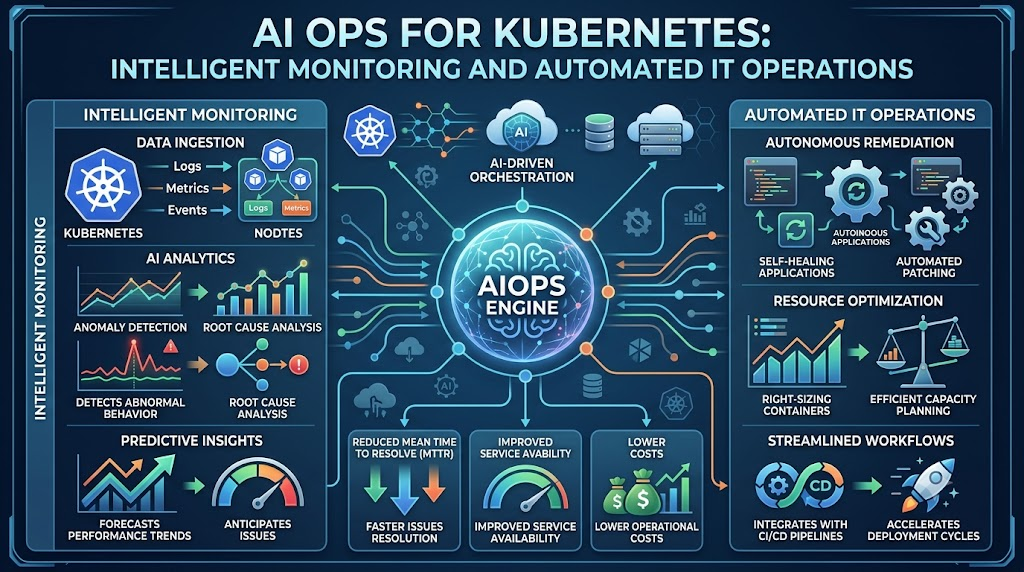
AIOps for Kubernetes means applying AI, machine learning, analytics, and automation to the operational data generated by Kubernetes environments.
A Kubernetes environment can produce large volumes of information from pods, nodes, deployments, services, containers, applications, networking components, and cloud infrastructure. Traditional monitoring can show whether a metric has crossed a threshold, but AIOps can examine relationships and patterns across multiple signals.
For example, a sudden increase in application latency may occur at the same time as pod restarts, database connection failures, and node resource pressure. Rather than treating each signal as a separate problem, an AIOps system can analyze the relationship between them and provide a more contextual incident view.
Why Kubernetes Needs Intelligent Operations
Kubernetes environments are highly dynamic. Pods can be created and removed automatically, workloads can move between nodes, services communicate across multiple layers, and deployments can change application behavior quickly.
This creates several operational challenges:
- Large volumes of monitoring data
- Short-lived containers and workloads
- Complex service dependencies
- Alert duplication and noise
- Difficult root-cause analysis
- Increasing operational workload
- Hybrid and multi-cloud complexity
AIOps can provide an additional analytical layer over existing monitoring and observability systems. It does not replace monitoring; instead, it can help teams interpret operational information more effectively.
How AIOps Works With Kubernetes Observability
AIOps depends heavily on good operational data. Kubernetes observability typically involves three major telemetry types: metrics, logs, and traces.
Metrics provide numerical information such as CPU usage, memory consumption, request rates, and latency.
Logs provide detailed records of application and infrastructure activity.
Traces show how requests move between services in distributed applications.
An AIOps Platform can combine these signals with Kubernetes events, deployment information, configuration data, and service relationships.
Anomaly Detection
Anomaly detection identifies behavior that differs significantly from an established baseline.
For example, an application normally processes a consistent number of requests, but suddenly experiences an unusual latency increase. AIOps can flag the behavior for investigation even when a traditional fixed threshold has not been crossed.
Event Correlation
Event correlation connects related signals.
Suppose a Kubernetes node develops resource pressure. Several pods may restart, application requests may fail, and monitoring systems may generate multiple alerts. Instead of presenting every notification independently, AIOps Tools can correlate related events into a more meaningful incident.
Root-Cause Analysis
Correlation does not automatically prove the root cause. It provides relationships and context that can help engineers investigate the underlying problem.
An AIOps system may connect a deployment change with increased error rates, container restarts, and downstream service failures. Engineers can then validate whether the deployment actually caused the degradation.
Practical Kubernetes AIOps Use Cases
AIOps can support several common Kubernetes operations.
Application Performance Monitoring
Teams can analyze application latency, error rates, throughput, and service dependencies alongside infrastructure metrics.
Infrastructure Monitoring
AIOps can analyze node health, resource utilization, storage conditions, networking signals, and cluster events.
Incident Management
Correlated alerts can be converted into more meaningful incidents and routed to appropriate teams based on service ownership and severity.
Predictive Analytics
Historical operational patterns can be analyzed to identify potential capacity or performance problems before they become serious incidents.
Automated Remediation
For well-understood and low-risk problems, AIOps may trigger approved runbooks. Examples include restarting a failed workload, scaling resources, or initiating a predefined recovery workflow.
Automation should remain controlled, particularly in production environments.
Kubernetes AIOps Capabilities at a Glance
| Capability | Purpose | Practical Kubernetes Example |
|---|---|---|
| Anomaly Detection | Identifies unusual system behavior | Detecting abnormal pod latency or memory usage |
| Event Correlation | Groups related operational signals | Connecting node pressure with pod failures |
| Root-Cause Analysis | Supports investigation of likely causes | Linking application errors with a recent deployment |
| Automated Remediation | Executes approved corrective workflows | Restarting a failed workload after validation |
A Practical AIOps Implementation Approach
A successful implementation should begin with a clearly defined operational problem rather than simply deploying an AI product.
1. Identify a High-Value Use Case
Start with a specific challenge such as alert overload, recurring application incidents, or slow Kubernetes troubleshooting.
2. Review Existing Observability
Assess the quality of existing metrics, logs, traces, Kubernetes events, dashboards, and alerting rules. Poor telemetry can reduce the usefulness of AI-based analysis.
3. Integrate Operational Data
Connect appropriate monitoring and observability sources. Standardized resource names, service identifiers, timestamps, and metadata make cross-system analysis easier.
4. Test Correlation and Anomaly Detection
Run the system in an environment where engineers can compare its findings with known incidents. False positives and missed events should be reviewed before expanding the implementation.
5. Introduce Controlled Automation
Begin with low-risk actions and clearly defined conditions. Production automation should include access controls, approval requirements where appropriate, health checks, audit logs, and rollback procedures.
Security and Governance Considerations
AIOps may receive access to sensitive operational systems, so security should be part of the architecture from the beginning.
Use least-privilege permissions and separate read-only analytical access from permissions that can change infrastructure. Automated actions should be logged and traceable.
Teams should also define which actions can run automatically and which require human approval. A failed automated remediation can potentially make an incident worse, so validation and rollback mechanisms are essential.
Choosing AIOps Tools for Kubernetes
Organizations evaluating AIOps Tools should consider how well a solution works with their existing technology stack.
Important evaluation areas include Kubernetes integrations, observability support, logs, metrics, traces, event correlation, anomaly detection, incident management, APIs, automation capabilities, scalability, access controls, and reporting.
The right solution depends on the organization’s architecture, operational maturity, data sources, compliance requirements, and automation goals. A tool should solve a defined operational problem rather than being selected simply because it includes AI features.
Skills Needed for Kubernetes AIOps
Professionals working with Kubernetes AIOps benefit from a combination of infrastructure and analytical skills.
An AIOps Engineer may need knowledge of Kubernetes, cloud infrastructure, monitoring, observability, scripting, automation, incident management, DevOps, and basic machine learning concepts.
AIOps Training can help learners build these skills through practical exercises involving telemetry, anomaly detection, event correlation, and automation. An AIOps Course may also cover platform architecture, implementation methods, and operational use cases.
AIOps Certification can demonstrate structured knowledge of relevant concepts, although certification requirements and learning outcomes vary by provider.
For organizations, AIOps Consulting and AIOps Services can also support architecture planning, tool evaluation, integration, and implementation when internal teams need additional expertise.
Common Mistakes to Avoid
AIOps adoption can become difficult when organizations focus on automation before establishing reliable operational foundations.
Common mistakes include:
- Collecting large amounts of poor-quality telemetry
- Integrating every data source without a clear use case
- Automating high-risk production actions too early
- Ignoring false positives and false negatives
- Treating correlation as guaranteed root-cause identification
- Failing to define ownership for incidents
- Measuring success only by alert-volume reduction
A better approach is to start small, measure operational outcomes, learn from incidents, and expand gradually.
The Future of Kubernetes and AIOps
As cloud-native systems become more distributed, operations teams will continue to manage increasingly complex relationships between applications, infrastructure, networks, and data services.
AIOps is likely to remain useful for interpreting large operational datasets, identifying unusual behavior, connecting related signals, and supporting controlled automation. The strongest implementations will combine machine intelligence with observability, reliable engineering practices, governance, and human decision-making.
FAQs
1. What is AIOps for Kubernetes?
AIOps for Kubernetes applies AI, machine learning, analytics, and automation to Kubernetes operational data to support monitoring, anomaly detection, event correlation, incident management, and remediation.
2. How does AIOps improve Kubernetes monitoring?
It can analyze signals from multiple sources and identify patterns that may be difficult to recognize when engineers examine individual alerts separately.
3. Can AIOps detect Kubernetes anomalies?
Yes. AIOps systems can analyze historical and current operational behavior to identify unusual patterns in metrics, logs, events, and other telemetry.
4. Can AIOps reduce Kubernetes alert noise?
It can help reduce noise by deduplicating and correlating related alerts, allowing engineers to focus on meaningful incidents rather than individual notifications.
5. Does AIOps automatically identify the root cause?
Not always. AIOps can provide correlations, evidence, and likely causes, but engineers may still need to validate the actual root cause.
6. Can AIOps automate Kubernetes remediation?
Yes, controlled automation can trigger predefined remediation workflows for suitable incidents. Production actions should use permissions, validation, monitoring, and rollback safeguards.
7. What data does Kubernetes AIOps use?
Depending on the implementation, it may use metrics, logs, traces, Kubernetes events, deployment information, configuration data, infrastructure telemetry, and service dependency information.
8. Is Kubernetes knowledge necessary for an AIOps Engineer?
Kubernetes is not required for every AIOps role, but knowledge of Kubernetes and cloud-native operations can be valuable for engineers working with containerized environments.
9. What should organizations consider before implementing AIOps?
They should define clear use cases, assess telemetry quality, review integrations, establish security controls, select suitable AIOps capabilities, and introduce automation gradually.
10. Can AIOps replace DevOps or SRE teams?
AIOps is generally designed to augment operational teams rather than completely replace them. Engineers remain responsible for architecture, validation, governance, complex troubleshooting, and important operational decisions.
Conclusion
AIOps can bring additional intelligence to Kubernetes operations by combining observability data, anomaly detection, event correlation, incident analysis, and controlled automation. Its value depends heavily on reliable telemetry, appropriate use cases, strong governance, and careful implementation. Rather than treating AIOps as a replacement for engineers, organizations can use it to reduce repetitive operational work and provide better context during incidents. For teams managing complex Kubernetes environments, combining AIOps with DevOps, SRE, observability, and disciplined automation can create a more informed and proactive approach to IT operations.