Introduction
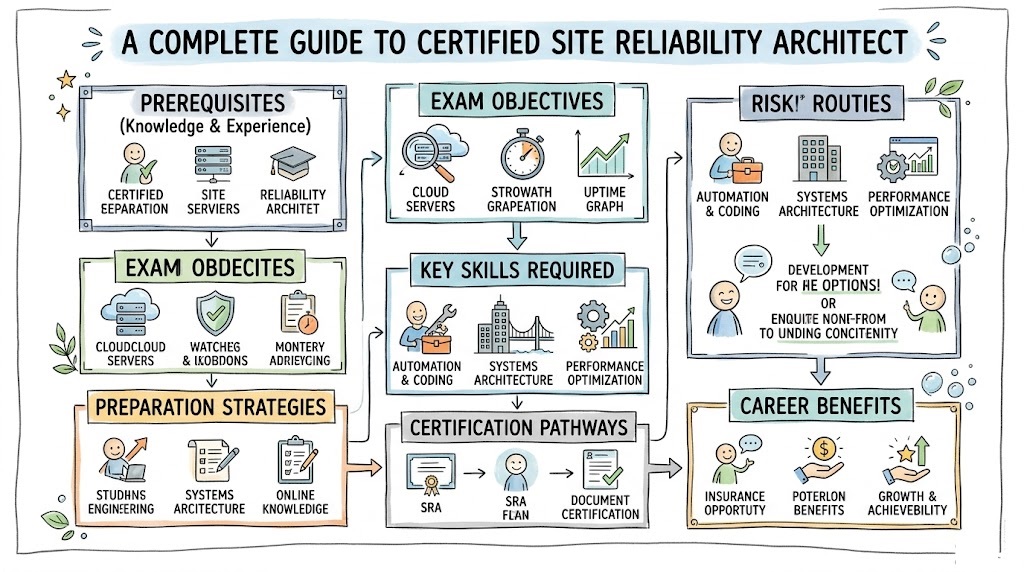
The Certified Site Reliability Architect program represents the pinnacle of modern infrastructure engineering, bridging the gap between traditional operations and advanced software architectural patterns. This guide is designed for professionals navigating the complex landscape of DevOps, cloud-native ecosystems, and platform engineering who seek to move beyond tactical tasks into strategic system design. As organizations shift toward distributed systems and microservices, the role of an architect who understands reliability as a first-class citizen has become indispensable. By following this comprehensive analysis, engineers and technical leaders can make informed decisions about their professional development, ensuring their skill sets align with the high-availability requirements of modern enterprise environments. DevOpsSchool provides the foundational ecosystem where these advanced architectural principles are cultivated through rigorous practice and industrial validation.
What is the Certified Site Reliability Architect?
The Certified Site Reliability Architect is a professional designation that validates an individual’s ability to design, implement, and govern large-scale systems with an inherent focus on stability and scalability. Unlike entry-level certifications that focus on specific tool syntax, this credential emphasizes the architectural blueprints required to maintain “five nines” of availability in production. It represents a deep understanding of how code interacts with infrastructure, how failures propagate across distributed networks, and how to build automated “self-healing” mechanisms. This certification exists to bridge the talent gap in the industry, moving away from theoretical computer science into the practical, high-stakes world of enterprise-grade production environments.
Who Should Pursue Certified Site Reliability Architect?
This track is primarily designed for mid-to-senior level professionals who are already familiar with the basics of Linux, networking, and at least one cloud provider. Systems engineers, DevOps practitioners, and SREs who find themselves responsible for the structural integrity of their platforms will find the most immediate value here. However, it is equally relevant for Cloud Architects and Security Engineers who need to ensure that their designs are not just functional, but resilient against unpredictable traffic spikes and infrastructure degradation. In the Indian market and globally, there is a massive surge in demand for architects who can justify infrastructure costs through the lens of reliability and performance metrics, making this ideal for aspiring technical leads and engineering managers.
Why Certified Site Reliability Architect is Valuable and Beyond
The longevity of a career in technology is often threatened by the rapid “tool churn” where software becomes obsolete in a matter of months; however, architectural principles remain constant. This certification focuses on the core logic of reliability, such as error budgets, toil reduction, and observability, which are independent of whether a company uses AWS, Azure, or on-premise data centers. As enterprises increasingly adopt hybrid-cloud and multi-cloud strategies, the ability to architect for consistency across diverse environments ensures long-term career relevance. Investing time in this certification offers a high return because it shifts a professional’s value proposition from “someone who runs tools” to “someone who designs resilient business systems.”
Certified Site Reliability Architect Certification Overview
The program is delivered via the official training portal and hosted on Sreschool. The assessment approach is uniquely focused on practical competency, requiring candidates to demonstrate knowledge of complex system interactions rather than just memorizing definitions. Ownership of the certification rests with a body of industry practitioners who ensure the curriculum reflects current production challenges found in top-tier tech firms. The structure is modular, allowing learners to progress from foundational concepts of reliability to the advanced nuances of architectural governance and automated incident response.
Certified Site Reliability Architect Certification Tracks & Levels
The certification is structured to support a natural career progression, starting with a Foundation level that introduces SRE terminology and basic metrics like SLIs and SLOs. From there, the Professional level dives into the implementation of automation and deployment pipelines that prioritize safety and rollback capabilities. The Advanced or Architect level focuses on the holistic design of ecosystems, including disaster recovery at scale and cost-optimization strategies. Specialization tracks are also available for those who want to blend SRE principles with specific domains like security (DevSecOps) or financial management (FinOps), ensuring that the architect can speak the language of both the developer and the CFO.
Complete Certified Site Reliability Architect Certification Table
| Track | Level | Who it’s for | Prerequisites | Skills Covered | Recommended Order |
| Core SRE | Foundation | Junior Engineers | Basic Linux | SLOs, SLIs, Toil, Monitoring | 1 |
| Engineering | Professional | SRE / DevOps | 2 Years Exp | Automation, Python, CI/CD | 2 |
| Architecture | Advanced | Senior SRE / Lead | 5 Years Exp | Distributed Systems, DR, Scalability | 3 |
| Security | Specialist | Security Eng | Cloud Basics | Chaos Engineering, IAM, Compliance | 4 |
| Operations | Management | Eng Managers | Team Lead Exp | Error Budgets, Incident Response | 5 |
Detailed Guide for Each Certified Site Reliability Architect Certification
What it is
This level validates the candidate’s understanding of the fundamental vocabulary and philosophy of Site Reliability Engineering. It ensures that the professional can distinguish between traditional IT operations and the SRE approach to managing systems.
Who should take it
It is suitable for junior developers, system administrators, or technical project managers who are new to the world of SRE and need a solid conceptual footing.
Skills you’ll gain
- Defining and measuring Service Level Objectives (SLOs)
- Identifying and eliminating operational toil
- Understanding the basics of monitoring and alerting
- Grasping the concept of Error Budgets
Real-world projects you should be able to do
- Create a reliability dashboard for a simple web application
- Draft a basic Service Level Agreement (SLA) for a departmental tool
- Perform a post-mortem analysis on a simulated system failure
Preparation plan
- 7-14 Days: Focus on reading the SRE Handbook and understanding key definitions.
- 30 Days: Engage with online labs to practice setting up basic Prometheus monitoring.
- 60 Days: Participate in study groups and complete three full-length mock examinations.
Common mistakes
- Confusing SLAs with SLOs during the assessment.
- Focusing too much on specific tools like Grafana instead of the underlying metrics.
Best next certification after this
- Same-track option: Professional SRE Engineer
- Cross-track option: Cloud Practitioner
- Leadership option: Technical Team Lead
Choose Your Learning Path
DevOps Path
This path focuses on the integration of development and operations through the lens of reliability. It emphasizes CI/CD pipelines that are not just fast, but resilient. Professionals will learn how to inject automated testing and reliability gates into every stage of the software delivery lifecycle. This ensures that only high-quality, stable code reaches the production environment.
DevSecOps Path
Safety and reliability are two sides of the same coin in this learning track. You will learn how to integrate security scanning and compliance checks into the SRE workflow without slowing down the release cycle. This path is essential for those working in regulated industries where a system failure or a security breach carries equal weight.
SRE Path
The pure SRE path is dedicated to the science of operations. It focuses heavily on software engineering approaches to infrastructure problems. You will master the art of observability, incident management, and capacity planning. This is the core track for anyone aiming to become a specialist in maintaining high-scale web properties.
AIOps Path
In this specialized track, you will explore how machine learning can be applied to operational data to predict and prevent outages. It involves using algorithms to filter through millions of log lines and metrics to find the “needle in the haystack” before it causes a system-wide failure. This is the future of managing hyper-scale environments.
MLOps Path
This path is tailored for those supporting data science teams. It focuses on the reliability of machine learning models in production. You will learn how to architect systems that handle model versioning, data drift, and the unique resource requirements of GPU-heavy workloads, ensuring that AI services remain available and accurate.
DataOps Path
Reliability in the world of big data is the primary focus here. This path covers the architecture of data pipelines, ensuring that data flows from sources to warehouses without corruption or delay. You will learn how to apply SRE principles to databases, streaming platforms like Kafka, and large-scale analytical engines.
FinOps Path
The FinOps path teaches the architect how to balance performance and reliability with cost-efficiency. It involves understanding cloud billing models and designing architectures that scale down during low-usage periods. This ensures that the pursuit of five-nines reliability does not result in an unsustainable cloud bill for the organization.
Role → Recommended Certified Site Reliability Architect Certifications
| Role | Recommended Certifications |
| DevOps Engineer | Foundation, Professional, DevSecOps Specialist |
| SRE | Foundation, Professional, Advanced Architect |
| Platform Engineer | Professional, Advanced, FinOps Specialist |
| Cloud Engineer | Foundation, Professional, Multi-Cloud Architect |
| Security Engineer | Foundation, DevSecOps Specialist, Advanced |
| Data Engineer | Foundation, DataOps Specialist |
| FinOps Practitioner | Foundation, FinOps Specialist |
| Engineering Manager | Foundation, SRE Management, Advanced |
Next Certifications to Take After Certified Site Reliability Architect
Same Track Progression
After achieving the Architect status, professionals should look toward deep specialization in specific domains like Chaos Engineering or Advanced Observability. These micro-credentials allow a practitioner to stay at the absolute cutting edge of the SRE field. Continuous learning is required to maintain the architect status as new technologies like serverless and edge computing evolve.
Cross-Track Expansion
An architect who masters reliability may choose to expand into the world of Data Science or Security. By obtaining certifications in DevSecOps or MLOps, a Site Reliability Architect becomes a “T-shaped” professional. This makes them significantly more valuable as they can lead cross-functional teams and understand the constraints of multiple departments.
Leadership & Management Track
For those looking to move away from the keyboard and into the boardroom, the transition to Engineering Management is the logical next step. Certifications in Agile leadership or IT Service Management (ITSM) can complement the technical depth of the SRE Architect. This allows the professional to manage large budgets, set department strategy, and mentor the next generation of engineers.
Training & Certification Support Providers for Certified Site Reliability Architect
DevOpsSchool
DevOpsSchool provides an extensive ecosystem for learning SRE and architectural principles. They offer instructor-led training that focuses on real-world scenarios and hands-on labs. Their curriculum is updated frequently to include the latest industry trends and toolsets.
Cotocus
Cotocus is known for its boutique training approach, focusing on niche high-end technologies within the SRE domain. They provide specialized coaching for senior professionals looking to master complex architectural patterns. Their trainers are often active consultants in the field.
Scmgalaxy
Scmgalaxy serves as a massive community resource and training hub for Configuration Management and SRE professionals. They provide a wealth of free tutorials alongside their structured certification programs. It is an excellent place for continuous learning and community engagement.
BestDevOps
BestDevOps focuses on delivering high-quality, streamlined courses for those who want to achieve certification quickly without sacrificing depth. Their methodology emphasizes exam readiness and practical implementation. They are a popular choice for corporate training batches.
Devsecopsschool
Devsecopsschool is the premier destination for professionals who want to blend reliability with security. Their training programs are designed to teach how to bake security into the SRE lifecycle. They offer some of the most comprehensive DevSecOps labs available today.
Sreschool
Sreschool is the primary host for the Site Reliability Architect programs, offering a dedicated environment for SRE excellence. Their focus is purely on the reliability engineering discipline, ensuring a deep and focused learning experience. They provide the official curriculum and assessment platforms.
Aiopsschool
Aiopsschool is at the forefront of the artificial intelligence revolution in operations. They provide training on how to use AI and ML to automate IT operations. Their courses cover everything from basic data analysis to complex predictive maintenance models.
Dataopsschool
Dataopsschool focuses on the intersection of data engineering and operational excellence. They teach professionals how to manage data as a product with high reliability. Their training covers data pipeline automation, quality, and governance at scale.
Finopsschool
Finopsschool addresses the growing need for cloud financial management. They provide training on how to align cloud spending with business value. Their courses are essential for architects who need to manage large-scale infrastructure budgets.
Frequently Asked Questions (General)
1.How difficult is the Certified Site Reliability Architect exam?
The exam is considered challenging as it requires a blend of architectural theory and practical troubleshooting. It is designed to test your ability to think under pressure and design for failure.
2.How much time does it take to get certified?
Depending on your starting experience, it can take anywhere from three to six months. A seasoned SRE might complete the core levels faster than a generalist developer.
3.What are the prerequisites for the Architect level?
You generally need a solid understanding of cloud computing and at least five years of experience in an operations or development role.
4.Is there a high ROI for this certification?
Yes, architects in this field often see significant salary increases and access to leadership roles in top-tier technology firms.
5.Do I need to know how to code?
While you don’t need to be a senior software engineer, you must be comfortable with scripting and understanding application logic.
6.How long is the certification valid?
Most certifications in this track are valid for two to three years, after which you must renew to prove your knowledge of current tools.
7.Is the exam lab-based or multiple choice?
The program uses a combination of both to ensure that candidates can apply what they have learned in a real-world environment.
8.Can I take the exam online?
Yes, the certification is designed to be accessible globally through secure online proctoring platforms.
9.Are there study groups available?
Yes, the provider communities often host study groups and forums where candidates can share tips and resources.
10.What is the passing score?
Passing scores vary by level, but generally, you need to achieve at least 70% to demonstrate proficiency.
11.Is the certification recognized globally?
Yes, SRE principles are universal, and this certification is valued by multinational corporations across all continents.
12.What if I fail the exam?
Most providers offer a retake policy after a mandatory waiting period to allow for further study and preparation.
FAQs on Certified Site Reliability Architect
1.What makes the architecture level different from a senior SRE role?
The architecture level focuses on the “big picture” and the long-term structural health of the entire organization’s platform, rather than just the reliability of a single service or team.
2.How does this certification handle multi-cloud environments?
The curriculum is designed to be cloud-agnostic, focusing on patterns that work across AWS, Azure, and Google Cloud, which is vital for modern enterprise architects.
3.Does this cover legacy system migration?
Yes, a key component of the architect’s role is understanding how to bring SRE principles to older, monolithic systems during the modernization process.
4.Is Chaos Engineering a major part of the curriculum?
Absolutely. Learning how to safely inject failure into a system to test its resilience is a core competency at the Professional and Architect levels.
5.How are SLOs and Error Budgets tested?
You will be expected to calculate error budgets based on various availability targets and explain how to negotiate these with product stakeholders.
6.Does the course cover the cultural shift of SRE?
Yes, the certification recognizes that SRE is as much about culture and people as it is about technology and automation.
7.Will I learn about serverless reliability?
The advanced modules cover the unique challenges of serverless and event-driven architectures, where traditional monitoring often fails.
8.Can this certification help me move into a CTO role?
It provides the technical foundation and strategic thinking necessary to oversee an organization’s entire technology operations and infrastructure roadmap.
Conclusion
In the current landscape of digital transformation, the Certified Site Reliability Architect is more than just a title; it is a validation of a professional’s ability to safeguard a company’s digital future. While the journey to achieving this certification requires a significant investment of time and intellectual effort, the rewards are tangible. You move from being a reactive problem-solver to a proactive designer of resilient systems. For the engineer who wants to stay relevant and the manager who wants to build high-performing teams, this path offers a clear, structured, and highly respected roadmap. It is an investment in your ability to handle the scale and complexity of tomorrow’s technology today.