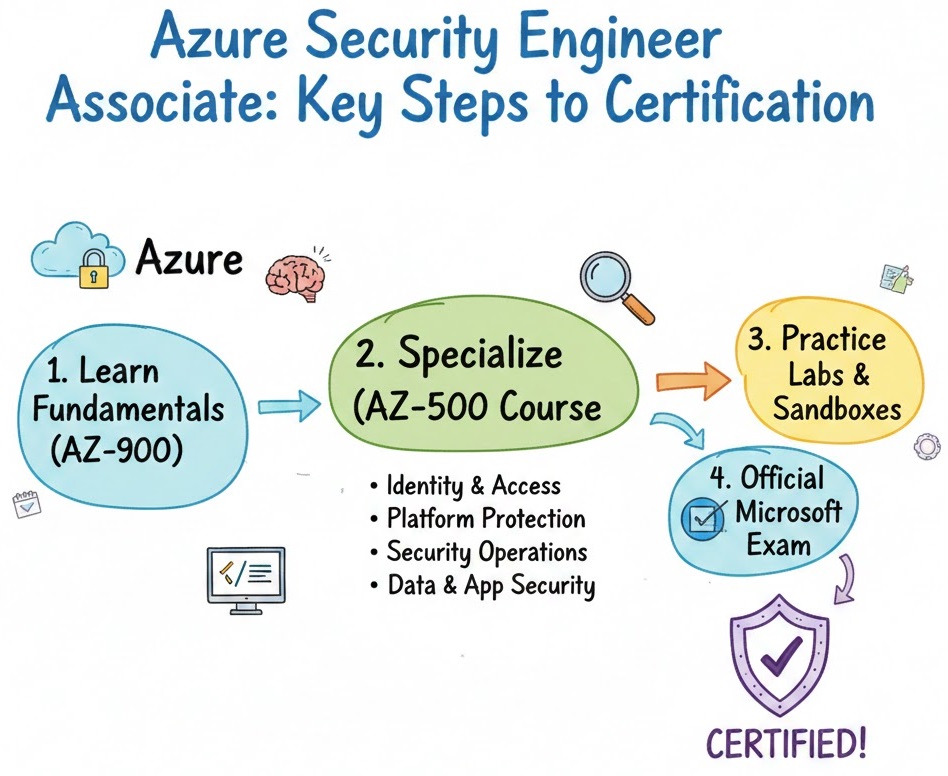
Introduction
The Azure Security Engineer Associate (AZ-500) certification is an industry-recognized credential from Microsoft that validates your ability to secure Microsoft Azure environments. As cloud services become integral to business operations, the demand for professionals skilled in securing these environments is rising rapidly. This guide serves as a comprehensive resource to understand what this certification entails, how to prepare for it, the skills you’ll gain, and how it can accelerate your career.In this guide, we will cover the certification in detail, explain the best ways to prepare, list recommended next steps after certification, and help you decide whether the Azure Security Engineer Associate certification aligns with your career goals.
What is Azure Security Engineer Associate (AZ-500)?
The Azure Security Engineer Associate (AZ-500) certification is a specialized credential that validates a candidate’s skills in securing Microsoft Azure environments. This certification is essential for professionals responsible for securing cloud-based infrastructures, applications, and data in Microsoft Azure.
As an Azure Security Engineer, you will be responsible for:
- Implementing security controls and threat protection
- Managing identity and access within Azure
- Protecting data, applications, and networks from cyber threats
- Monitoring and responding to security incidents using Azure tools
This certification is designed to confirm that you can perform essential security tasks on the Azure platform, ensuring your company’s cloud infrastructure remains secure and compliant.
Who Should Take the AZ-500 Certification?
The AZ-500 certification is perfect for professionals who are working or aspiring to work in security-focused roles in Azure environments. The certification is designed for:
- Azure Security Engineers – Professionals who specialize in securing Azure environments and cloud-based systems.
- Cloud Administrators – Those responsible for managing Azure cloud environments and ensuring their security.
- DevSecOps Engineers – Professionals focused on integrating security practices into DevOps workflows in Azure.
- Security Consultants – Individuals advising organizations on securing their cloud infrastructure and applications.
- Cloud Engineers – Engineers working on infrastructure and security configuration within Azure.
If you are already working with Azure or looking to transition into a security-focused role within Azure, this certification can help you stand out in the cloud security job market.
Skills You’ll Gain
By earning the AZ-500 certification, you will master a wide range of skills critical to securing Azure environments. The key skills you will gain include:
1. Identity and Access Management
- Implementing Azure Active Directory (Azure AD) for identity management
- Configuring multi-factor authentication (MFA)
- Managing access control policies using Role-Based Access Control (RBAC)
- Configuring conditional access policies
2. Platform Protection
- Configuring Azure Firewall, Network Security Groups (NSGs), and Virtual Networks for protection
- Implementing DDoS Protection and Web Application Firewall (WAF)
- Managing Azure Security Center and Azure Sentinel for security operations
3. Data Protection
- Encrypting data in transit and at rest using Azure services
- Configuring Azure Key Vault for storing secrets, keys, and certificates
- Implementing information protection policies for sensitive data in Azure
4. Security Operations Management
- Monitoring security alerts using Azure Security Center and Azure Sentinel
- Investigating and responding to security incidents and vulnerabilities
- Leveraging Azure Defender to provide advanced threat protection
5. Application Security
- Securing applications deployed on Azure App Services and Azure Kubernetes Services
- Implementing API management and securing containerized applications
- Integrating security practices into DevOps pipelines
These skills will empower you to implement robust security measures in Azure environments and effectively mitigate potential risks and vulnerabilities.
Real-World Projects You Should Be Able to Do After the AZ-500 Certification
Upon completing the AZ-500 certification, you should be able to implement several real-world security practices, including:
- Configuring and securing Azure Active Directory: Setting up an identity management system with proper role assignments and MFA.
- Implementing secure network infrastructure: Configuring virtual networks, NSGs, and firewalls to create secure communication paths.
- Setting up threat detection: Using Azure Security Center and Sentinel to monitor for malicious activity, identify vulnerabilities, and take action.
- Encrypting sensitive data: Configuring encryption for data stored in Azure Blob Storage, Azure SQL Database, and more.
- Building a secure DevOps pipeline: Integrating security into DevOps workflows using Azure DevOps, ensuring the protection of deployed code.
These projects will give you hands-on experience with Azure’s security tools and make you well-prepared for the real-world challenges security engineers face.
Preparation Plan
7-14 Days
- Overview of Azure Security Concepts: Familiarize yourself with Azure Active Directory (AAD), RBAC, and basic Azure security services.
- Focus on Identity Protection: Learn to implement MFA, manage identity lifecycles, and understand Azure AD Connect.
30 Days
- Azure Security Center and Sentinel: Learn about these critical tools for security management.
- Hands-on Labs: Work on setting up firewalls, configuring NSGs, and securing APIs.
- Threat Detection: Practice using Azure Defender and Azure Security Center to identify and mitigate threats.
60 Days
- Advanced Topics: Dive into complex topics like Azure Key Vault, Advanced Threat Protection, and Application Security.
- Real-World Simulations: Work on simulated projects that mirror the real-world tasks you will face in Azure security.
- Mock Exams: Take practice exams to test your knowledge and skills.
Common Mistakes to Avoid
- Ignoring Hands-On Practice: Simply reading about Azure security concepts is not enough. Hands-on experience with Azure services is essential.
- Not Mastering Identity Management: Azure AD is a core aspect of cloud security. Ignoring it can result in a poor understanding of security access controls.
- Neglecting Threat Protection: Without threat protection tools like Azure Sentinel, your security infrastructure may be left vulnerable.
- Skipping Networking and Firewall Configurations: These are vital components for securing cloud networks, and understanding them will give you an edge.
Best Next Certification After AZ-500
- Microsoft Certified: Azure Solutions Architect Expert (AZ-303 & AZ-304)
- Certified Information Systems Security Professional (CISSP)
- Certified Ethical Hacker (CEH)
Choose Your Path
1. DevOps
Focus on integrating security into the DevOps workflow. Automate security in the CI/CD pipeline and ensure secure code deployment.
Recommended Next Certifications:
- AZ-400: Azure DevOps Engineer Expert
- Certified Kubernetes Administrator (CKA)
Roles: DevOps Engineer, Security DevOps Engineer
2. DevSecOps
DevSecOps integrates security into DevOps, ensuring continuous security in the development process.
Recommended Next Certifications:
- Certified DevSecOps Professional
- Certified Ethical Hacker (CEH)
Roles: DevSecOps Engineer, Cloud Security Engineer
3. SRE (Site Reliability Engineering)
Focus on maintaining system reliability while securing services in the cloud. Ensure uptime and security in production environments.
Recommended Next Certifications:
- AZ-303 & AZ-304: Azure Solutions Architect Expert
- Google Cloud Professional Cloud Security Engineer
Roles: Site Reliability Engineer, Cloud Operations Engineer
4. AIOps/MLOps
Leverage AI and ML to enhance operations and security in cloud environments. Automate anomaly detection and optimize cloud security.
Recommended Next Certifications:
- AZ-102: Azure AI Engineer Associate
- Azure Data Scientist Associate (DP-100)
Roles: AIOps Engineer, Machine Learning Engineer
5. DataOps
Secure data pipelines and manage data workflows in the cloud. Ensure compliance and security in big data operations.
Recommended Next Certifications:
- Azure Data Engineer Associate (DP-203)
- Certified Information Privacy Professional (CIPP)
Roles: DataOps Engineer, Data Security Architect
6. FinOps
FinOps focuses on optimizing cloud costs while ensuring security compliance in financial operations.
Recommended Next Certifications:
- Azure Fundamentals (AZ-900)
- FinOps Certified Practitioner
Roles: FinOps Practitioner, Cloud Financial Analyst
Role → Recommended Certifications
| Role | Recommended Certifications |
|---|---|
| DevOps Engineer | AZ-500, AZ-400, Azure Solutions Architect |
| SRE | AZ-500, Azure Monitoring & Management |
| Cloud Engineer | AZ-500, AZ-303, AZ-304 |
| Security Engineer | AZ-500, CISSP, Certified Ethical Hacker (CEH) |
| Data Engineer | AZ-500, Azure Data Engineer |
| Platform Engineer | AZ-500, Azure Infrastructure |
| Engineering Manager | AZ-500, Azure DevOps Engineer Expert |
Comparison Table of Azure Security Engineer Associate (AZ-500) with Other Security Certifications
| Certification | Track | Level | Who it’s For | Prerequisites | Skills Covered | Recommended Order |
|---|---|---|---|---|---|---|
| Azure Security Engineer Associate (AZ-500) | Cloud Security | Associate | Cloud engineers, security professionals | Basic Azure knowledge | Identity management, threat protection, data and app security, security operations, network security | 1. AZ-104 (Azure Administrator) |
| Certified Information Systems Security Professional (CISSP) | Cybersecurity | Advanced | Security managers, architects, and engineers | 5 years of full-time work experience in security | Risk management, asset security, security operations, software development, cloud security | Followed by leadership or architect roles |
| Certified Ethical Hacker (CEH) | Cybersecurity | Associate | IT professionals, security experts | CompTIA Security+ (or equivalent) | Penetration testing, network security, web app security, system hacking techniques, vulnerability analysis | Follow-up certifications like OSCP |
| Microsoft Certified: Azure Solutions Architect Expert | Cloud Architecture | Expert | Experienced cloud professionals | AZ-103 or equivalent | Designing and implementing Azure infrastructure, advanced networking, security, hybrid cloud architecture | After AZ-500 or similar foundational exams |
| CompTIA Security+ | General Security | Entry-level | Beginners in IT security | None | Basic network security, risk management, cryptography, compliance, threats and vulnerabilities | Ideal entry before advanced certifications |
Top Institutions for Azure Security Engineer Associate (AZ‑500) Training and Certification
1. DevOpsSchool
DevOpsSchool is known for its industry‑aligned curriculum that blends theory with hands‑on labs. Their AZ‑500 training focuses on real‑world cloud security practices, practical scenarios, and exam tips. Sessions include identity and access management, network security, security monitoring, and compliance best practices.
2. Cotocus
Cotocus offers structured Azure security programs that are easy to follow for both beginners and experienced professionals. Their training includes live instructor sessions, interactive Q&A, and hands‑on labs, helping you build confidence in core AZ‑500 topics like Azure Security Center, Azure Sentinel, and threat protection.
3. ScmGalaxy
ScmGalaxy is a community‑driven training provider that emphasizes practical learning. Their Azure Security Engineer training integrates real case studies, hands‑on Azure labs, and test simulation exercises. This makes it a good fit for professionals who want in‑depth understanding beyond theoretical concepts.
4. BestDevOps
BestDevOps delivers flexible Azure security training options suited for working professionals. Their AZ‑500 training covers identity, network security, encryption, threat detection, and secure governance. The program includes practice tests and lab sessions to enhance readiness for the certification exam.
5. DevSecOpsSchool
DevSecOpsSchool specializes in combining security and cloud technologies. The AZ‑500 training here is built for security‑first professionals who want to master secure infrastructure, automated threat detection, and defensive cloud security practices. The curriculum focuses on real‑world security operations in Azure.
6. SRESchool
SRESchool bridges reliability engineering with security practices. While not limited to security alone, their Azure Security training is adapted for site reliability and infrastructure engineers looking to upskill in Azure security and monitoring. Their focus on observability and incident response complements the AZ‑500 exam objectives.
7. AIOpsSchool
For professionals interested in AI‑powered cloud operations and security automation, AIOpsSchool offers specialized training that incorporates AI/ML into security operations on Azure. This is beneficial for those who want to leverage Azure Sentinel and AI‑driven threat analytics in their career.
8. DataOpsSchool
DataOpsSchool focuses on secure data engineering practices within Azure. The AZ‑500 training here places special emphasis on data protection, encryption, access governance, and compliance controls—valuable for data professionals aiming to secure cloud data pipelines.
9. FinOpsSchool
FinOpsSchool combines cloud cost optimization with security governance. Their AZ‑500 training includes modules on secure financial operations, compliance, budget governance, and cloud policy enforcement. This makes it a great fit for professionals who want to manage secure, cost‑efficient cloud environments.
FAQs on Azure Security Engineer Associate (AZ-500)
- What is the difficulty level of the AZ-500 exam?
The AZ-500 exam is considered intermediate to advanced, requiring a strong grasp of Azure’s security services and cloud security practices. - How much time should I devote to studying for the AZ-500?
A study period of 30-60 days is recommended for most candidates. - What are the prerequisites for taking the AZ-500 exam?
Basic understanding of Azure, cloud computing, and security principles is recommended. - What should I study first?
Start with understanding Azure Active Directory, as it forms the foundation of Azure security. - How much does the AZ-500 exam cost?
The exam typically costs around $165 USD. Always check the official Microsoft site for updates. - Can I take the AZ-500 exam online?
Yes, you can take the AZ-500 exam online through Pearson VUE. - What are the career outcomes after earning the AZ-500?
This certification can lead to roles like Azure Security Engineer, Cloud Security Architect, and Cybersecurity Analyst. - How do I renew my Azure certification?
Microsoft certifications are valid for two years. To renew, you need to take the free online renewal exam.
FAQs
- What is the difficulty level of the AZ-500 exam?
The AZ-500 exam is considered intermediate to advanced. You need a solid understanding of Azure security concepts, practical experience, and hands-on skills to succeed. - How long does it take to prepare for the AZ-500 exam?
Preparation time typically ranges from 30 to 60 days, depending on your experience level and study schedule. Focus on hands-on practice and understanding Azure services. - Do I need prior Azure experience before taking the AZ-500 exam?
It is recommended to have some basic knowledge of Azure, such as understanding Azure Active Directory and networking basics, though the certification doesn’t have strict prerequisites. - What are the key topics covered in the AZ-500 exam?
Key topics include managing identity and access, implementing platform protection, managing security operations, protecting data and applications, and securing virtual networks. - Can I take the AZ-500 exam online?
Yes, the AZ-500 exam is available online through Pearson VUE, which allows you to take the exam from the comfort of your home or office. - What study materials should I use for the AZ-500 exam?
Use a combination of Microsoft Learn, official Azure documentation, practice exams, and hands-on labs to prepare effectively. Online courses and books from recognized training providers can also be very helpful. - What is the cost of the AZ-500 exam?
The exam typically costs around $165 USD. Be sure to check the Microsoft certification website for the most up-to-date pricing. - Is the AZ-500 certification valid globally?
Yes, the AZ-500 certification is recognized globally and is highly valued by employers looking for cloud security professionals. - How many questions are in the AZ-500 exam?
The exam consists of approximately 40 to 60 questions. The questions are a mix of multiple-choice, drag-and-drop, and scenario-based questions. - How long is the AZ-500 exam?
The exam is typically 150 minutes (2.5 hours) long, giving you ample time to answer the questions and review your answers. - What is the passing score for the AZ-500 exam?
The passing score for the AZ-500 exam is 700 out of 1000. This score reflects your overall understanding of the exam topics. - What career opportunities can I pursue after obtaining the AZ-500?
After earning the AZ-500 certification, you can pursue roles such as Azure Security Engineer, Cloud Security Architect, Cybersecurity Analyst, or Cloud Engineer, with opportunities in both on-premise and cloud environments.
Conclusion
The Azure Security Engineer Associate (AZ-500) certification is an essential credential for cloud security professionals. It equips you with the skills and knowledge needed to protect and secure Azure environments, from identity management to advanced threat protection. By obtaining this certification, you demonstrate your ability to implement robust security controls, manage risks, and respond to security incidents within Azure.Whether you’re just starting your career or looking to deepen your cloud security expertise, the AZ-500 certification offers tremendous value. It opens up career opportunities in various industries and can lead to roles such as Azure Security Engineer, Cloud Security Architect, and more. With the right preparation, resources, and hands-on practice, you’ll be well on your way to passing the exam and advancing in your cloud security career.