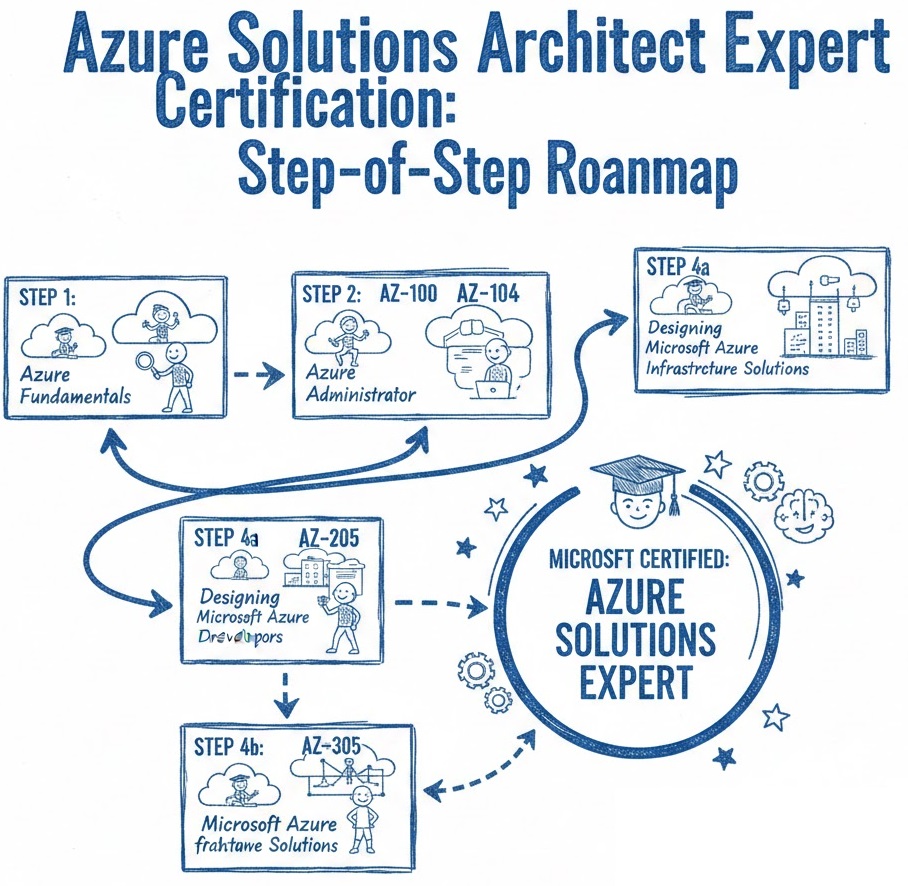
Cloud work today is not only about deploying an app. It is about building systems that stay secure, handle growth, recover from failures, and remain cost-controlled. That is exactly where Azure Solutions Architect Expert fits. This certification is designed for people who make design decisions: how identity is structured, how networks are segmented, how apps run, how data is stored, how resilience is planned, and how governance is enforced.This guide is written for working engineers and managers (India + global) who want a clear, practical understanding of what this certification proves, what you should learn, what projects you should be able to deliver, and how to prepare in a realistic timeline.
What Azure Solutions Architect Expert Really Means in the Real World
A Solutions Architect in Azure is the person who connects business needs to technical design. The job is not “knowing every Azure service.” The job is choosing the right services and patterns so the system works under pressure.
This certification validates that you can:
- Design secure access and governance for teams and workloads
- Build network and connectivity plans for cloud and hybrid setups
- Select compute platforms based on workload needs (VMs, containers, PaaS)
- Design data and storage with performance, backup, and security in mind
- Plan reliability: availability, failover, backup, disaster recovery
- Enable operations: monitoring, logging, alerting, incident readiness
- Design with cost awareness: scaling choices, budgets, and guardrails
If your role already touches architecture decisions, this certification helps you formalize and strengthen that capability.
Who Should Consider This Certification
This certification is a strong match if you are:
- A Cloud Engineer moving toward architecture ownership
- A DevOps / Platform Engineer building shared platforms, landing zones, and guardrails
- An SRE who designs reliability, resilience, and operational readiness
- A Senior Developer who wants to lead system design, not only code
- A Security Engineer supporting cloud governance and secure architecture
- An Engineering Manager who must evaluate design trade-offs and risk
What You Should Know Before Starting
You do not need a job title called “Architect” to take it. But you should be comfortable with:
- Basic Azure concepts (subscriptions, resource groups, IAM basics)
- Networking fundamentals (VNets, routing, segmentation basics)
- Security basics (least privilege, identity-first thinking)
- General system design ideas (availability, scaling, performance)
Even if your experience is mixed (some Azure + some other cloud), you can still succeed by using a structured plan and practicing architecture scenarios.
Certification Reference Table
You requested a table with Track, Level, Who it’s for, Prerequisites, Skills covered, Recommended order, Link. You also requested that no external links appear except the URLs you provided. So, for items where a link is not provided in your prompt, the Link is written as Not provided.
| Track | Level | Certification | Who it’s for | Prerequisites | Skills covered | Recommended order |
|---|---|---|---|---|---|---|
| Azure Architecture | Expert | Azure Solutions Architect Expert | Senior engineers, cloud/platform/devops roles, managers guiding architecture | Azure basics + real workload exposure recommended | Identity, governance, networking, compute, storage/data, reliability, ops, cost | 1 |
| Azure Administration | Intermediate | Azure Administration Skill Path | Cloud/Ops engineers | Azure basics | Resource control, operations, networking basics, storage fundamentals | 2 |
| Azure Development | Intermediate | Azure Development Skill Path | Developers building on Azure | App development basics | PaaS usage, app integration, deployment practices | 3 |
| DevOps / Platform | Advanced | DevOps Engineering Skill Path | DevOps and platform engineers | CI/CD basics + cloud basics | Pipelines, IaC, releases, reliability patterns, automation | 4 |
| Azure Security | Advanced | Cloud Security Skill Path | Security and cloud engineers | Security fundamentals | Identity security, governance controls, secure design patterns | 5 |
| Data Engineering | Advanced | Data Engineering Skill Path | Data engineers and analytics teams | Data fundamentals | Storage design, pipelines, governance, reliability | 6 |
| Reliability | Advanced | SRE Skill Path | SREs, platform ops | Production operations knowledge | SLO thinking, observability, incident response, resilience | 7 |
| FinOps | Professional | FinOps Skill Path | Cost owners, cloud managers, engineers | Cloud billing basics | Cost allocation, optimization, budget guardrails, value measurement | 8 |
Azure Solutions Architect Expert
What it is
Azure Solutions Architect Expert validates your ability to design Azure solutions that are secure, scalable, resilient, and manageable in real production. It focuses on architecture decisions across identity, networking, compute, storage, data, governance, and continuity.
Who should take it
- Engineers already working on Azure systems who want to move into senior ownership
- People designing platforms and shared environments for multiple teams
- Professionals involved in migration, modernization, and cloud governance
- Managers who review architecture decisions and want stronger confidence
- Engineers working in regulated environments where security and governance matter
Skills you’ll gain
- Designing access control using least privilege thinking and role models
- Structuring cloud environments for governance, isolation, and safe scale
- Designing network segmentation and secure connectivity for cloud/hybrid
- Choosing compute platforms wisely based on workload behavior
- Designing storage and data platforms with lifecycle and protection
- Planning availability, failover, backup, and disaster recovery strategy
- Creating monitoring and operational practices for stable production
- Building cost-aware architectures with clear guardrails
Real-world projects you should be able to do after it
- Enterprise landing zone design (accounts/subscriptions structure, policies, guardrails)
- Secure hybrid architecture (cloud + on-prem connectivity with proper segmentation)
- Highly available application design (multi-zone, failover approach, scaling strategy)
- Container or microservices platform blueprint (networking, identity, monitoring approach)
- Data and storage architecture (tiering, lifecycle, performance, access model)
- BC/DR plan (RTO/RPO thinking, backup strategy, DR testing plan)
- Cost governance model (tagging approach, budgets, optimization cycles, reporting)
Preparation plan (7–14 days / 30 days / 60 days)
7–14 days (Fast plan for strong Azure hands-on)
Use this if you already run workloads on Azure and understand the basics.
- Day 1–2: Map the architecture domains and common services (identity/network/compute/data)
- Day 3–4: Identity + governance design practice (RBAC mindset, policy thinking)
- Day 5–6: Networking patterns (segmentation, routing, private access concepts)
- Day 7–8: Compute decisions (VM vs containers vs managed platform choices)
- Day 9–10: Data and storage design (tiers, lifecycle, performance, protection)
- Day 11–12: BC/DR and reliability scenarios (failover approach, backup models)
- Day 13–14: Mock scenarios and full revision using real design questions
Goal: sharpen decision-making, not memorization.
30 days (Balanced plan for most working professionals)
- Week 1: Azure architecture foundation + identity/governance
- Week 2: Networking + security patterns + hybrid design concepts
- Week 3: Compute + app architecture + integration patterns
- Week 4: Data/storage + BC/DR + monitoring + full scenario practice
Goal: solid coverage and confidence across all exam domains.
60 days (Steady plan for people new to architecture ownership)
- Weeks 1–2: Azure basics + hands-on practice (core services and navigation)
- Weeks 3–4: Identity, governance, and security-by-design habits
- Weeks 5–6: Architecture patterns, migration thinking, case studies
- Weeks 7–8: Scenario practice, mock reviews, strengthen weak areas
Goal: grow into architect thinking with stable progress.
Common mistakes
- Studying service names without learning architecture trade-offs
- Designing everything as one big network without segmentation
- Ignoring governance until the end (guardrails must come early)
- Treating availability as “multi-zone” only and forgetting recovery planning
- Skipping operational readiness (monitoring, alerting, and ownership)
- Building designs that scale but become too expensive in production
- Overcomplicating solutions when a simpler design meets requirements
Best next certification after this
Pick your next step based on your job direction:
- If you want delivery and automation, move toward DevOps engineering skills
- If you want security-first design, deepen into cloud security and governance skills
- If you want reliability leadership, strengthen SRE practice and operational excellence
- If you want cost ownership, build FinOps capability on top of architecture
Choose Your Path
Azure architecture is a core skill. What you add next depends on the role you want to grow into.
DevOps Path (Build, ship, and operate faster)
This path fits engineers who want faster releases with stable operations.
- Focus: CI/CD, infrastructure automation, release strategy, observability basics
- What to build: reusable pipelines, environment templates, safer deployments
- Outcome: stronger engineering productivity with fewer delivery risks
DevSecOps Path (Security by default)
This path fits teams who ship software in regulated or high-risk environments.
- Focus: secure pipelines, policy guardrails, secrets hygiene, compliance readiness
- What to build: security checks in CI/CD, policy automation, access controls
- Outcome: reduced security incidents and smoother audits
SRE Path (Reliability ownership)
This path is for engineers responsible for uptime and production stability.
- Focus: SLOs, incident response, alerting quality, resilience engineering
- What to build: better monitoring, incident playbooks, capacity planning habits
- Outcome: fewer outages and faster recovery during incidents
AIOps/MLOps Path (Smarter operations at scale)
This path fits large environments where telemetry is huge and noisy.
- Focus: anomaly detection, event correlation, automation, model lifecycle basics
- What to build: better signal pipelines, automated triage, smart alert reduction
- Outcome: lower alert fatigue and improved MTTR
DataOps Path (Reliable data delivery)
This path fits engineers building analytics and data products on Azure.
- Focus: pipeline reliability, quality checks, governance, lineage, observability
- What to build: stable data pipelines, monitoring for data freshness, access models
- Outcome: trusted data and fewer pipeline failures
FinOps Path (Cost control without slowing delivery)
This path fits engineers and managers who want predictable cloud spend.
- Focus: allocation, optimization cycles, budgeting, guardrails, unit economics basics
- What to build: tagging rules, budget alerts, optimization routines, reporting
- Outcome: reduced waste and better cost decisions
Role → Recommended Certifications Mapping
You requested mapping for these roles. Only the provided URLs are shown; everything else is “Not provided” to respect your link rule.
| Role | Recommended direction | Certifications to prioritize | Why it fits |
|---|---|---|---|
| DevOps Engineer | Architecture + delivery automation | Azure Solutions Architect Expert → DevOps Engineering Path | Combines design + CI/CD + automation |
| SRE | Architecture + reliability | Azure Solutions Architect Expert → SRE Path | Builds resilience, observability, incident readiness |
| Platform Engineer | Landing zones + governance | Azure Solutions Architect Expert → DevOps Engineering Path | Enables scalable internal platforms |
| Cloud Engineer | Broad Azure design ownership | Azure Solutions Architect Expert → Security/DevOps cross-skill | Improves end-to-end design and delivery |
| Security Engineer | Secure architecture + governance | Azure Solutions Architect Expert → DevSecOps Path | Strengthens identity, policy, guardrails |
| Data Engineer | Data platform architecture | Azure Solutions Architect Expert → DataOps Path | Better pipelines, storage, governance decisions |
| FinOps Practitioner | Cost discipline + governance | Azure Solutions Architect Expert → FinOps Path | Architecture choices drive cloud costs |
| Engineering Manager | Risk, cost, and architecture clarity | Azure Solutions Architect Expert → Leadership track | Improves decision-making and stakeholder alignment |
Next Certifications to Take (Same Track, Cross-Track, Leadership)
Option 1: Same Track (Architecture depth)
Choose this if your work is about owning system design across teams.
- Deepen governance and landing zone patterns
- Expand hybrid and enterprise network design skills
- Strengthen reliability and disaster recovery strategy
- Build reusable reference architectures for key workloads
This path makes you the person teams call when the design is complex.
Option 2: Cross-Track (Architecture + execution speed)
Choose this if you want to be strong in both design and delivery.
- Build CI/CD maturity so architecture becomes deployable and repeatable
- Improve infrastructure automation and standard templates
- Learn release patterns that reduce risk (progressive delivery mindset)
- Tie monitoring and operations into delivery from day one
This is often the fastest path to become a senior platform or cloud leader.
Option 3: Leadership Track (Architecture + business ownership)
Choose this if you lead teams or want to move into leadership roles.
- Strengthen cloud strategy: governance operating model and standards
- Build cost discipline: budgeting, allocation, optimization rhythm
- Improve stakeholder communication: trade-offs, risk, timelines, priorities
- Learn how to guide teams through migration and modernization safely
This path makes you effective in both engineering and business conversations.
Top Institutions Supporting Training and Certification Readiness
DevOpsSchool
DevOpsSchool supports structured learning paths that connect cloud architecture with real engineering outcomes. It suits professionals who prefer a clear roadmap, practical examples, and job-aligned guidance. It is especially useful when you want to link architecture to delivery and operations. Many learners value a structured approach that keeps preparation focused. It also helps when you want consistent mentorship-style learning.
Cotocus
Cotocus is often associated with practical enablement and learning support across modern engineering skills. It can be useful if you want guidance that connects architecture thinking to implementation work. Learners who prefer a practical mindset may find it aligned. It supports a style of learning where clarity and application matter more than theory. This helps working professionals stay consistent.
Scmgalaxy
Scmgalaxy is known for structured learning support across IT domains. It can be helpful for learners who want step-by-step skill building with a roadmap mindset. It suits people who like organized progression and consistent practice. For certification preparation, a structured approach helps reduce confusion. It is also useful when learners want steady improvement.
BestDevOps
BestDevOps is positioned for learners strengthening DevOps-aligned capabilities. For cloud architects, this matters because architecture is not complete without delivery automation and stable operations. It can help connect design choices to CI/CD and infrastructure workflows. This improves your ability to build systems that can be delivered repeatedly. It is a good complement to architecture skills.
devsecopsschool
devsecopsschool supports security-oriented learning. Architects gain a lot when security is treated as part of design, not a last-minute check. This direction helps reduce risk from weak identity or ungoverned services. It is useful for building “secure-by-default” thinking. It also supports better compliance readiness.
sreschool
sreschool is aligned with reliability and operational excellence. For Azure architects, reliability skills strengthen availability and recovery planning. It helps you think clearly about monitoring, alert strategy, incident response, and service ownership. This is useful if your role touches production uptime and stability. It complements architecture very well.
aiopsschool
aiopsschool focuses on smarter operations and automation through data. It becomes valuable in environments where telemetry volume is high and alerts are noisy. This direction helps you reduce alert fatigue and improve response time. It also supports automation thinking for operations. It is a useful add-on for large systems.
dataopsschool
dataopsschool aligns well for professionals designing data platforms and pipelines. Azure solutions often include storage, analytics, and data movement layers. DataOps thinking improves reliability, quality, and governance of data workflows. It also helps prevent common failures like broken pipelines and missing access controls. This is important in analytics-heavy companies.
finopsschool
finopsschool focuses on cloud cost management and value alignment. Architects strongly influence cost through compute choices, scaling decisions, and storage lifecycle design. This direction helps you build predictable cloud spending habits. It improves budgeting, allocation, and optimization cycles. It is useful for engineers and managers handling cloud bills.
FAQs Focused on Difficulty, Time, Prerequisites, Sequence, Value, Career Outcomes
1) Is Azure Solutions Architect Expert hard?
It can be challenging because it is scenario-driven and broad. You must think across identity, network, compute, data, reliability, and governance. With good scenario practice, it becomes manageable.
2) How long does preparation usually take?
If you already work on Azure workloads, 7–14 days may be enough for focused revision. Most working professionals do better with 30 days. If you are new to architecture ownership, 60 days is safer.
3) What prerequisites should I have?
Hands-on Azure exposure is important. You should be comfortable with basic identity and networking concepts. Real project experience makes preparation easier than only reading theory.
4) What is the best order to learn topics?
Start with governance and identity, then networking, then compute, then data/storage. After that focus on BC/DR and monitoring. Finally practice complete scenarios end-to-end.
5) Does this certification help developers too?
Yes. Developers who want more ownership benefit a lot. It helps you design systems that are secure and scalable, not just write application code.
6) Does it help DevOps and platform engineers?
Yes. Platform engineers often build landing zones, shared networks, and guardrails. This certification supports that work and improves design thinking.
7) What jobs can it support?
It supports roles like Cloud Architect, Solutions Architect, Senior Cloud Engineer, Platform Architect, and architecture-oriented DevOps roles. It also boosts credibility in architecture reviews.
8) Will it help in promotion or leadership growth?
It often does when paired with real projects. Leaders value people who can reduce risk, improve stability, and design for growth. This certification helps you communicate those skills.
9) What is the most common reason people fail?
They focus on memorizing services rather than practicing scenario decisions. The exam expects “best design choice” thinking, not only “what the service does.”
10) What kind of study approach works best?
Use scenario practice. Pick a business system and design it fully: identity, network, compute, data, monitoring, and DR. Then explain your design decisions clearly.
11) What is the biggest value of this certification?
It improves your architecture thinking. You learn to design systems that are secure, resilient, and operationally ready. That skill remains valuable even when services change.
12) How do I show proof beyond the certificate?
Create 2–3 case studies. For example: landing zone blueprint, highly available application, secure hybrid connectivity. Document trade-offs and show how you would operate it.
FAQs on Azure Solutions Architect Expert
1) What does an Azure Solutions Architect do day-to-day?
They gather requirements, design the system, review architecture choices, guide implementation teams, and ensure security, resilience, and cost controls are planned from the start.
2) Is this certification only for large enterprises?
No. Even mid-size companies need strong architecture decisions. Poor design becomes expensive quickly, especially as systems grow.
3) How important is networking for this certification?
Very important. Many production problems come from weak network design, poor segmentation, and insecure connectivity. A strong architect must be confident here.
4) Do I need to learn every Azure service?
No. Focus on the most common services and the design patterns behind them. Learn how to choose wisely rather than trying to memorize everything.
5) What should I practice more: theory or hands-on?
Both matter, but hands-on scenario design is more important. You must be able to think through real problems and choose solutions.
6) What is the best way to improve architecture decision-making?
Study real incidents. Ask what failed, what could have prevented it, and what design changes reduce risk. This builds practical judgment.
7) How does this certification help managers?
It helps managers understand trade-offs, risk, cost impact, and delivery implications. It supports stronger planning and clearer architecture reviews.
8) What should I be able to explain confidently after preparation?
You should be able to explain identity and governance, network design, compute choices, data strategy, monitoring approach, and recovery plan—clearly and confidently.
Conclusion
Azure Solutions Architect Expert is valuable because it strengthens how you think, not only what you know. It pushes you to design systems that are secure by default, resilient under failures, and practical to operate daily. If you want senior responsibility, this certification can help you move from “implementing tasks” to “owning system outcomes.” Prepare with scenario practice: governance and identity first, networking next, then compute and data, followed by monitoring and recovery planning. Choose your next path based on your role goals—DevOps for faster delivery, DevSecOps for stronger security, SRE for reliability leadership, AIOps/MLOps for smart operations, DataOps for reliable pipelines, or FinOps for cost control. Pair the certification with real project case studies and you will carry lasting confidence into architecture decisions.