Introduction
In today’s fast-moving tech landscape, the speed and efficiency of software delivery can be a key differentiator for businesses. Azure DevOps, a comprehensive suite of tools by Microsoft, helps automate the development pipeline and enables continuous delivery with minimal human intervention. The Master in Azure DevOps certification is an advanced credential that arms professionals with the necessary skills to optimize workflows and manage the entire software development lifecycle (SDLC) using Azure’s integrated services.Whether you’re an engineer, manager, or IT leader, Azure DevOps provides the power to build, test, and deploy applications at scale. This guide will walk you through the key components of the Master in Azure DevOps certification, explain its benefits, and outline the skills required to ace the exam.
What is the Master in Azure DevOps?
The Master in Azure DevOps certification is designed to help professionals dive deep into the world of Azure DevOps, focusing on automating the software delivery pipeline and cloud-based infrastructure management. It covers everything from version control, continuous integration (CI), and continuous delivery (CD) pipelines, to release management, automated testing, and monitoring.
This certification equips professionals with the technical know-how to leverage Azure DevOps for improved collaboration, faster deployments, and smoother application lifecycle management. It’s ideal for professionals looking to excel in roles that involve managing development and operations (DevOps), cloud computing, and IT automation.
Who Should Pursue This Certification?
The Master in Azure DevOps certification is suited for a wide range of professionals:
- DevOps Engineers: Those who focus on automating and streamlining the development pipeline using Azure DevOps tools.
- Cloud Engineers: Individuals who want to learn how to integrate Azure DevOps for building scalable, cloud-based applications.
- Engineering Managers: Managers who oversee teams implementing DevOps practices and cloud solutions.
- Platform Engineers: Those responsible for building and managing the infrastructure behind continuous delivery pipelines.
If you’re looking to become proficient in automating and managing a software delivery pipeline or want to strengthen your cloud and DevOps knowledge, this certification is for you.
Skills You Will Gain
By earning the Master in Azure DevOps certification, you’ll gain a wide range of technical and practical skills necessary to design and manage CI/CD pipelines using Azure DevOps tools. These include:
- Continuous Integration and Continuous Delivery (CI/CD): Build, test, and deploy software automatically with Azure Pipelines.
- Version Control: Utilize Azure Repos to manage and track your codebase using Git.
- Infrastructure as Code (IaC): Automate infrastructure deployment using Azure Resource Manager (ARM) templates and Terraform.
- Automation: Automate the creation and deployment of applications, ensuring faster and more efficient software delivery.
- Project Management: Use Azure Boards to manage agile projects, tasks, backlogs, and sprints.
- Monitoring: Implement monitoring strategies using Azure Monitor and Azure Application Insights for real-time app diagnostics.
- Security Integration: Integrate security practices into your DevOps pipeline through DevSecOps principles.
Practical Applications After Certification
Upon completion of the Master in Azure DevOps certification, you will be capable of executing the following real-world tasks:
- Designing and setting up CI/CD pipelines for automated code integration, testing, and deployment across environments.
- Building automated infrastructure deployments using Terraform and Azure DevOps Pipelines.
- Setting up version control systems using Azure Repos and integrating them with automated deployment processes.
- Managing projects effectively using Azure Boards, prioritizing tasks, tracking team performance, and overseeing releases.
- Monitoring and improving application performance with Azure Monitor and Azure Application Insights.
- Implementing security checks in your pipelines using security tools integrated with Azure DevOps for a DevSecOps approach.
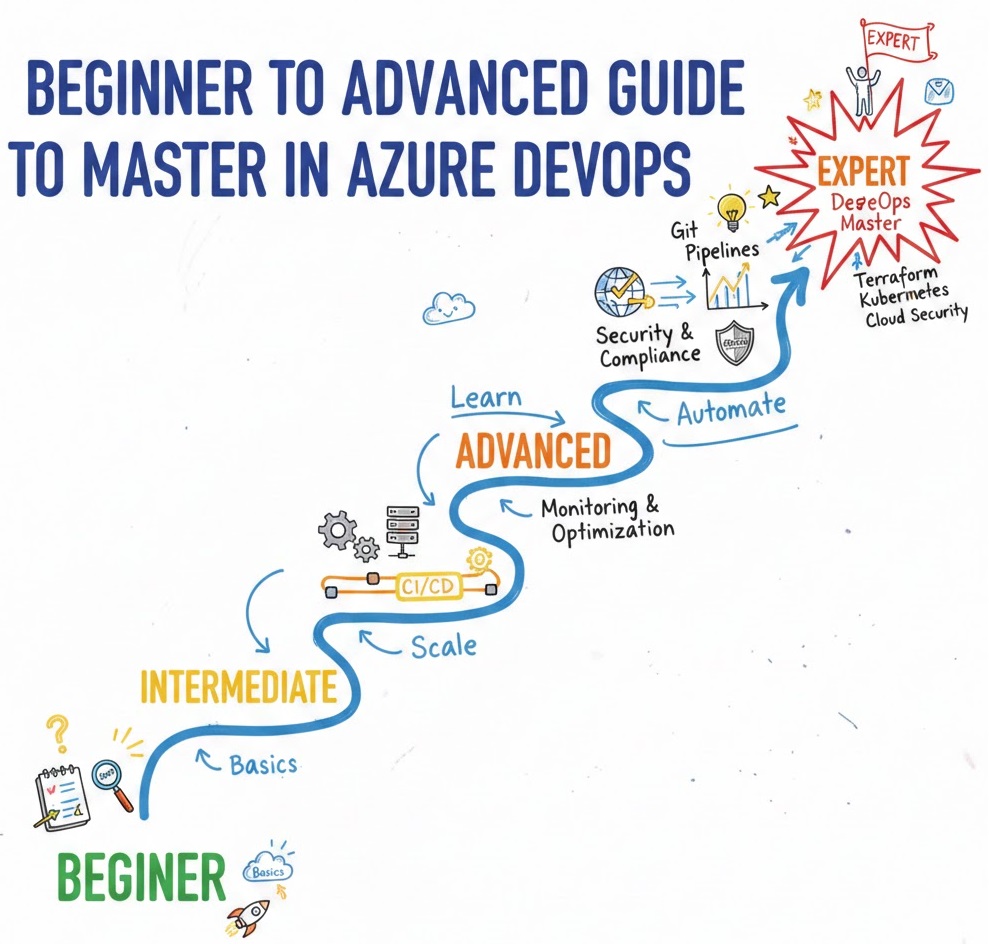
Preparation Strategy
Preparing for the Master in Azure DevOps certification requires a structured approach. Here’s a suggested preparation timeline based on different time frames:
7–14 Days: Introduction to the Basics
- Familiarize with Azure DevOps tools such as Azure Pipelines, Azure Repos, Azure Boards, and Azure Artifacts.
- Learn Git version control and set up simple CI pipelines.
- Start with basic CI/CD concepts, focusing on automating builds and deployments.
- Familiarize yourself with YAML configurations for pipeline setups.
30 Days: Intermediate Concepts
- Dive deeper into multi-stage pipelines, including triggers, manual approvals, and conditional tasks.
- Learn to manage and configure Azure Boards for Agile project management.
- Understand Infrastructure as Code (IaC) using Terraform or Azure ARM templates.
- Integrate automated testing into your pipeline and explore monitoring strategies with Azure Monitor.
60 Days: Mastering Real-World Scenarios
- Work on comprehensive DevOps pipelines with multi-environment deployments, testing automation, and feedback loops.
- Explore DevSecOps practices by integrating security scans and compliance checks.
- Create end-to-end Azure DevOps projects, automating deployments across cloud environments like Azure Kubernetes Service (AKS).
- Practice troubleshooting and debugging real-world scenarios to simulate real job environments.
Common Mistakes to Avoid
As you prepare for the Master in Azure DevOps certification, be aware of these common mistakes:
- Not Understanding DevOps Culture: DevOps is about collaboration, automation, and continuous improvement. Tools alone are not enough.
- Overlooking Security: Don’t skip integrating security practices (DevSecOps) into your pipelines. Secure software delivery is essential.
- Skipping Hands-On Labs: Theoretical knowledge is not enough. Always prioritize real hands-on experience with the tools.
- Focusing Too Much on Tools, Not Practices: Understand DevOps practices like continuous integration, testing, and automation before diving into tool-specific configurations.
Choose Your Path
1. DevOps Path
- Focus: Master the core principles of DevOps, focusing on automating the software delivery process, improving collaboration, and integrating testing and deployment.
- Ideal for: Engineers looking to specialize in automating CI/CD pipelines, managing releases, and optimizing the development lifecycle.
- Key Skills: Continuous integration and delivery, version control, pipeline automation, and monitoring with Azure DevOps tools.
2. DevSecOps Path
- Focus: Integrate security throughout the DevOps lifecycle, ensuring that applications and infrastructure are secure by design.
- Ideal for: Security professionals or DevOps engineers who want to specialize in securing the development pipeline and ensuring compliance.
- Key Skills: Integrating security checks into CI/CD pipelines, vulnerability scanning, securing cloud infrastructure, and compliance management within Azure DevOps.
3. Site Reliability Engineering (SRE) Path
- Focus: Focus on maintaining the reliability and scalability of applications in production environments using Azure DevOps.
- Ideal for: Professionals who want to specialize in ensuring high availability, fault tolerance, and scalability in cloud applications.
- Key Skills: Incident management, service monitoring, auto-scaling, high-availability configurations, and application performance optimization using Azure DevOps tools.
4. AIOps/MLOps Path
- Focus: Leverage AI and machine learning to optimize and automate operations, improving the monitoring and remediation of issues within your DevOps pipelines.
- Ideal for: Data scientists, AI engineers, or DevOps professionals interested in incorporating machine learning and artificial intelligence into their cloud infrastructure and operations.
- Key Skills: AI-driven monitoring, anomaly detection, performance forecasting, and automating operational tasks using Azure DevOps.
5. DataOps Path
- Focus: Specialize in managing data workflows and automating data pipelines, ensuring seamless data integration within the DevOps environment.
- Ideal for: Data engineers or professionals who focus on managing data pipelines, processing, and automating data integration and delivery in cloud environments.
- Key Skills: Automating data pipeline workflows, managing data versioning, integrating with CI/CD pipelines, and using Azure DevOps for data automation.
6. FinOps Path
- Focus: Manage and optimize cloud costs and financial operations in a DevOps environment, ensuring that resources are used efficiently and cost-effectively.
- Ideal for: Financial engineers or professionals responsible for managing cloud costs, budgeting, and optimizing cloud resources in a DevOps setup.
- Key Skills: Cloud cost optimization, resource budgeting, financial forecasting, and integrating cost-management practices within DevOps processes using Azure DevOps.
Career Paths → Recommended Certifications
To align your role with the appropriate certifications, here’s a quick guide:
| Role | Recommended Certifications |
|---|---|
| DevOps Engineer | Master in Azure DevOps, Azure DevOps Expert, Certified Kubernetes Administrator |
| SRE | Master in Azure DevOps, Certified Kubernetes Administrator, Google Cloud DevOps Engineer |
| Platform Engineer | Master in Azure DevOps, Certified Kubernetes Administrator, Azure Solutions Architect |
| Cloud Engineer | Azure Solutions Architect Expert, Master in Azure DevOps, AWS Certified Solutions Architect |
| Security Engineer | Master in Azure DevOps, Certified Cloud Security Professional (CCSP), DevSecOps |
| Data Engineer | Master in Azure DevOps, Azure Data Engineer Associate, Google Cloud Professional Data Engineer |
| FinOps Practitioner | Master in Azure DevOps, FinOps Certified Practitioner, Certified Cloud Financial Manager |
| Engineering Manager | Master in Azure DevOps, Certified Agile Leadership, ScrumMaster Certification |
Comparison Table of Certifications
| Certification | Track | Level | Who It’s For | Skills Covered | Prerequisites | Duration |
|---|---|---|---|---|---|---|
| Master in Azure DevOps | DevOps | Advanced | DevOps Engineers, Managers | CI/CD, Version Control, Azure Pipelines, Project Management, Monitoring, Security | Basic knowledge of DevOps and Azure | 30–60 Days |
| Azure DevOps Expert | DevOps | Expert | DevOps Engineers, Managers | Advanced Azure Pipelines, Complex CI/CD, Scaling DevOps | Master in Azure DevOps or equivalent experience | 60–90 Days |
| Certified Kubernetes Administrator | Cloud/Container | Intermediate | Platform Engineers, DevOps Engineers | Kubernetes orchestration, Cluster management, Networking, Security | Basic understanding of containers and cloud concepts | 30–60 Days |
| Certified Cloud Security Professional (CCSP) | Security | Advanced | Security Engineers, Cloud Engineers | Cloud security, Risk management, Compliance, Securing cloud infrastructure | Experience in cloud computing and security principles | 30–45 Days |
| Azure Solutions Architect Expert | Cloud | Expert | Cloud Engineers, Architects | Solution design, Azure services, Scalability, High availability, Disaster recovery | Experience with Azure cloud services | 60–90 Days |
| Azure Data Engineer Associate | DataOps/Cloud | Associate | Data Engineers, Architects | Data storage, Integration, Processing, Monitoring, ETL Automation | Knowledge of Azure services and data management concepts | 30–45 Days |
| FinOps Certified Practitioner | FinOps | Associate | Cloud Cost Managers, Engineers | Cloud cost management, Budgeting, Forecasting, Cloud resource optimization | Basic knowledge of cloud cost management | 30–60 Days |
| AWS Certified Solutions Architect – Associate | Cloud | Associate | Cloud Engineers, Architects | AWS Architecture, Cloud Security, High availability, Cost optimization | Basic understanding of AWS services and cloud concepts | 45–60 Days |
| Google Cloud Professional DevOps Engineer | Cloud/DevOps | Expert | DevOps Engineers, Cloud Engineers | Cloud automation, Continuous integration, Monitoring, Incident response | Experience with Google Cloud and DevOps practices | 45–60 Days |
Top Institutions Providing Training and Certification for Master in Azure DevOps
1. DevOpsSchool
DevOpsSchool is a leading platform offering Azure DevOps training with a focus on practical, hands-on learning. Their instructor-led sessions and live projects make the learning process engaging and effective. The training covers all aspects of Azure DevOps, including CI/CD, version control, and cloud automation. It’s ideal for both beginners and advanced learners. Post-training support ensures that professionals can apply their knowledge to real-world projects.
2. Cotocus
Cotocus specializes in DevOps and Azure DevOps training with a focus on real-world applications. Their training modules include a comprehensive curriculum with deep dives into CI/CD pipelines, automated deployments, and cloud infrastructure management. Cotocus is known for small batch sizes, personalized mentorship, and industry-expert trainers, ensuring quality learning experiences. Their focus on project-based learning prepares candidates for the Master in Azure DevOps certification.
3. ScmGalaxy
ScmGalaxy offers a robust training program in Azure DevOps, covering all the essential tools and techniques needed to pass the certification. Their course includes practical training on Azure Pipelines, Azure Repos, and Terraform. They provide detailed resources, expert instructors, and hands-on labs. ScmGalaxy’s programs are suitable for professionals at all levels, from entry-level engineers to advanced DevOps practitioners.
4. BestDevOps
BestDevOps offers specialized training for Azure DevOps certification with an emphasis on continuous delivery and cloud-based automation. Their instructors, who are industry experts, guide learners through complex DevOps pipelines, version control, and automated testing. BestDevOps provides real-time, scenario-based learning and supports learners throughout their certification journey. They also focus on integrating security into the pipeline, which is key to DevSecOps.
5. DevSecOpsSchool
DevSecOpsSchool focuses on integrating security within the DevOps lifecycle, specifically through Azure DevOps. Their training covers security testing, vulnerability scanning, and compliance checks in DevOps pipelines. This institution is ideal for professionals who want to specialize in DevSecOps and ensure that their software delivery pipelines are secure from start to finish. Their hands-on approach and post-training support make them a standout choice for those aiming for security certifications.
6. SRESchool
SRESchool specializes in Site Reliability Engineering (SRE), using Azure DevOps tools for infrastructure automation, scalability, and system reliability. The training focuses on high availability, auto-scaling, and incident management within cloud environments. It’s ideal for engineers aiming to optimize production environments and maintain operational stability. SRESchool’s training is tailored for professionals looking to integrate SRE practices with DevOps.
7. AIOPSSchool
AIOPSSchool provides advanced training in AIOps (Artificial Intelligence for IT Operations), focusing on automating monitoring, troubleshooting, and optimization in the Azure DevOps pipeline. They combine AI/ML techniques with DevOps practices, enabling professionals to leverage artificial intelligence for better decision-making in operations. This is a great option for those wanting to integrate AI and machine learning into their DevOps pipelines.
8. DataOPSSchool
DataOPSSchool focuses on integrating DataOps with DevOps principles using Azure DevOps tools. Their training covers data pipeline automation, data storage management, and cloud data integration. This program is tailored for data engineers and data scientists looking to apply DevOps practices to manage data workflows. Hands-on labs and real-world case studies make it a suitable option for anyone wanting to improve their data delivery pipeline.
9. FinOpsSchool
FinOpsSchool focuses on managing cloud financial operations in a DevOps setup using Azure DevOps. Their curriculum emphasizes cost optimization, cloud budgeting, and financial forecasting. This is ideal for FinOps practitioners who want to manage and optimize cloud resources while ensuring efficient financial operations. The training includes practical scenarios for tracking and reducing cloud spend while maintaining operational efficiency.
FAQs on Master in Azure DevOps
- How difficult is the Master in Azure DevOps certification?
- It is moderately challenging, designed for professionals with foundational knowledge in DevOps and Azure. Hands-on practice is crucial.
- How long will it take to prepare for the exam?
- Preparation time varies but can range from 30 to 60 days, depending on your current level of expertise.
- Do I need experience in Azure?
- While some prior knowledge of cloud technologies and DevOps is helpful, the course covers all foundational concepts.
- What’s the difference between this certification and others?
- This certification specifically focuses on Azure DevOps tools and how they integrate into the broader DevOps lifecycle, whereas others may focus on general DevOps practices.
- What career opportunities will this certification provide?
- You’ll be eligible for roles like DevOps Engineer, Cloud Engineer, Platform Engineer, SRE, and more.
- Can I prepare for the exam while working full-time?
- Yes, the program is flexible, and many resources are available for self-paced learning.
- What are the prerequisites for this certification?
- A basic understanding of software development, version control, and cloud computing is recommended.
- What are the benefits of having this certification?
- It enhances your credibility in the Azure DevOps space, opening up career opportunities and providing you with essential skills for modern software delivery.
FAQs on Master in Azure DevOps
1. How difficult is the Master in Azure DevOps certification?
- The Master in Azure DevOps certification is moderately challenging, designed for professionals with a foundational understanding of DevOps practices and Azure tools. Hands-on practice and real-world scenarios are crucial to mastering the content.
2. How long does it take to complete the Master in Azure DevOps program?
- On average, it takes 30–60 days to prepare for the certification, depending on your familiarity with Azure DevOps concepts and tools. You can pace your preparation based on the suggested 7–14 days, 30 days, or 60 days plan.
3. Do I need prior experience with Azure?
- While prior knowledge of Azure or DevOps concepts is helpful, it’s not mandatory. The program is designed to cover the foundational aspects of Azure DevOps tools and services, so you can learn from scratch if needed.
4. What are the prerequisites for the certification?
- Basic knowledge of software development, version control systems (like Git), and cloud computing principles is beneficial. Familiarity with Agile methodologies and scripting languages will also help.
5. What makes this certification different from other DevOps certifications?
- The Master in Azure DevOps certification specifically focuses on Azure DevOps tools and their integration with the DevOps lifecycle. Other certifications may cover broader DevOps concepts, but this one specializes in automating the software delivery pipeline using Azure services.
6. What career opportunities will this certification provide?
- This certification opens doors to roles like DevOps Engineer, Cloud Engineer, Site Reliability Engineer (SRE), Platform Engineer, Engineering Manager, and other DevOps-related positions across various industries.
7. How can I prepare for the certification exam?
- A combination of hands-on practice, official Azure DevOps documentation, online courses, and real-world projects is essential. Focus on building pipelines, managing repositories, automating infrastructure, and integrating security in DevOps processes.
8. Is there any online support during the training?
- Yes, many training providers such as DevOpsSchool, ScmGalaxy, and Cotocus offer online support through forums, mentorship, and interactive sessions with instructors.
9. How much does the Master in Azure DevOps certification cost?
- The exam fee typically ranges from $150 to $250 USD. Training programs can cost between $500 and $2,000 USD, depending on the provider and the depth of the course.
10. How do I register for the exam?
- Registration can be done through Microsoft’s certification portal. After completing your training, you can sign up for the exam through the official certification provider or Azure portal.
11. Is there a time limit to complete the certification?
- There is no specific time limit for completing the Master in Azure DevOps certification. However, it’s advisable to complete the exam within a reasonable timeframe after training to retain your knowledge.
12. Can I take this certification while working full-time?
- Yes, the Master in Azure DevOps certification is flexible, and many self-paced learning options are available. You can easily manage your study schedule around your work commitments.
Conclusion
The Master in Azure DevOps certification is a critical credential for professionals aiming to specialize in the Azure DevOps ecosystem and automation tools. With a deep focus on continuous integration, delivery, and cloud infrastructure management, this certification equips professionals with the skills needed to excel in DevOps, cloud management, and SRE roles.By completing this certification, you’ll gain expertise in automating and managing the software development lifecycle using Azure DevOps tools. Whether you’re looking to enhance your career in DevOps, move into cloud engineering, or transition to a security or dataops role, Master in Azure DevOps provides a comprehensive skill set to boost your career.