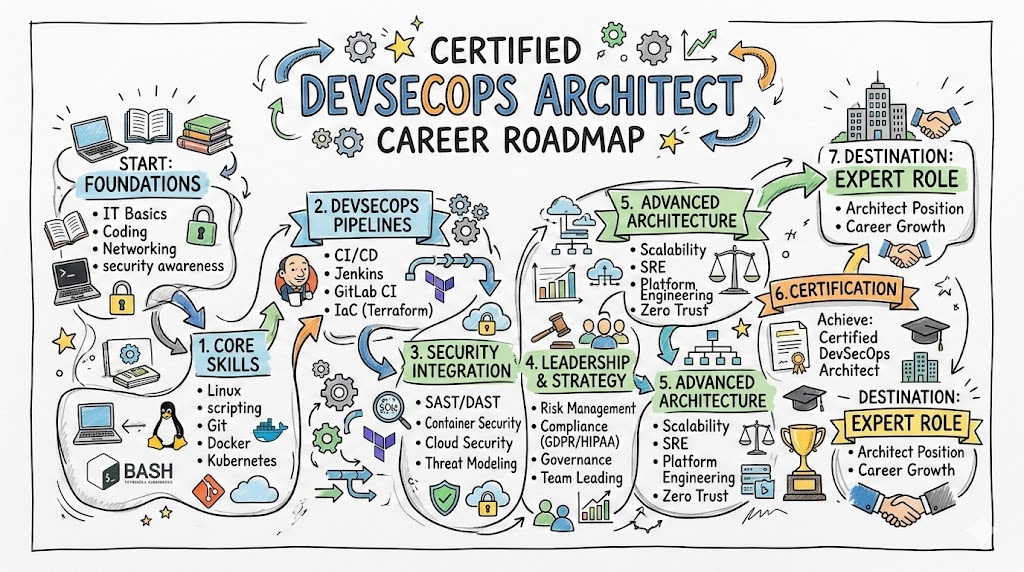
Introduction
In today’s software-driven world, security cannot be an afterthought. Organizations are increasingly looking for professionals who can seamlessly integrate security practices into the DevOps pipeline—ensuring speed, reliability, and safety. This is where the Certified DevSecOps Architect certification comes in. It empowers engineers and managers to embed security across the software development lifecycle while embracing DevOps principles.Why this matters: Organizations now demand engineers who understand both DevOps and security, making this certification highly valuable for career growth and operational excellence.
What is Certified DevSecOps Architect?
The Certified DevSecOps Architect is a professional certification designed to validate your ability to integrate security into DevOps practices. It focuses on practical skills, real-world tools, and methodologies to create secure, resilient, and compliant software delivery pipelines.
Why this matters: With cyber threats evolving daily, organizations need engineers who can ensure security without slowing down innovation.
Who Should Take It
- Software engineers and developers seeking to strengthen security in CI/CD pipelines
- DevOps engineers looking to expand into security-focused roles
- IT managers and engineering leads responsible for secure software delivery
- Cloud and platform engineers aiming to adopt DevSecOps principles
Why this matters: This certification is for anyone responsible for developing, deploying, or managing secure software in modern IT environments.
Skills You’ll Gain
- Secure CI/CD pipeline design and implementation
- Threat modeling and vulnerability assessment
- Infrastructure as Code security (Terraform, Ansible, CloudFormation)
- Container and cloud security (Docker, Kubernetes, AWS, Azure, GCP)
- Compliance, auditing, and risk mitigation strategies
- Automated security testing integration (SAST, DAST, SCA)
Why this matters: These skills make you a security-savvy DevOps professional capable of reducing risk and improving software quality.
Real-World Projects You Should Be Able to Do After Certification
- Implement a secure CI/CD pipeline integrating automated security checks
- Conduct a cloud security assessment and implement remediation measures
- Automate vulnerability scanning in containerized environments
- Establish monitoring, alerting, and logging for security incidents
- Develop compliance and audit reports for software delivery pipelines
Preparation Plan
| Duration | Focus Areas | Approach |
|---|---|---|
| 7–14 Days | Core DevOps security concepts, pipeline basics | Quick crash course + focused labs |
| 30 Days | Full DevSecOps toolchain, cloud & container security | Structured learning + hands-on labs |
| 60 Days | Advanced topics, compliance, real-world projects | Deep dive + mock assessments + project implementation |
Common Mistakes
- Ignoring hands-on practice and relying only on theory
- Overlooking cloud and container security nuances
- Not integrating automated security tools in pipelines
- Skipping compliance and audit training
- Treating DevSecOps as a one-time effort instead of continuous practice
Best Next Certification After This
- Same Track: Master in DevSecOps Engineering
- Cross-Track: Certified SRE or DevOps Architect
- Leadership: DevSecOps Manager / Security Program Lead
Certification Table
| Certification | Track | Level | Who it’s for | Prerequisites | Skills Covered | Recommended Order |
|---|---|---|---|---|---|---|
| Certified DevSecOps Architect | DevSecOps | Professional | Engineers, Managers | Basic DevOps experience | CI/CD security, cloud/container security, compliance, automation | After foundational DevOps/Cloud skills |
Choose Your Path
This section helps you pick a DevSecOps learning focus based on your career goals:
- DevOps – Core pipelines, automation, IaC; ideal for engineers building secure CI/CD workflows.
- DevSecOps – Security-first DevOps; for embedding automated testing, compliance, and container security.
- SRE – Reliability and incident management; ensures systems are fault-tolerant and secure.
- AIOps/MLOps – AI/ML-driven operations; for smarter monitoring, anomaly detection, and ML deployment.
- DataOps – Secure, automated data pipelines; ensures data governance and quality.
- FinOps – Cloud cost and compliance; focuses on financial operations in secure cloud environments.
Role → Recommended Certifications
| Role | Recommended Certification |
|---|---|
| DevOps Engineer | Certified DevSecOps Architect, Master in DevOps Engineering |
| SRE | Certified DevSecOps Architect, SRE Professional |
| Platform Engineer | Certified DevSecOps Architect, Cloud Security Specialist |
| Cloud Engineer | Certified DevSecOps Architect, Cloud Architect Certifications |
| Security Engineer | Certified DevSecOps Architect, CISSP, Cloud Security |
| Data Engineer | Certified DevSecOps Architect, DataOps Certification |
| FinOps Practitioner | Certified DevSecOps Architect, FinOps Practitioner |
| Engineering Manager | Certified DevSecOps Architect, DevSecOps Manager |
Top Institutions for Training & Certification Support
Preparing for the Certified DevSecOps Architect certification requires structured guidance, practical experience, and access to the right tools. Several institutions specialize in providing training and certification support, combining theory, hands-on labs, and real-world case studies. Here’s a detailed look at the top providers:
FinOpsSchool
FinOpsSchool trains professionals in cloud cost optimization, compliance, and financial operations. The program emphasizes secure DevOps processes for financial systems, balancing cost-efficiency, compliance, and pipeline security. This path is particularly useful for organizations handling sensitive financial workloads.oosing the right institution ensures quality learning, hands-on practice, and certification readiness.
DevOpsSchool
DevOpsSchool is a globally recognized leader in DevOps and DevSecOps training. Their programs include instructor-led sessions, practical labs, and real-world projects designed to simulate enterprise environments. They provide dedicated guidance for the Certified DevSecOps Architect exam, helping learners understand CI/CD security, cloud security, and compliance practices.
Cotocus
Cotocus focuses on practical, hands-on DevSecOps learning. Their workshops and bootcamps cover pipeline security, automation, and threat modeling. Cotocus emphasizes real-world applications, ensuring learners can implement secure DevOps pipelines in production environments with confidence.
ScmGalaxy
ScmGalaxy offers a comprehensive curriculum covering DevOps, cloud computing, and security technologies. Their courses blend theoretical knowledge with hands-on exercises, enabling learners to apply DevSecOps principles to real projects. ScmGalaxy also provides guidance on certification strategy and preparation techniques.
BestDevOps
BestDevOps delivers flexible schedules and practical exercises tailored for working professionals. Their training covers automation, monitoring, container security, and compliance, ensuring learners develop confidence with DevSecOps tools and processes while preparing for certification exams.
DevSecOpsSchool
As a specialized platform, DevSecOpsSchool focuses entirely on integrating security into DevOps workflows. Their training emphasizes secure pipeline design, automated security testing, threat management, and compliance. Learners gain deep insights into CI/CD security practices directly aligned with Certified DevSecOps Architect requirements.
SRESchool
SRESchool specializes in Site Reliability Engineering while integrating security practices. Their courses teach how to maintain system reliability, implement incident response strategies, and embed security controls across infrastructure and applications. This approach is valuable for professionals bridging reliability and DevSecOps responsibilities.
AIOpsSchool
AIOpsSchool teaches AI/ML-driven operations for smarter monitoring, anomaly detection, and automated incident management. Their programs highlight how AI can enhance DevSecOps practices, enabling engineers to detect security issues faster and implement predictive solutions in real-time pipelines.
DataOpsSchool
DataOpsSchool focuses on secure and efficient data pipelines. Their courses cover automation, data governance, compliance, and monitoring, helping data engineers and DevSecOps professionals manage secure data workflows. Learners gain skills in integrating security into data platforms without slowing operations.
FAQs – Certified DevSecOps Architect
- How difficult is the Certified DevSecOps Architect exam?
Moderate to high; requires hands-on experience in DevOps pipelines and security practices. - How long does it take to prepare?
Typically 30–60 days depending on prior experience and practice. - What are the prerequisites?
Basic understanding of DevOps tools, CI/CD, cloud platforms. - Do I need prior security experience?
Helpful but not mandatory; the course covers core security practices. - What career benefits does this certification provide?
Opens opportunities in DevSecOps, Cloud Security, SRE, and leadership roles. - Can I take it remotely?
Yes, most training institutions and certification exams are online. - Is hands-on experience required?
Strongly recommended; practical labs significantly improve success. - Which tools are covered?
CI/CD pipelines, Docker, Kubernetes, Terraform, Ansible, cloud security tools. - Can this certification help in leadership roles?
Yes, it builds the foundation for security leadership in DevOps environments. - What is the recommended sequence for learning?
Foundational DevOps → Cloud fundamentals → Security integration → DevSecOps Architect. - Is it globally recognized?
Yes, particularly valued in organizations adopting DevSecOps practices worldwide. - What is the cost of certification?
Varies by training provider; check official institutions for details.
FAQs – Certified DevSecOps Architect
1. Can I take the training and exam online?
Yes. Most institutions, including DevOpsSchool, Cotocus, and DevSecOpsSchool, offer online training and remote certification exams, allowing learners from India and around the world to participate.
2. What is the difficulty level of the Certified DevSecOps Architect exam?
The exam is moderate to advanced, as it tests both practical DevOps skills and security knowledge. Hands-on experience with CI/CD pipelines, cloud, and container security significantly improves your chances of success.
3. How long does it take to prepare for this certification?
Preparation typically takes 30–60 days, depending on prior experience. Beginners may require the full 60 days to cover DevOps fundamentals, security practices, and hands-on labs.
4. Are there any prerequisites?
A basic understanding of DevOps processes, cloud platforms, and CI/CD tools is recommended. Security experience helps but is not mandatory, as the course covers essential DevSecOps concepts.
5. What tools and technologies will I learn?
You’ll gain hands-on experience with Docker, Kubernetes, Terraform, Ansible, CI/CD pipelines, SAST/DAST tools, cloud platforms (AWS, Azure, GCP), and compliance automation tools.
6. Who should take this certification?
Software engineers, DevOps engineers, cloud engineers, platform engineers, security engineers, IT managers, and anyone responsible for secure software delivery will benefit from this certification.
7. Does this certification help in career growth?
Yes. It positions you for DevSecOps roles, cloud security positions, SRE, platform engineering, and leadership roles, making you a sought-after professional in organizations adopting secure DevOps practices.
8. Is practical experience important?
Absolutely. Hands-on labs, real-world projects, and pipeline implementation exercises are essential to understand secure DevOps workflows and pass the certification exam confidently.
Conclusion
The Certified DevSecOps Architect is more than just a certification—it’s a career accelerator for engineers and managers seeking to integrate security into modern software delivery. With hands-on practice, structured learning, and guidance from expert institutions, you can become a highly sought-after professional who bridges the gap between development, operations, and security. By following the recommended learning paths, role-specific certifications, and preparation strategies, you position yourself for success in today’s security-first DevOps landscape. Embrace this certification, and let it be a stepping stone to advanced DevSecOps, SRE, cloud, and leadership opportunities.