Introduction
Modern software moves fast, but security risks move even faster. Organizations now need leaders who can manage both speed and security together, not in separate silos.The Certified DevSecOps Manager program from DevSecOpsSchool helps managers and senior engineers lead this transformation in a practical, structured way.It is designed for people who manage teams, own delivery outcomes, and are responsible for security, compliance, and reliability in real projects.
What is a Certified DevSecOps Manager?
A Certified DevSecOps Manager is a professional who can connect development, operations, and security into one aligned way of working.
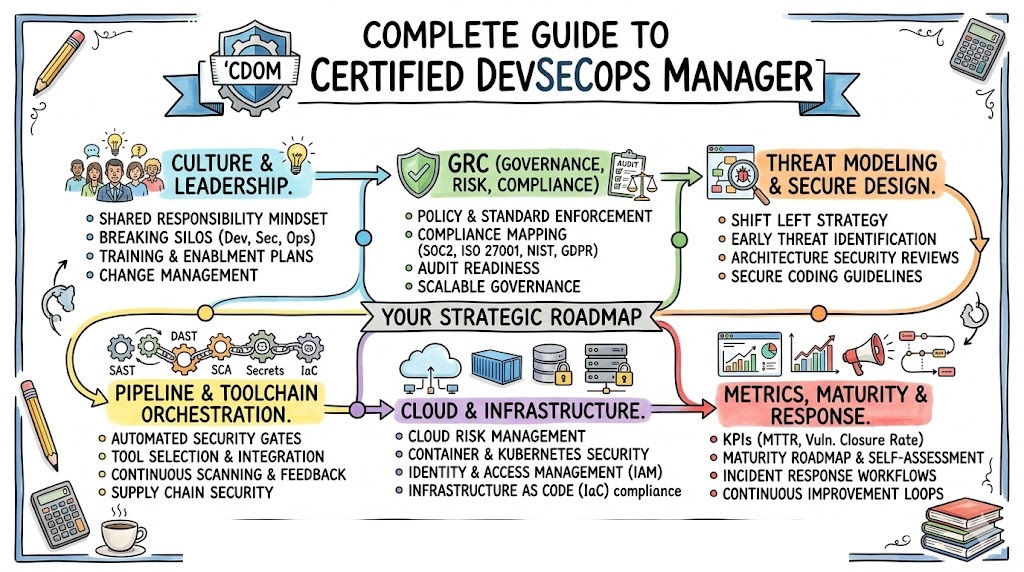
Instead of treating security as a late stage check, this role builds security into every step of the software lifecycle: planning, coding, building, testing, deployment, and operations.You learn how to build governance, set policies, select tools, track the right metrics, and coach teams so that secure delivery becomes a habit, not a one-time project.
Why this certification is important now
- Security incidents are rising while release cycles are getting shorter.
- Regulations and audits are stricter, and leaders must show evidence of security in process, not just in tools.
- Many teams already use DevOps, but do not know how to embed security into pipelines, infrastructure, and culture.
- Companies are openly looking for DevSecOps managers who understand both leadership and hands-on realities.
Certified DevSecOps Manager gives you a clear framework to lead this change, instead of doing it by trial and error.
What it is
Certified DevSecOps Manager is a leadership-focused certification that teaches you how to plan, manage, and scale DevSecOps practices across teams and projects.
It covers strategy, governance, security integration, metrics, and culture, not just individual tools.
Who should take it
- DevOps or platform engineers moving into lead/manager roles
- Security engineers who work closely with product and DevOps teams
- Technical leads, architects, and delivery managers
- Engineering managers responsible for secure delivery and compliance
Skills you will gain
- Building and leading DevSecOps programs across teams
- Designing governance, policies, and guardrails that still allow speed
- Mapping security controls into CI/CD pipelines and toolchains
- Planning secure SDLC and secure-by-default architectures
- Driving culture change and shared responsibility for security
- Defining KPIs, metrics, and maturity models for DevSecOps
- Managing risk, audits, and regulatory requirements in modern environments
Real-world projects you should be able to handle
After this certification, you should be able to:
- Design and roll out a DevSecOps transformation roadmap for a product or business unit
- Integrate security checks into existing pipelines without blocking delivery
- Define a standardized model for secrets management, vulnerability management, and compliance as code
- Lead cross-functional war‑rooms after incidents and design long-term fixes
- Align security controls with cloud migration, microservices, containers, and Kubernetes adoption
Preparation plan (7–14 / 30 / 60 days)
You can adjust the plan based on your existing experience.
7–14 days (fast track, experienced professionals):
- Day 1–3: Understand DevSecOps fundamentals, Secure SDLC, threat modeling, and governance.
- Day 4–7: Focus on CI/CD security, supply chain risks, infrastructure as code security, and container security.
- Day 8–10: Study DevSecOps metrics, maturity models, and culture change patterns.
- Day 11–14: Revise, practice with case studies, and review sample scenarios and exam-style questions.
30 days (balanced working professional plan):
- Week 1: Foundations of DevOps, security basics, and DevSecOps principles.
- Week 2: Deep dive into secure SDLC, CI/CD security, and toolchain integration.
- Week 3: Governance, risk management, compliance mapping, and metrics.
- Week 4: Case studies, hands-on labs or simulations, and focused exam preparation.
60 days (comfortable, part-time learning plan):
- Phase 1 (Weeks 1–2): Core DevOps, cloud, and security foundations.
- Phase 2 (Weeks 3–4): DevSecOps patterns, secure pipelines, IaC, and container security.
- Phase 3 (Weeks 5–6): Governance, culture, org design, metrics, and transformation roadmaps.
Common mistakes to avoid
- Treating DevSecOps as a “tool problem” instead of a people and process problem
- Overloading teams with security checks that break pipelines and slow delivery
- Ignoring culture, communication, and training for developers and operations
- Focusing only on application security and forgetting infrastructure, cloud, and supply chain risks
- Not defining clear metrics (MTTR, vulnerability SLAs, policy compliance, etc.) to show progress
Best next certification after this
- Same track (DevSecOps / security):
- Certified DevSecOps Architect or similar advanced design-level DevSecOps certification
- Cross-track (to widen your scope):
- A DevOps/SRE master program such as Master in DevOps Engineering (MDE) from DevOpsSchool, which blends DevOps, DevSecOps, and SRE.
- Leadership track:
Certification table
Below is a sample certification view centred around Certified DevSecOps Manager and related learning. It follows the structure used in Master in DevOps Engineering content.
| Certification | Track | Level | Who it’s for | Prerequisites | Skills covered | Recommended order |
|---|---|---|---|---|---|---|
| Certified DevSecOps Manager | DevSecOps | Manager | Working engineers, tech leads, architects, and managers leading secure delivery | Comfort with DevOps basics, CI/CD, cloud fundamentals, and basic security concepts | DevSecOps governance, secure SDLC, CI/CD security, risk management, culture change, metrics, compliance mapping | Build DevOps + security basics → gain 1–2 real projects → take Certified DevSecOps Manager |
| Master in DevOps Engineering (MDE) | DevOps | Master | Working engineers, leads, and managers owning delivery + reliability | Linux, Git, CI/CD basics, cloud basics, some real project exposure | CI/CD, automation, containers, Kubernetes, IaC, observability, SRE mindset, security‑in‑pipeline mindset | Build basics → work on projects → use MDE to validate end‑to‑end DevOps capability |
Choose your path: 6 learning paths
You can position Certified DevSecOps Manager inside different learning paths depending on the career direction.
1. DevOps path
Focus: fast, reliable delivery with strong automation.
Suggested path:
- Foundations: Linux, Git, scripting, cloud basics
- Core: CI/CD, containers, Kubernetes, infrastructure as code
- Advanced: Master in DevOps Engineering (MDE) or similar master‑level DevOps program
- Security layer: Certified DevSecOps Manager to add security governance on top of DevOps practices
2. DevSecOps path
Focus: security integrated into everything.
Suggested path:
- Foundations: DevOps basics, security fundamentals, secure coding practices
- Core: DevSecOps practitioner or professional-level hands-on security-in-pipeline course
- Advanced: Certified DevSecOps Manager for strategy, governance, and leadership
- Optional next: Architect-level DevSecOps or cloud security leadership program
3. SRE path
Focus: reliability, availability, and performance at scale.
Suggested path:
- Foundations: Linux, networking, cloud, observability basics
- Core: SRE-focused courses (SLIs/SLOs, error budgets, incident response)
- Integration: Master in DevOps Engineering (includes SRE concepts)
- Security + reliability: Certified DevSecOps Manager to integrate security into SRE practices, change management, and incident response.
4. AIOps / MLOps path
Focus: automation and machine learning in operations and model delivery.
Suggested path:
- Foundations: DevOps + cloud + basic ML lifecycle
- Core: MLOps courses (model deployment, monitoring, data pipelines)
- AIOps: courses on monitoring, anomaly detection, and intelligent alerting
- Security overlay: Certified DevSecOps Manager to bring governance, security checks, and risk management into ML pipelines and AIOps tools.
5. DataOps path
Focus: data pipelines, governance, and analytics delivery.
Suggested path:
- Foundations: SQL, ETL concepts, data platforms, and cloud data services
- Core: DataOps practices (versioning, testing, CI/CD for data pipelines)
- Governance: data quality, privacy, and regulatory compliance
- Security & governance: Certified DevSecOps Manager to align data controls, access policies, and compliance with DevOps teams.
6. FinOps path
Focus: cloud cost optimization and financial governance.
Suggested path:
- Foundations: cloud fundamentals, billing models, and usage patterns
- Core: FinOps practitioner or equivalent cost management courses
- Advanced: optimization strategies, chargeback/showback, and forecasting
- Security and compliance: Certified DevSecOps Manager to balance cost, security, and compliance when teams use cloud at scale.
Role → Recommended certifications mapping
You can use this section as a quick mapping table inside the blog.
| Role | Primary focus | Recommended certifications flow (including Certified DevSecOps Manager) |
|---|---|---|
| DevOps Engineer | Delivery speed, automation, pipelines | DevOps fundamentals → CI/CD & Kubernetes courses → Master in DevOps Engineering (MDE) → Certified DevSecOps Manager for security governance |
| SRE | Reliability, SLIs/SLOs, incident response | SRE fundamentals → Observability and incident management courses → MDE or SRE‑focused programs → Certified DevSecOps Manager to integrate security into SRE |
| Platform Engineer | Platforms, Kubernetes, internal developer tools | Cloud + Kubernetes + platform engineering courses → MDE → Certified DevSecOps Manager to secure platforms and pipelines end‑to‑end |
| Cloud Engineer | Cloud infra, networking, deployment | Cloud provider certifications → IaC and automation → MDE or infra-focused DevOps course → Certified DevSecOps Manager to align cloud security and governance |
| Security Engineer | Application and infrastructure security | Security fundamentals → AppSec and cloud security courses → DevSecOps practitioner/professional → Certified DevSecOps Manager to lead security in DevOps teams |
| Data Engineer | Data pipelines, ETL, analytics | Data engineering and cloud data courses → DataOps practice → Certified DevSecOps Manager to enforce security and governance in data pipelines |
| FinOps Practitioner | Cloud cost, budgeting, financial accountability | Cloud cost management and FinOps courses → Certified DevSecOps Manager to connect cost, risk, and security governance in cloud environments |
| Engineering Manager | People, delivery, strategy | Project/program management → MDE or similar DevOps leadership course → Certified DevSecOps Manager → optional architect/leadership security certifications |
Next certifications to take after Certified DevSecOps Manager
Once you complete Certified DevSecOps Manager, you should think in three directions: same track, cross track, and leadership.
- Same track (DevSecOps / security):
- Advanced DevSecOps architect or designer certifications
- Specialized cloud security certifications (focused on securing AWS/Azure/GCP, containers, and Kubernetes)
- Cross track (DevOps / SRE / platform):
- Master in DevOps Engineering (MDE) from DevOpsSchool to deepen DevOps, SRE, and automation capabilities alongside your DevSecOps mindset.
- SRE-focused programs that sharpen SLIs/SLOs, error budgets, and incident handling.
- Leadership track:
- Security or cloud governance programs that focus on risk, regulations, audits, and enterprise security management
- Product or engineering leadership courses that help you manage budgets, stakeholders, and large cross-functional programs
This combination makes you a strong candidate for roles such as Head of DevSecOps, Director of Platform & Security, or similar leadership positions.
Top institutions for Certified DevSecOps Manager training and certification support
DevOpsSchool
DevOpsSchool is a well-known training platform that offers hands-on courses in DevOps, DevSecOps, SRE, Kubernetes, and cloud.
Its Master in DevOps Engineering (MDE) program is recognized for combining DevOps, DevSecOps, and SRE into one integrated learning path, and the same ecosystem supports DevSecOps-focused learning.
Learners get structured content, real-world labs, and guidance aligned with industry projects, which makes it easier to apply DevSecOps Manager skills at work.
Cotocus
Cotocus focuses on consulting-driven training, where practitioners bring real project experience into the classroom.
They support organizations and individuals in setting up DevOps, DevSecOps, SRE, and cloud transformations, and can help learners prepare for management-level certifications like Certified DevSecOps Manager.
For professionals who want both coaching and implementation guidance, Cotocus offers a good blend of training and advisory-style support.
Scmgalaxy
Scmgalaxy provides training on source control, build and release management, DevOps pipelines, and cloud-native tooling.
For DevSecOps Manager aspirants, this platform is useful to strengthen the technical side of CI/CD, version control, and automation, which then connects well with governance and security topics.
They often cover practical labs, toolchains, and real-world pipeline design patterns that align with DevSecOps practices.
BestDevOps
BestDevOps works as a knowledge and community hub around DevOps and related practices.
It helps learners stay updated with modern tools, case studies, and learning resources related to DevOps, DevSecOps, SRE, and cloud.
For someone preparing for Certified DevSecOps Manager, it offers context, trends, and supporting material beyond the main course.
devsecopsschool
DevSecOpsSchool is focused directly on DevSecOps certifications and training, including Certified DevSecOps Manager.
It brings together security, DevOps, and cloud experts to build programs that are both practical and aligned with modern security challenges.
If your primary goal is DevSecOps leadership, this is the core platform you will rely on for this certification.
sreschool
SREschool specializes in Site Reliability Engineering concepts such as SLIs/SLOs, incident response, and reliability patterns.
For DevSecOps Managers, SREschool’s content helps you understand how reliability, performance, and security come together in real-world systems.
This is valuable when designing policies and governance that do not harm uptime or user experience.
aiopsschool
AIOpsSchool focuses on automation, intelligent monitoring, and AI-driven operations.
DevSecOps Managers benefit from understanding how AIOps tools, anomaly detection, and advanced monitoring can support security and incident response.
This combination helps you design proactive detection, faster root cause analysis, and risk-based alerting strategies.
dataopsschool
DataOpsSchool works on data engineering, DataOps practices, and governance for analytics and data products.
With more security and privacy regulations around data, DevSecOps Managers must work closely with DataOps teams to align controls, access policies, and audits.
Training here helps you extend DevSecOps thinking into the data side of your organization’s landscape.
finopsschool
FinOpsSchool is focused on cloud cost optimization and financial governance.
DevSecOps Managers often partner with FinOps teams to balance cost, security controls, and compliance requirements.
Understanding FinOps helps you design policies that keep systems secure and compliant without wasting cloud budget.
FAQs about Certified DevSecOps Manager
- What is the Certified DevSecOps Manager certification?
It is a management and leadership-focused certification that teaches you how to design, roll out, and scale DevSecOps practices in real organizations.
You learn strategy, governance, policy design, and how to connect security with DevOps teams and business goals.
- Who should consider this certification?
This certification is ideal for working engineers, team leads, architects, security engineers, and engineering managers who are responsible for secure delivery and governance.
If you already work with DevOps or cloud and want to lead security integration, this is a strong fit.
- What are the prerequisites?
You should be comfortable with basic DevOps concepts (CI/CD, automation, cloud) and fundamental security ideas like vulnerabilities, threats, and secure SDLC.
Hands-on experience with at least one real project where delivery and operations were involved will help a lot.
- How long does it take to prepare?
Many working professionals can prepare in 30–60 days with a focused plan.
If you already work in DevOps or security, a 7–14 day fast-track plan is possible with disciplined study and practice.
- Is the exam very difficult?
The exam is challenging because it tests your understanding of practical scenarios, not just definitions.
However, if you follow the official curriculum, practice with real-world cases, and revise carefully, the difficulty is manageable.
- What kind of roles can I target after this certification?
You can target roles like DevSecOps Manager, DevSecOps Lead, Security Lead for DevOps, Platform Security Manager, or Engineering Manager with DevSecOps focus.
It also helps if you want to move into architect-level roles where you design secure delivery models.
- Does this certification cover tools or only concepts?
It covers both. You learn frameworks and governance models as well as how to apply them with real CI/CD, security, and monitoring tools.
The main focus is on how to use tools to support a strong DevSecOps process, not just how to click through them.
- How does this certification compare to a pure DevOps or SRE certification?
DevOps and SRE certifications focus more on speed, reliability, and automation.
Certified DevSecOps Manager adds a strong security and governance layer, making you responsible for how secure delivery is designed and led across teams.
FAQs on difficulty, time, sequence, value, and career outcomes
- Is Certified DevSecOps Manager suitable for freshers?
It is mainly designed for working professionals with some exposure to DevOps, cloud, or security.
Freshers can aim for this later, after 1–2 years of hands-on project work and some foundational certifications.
- How many hours per week should I study?
If you are working full-time, 7–10 focused hours per week are usually enough to progress steadily.
You can increase this to 12–15 hours when you are closer to the exam for revision and practice questions.
- In what sequence should I plan my certifications?
A good sequence is: DevOps fundamentals → one hands-on DevOps or security certification → Certified DevSecOps Manager → broader master-level programs like MDE or cloud security leadership.
This sequence builds your technical base first, then your leadership and governance skills.
- Is it worth doing Certified DevSecOps Manager if I am already an Engineering Manager?
Yes, it gives you a structured language and framework to talk about security, risk, and governance with both technical teams and business leaders.
It also helps you design processes that meet audit and compliance needs without slowing delivery.
- What is the main difference between a DevSecOps Engineer and a DevSecOps Manager?
DevSecOps Engineers focus more on hands-on implementation, such as integrating scanners, securing pipelines, and fixing vulnerabilities.
DevSecOps Managers focus on strategy, governance, metrics, and leading multiple teams or initiatives.
- Do I need coding skills for this certification?
You do not need to be a deep programmer, but you should understand how code moves through pipelines and where security checks fit in.
Basic scripting or configuration experience is helpful when discussing real implementation patterns with your teams.
- How does this certification help my salary and career growth?
DevSecOps and security leadership skills are in high demand because organizations must balance risk with speed.
Certified DevSecOps Manager can position you for higher-responsibility roles that typically come with better compensation and long-term career stability.
- Can I combine this certification with cloud provider certifications?
Yes, this is a very strong combination.
Cloud certifications prove your platform knowledge, and Certified DevSecOps Manager proves your ability to secure and govern delivery on those platforms.
- How do I show the value of this certification to my company?
You can design and drive visible initiatives such as secure pipeline rollouts, improved vulnerability SLAs, or better audit readiness.
When you connect these outcomes to reduced risk, fewer incidents, and smoother audits, leaders clearly see the value.
- Is this certification more technical or managerial?
It is a mix, but with a strong leaning towards managerial and strategic aspects of security in DevOps environments.
You need enough technical depth to talk to engineers, but the main goal is to lead and coordinate secure delivery.
- Can I use this certification to move from security into DevOps?
Yes. If you come from a security background, this certification helps you understand DevOps workflows, pipelines, and team culture.
You can then become the bridge between security and DevOps teams, which is a very valuable role.
- How does this certification relate to the Master in DevOps Engineering program?
Master in DevOps Engineering is a broad, deep technical and practical program covering DevOps, DevSecOps, and SRE in one track.
Certified DevSecOps Manager complements it by focusing specifically on leadership, governance, and security strategy in DevOps environments.
Conclusion
Certified DevSecOps Manager is a powerful certification for professionals who want to lead security in the world of DevOps, cloud, and continuous delivery.
It helps you move beyond tools to governance, culture, and measurable outcomes, which is exactly what organizations need from their security and engineering leaders today.By combining this certification with strong DevOps or SRE skills and programs like Master in DevOps Engineering, you can position yourself as a complete leader for modern digital transformation—owning speed, security, reliability, and governance together.