Introduction
Modern businesses are under pressure to release software faster, reduce downtime, improve security, control cloud costs, and build skilled engineering teams. But many organizations still struggle with manual deployments, disconnected teams, weak automation, unclear ownership, and slow incident response. This is where a trusted DevOps Consulting Company can make a measurable difference.
Cotocus helps enterprises approach technology transformation with consulting, implementation guidance, and corporate training across DevOps, cloud, Kubernetes, SRE, DevSecOps, GitOps, platform engineering, AIOps, MLOps, and DataOps. This blog explains how businesses can use DevOps consulting and training to improve delivery speed, reliability, security, and long-term engineering maturity.
What Is a DevOps Consulting Company?
A DevOps Consulting Company helps organizations improve the way software is planned, built, tested, deployed, monitored, and operated. The goal is not only to install tools but to improve culture, processes, automation, governance, and team capability.
Strong DevOps Consulting Services usually cover:
- CI/CD strategy and implementation
- Cloud migration and cloud optimization
- Infrastructure automation
- Kubernetes adoption
- DevSecOps integration
- SRE and observability practices
- GitOps workflows
- Platform engineering strategy
- Corporate training for internal teams
For example, an enterprise may have multiple development teams, but deployments still depend on manual approvals and weekend releases. A consulting partner can assess the current workflow, design a practical roadmap, automate release pipelines, train teams, and create measurable improvement milestones.
Why Businesses Need DevOps Consulting Services
Businesses need DevOps consulting when delivery speed, reliability, security, and team productivity become business problems. Many companies adopt cloud, Kubernetes, or CI/CD tools but fail to get value because processes remain fragmented.
A consulting partner helps businesses answer important questions:
- Why are releases slow?
- Why do incidents repeat?
- Why is cloud cost increasing?
- Why are teams not using automation correctly?
- Why are security checks happening too late?
- Why is Kubernetes adoption becoming complex?
Cotocus supports organizations through Cloud Consulting Services, Kubernetes Consulting Services, SRE Consulting Services, DevSecOps Consulting Services, and Platform Engineering Consulting so teams can modernize without depending only on trial and error.
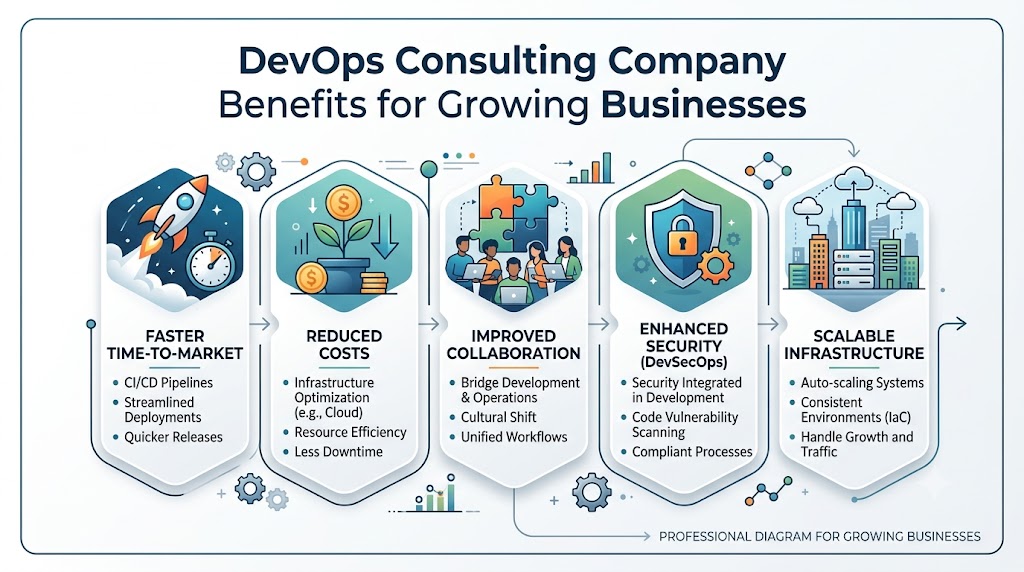
For CTOs, CIOs, engineering managers, and IT leaders, the value is clear: faster delivery, better reliability, stronger governance, improved team skills, and reduced operational risk.
Table 1: Traditional Approach vs Modern DevOps Approach
| Feature | Benefits | Limitations | Use Cases | Best Choice |
|---|---|---|---|---|
| Manual deployments | Simple for small teams | Slow, risky, error-prone | Small internal apps | Early-stage teams |
| CI/CD pipelines | Faster and repeatable releases | Needs proper design | Product teams, SaaS apps | Growing businesses |
| Infrastructure as Code | Consistent environments | Requires skill and governance | Cloud and hybrid setups | Enterprises |
| DevSecOps | Security built into delivery | Needs tool integration | Regulated industries | Security-focused teams |
| SRE practices | Better uptime and reliability | Requires cultural maturity | Production platforms | Large-scale systems |
Key Services Enterprises Should Consider
DevOps and CI/CD Pipeline Consulting
CI/CD Pipeline Consulting helps teams automate code integration, testing, security scanning, approvals, and deployment. A good pipeline reduces manual errors and gives teams confidence to release more frequently.
This is useful when teams face delayed releases, broken builds, inconsistent environments, or poor rollback planning. Cotocus can help organizations design practical pipelines that match their development model, compliance needs, and release strategy.
Cloud Migration and Cloud Consulting
Cloud Migration Services and Cloud Consulting Services help businesses move applications, workloads, databases, and infrastructure to cloud platforms in a structured way.
A successful cloud journey includes readiness assessment, workload planning, cost visibility, security design, migration waves, automation, monitoring, and post-migration optimization. Without this, cloud adoption can lead to overspending, downtime, and operational confusion.
Kubernetes and Platform Engineering
Kubernetes Consulting Services support enterprises that want to run containerized applications at scale. Kubernetes brings flexibility, but it also introduces complexity in networking, storage, security, monitoring, upgrades, and governance.
Platform Engineering Consulting helps organizations create internal developer platforms so teams can deploy faster using approved, reusable, and secure workflows. This improves developer experience and reduces dependency on manual operations.
SRE, DevSecOps, GitOps, AIOps, MLOps, and DataOps
Modern enterprises need more than basic DevOps. Site Reliability Engineering Consulting improves reliability, incident response, service-level objectives, and observability. DevSecOps Corporate Training and consulting help teams integrate security into pipelines. GitOps Consulting Services improve infrastructure and deployment governance through Git-based workflows.
Cotocus also aligns with emerging areas such as AIOps Consulting Services, MLOps Consulting Services, and DataOps Consulting Services, helping organizations modernize IT operations, machine learning delivery, and data pipeline reliability.
Table 2: Consulting vs In-House Team vs Hybrid Model
| Feature | Benefits | Limitations | Use Cases | Best Choice |
| In-house team | Strong business context | May lack specialized expertise | Stable internal platforms | Mature teams |
| External consulting | Fast expert guidance | Needs internal participation | Transformation projects | Urgent improvement |
| Hybrid model | Combines expertise and ownership | Requires coordination | Enterprise modernization | Best long-term choice |
| Corporate training | Builds internal capability | Needs learning time | Skill development | L&D and HR teams |
| Managed implementation | Faster execution | Must avoid vendor dependency | Complex migrations | High-priority projects |
Enterprise Use Cases
A Digital Transformation Consulting Company like Cotocus can support multiple business scenarios.
For startups, consulting may focus on setting up scalable CI/CD, cloud infrastructure, Kubernetes basics, and release automation. For mid-sized companies, the priority may be cloud cost optimization, DevSecOps, observability, and standardized pipelines. For enterprises, the focus often shifts to governance, platform engineering, SRE, multi-team training, compliance, and long-term operating models.
Common use cases include:
- Migrating legacy applications to cloud
- Building secure CI/CD pipelines
- Setting up Kubernetes platforms
- Improving incident response
- Creating internal DevOps standards
- Training teams through DevOps Corporate Training
- Enabling DevOps Training for Companies
- Automating infrastructure provisioning
- Improving data, ML, and AI operations
Table 3: DevOps, SRE, DevSecOps, and Platform Engineering
| Feature | Benefits | Limitations | Use Cases | Best Choice |
| DevOps | Faster software delivery | Needs culture change | CI/CD and automation | Most software teams |
| SRE | Higher reliability | Needs metrics discipline | Critical production systems | Large platforms |
| DevSecOps | Earlier security checks | Needs security ownership | Compliance-heavy apps | Regulated businesses |
| GitOps | Better deployment control | Needs Git workflow maturity | Kubernetes environments | Cloud-native teams |
| Platform Engineering | Better developer experience | Needs platform strategy | Multi-team enterprises | Scaling organizations |
Best Practices for Successful DevOps Adoption
Start with a current-state assessment before buying tools. Identify bottlenecks in release flow, testing, environment provisioning, cloud usage, security reviews, and incident handling. Build a roadmap with short-term wins and long-term platform goals.
Use automation carefully. Automate repeatable tasks, but do not automate broken processes without improving them first. Define ownership across development, operations, security, and platform teams. Measure progress using deployment frequency, lead time, change failure rate, recovery time, cloud cost, and incident trends.
Most importantly, combine consulting with training. Kubernetes Corporate Training, DevSecOps Corporate Training, and DevOps Corporate Training help internal teams maintain improvements after the consulting project ends.
Common Mistakes and How to Avoid Them
Many organizations treat DevOps as a tool installation project. This creates limited results because DevOps depends on people, process, automation, measurement, and culture.
Common mistakes include:
- Buying tools without a roadmap
- Migrating to cloud without cost governance
- Running Kubernetes without platform standards
- Adding security checks only at the end
- Ignoring monitoring and incident learning
- Creating pipelines without testing maturity
- Not training internal teams
To avoid these problems, work with a consulting partner that can combine implementation, governance, and corporate training. This helps teams improve continuously instead of depending on one-time tool setup.
Expert Tips for Technology Leaders
Begin with business outcomes, not tools. Decide whether the priority is faster releases, lower downtime, better cloud cost control, improved security, or team skill development. Then map DevOps, SRE, DevSecOps, cloud, and platform engineering initiatives to those outcomes.
Create a small pilot project before scaling across the enterprise. Choose one application, one team, and one measurable goal. Use the pilot to validate pipeline design, cloud automation, security checks, and monitoring practices. After that, expand gradually.
Finally, invest in internal capability. Corporate training ensures engineers, managers, and operations teams understand the new way of working.
Why Choose Cotocus
Cotocus is suitable for organizations looking for a technology partner across consulting, implementation support, and corporate training. Its service focus aligns with modern enterprise needs such as DevOps, cloud, Kubernetes, SRE, DevSecOps, GitOps, DataOps, AIOps, MLOps, and platform engineering.
Businesses can consider Cotocus when they need:
- A practical DevOps transformation roadmap
- Cloud migration and optimization guidance
- Kubernetes and container adoption support
- Secure DevOps implementation
- SRE and reliability improvement
- Corporate training for engineering teams
- Support for AI, ML, data, and modern operations
For enterprises, the biggest advantage is the combination of consulting and training. This helps teams not only implement modern practices but also learn how to sustain them.
Frequently Asked Questions
1. What does a DevOps Consulting Company do?
A DevOps Consulting Company helps businesses improve software delivery, automation, collaboration, infrastructure management, security integration, and reliability. It assesses current challenges, designs a roadmap, implements tools and processes, and trains internal teams. The goal is to make software releases faster, safer, more consistent, and more aligned with business needs.
2. Why do enterprises need DevOps Consulting Services?
Enterprises need DevOps Consulting Services when software delivery becomes slow, costly, risky, or difficult to scale. Consulting helps identify bottlenecks, standardize workflows, automate manual tasks, improve cloud usage, strengthen security, and build better collaboration between development, operations, security, and business teams.
3. How does DevOps Corporate Training help companies?
DevOps Corporate Training helps internal teams learn modern practices such as CI/CD, automation, infrastructure as code, cloud, containers, monitoring, and collaboration. Training reduces dependency on external support and helps employees apply DevOps practices confidently in real projects, improving long-term delivery maturity.
4. What is the difference between DevOps Consulting and DevOps Training?
DevOps Consulting focuses on strategy, assessment, implementation, and process improvement. DevOps Training for Companies focuses on building team knowledge and practical skills. Both are important because consulting improves systems and workflows, while training ensures internal teams can maintain and improve those systems.
5. When should a company use Cloud Migration Services?
A company should use Cloud Migration Services when moving applications, infrastructure, databases, or workloads from on-premises systems to cloud platforms. Expert guidance is useful for planning migration waves, reducing downtime, improving security, managing cost, and choosing the right cloud architecture.
6. What are Cloud Consulting Services?
Cloud Consulting Services help businesses plan, adopt, secure, optimize, and manage cloud environments. These services may include cloud readiness assessment, architecture design, migration planning, cost optimization, automation, monitoring, governance, and cloud-native modernization for applications and infrastructure.
7. Why are Kubernetes Consulting Services important?
Kubernetes Consulting Services are important because Kubernetes can become complex without proper design. Consultants help with cluster architecture, networking, security, storage, monitoring, deployment workflows, scaling, and governance. This helps teams use Kubernetes safely and efficiently for production workloads.
8. What is Kubernetes Corporate Training?
Kubernetes Corporate Training teaches teams how to use Kubernetes for container orchestration, deployments, services, configuration, scaling, troubleshooting, and security. It is useful for DevOps engineers, cloud engineers, SRE teams, developers, and platform teams working with cloud-native applications.
9. How does SRE Consulting improve reliability?
SRE Consulting Services improve reliability by introducing service-level objectives, monitoring, incident response, error budgets, automation, and post-incident learning. Site Reliability Engineering Consulting helps businesses balance faster innovation with stable production systems, especially for customer-facing platforms.
10. What is DevSecOps Consulting?
DevSecOps Consulting Services help organizations integrate security into development and delivery workflows. Instead of treating security as a final approval step, DevSecOps adds security scanning, policy checks, secrets management, compliance controls, and secure coding practices into CI/CD pipelines and team processes.
11. Why is GitOps useful for enterprises?
GitOps Consulting Services help enterprises manage infrastructure and application deployments using Git as the source of truth. This improves auditability, version control, rollback capability, and deployment consistency. GitOps is especially useful for Kubernetes, cloud-native platforms, and multi-team engineering environments.
12. What is Platform Engineering Consulting?
Platform Engineering Consulting helps organizations build internal platforms that make software delivery easier for developers. These platforms provide reusable templates, approved infrastructure patterns, automated workflows, security controls, and self-service capabilities. The goal is to improve developer experience while maintaining governance.
13. How do AIOps and MLOps support modern IT teams?
AIOps Consulting Services help IT teams use intelligent automation for monitoring, alert correlation, incident detection, and operations improvement. MLOps Consulting Services help teams manage the machine learning lifecycle, including model development, deployment, monitoring, and governance. Both support advanced digital operations.
14. What is DataOps Consulting?
DataOps Consulting Services help businesses improve the speed, quality, reliability, and governance of data pipelines. It combines automation, collaboration, testing, monitoring, and lifecycle management so data teams can deliver trusted data faster for analytics, reporting, AI, and business decision-making.
15. How should companies choose a DevOps consulting partner?
Companies should choose a partner with experience in DevOps, cloud, Kubernetes, SRE, DevSecOps, automation, and corporate training. The partner should understand business goals, provide practical roadmaps, avoid tool-only thinking, support implementation, train teams, and help measure improvement through clear delivery and reliability metrics.
Conclusion
DevOps is no longer only a technical improvement project. It is a business capability that affects release speed, customer experience, security, cloud cost, reliability, and innovation. Enterprises that combine consulting, implementation, automation, and corporate training can build stronger engineering teams and more dependable digital platforms.
Cotocus can support businesses with DevOps Consulting Services, Cloud Migration Services, Kubernetes Consulting Services, SRE Consulting Services, DevSecOps Consulting Services, Platform Engineering Consulting, and related corporate training programs. The right approach helps organizations modernize with clarity, reduce operational risk, and create long-term technology value.