Introduction
The role of a modern engineering leader has shifted from managing people to managing complex, data-driven ecosystems. In the current landscape, manual oversight is a bottleneck that prevents true scalability. The Certified AIOps Architect program is designed for leaders who need to transition their departments into a proactive, “intelligent” operational model. This guide is written for Engineering Managers, Directors, and aspiring Site Reliability Engineer leads who want to move beyond simple automation and build a culture of autonomous reliability.
What is the Certified AIOps Architect?
This certification represents the highest level of strategic technical planning in the “Ops” world. It is a framework that allows architects to design systems capable of self-healing, predictive scaling, and advanced event correlation. For a leader, this means moving your team away from the “toil” of manual incident response and toward high-value architectural improvements. An AIOps Architect ensures that the business can scale its infrastructure without linearly scaling its headcount, creating a lean, high-performing engineering organization.
Who Should Pursue Certified AIOps Architect?
This path is essential for technical leaders who are responsible for the uptime and performance of enterprise-grade applications. It is ideal for Engineering Managers, Principal SREs, and Platform leads who need to make informed decisions about AI and machine learning tools. Whether you are leading a team in a fast-paced startup or a large global firm in India, this certification provides the technical authority to guide your organization through the complexities of AI-driven digital transformation.
Why Certified AIOps Architect is Valuable Today
As infrastructure becomes more distributed across multi-cloud environments, the risk of “information overload” for engineers is real. The value of an AIOps Architect is their ability to implement a strategy that filters out the noise and focuses human energy on the most critical issues. For a career professional, this skill set is a differentiator. It marks you as a leader who understands not just how to build systems, but how to make those systems “smart” enough to manage themselves, ensuring long-term operational excellence and reduced business risk.
Certified AIOps Architect Certification Overview
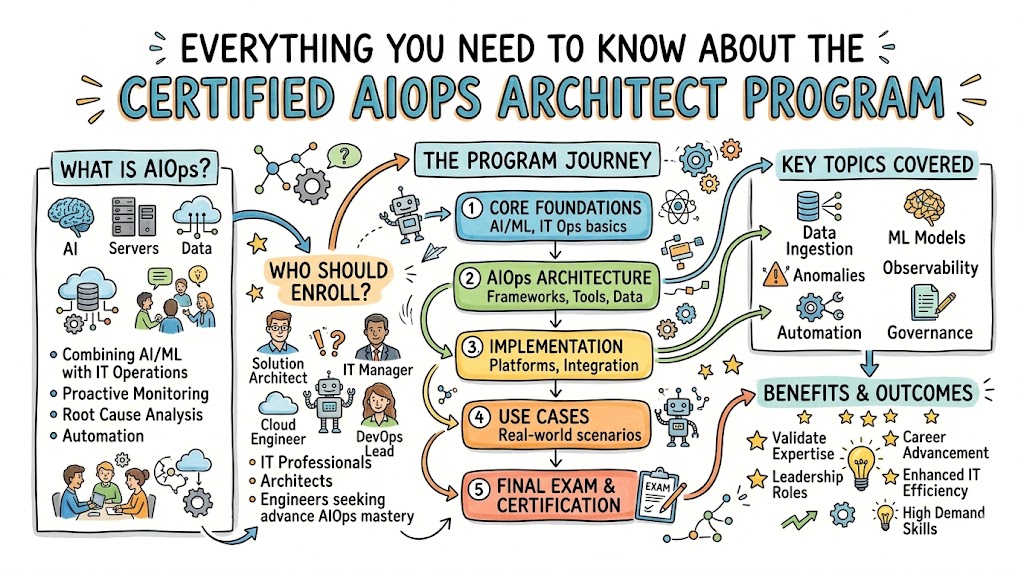
The program is officially delivered via the course portal and hosted on aiopsschool.com. It is structured to provide a comprehensive look at the lifecycle of an AI-driven operational model. Unlike traditional certifications that focus on a single tool, this program teaches the underlying principles of data science applied to infrastructure. You will learn how to design data pipelines, select appropriate machine learning models for anomaly detection, and create automated remediation workflows that integrate with modern CI/CD practices.
Certified AIOps Architect Certification Tracks & Levels
The curriculum follows a logical progression designed to build expertise from the ground up. The foundation level covers the basics of observability and data collection. The professional level dives into the application of ML models for specific operational use cases like root cause analysis. The expert architect level focuses on enterprise-wide strategy, including governance, security integration, and calculating the financial impact of AIOps. This tiered approach ensures that leaders can develop a deep, well-rounded understanding of the entire domain.
Complete Certification Mapping Table
| Track | Level | Who it’s for | Prerequisites | Skills Covered | Recommended Order |
| Leadership | Foundation | Team Leads | 2+ Years Exp | Observability, SLIs | 1 |
| Strategy | Professional | Managers | AIOps Foundation | Automation, ML Ops | 2 |
| Governance | Architect | Directors/CTOs | AIOps Professional | System Design, ROI | 3 |
Detailed Guide for Certified AIOps Architect – Foundation
What it is
This certification validates a professional’s understanding of how to transition from traditional monitoring to data-driven observability. It focuses on the core pillars of AIOps: Data, Analysis, and Action.
Who should take it
It is perfect for engineering leads, senior developers, and managers who need to understand the fundamental concepts of AI in IT operations before leading a transformation project.
Skills you’ll gain
- Mastery of telemetry data types (Metrics, Logs, Traces).
- Understanding of statistical vs. machine learning-based anomaly detection.
- Knowledge of how to reduce alert noise in production environments.
Real-world projects you should be able to do after it
- Designing a centralized dashboard that correlates logs and metrics in real-time.
- Implementing a basic automated alerting strategy based on historical system trends.
Preparation plan
- 14 Days: Review the official AIOps framework and learn the “Three Pillars of Observability.”
- 30 Days: Practice ingesting data from various cloud services into a single analysis engine.
- 60 Days: Conduct a “Gap Analysis” on your current monitoring stack to identify AIOps opportunities.
Common mistakes
- Assuming that AIOps will solve poor infrastructure design issues.
- Focusing on buying a tool before defining the operational problems you need to solve.
Best next certification after this
- Same-track: Certified AIOps Architect – Professional
- Cross-track: Certified DevSecOps Professional
- Leadership: Site Reliability Manager
Choose Your Learning Path
DevOps Path
The DevOps path focuses on making the “Delivery” phase intelligent. Leaders learn how to use AI to predict if a software release will negatively impact performance or security. It is about building a pipeline that learns from every deployment and gets safer over time.
DevSecOps Path
This path is about “Intelligent Security.” You will design systems that use anomaly detection to identify zero-day threats and automated responses to isolate security breaches. It ensures that security is baked into the automated operational heartbeat of the company.
SRE Path
The SRE path is the core of “Reliability Engineering.” Leaders focus on managing error budgets and using AI to automate the remediation of recurring incidents. It is the path for those who want to build highly resilient, global-scale platforms.
AIOps/MLOps Path
This specialized track focuses on the infrastructure required to run machine learning models. You will learn how to monitor model performance and ensure that the AI driving your operations is accurate, reliable, and properly resourced.
DataOps Path
DataOps is essential for ensuring the “Data Quality” in AIOps. This path teaches you how to manage the flow of telemetry data. You ensure that the AI has access to clean, real-time data from every part of the infrastructure.
FinOps Path
The FinOps path uses AI to manage “Cloud Economics.” Leaders learn how to build models that predict spending and identify opportunities for cost reduction through automated resource rightsizing and waste identification.
Role → Recommended Certifications
| Role | Recommended Certifications |
| DevOps Engineer | AIOps Professional |
| SRE | Certified Site Reliability Engineer – Foundation |
| Platform Engineer | AIOps Architect |
| Cloud Engineer | AIOps Foundation |
| Security Engineer | AI-Driven Security Specialist |
| Data Engineer | DataOps Professional |
| FinOps Practitioner | AIOps for Finance |
| Engineering Manager | AIOps Leadership Track |
Top Training & Certification Support Providers
DevOpsSchool
This provider is excellent for leaders who need to understand the cultural and technical shift required for AIOps. They offer comprehensive training that bridges the gap between traditional management and modern automation strategies.
Cotocus
Cotocus focuses on high-level architectural consulting and training. Their programs are designed for senior professionals who need to design and implement complex AI strategies in enterprise-scale environments.
Scmgalaxy
Scmgalaxy provides a wealth of technical tutorials and community-driven resources. It is a great platform for leaders who want to stay informed about the latest open-source tools and community-vetted best practices in AIOps.
BestDevOps
BestDevOps offers efficient, results-focused training modules. Their approach is ideal for busy managers who need to gain a deep understanding of AIOps principles quickly to drive strategic projects.
Devsecopsschool
This is the primary choice for integrating security into the intelligent operational lifecycle. They train leaders to treat security as a critical component of system reliability and AI-driven automation.
Sreschool
Sreschool focuses on the management of Site Reliability Engineering. Their AIOps curriculum is built to help managers reduce “toil” and improve the stability of global-scale systems through smart automation.
As the official host for the Certified AIOps Architect program, Aiopsschool offers the most direct and thorough curriculum. They cover everything from the basics of data science to enterprise-wide AI strategy.
Dataopsschool
Dataopsschool addresses the critical need for data management. They teach leaders how to build reliable data pipelines that ensure the AI powering their operations is always accurate and effective.
Finopsschool
Finopsschool helps leaders understand the financial side of operations. They offer training on using AI to manage cloud costs, ensuring that high-scale systems remain both performant and profitable.
Frequently Asked Questions (General)
- Is the AIOps Architect certification worth it for a manager?
Yes, it provides the technical authority and strategic framework needed to lead modern engineering teams and make informed tool selections. - How long does the program take?
For a manager, the conceptual and strategic sections take about three to four months of consistent study to fully master. - Are there any prerequisites for leadership roles?
A background in software engineering or infrastructure management is highly recommended to understand the context of AI application. - Should I take the SRE or AIOps track first?
SRE provides the “Mindset,” while AIOps provides the “Tooling.” Most leaders find it helpful to understand SRE principles before moving into AIOps. - What is the value of this certification in the market?
It marks you as a forward-thinking leader capable of reducing operational costs and improving system reliability through advanced technology. - Do I need to know how to code in Python?
While you don’t need to be a developer, understanding Python allows you to better oversee the integration of ML models and automation scripts. - Is the certification recognized globally?
Yes, as companies worldwide move toward autonomous operations, credentials from recognized providers like Aiopsschool are highly sought after. - Can I take the training while managing a full-time team?
Yes, the programs are often designed for working professionals with flexible schedules and remote learning options. - What is the ROI of AIOps for a business?
ROI is typically seen in reduced MTTR (Mean Time To Resolution), lower operational costs, and higher system availability. - Is the exam available online?
Yes, the certification exams are proctored online to accommodate professionals from across India and the global market. - What is the most important skill for a leader in AIOps?
The ability to align AI-driven technical strategies with the broader financial and operational goals of the business. - Are there labs for managers?
Yes, the programs include high-level labs that focus on dashboard design, strategy planning, and model oversight.
FAQs on Certified AIOps Architect
- How does AIOps help with team burnout?
By automating routine alerts and incident response, AIOps reduces the “on-call” stress and toil that typically leads to engineer burnout. - Can AIOps improve our security posture?
Absolutely. AIOps allows for faster detection of anomalous patterns that indicate a breach, enabling a quicker automated response. - Does the curriculum cover budget management?
Yes, especially in the architect and FinOps tracks, where you learn to use AI to forecast and optimize cloud spending. - Is knowledge of Kubernetes required for leaders?
A conceptual understanding is necessary, as most AIOps implementations today occur within containerized and orchestrated environments. - How does AIOps handle false positives?
One of the core skills learned is how to “tune” ML models to improve accuracy and reduce the frequency of incorrect alerts. - What is the format of the final architect assessment?
It usually involves a strategic case study or a design project that proves your ability to plan an enterprise-wide AIOps rollout. - Are there community groups for certified leaders?
Yes, alumni gain access to professional networks where they can discuss management challenges and hiring trends in the AIOps field. - Is there a focus on multi-cloud strategy?
Yes, the program teaches you how to maintain consistent operational intelligence across AWS, Azure, and Google Cloud environments.
Conclusion
If your goal is to grow from operational execution into architecture and strategy, Certified AIOps Architect is worth serious attention. It helps you understand how telemetry, automation, event intelligence, and service reliability come together in modern enterprises. That makes it valuable for professionals who want to stay relevant as systems become more complex. This certification is especially useful for people who want to reduce operational noise, improve incident handling, and design better digital operations workflows. In simple words, it helps you move from reacting to problems toward building systems that handle problems more intelligently.