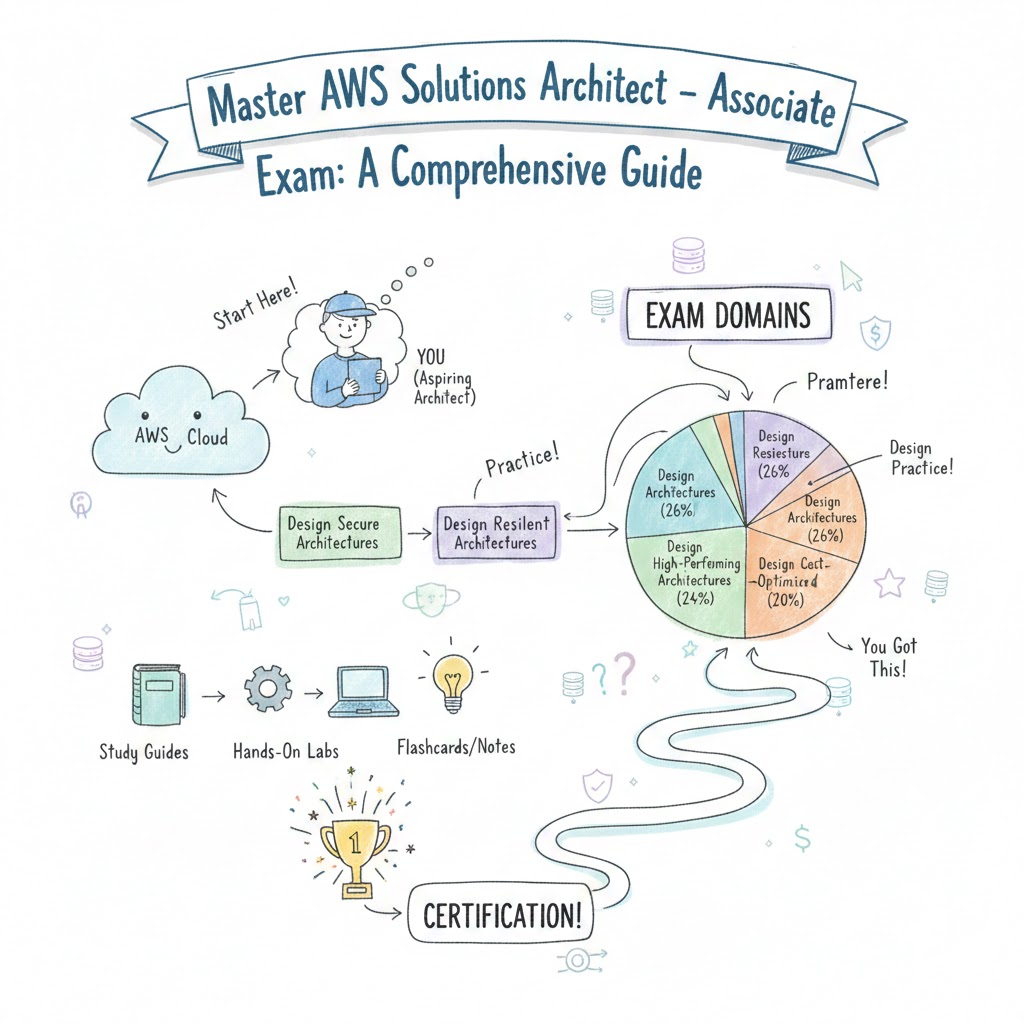
Introduction
Cloud computing has revolutionized how businesses operate, with Amazon Web Services (AWS) being the leader in the field. As organizations continue migrating to the cloud, the need for skilled professionals who can design, implement, and manage cloud solutions has grown significantly. The AWS Certified Solutions Architect – Associate certification is a foundational certification that proves you have the technical knowledge and hands-on experience to architect and deploy scalable, secure, and cost-effective systems on AWS.Whether you’re a seasoned engineer looking to move into cloud computing, or someone new to AWS, this guide will walk you through everything you need to know about the AWS Solutions Architect – Associate certification, from the exam requirements to preparation tips and career advice.
What is AWS Certified Solutions Architect – Associate?
The AWS Certified Solutions Architect – Associate is an entry-level cloud certification that validates your ability to design distributed applications and systems on the AWS platform. This certification is specifically for professionals who have a basic understanding of AWS cloud services and want to build, design, and deploy scalable, fault-tolerant, and highly available applications in the AWS cloud environment.
AWS offers a range of certifications, but the Solutions Architect – Associate is considered one of the most critical for professionals who want to gain a strong understanding of the cloud architecture and its foundational concepts.
- Key Focus Areas: The certification focuses on topics such as networking, security, and architecture design, making sure candidates are proficient in utilizing AWS core services effectively.
- Exam Overview: The exam measures your ability to identify and implement best practices for high availability, cost optimization, security, and fault tolerance in a cloud environment.
Who Should Take It?
This certification is designed for professionals who are involved in building applications on AWS or designing AWS-based solutions. It’s particularly beneficial for the following audiences:
- Software Engineers/Developers: Professionals who want to learn how to design and build cloud applications using AWS services.
- Cloud Engineers: Engineers who are responsible for maintaining cloud infrastructure and are looking to deepen their understanding of AWS cloud architecture.
- IT Managers: Managers who need to understand cloud concepts in depth and make decisions regarding cloud architecture for their teams.
- System Administrators: Those managing on-premise or hybrid cloud systems who want to transition to cloud solutions.
- Architects: Professionals already working in a cloud domain who want to improve their knowledge in AWS, specifically related to design and deployment.
It’s also a great entry-level certification for anyone who is new to the cloud computing world and wants to enter the field of cloud architecture.
Skills You’ll Gain
Upon completing this certification, you’ll develop a broad skill set to work as an AWS Solutions Architect. These skills include:
- Designing Highly Available and Scalable Systems: You will learn how to architect systems that can scale dynamically to meet varying loads while remaining resilient and fault-tolerant.
- Optimizing Cost and Performance: AWS provides multiple tools for cost management, such as Auto Scaling and Reserved Instances. You’ll learn how to balance cost with performance optimization.
- Security Best Practices: You will gain a solid understanding of security best practices for AWS, including the proper setup of Identity and Access Management (IAM), encryption, and firewalls.
- Working with AWS Core Services: Key AWS services such as EC2 (Elastic Compute Cloud), S3 (Simple Storage Service), RDS (Relational Database Service), VPC (Virtual Private Cloud), and IAM are central to your learning. You’ll get familiar with how to use these tools to implement various architectures.
- Disaster Recovery Planning: You will learn how to design and implement systems that automatically back up data and ensure recovery in case of a disaster.
- Networking and Communication: You’ll gain knowledge on how to create secure networks within AWS using tools like VPC and CloudFront. These tools ensure that data flows securely and efficiently between applications and users.
Real-World Projects You Should Be Able to Do
After passing the certification, you should be able to apply the knowledge you’ve gained to various real-world projects, such as:
- Design a Multi-Tier Architecture: For example, creating a multi-tier web application with a load balancer, auto-scaling EC2 instances, and a secure RDS database. The application should be designed to handle traffic spikes while maintaining performance.
- Implementing Fault-Tolerant Architectures: Designing systems where resources like EC2 instances or databases automatically scale and recover in case of failure, ensuring business continuity.
- Cost Optimization: Developing solutions that maximize efficiency while minimizing costs. For example, configuring a system that uses spot instances where possible to reduce costs, or implementing Auto Scaling to ensure efficient resource usage.
- Designing Secure Applications: Utilizing AWS security tools to create secure solutions. For instance, configuring IAM roles and policies to restrict access to critical resources, setting up VPCs with private subnets, and ensuring secure data transfer through SSL/TLS.
- Build and Deploy Cloud-Native Applications: You should be able to set up a cloud-native environment where applications are scalable and flexible. This includes deploying applications using AWS Elastic Beanstalk or containers on AWS ECS (Elastic Container Service).
Preparation Plan
7-14 Days Preparation Plan
For candidates who have some familiarity with AWS services:
- Focus Areas: Basic AWS services (EC2, S3, IAM, RDS, VPC, CloudWatch).
- Study Resources: Utilize free AWS documentation and introductory training from AWS. Review free video tutorials available on platforms like YouTube or Cloud Academy.
- Hands-on Practice: Set up basic services in AWS, like launching an EC2 instance, creating an S3 bucket, and configuring security groups.
30 Days Preparation Plan
For a more dedicated, in-depth approach:
- Focus Areas: Advanced topics like auto-scaling, fault tolerance, and security best practices. Get familiar with AWS whitepapers and case studies.
- Study Resources: AWS Certified Solutions Architect – Associate courses on platforms like Cloud Academy, Udemy, or A Cloud Guru.
- Hands-on Practice: Focus on building real-world projects such as an auto-scalable web app using EC2 and an RDS database. Use the AWS free tier for practice.
60 Days Preparation Plan
For those new to AWS or those who want to build confidence before the exam:
- Focus Areas: Security architecture, high availability, and networking. Study CloudFormation, CloudWatch, and Auto Scaling in depth.
- Study Resources: Take comprehensive online courses from platforms such as A Cloud Guru, Cloud Academy, or AWS Certified Solutions Architect study guides.
- Hands-on Practice: Create more complex projects that require integration of multiple AWS services, including setting up a multi-tier web application with load balancers and auto-scaling.
Common Mistakes to Avoid
When preparing for the AWS Certified Solutions Architect – Associate exam, candidates often make these mistakes:
- Not Practicing Enough: AWS is hands-on, and only understanding the theory won’t be enough. You need to gain practical experience by working with AWS services regularly.
- Overlooking Cost Management: Many candidates focus too much on functionality and forget to consider how to optimize costs. Cost management is an important aspect of AWS architecture.
- Skipping Security Configurations: Security is a core part of AWS solutions. Understanding how to configure IAM roles, encryption, and firewalls will be critical for passing the exam.
- Not Reviewing the Exam Guide Thoroughly: The exam guide from AWS gives clear insights into the topics covered. Missing out on this can make your preparation incomplete.
Best Next Certification After This
After achieving the AWS Certified Solutions Architect – Associate, there are several certification paths you can pursue to continue your career in cloud computing:
- Same Track: AWS Certified Solutions Architect – Professional: If you want to go deeper into cloud architecture, the Professional certification will teach you how to handle more complex systems.
- Cross-Track: AWS Certified DevOps Engineer – Professional: Ideal for those interested in automating AWS infrastructure or working on DevOps practices.
- Leadership: AWS Certified Cloud Practitioner: A good option if you’re interested in leadership roles, focusing more on cloud fundamentals at an enterprise level.
Choose Your Path
Once you’ve achieved the AWS Certified Solutions Architect – Associate, you can further specialize in various areas of cloud computing based on your career goals. Here are some paths you might consider:
1. DevOps Path
- Next Certification: AWS Certified DevOps Engineer – Professional
- Focus: Automating infrastructure, CI/CD pipelines, infrastructure as code.
2. DevSecOps Path
- Next Certification: AWS Certified Security Specialty
- Focus: Embedding security practices into the DevOps pipeline.
3. SRE Path
- Next Certification: AWS Certified SysOps Administrator
- Focus: Monitoring, fault tolerance, system reliability, and scaling.
4. AIOps/MLOps Path
- Next Certification: AWS Certified Machine Learning Specialty
- Focus: Integrating AI and ML into cloud systems and operations.
5. DataOps Path
- Next Certification: AWS Certified Data Analytics Specialty
- Focus: Managing big data and analytics on AWS.
6. FinOps Path
- Next Certification: AWS Certified Cloud Financial Management Specialty
- Focus: Optimizing and managing cloud costs.
Role → Recommended Certifications
Here’s a recommended certification map based on your role:
| Role | Recommended Certifications |
|---|---|
| DevOps Engineer | AWS Certified DevOps Engineer – Professional, Certified Kubernetes Administrator |
| SRE | AWS Certified SysOps Administrator, Certified Site Reliability Engineer |
| Platform Engineer | AWS Certified Solutions Architect – Professional, Certified Kubernetes Administrator |
| Cloud Engineer | AWS Certified Solutions Architect – Associate, AWS Certified Cloud Practitioner |
| Security Engineer | AWS Certified Security Specialty, Certified Ethical Hacker |
| Data Engineer | AWS Certified Data Analytics Specialty, AWS Certified Big Data Specialty |
| FinOps Practitioner | AWS Certified Cloud Financial Management Specialty |
| Engineering Manager | AWS Certified Cloud Practitioner, AWS Certified Solutions Architect – Professional |
List of Top Training Institutions
Several institutions offer excellent AWS Certified Solutions Architect – Associate training programs that provide in-depth learning and hands-on experience. Here are the top training providers:
1. DevOpsSchool
DevOpsSchool is one of the leading platforms for cloud and DevOps training, offering expert-led courses specifically designed to prepare you for the AWS Certified Solutions Architect – Associate exam. Their training includes hands-on labs, industry-specific use cases, and live projects, providing a practical learning experience. The courses are available online and in-person, making it accessible for learners worldwide.
- Key Features: Practical labs, expert instructors, comprehensive course materials, flexible learning options.
2. Cotocus
Cotocus specializes in cloud computing and AWS training with a focus on real-world application and best practices for cloud architecture. Their AWS Certified Solutions Architect – Associate course covers everything from core AWS services to advanced architectural principles. They also offer personalized mentorship and a community-driven learning experience.
- Key Features: Real-world scenarios, mentorship, community-driven learning, certification guidance.
3. Scmgalaxy
Scmgalaxy is a prominent provider of cloud computing and AWS certification programs. Their AWS Certified Solutions Architect – Associate course provides extensive coverage of AWS architecture, scalability, security, and networking. Scmgalaxy offers a variety of learning formats, including instructor-led classes, self-paced courses, and corporate training.
- Key Features: Self-paced and instructor-led courses, hands-on training, corporate training options.
4. BestDevOps
BestDevOps offers an in-depth AWS Certified Solutions Architect – Associate training program, emphasizing cloud architecture, automation, and cost optimization. With experienced instructors and real-world examples, BestDevOps ensures that you gain practical knowledge that can be immediately applied to your projects.
- Key Features: Real-world use cases, cloud architecture best practices, cost optimization techniques, hands-on labs.
5. DevSecOpsSchool
DevSecOpsSchool focuses on integrating security with AWS architecture, making it a great choice for those who want to add security best practices to their cloud expertise. Their courses emphasize secure cloud design, identity management, encryption, and compliance in AWS environments.
- Key Features: Focus on cloud security, IAM and encryption practices, compliance and security audits.
6. SRESchool
SRESchool provides AWS training tailored to Site Reliability Engineering (SRE) principles. This training helps you understand how to design highly available, fault-tolerant, and scalable cloud systems on AWS. The course includes monitoring, scaling strategies, and operational best practices for AWS cloud systems.
- Key Features: SRE principles, high availability, fault-tolerant system design, scaling strategies.
7. AIOpsSchool
AIOpsSchool focuses on combining AWS training with Artificial Intelligence and Machine Learning operations. The course covers deploying AI/ML models on AWS, automating machine learning pipelines, and using AWS for smart operations. If you’re interested in AIOps, this is the perfect platform to start.
- Key Features: AI/ML integration with AWS, automation of ML pipelines, machine learning model deployment.
8. DataOpsSchool
DataOpsSchool specializes in AWS training for professionals looking to manage and analyze data at scale. The courses focus on AWS tools like Redshift, Athena, Glue, and Kinesis to design efficient, scalable data pipelines. DataOps practices for continuous delivery and integration are also emphasized.
- Key Features: Data engineering and analytics, AWS big data services, DataOps principles, scalable data pipelines.
9. FinOpsSchool
FinOpsSchool offers cloud financial management and optimization training with a focus on AWS. Their FinOps program is designed for professionals interested in understanding cloud cost management, budgeting, and efficient financial operations on AWS. The course teaches how to optimize AWS usage and reduce costs.
- Key Features: Cloud cost management, budgeting, financial optimization, AWS pricing models.
Comparison Table of Key AWS Services
| AWS Service | Description | Use Case | Key Features |
|---|---|---|---|
| EC2 (Elastic Compute Cloud) | A scalable compute service that allows you to run virtual servers in the cloud. | Deploying applications that require on-demand compute resources. | Pay-as-you-go pricing, auto-scaling, various instance types. |
| S3 (Simple Storage Service) | Object storage for the internet, providing scalable storage. | Storing large amounts of data, backups, and static web assets. | High durability (99.999999999%), easy to use, integrated with other AWS services. |
| VPC (Virtual Private Cloud) | A private cloud within AWS that allows users to define their network architecture. | Creating isolated network environments for applications. | Subnets, security groups, VPNs, route tables, and private/public IP addresses. |
| RDS (Relational Database Service) | Managed relational databases, such as MySQL, PostgreSQL, and SQL Server. | Running applications that require relational data stores. | Automated backups, scaling, multi-availability zone deployment. |
| IAM (Identity and Access Management) | Service that helps manage user access to AWS resources securely. | Controlling access permissions for different users and services. | Granular access control policies, Multi-Factor Authentication (MFA). |
| Lambda | Serverless computing service that runs code in response to events, without managing servers. | Building event-driven applications or microservices. | Auto-scaling, low cost, no server management, integrates with many AWS services. |
| CloudFront | Content delivery network (CDN) that speeds up the distribution of static and dynamic content. | Delivering web content (images, videos) to users with low latency. | Global distribution, integrated with S3 and EC2, SSL/TLS encryption. |
| Elastic Load Balancing (ELB) | Distributes incoming traffic across multiple targets, such as EC2 instances, in multiple availability zones. | Improving application fault tolerance and availability. | Supports automatic scaling, SSL termination, cross-region support. |
| CloudFormation | A service that helps you model and set up your AWS resources so that they can be managed and provisioned automatically. | Automating resource deployment and infrastructure management. | Templates, infrastructure as code, version control, cross-region deployments. |
| Route 53 | Managed DNS service to route traffic to AWS services or external endpoints. | Managing DNS routing and domain registration. | High availability, low latency, routing policies, domain registration. |
FAQs
- How difficult is the AWS Certified Solutions Architect – Associate exam?
- It’s moderately difficult. The exam is designed to test practical knowledge and understanding of AWS services and best practices.
- How long does it take to prepare for the exam?
- Preparation time varies but generally takes 1-3 months based on your experience level.
- What are the prerequisites for this certification?
- No formal prerequisites, but a good understanding of cloud computing and AWS is recommended.
- Is there any hands-on practice required?
- Yes, hands-on practice is crucial to understand how AWS services work in the real world. AWS offers a free-tier account that you can use to experiment.
- What is the exam format?
- The exam consists of multiple-choice and multiple-response questions, which you have 130 minutes to answer.
- How much does the exam cost?
- The exam costs $150 USD.
- What career benefits can I expect after passing this certification?
- Expect improved job prospects, higher earning potential, and opportunities for advancement in cloud-related roles.
- Is the certification worth the investment?
- Yes, this certification is widely recognized and can significantly boost your credibility and career prospects in cloud architecture.
FAQs
- How difficult is the AWS Certified Solutions Architect – Associate exam?
The exam is moderately difficult. It tests your knowledge of AWS services and your ability to design scalable, cost-effective, and secure cloud architectures. Hands-on practice is essential to succeed. - How long does it take to prepare for the AWS Certified Solutions Architect – Associate exam?
Preparation time typically ranges from 1 to 3 months, depending on your prior experience with AWS and cloud computing. Beginners may need more time to get comfortable with AWS services. - What are the prerequisites for this certification?
There are no formal prerequisites for the AWS Certified Solutions Architect – Associate exam. However, familiarity with basic cloud computing concepts and some hands-on experience with AWS services will be helpful. - Can I take this exam without hands-on experience?
While it’s possible to take the exam without hands-on experience, it’s strongly recommended to practice with AWS services. Real-world experience is crucial for understanding the exam’s practical application questions. - What is the exam format?
The exam consists of 65 multiple-choice and multiple-response questions. You have 130 minutes to complete the exam, which is delivered in English, Japanese, Korean, and Simplified Chinese. - How much does the exam cost?
The exam costs $150 USD. You can reschedule or retake the exam, but there is a 14-day waiting period between retakes. - How long is the certification valid?
The AWS Certified Solutions Architect – Associate certification is valid for 3 years. After that, you will need to recertify to maintain your status. - What topics are covered in the exam?
The exam covers topics such as AWS architecture best practices, cloud security, cost optimization, designing scalable systems, and troubleshooting AWS environments. - What resources should I use to prepare for the exam?
AWS’s official training resources, including the AWS Certified Solutions Architect – Associate exam guide, practice exams, and whitepapers, are excellent resources. Platforms like A Cloud Guru, Udemy, and Cloud Academy also offer specialized courses. - How many practice exams should I attempt?
At least 2-3 practice exams should be completed to familiarize yourself with the question format, time limits, and to identify areas where you need more practice. - What are the common mistakes to avoid during preparation?
Common mistakes include relying solely on practice exams without real-world practice, not reviewing the exam guide thoroughly, and neglecting the cost management and security aspects of AWS services. - Is the AWS Certified Solutions Architect – Associate worth the investment?
Yes! This certification is one of the most recognized in the cloud industry and can lead to higher job opportunities, increased salary, and career advancement in cloud computing.
Conclusion
The AWS Certified Solutions Architect – Associate certification is a valuable credential for professionals looking to advance their careers in cloud computing. It demonstrates your ability to design scalable, cost-effective, and secure solutions using AWS. Whether you’re new to AWS or an experienced professional, this certification will validate your skills and open up new opportunities in cloud architecture.By following a structured preparation plan, gaining hands-on experience, and leveraging the resources provided, you can confidently prepare for and pass the exam. As cloud computing continues to grow, this certification will not only enhance your technical expertise but also improve your employability in the rapidly expanding cloud industry.