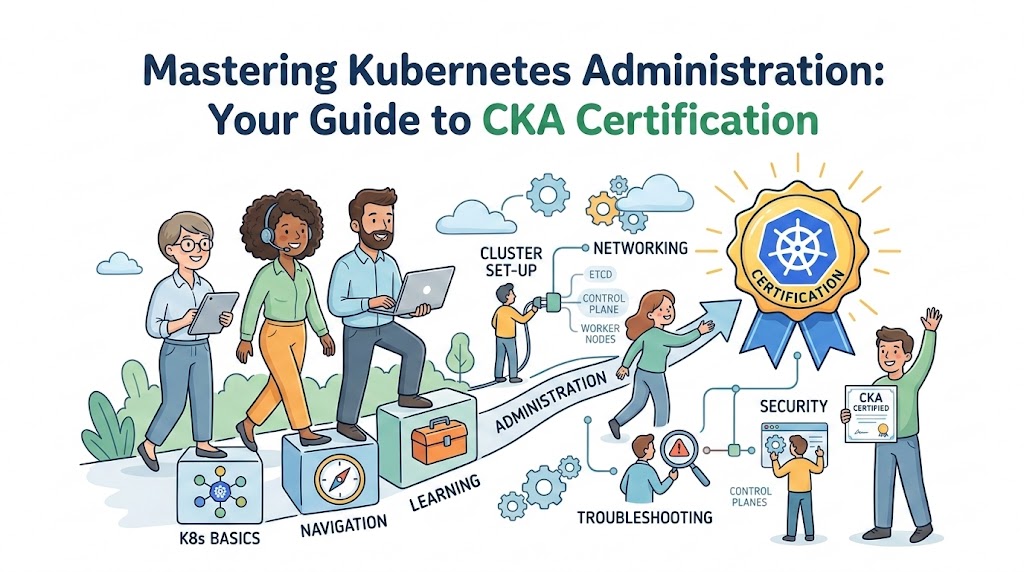
Introduction
In the fast-paced world of cloud computing and containerization, Kubernetes has become the de facto standard for container orchestration. The Certified Kubernetes Administrator (CKA) certification is a globally recognized credential that showcases your proficiency in managing Kubernetes clusters. Whether you’re a cloud engineer, DevOps professional, or systems administrator, earning the CKA certification can significantly boost your career prospects.In this comprehensive guide, we’ll cover the key aspects of the CKA certification—from what it is to the detailed preparation strategies, and everything in between. This will serve as a valuable resource to help you understand the certification’s importance, the skills you’ll acquire, and how to succeed in the exam.
What is the Certified Kubernetes Administrator (CKA) Certification?
The Certified Kubernetes Administrator certification is designed to validate the skills and knowledge required to deploy, manage, and troubleshoot Kubernetes clusters. It is an open-source container orchestration tool that is widely used by businesses and organizations for automating application deployment, scaling, and management.
Key Areas Covered in CKA:
- Cluster Architecture and Installation: How to deploy and configure a Kubernetes cluster.
- Networking and Security: Networking fundamentals in Kubernetes, as well as securing clusters using RBAC, Network Policies, and Service Accounts.
- Monitoring and Logging: Understanding logging and monitoring systems to ensure a Kubernetes cluster’s health.
- Scheduling: Managing resource allocation and balancing workloads in a cluster.
- Storage Management: Handling persistent volumes, volume claims, and storage backends for containers.
Who Should Take the Certified Kubernetes Administrator Exam?
The CKA exam is intended for professionals who manage Kubernetes clusters, ensuring their operation and scaling in production environments. Here’s a breakdown of the ideal candidates:
- Cloud Engineers: Cloud engineers working with containerized applications will benefit greatly from mastering Kubernetes and achieving the CKA certification.
- DevOps Engineers: Since Kubernetes is an integral part of most DevOps pipelines, DevOps engineers will find the CKA certification valuable.
- System Administrators: Sysadmins tasked with managing applications and workloads will also benefit from mastering Kubernetes’ container orchestration.
- Platform Engineers: Platform engineers, who manage and maintain cloud-native infrastructures, will need this certification to validate their expertise in managing scalable applications in Kubernetes clusters.
Skills You’ll Gain from the CKA Certification
By passing the CKA certification exam, you will demonstrate expertise in the following skills:
- Cluster Management: Learn how to install and manage Kubernetes clusters and master the Kubernetes architecture, ensuring scalability and reliability.
- Networking: Gain an understanding of Kubernetes networking, services, ingress controllers, and network policies.
- Security: Learn how to secure Kubernetes clusters using Role-Based Access Control (RBAC), service accounts, network policies, and other security features.
- Troubleshooting: Become adept at debugging Kubernetes issues related to pods, networking, and cluster failures.
- Persistent Storage Management: Learn to manage storage resources in Kubernetes, including persistent volumes, claims, and storage classes.
- Resource Scheduling: Understand how to optimize workloads by managing scheduling, affinity, taints, and tolerations.
Real-World Projects You Should Be Able to Do After Earning the CKA
Upon completing the CKA certification, you will have the skills needed to work on several real-world projects:
- Managing Kubernetes Clusters: You’ll be able to set up and manage Kubernetes clusters on public clouds such as AWS, GCP, and Azure, or on on-premises systems.
- Deploying and Scaling Microservices: Kubernetes is perfect for deploying and scaling microservices applications, and you will gain the ability to manage them using Kubernetes resources like Deployments, Pods, ReplicaSets, and more.
- Implementing CI/CD with Kubernetes: Implement Continuous Integration and Continuous Deployment (CI/CD) pipelines using Kubernetes, automating the application deployment process.
- Network Configuration in Kubernetes: You’ll be able to configure and troubleshoot networking in Kubernetes, setting up services and ingress controllers, and ensuring security with network policies.
- Handling Cluster Failures and Recovery: Understand how to troubleshoot, manage, and resolve issues like pod failures, container crashes, and network partitioning in production environments.
Preparation Plan for the CKA Exam
The CKA exam is practical and requires hands-on experience. Here is a preparation roadmap based on the amount of time you have before taking the exam:
7-14 Days (Fast-Track Preparation)
- Focus on the essentials: Kubernetes architecture, pod management, and deployment.
- Set up a personal Kubernetes environment using Minikube, Docker Desktop, or any cloud-based Kubernetes environment like GKE or EKS.
- Use short, video-based learning resources for a quick overview.
30 Days (Moderate Preparation)
- Begin diving into more complex topics like networking, persistent storage, and security within Kubernetes.
- Utilize Play with Kubernetes and Katacoda for practice scenarios and hands-on labs.
- Prepare for the exam using the official Kubernetes documentation (documentation is allowed during the exam, so familiarize yourself with it).
60 Days (Comprehensive Preparation)
- In-depth study: Allocate more time for mastering network policies, RBAC, and logging & monitoring.
- Work on real-world projects: Set up a production-like Kubernetes environment, deploy applications, and perform troubleshooting exercises.
- Consider mock exams and timed practice to simulate the real exam environment.
Common Mistakes to Avoid
While preparing for the CKA exam, be mindful of these common mistakes:
- Overlooking Documentation: The CKA exam is open-book, and Kubernetes documentation is a key resource during the exam. Make sure you’re familiar with it.
- Skipping Hands-On Practice: Kubernetes is not a theoretical topic—practical experience is essential to success.
- Not Practicing Under Exam Conditions: Try to simulate the exam environment by taking practice tests under timed conditions.
- Neglecting Security Topics: Security topics like RBAC, network policies, and pod security are critical and frequently tested.
Best Next Certifications After the CKA
Once you’ve achieved the CKA, you can advance your career further with the following certifications:
- Certified Kubernetes Application Developer (CKAD): A certification that focuses on application management and development within Kubernetes.
- Certified Cloud Security Professional (CCSP): Deepens your knowledge of cloud security practices, a valuable certification for Kubernetes professionals.
- Google Cloud Professional Cloud DevOps Engineer: A higher-level certification focusing on integrating Kubernetes with cloud-native technologies on Google Cloud.
Choose Your Path: Learning Paths After CKA
After earning the Certified Kubernetes Administrator (CKA) certification, professionals can enhance their expertise in various fields. Kubernetes plays a crucial role in DevOps, cloud engineering, security, and data management. Here are six recommended learning paths after CKA:
1. DevOps Path
- Focus: Kubernetes as the foundation of CI/CD pipelines and infrastructure automation.
- Certifications: Certified DevOps Engineer, Docker Certified Associate (DCA), HashiCorp Certified: Terraform Associate.
2. DevSecOps Path
- Focus: Integrating security into the Kubernetes pipeline, focusing on security best practices and vulnerability scanning.
- Certifications: Certified Kubernetes Security Specialist (CKS), Certified Cloud Security Professional (CCSP).
3. Site Reliability Engineering (SRE) Path
- Focus: Ensuring reliability, availability, and scaling of Kubernetes environments with monitoring and incident management.
- Certifications: Google Professional Cloud DevOps Engineer, AWS Certified SysOps Administrator.
4. AIOps/MLOps Path
- Focus: Using Kubernetes for deploying and scaling AI/ML workloads and managing data pipelines.
- Certifications: Certified Kubernetes Application Developer (CKAD), Google Cloud Professional Data Engineer.
5. DataOps Path
- Focus: Managing and automating data pipelines on Kubernetes.
- Certifications: Google Cloud Professional Data Engineer, AWS Certified Big Data – Specialty.
6. FinOps Path
- Focus: Managing Kubernetes cloud costs and optimizing resources.
- Certifications: AWS Certified Solutions Architect – Associate, FinOps Certified Practitioner.
Role → Recommended Certifications
Here’s how CKA fits into the career paths of different professionals:
| Role | Recommended Certifications |
|---|---|
| DevOps Engineer | CKA, Certified DevOps Engineer, CKAD |
| SRE | CKA, Google Professional Cloud DevOps Engineer, Kubernetes Security Specialist |
| Platform Engineer | CKA, Certified Kubernetes Application Developer |
| Cloud Engineer | CKA, AWS Certified DevOps Engineer, GCP Cloud Architect |
| Security Engineer | CKA, Certified Cloud Security Professional (CCSP) |
| Data Engineer | CKA, Google Professional Data Engineer |
| FinOps Practitioner | CKA, AWS Certified Solutions Architect Professional |
| Engineering Manager | CKA, Certified DevOps Leader |
Comparison Table: Kubernetes Certifications
| Certification | Track | Level | Who It’s For | Prerequisites | Skills Covered | Recommended Order |
|---|---|---|---|---|---|---|
| Certified Kubernetes Administrator (CKA) | Kubernetes & DevOps | Intermediate | Cloud Engineers, DevOps Engineers, SysAdmins | Basic knowledge of Linux & containers | Kubernetes cluster setup, networking, storage, monitoring, troubleshooting, security | CKA is ideal for those starting Kubernetes admin roles |
| Certified Kubernetes Application Developer (CKAD) | Kubernetes & DevOps | Intermediate | Developers, DevOps Engineers | Basic knowledge of containers and Kubernetes | Application development, configuration, services, networking, security within Kubernetes | Best followed after CKA or for developers focusing on Kubernetes apps |
| Certified Cloud Security Professional (CCSP) | Cloud Security | Advanced | Security Engineers, Cloud Professionals | Knowledge of cloud security concepts | Cloud security practices, risk management, cloud architecture security | Ideal for professionals in cloud security after CKA |
| Google Cloud Professional Cloud DevOps Engineer | Cloud Engineering | Advanced | Cloud Engineers, DevOps Engineers | Knowledge of cloud platforms | Google Cloud Platform services, CI/CD pipelines, GCP security, incident management | Best for professionals working with Google Cloud and Kubernetes |
| AWS Certified DevOps Engineer – Professional | Cloud & DevOps | Advanced | DevOps Engineers, Cloud Engineers | AWS Certified Solutions Architect – Associate | CI/CD pipelines, automation, monitoring, security, scalability in AWS | Suitable after AWS Certified Solutions Architect or CKA |
| Docker Certified Associate (DCA) | Containerization | Beginner/Intermediate | Developers, SysAdmins, DevOps Engineers | Basic understanding of containers | Docker installation, containerization, orchestration, networking with Docker | Can complement CKA for deeper container knowledge |
Top Institutions Offering CKA Training & Certification
1. DevOpsSchool
DevOpsSchool is a leading platform specializing in DevOps and cloud-native technologies. The CKA certification course offered here is highly structured, with a mix of theory and practical labs. The training emphasizes real-world scenarios, ensuring that learners are well-equipped to handle Kubernetes clusters in production environments.
- Key Features: Hands-on labs and practical exercises, expert instructors with years of industry experience, full exam preparation including mock tests, personalized mentorship and career support.
- Why Choose DevOpsSchool?: Focus on real-time Kubernetes scenarios, lifetime access to course material and resources, flexible learning options, including instructor-led sessions and self-paced courses.
2. Cotocus
Cotocus offers a well-rounded training program for Kubernetes administrators, with a focus on both theory and hands-on practical training. The courses are designed for professionals looking to dive deep into Kubernetes’ architecture, networking, storage management, and security features.
- Key Features: In-depth Kubernetes cluster management training, interactive sessions and projects, guidance on Kubernetes security best practices, dedicated support for exam preparation.
- Why Choose Cotocus?: Extensive focus on practical applications of Kubernetes, personalized learning paths tailored to your career goals, continuous support throughout your learning journey.
3. ScmGalaxy
ScmGalaxy is another popular platform offering Kubernetes training. Known for its hands-on approach, ScmGalaxy provides real-world Kubernetes projects that help solidify your understanding of key concepts. The training covers the complete CKA syllabus, ensuring you’re prepared for all aspects of the exam.
- Key Features: Real-time Kubernetes lab environments, coverage of all essential Kubernetes concepts, live training sessions led by industry experts, exam preparation with mock tests and quizzes.
- Why Choose ScmGalaxy?: Strong emphasis on practical experience, customizable course offerings for various skill levels, post-training support and job placement assistance.
4. BestDevOps
BestDevOps offers a comprehensive Kubernetes training program designed to equip learners with the skills needed to become proficient in managing Kubernetes clusters. The curriculum covers essential Kubernetes concepts along with practical exercises and hands-on projects, making it ideal for both beginners and intermediate learners.
- Key Features: Industry-relevant training focusing on Kubernetes architecture and administration, hands-on labs and project work for real-world experience, flexible learning options: live sessions and on-demand learning, 24/7 access to course materials and discussions.
- Why Choose BestDevOps?: Strong focus on DevOps integration with Kubernetes, personalized support and mentorship from experts, option to join a global community of learners for collaborative learning.
5. DevSecOpsSchool
For professionals who are looking to integrate security practices into their Kubernetes workflows, DevSecOpsSchool offers a specialized Kubernetes certification course with a security-focused curriculum. This course will help learners gain expertise in securing Kubernetes clusters, implementing Role-Based Access Control (RBAC), and using security tools within Kubernetes environments.
- Key Features: Focus on Kubernetes security, including RBAC, network policies, and securing services, emphasis on DevSecOps practices for continuous security, hands-on labs to practice security configurations and management, live training and interactive assignments.
- Why Choose DevSecOpsSchool?: Unique blend of Kubernetes and security training, strong industry connections and job assistance, focus on industry-standard security practices and tools.
6. SRESchool
SRESchool is a great option for Site Reliability Engineers (SREs) or anyone interested in ensuring high availability and reliability within Kubernetes clusters. The training program at SRESchool focuses on the operational aspects of Kubernetes, including scaling, monitoring, and incident management.
- Key Features: Emphasis on Kubernetes for Site Reliability Engineering, real-world examples of maintaining and scaling Kubernetes clusters, incident management, monitoring, and troubleshooting in Kubernetes, prepares you for the CKA and SRE-related job roles.
- Why Choose SRESchool?: Specializes in Kubernetes administration for SRE roles, focus on reliability, monitoring, and troubleshooting, direct alignment with modern DevOps and SRE practices.
7. AIOpsSchool
For those working in AI and machine learning environments, AIOpsSchool offers training that combines Kubernetes administration with the demands of AI/ML workloads. Learn how to deploy, manage, and scale AI models using Kubernetes while ensuring high availability and resource optimization.
- Key Features: Kubernetes for AI/ML model deployment, scaling and optimization for machine learning workloads, hands-on labs with real-world AI and Kubernetes integration, live sessions with Kubernetes and AI industry experts.
- Why Choose AIOpsSchool?: Tailored for AI/ML professionals using Kubernetes, focus on resource management and scaling in AI/ML environments, specialized courses that merge Kubernetes with machine learning tools.
8. DataOpsSchool
DataOpsSchool focuses on the intersection of Kubernetes and data operations. This training is designed for professionals managing data pipelines in Kubernetes environments, ensuring smooth and efficient data flow through distributed systems.
- Key Features: Kubernetes for managing data pipelines and analytics workloads, deployment and management of data-processing frameworks like Apache Kafka and Apache Spark on Kubernetes, hands-on experience in data orchestration and data storage within Kubernetes, focus on real-time data management and scalability.
- Why Choose DataOpsSchool?: Specialized training for data professionals working with Kubernetes, focus on distributed systems and cloud-native data pipelines, direct alignment with industry needs for cloud-based data operations.
9. FinOpsSchool
If you’re interested in managing Kubernetes clusters and cloud costs, FinOpsSchool is a specialized platform that offers training in Kubernetes cost optimization. Learn how to manage cloud resources, optimize spending, and ensure efficient use of resources in Kubernetes environments.
- Key Features: Focus on Kubernetes cost optimization, training on cloud financial operations (FinOps) with Kubernetes, best practices for cost management and resource allocation in Kubernetes, hands-on experience with cloud cost management tools like Kubecost.
- Why Choose FinOpsSchool?: Unique focus on cost management within Kubernetes environments, learn how to optimize Kubernetes usage to reduce costs, ideal for professionals working in cloud financial operations.
FAQs (Frequently Asked Questions)
1. How difficult is the Certified Kubernetes Administrator exam?
The CKA exam is challenging but achievable with the right preparation. It tests both theoretical knowledge and practical skills in a real-world environment.
2. How long does it take to prepare for the CKA exam?
Preparation time varies, but generally, it takes between 30 to 60 days of dedicated study and hands-on practice.
3. What resources are available for exam preparation?
The official Kubernetes documentation is an essential resource. Additionally, online platforms like Udemy, Pluralsight, and Linux Academy offer excellent training.
4. What is the passing score for the CKA exam?
You need a score of at least 66% to pass the CKA exam.
5. Can I retake the CKA exam if I fail?
Yes, if you don’t pass, you can retake the exam after 3 days. However, you will need to pay the exam fee again.
6. What is the format of the CKA exam?
The CKA exam is practical and conducted in a live environment, where you perform tasks related to Kubernetes management.
7. How long is the CKA certification valid?
The certification is valid for 3 years, after which you need to recertify.
8. How can the CKA certification help my career?
The CKA certification opens up various career opportunities in DevOps, cloud engineering, and Kubernetes administration, making you a valuable asset to employers.
FAQs
1. How difficult is the Certified Kubernetes Administrator (CKA) exam?
The CKA exam is moderately challenging. It is a practical exam, meaning you’ll be tested on real-world scenarios that require hands-on Kubernetes experience. Familiarity with the official Kubernetes documentation is crucial, as it is allowed during the exam.
2. How long does it take to prepare for the CKA exam?
Preparation time depends on your familiarity with Kubernetes and containerized environments. On average, most candidates take 30 to 60 days to prepare, with dedicated practice and hands-on labs being the key to success.
3. What prerequisites do I need for the CKA exam?
There are no formal prerequisites for the CKA exam, but having a basic understanding of Linux systems, containers (Docker), and general cloud computing concepts is recommended for a smoother learning experience.
4. Can I use Kubernetes documentation during the CKA exam?
Yes, the CKA exam is open book, meaning you can use the official Kubernetes documentation to look up commands and configurations. Familiarizing yourself with the documentation ahead of time is highly recommended, as it can help you save valuable time during the exam.
5. What is the passing score for the CKA exam?
To pass the CKA exam, you need to score at least 66%. The exam consists of multiple tasks, and you must complete them within the given timeframe to achieve the passing score.
6. How long is the CKA certification valid?
The CKA certification is valid for three years. After that, you will need to recertify by either taking the exam again or through a Kubernetes training program, depending on the guidelines at that time.
7. What is the format of the CKA exam?
The CKA exam is a practical, hands-on exam, taken online in a browser-based terminal environment. It consists of several tasks that you must complete in 2 hours. You will be asked to manage and troubleshoot Kubernetes clusters, and you’ll need to use the official documentation to help you with your tasks.
8. Can I retake the CKA exam if I fail?
Yes, if you fail the exam, you can retake it after 3 days. You will need to pay the exam fee again for the retake. However, it’s a good idea to carefully review the areas you struggled with and practice further before attempting again.
9. Are there any specific tools or platforms needed for the CKA exam?
The exam is taken in a web-based terminal, so no additional tools or platforms are needed. However, you should be familiar with tools like kubectl, kubeadm, Helm, and Kubernetes networking concepts. It is also essential to be comfortable with the official Kubernetes documentation.
10. How can I prepare for the CKA exam?
Preparation involves a combination of study materials, practice exams, and hands-on labs. Start with understanding the core concepts of Kubernetes, such as Pods, Services, Deployments, and Namespaces. Practice with real-world scenarios, using platforms like Katacoda, Play with Kubernetes, or setting up your own Kubernetes cluster.
11. How much does the CKA exam cost?
The CKA exam costs $300 USD. This fee includes one exam attempt and access to the exam environment. If you need to retake the exam, you will have to pay for a new attempt.
12. What are the career benefits of earning the CKA certification?
The CKA certification is highly valued by organizations that use Kubernetes for managing their containers. Earning this certification can enhance your credibility and job prospects, making you eligible for roles like Kubernetes Administrator, DevOps Engineer, Site Reliability Engineer (SRE), and more. It can also lead to higher-paying positions due to the growing demand for Kubernetes skills in the industry.
Conclusion
The Certified Kubernetes Administrator (CKA) certification is one of the most prestigious credentials for cloud engineers, DevOps professionals, and Kubernetes administrators. Kubernetes has become an essential tool in managing containerized applications at scale, and the CKA exam provides a formal recognition of your ability to work with and manage Kubernetes clusters.Preparing for the exam requires dedication, hands-on practice, and familiarity with Kubernetes concepts and tools. Whether you’re just starting with Kubernetes or already have some experience, the CKA certification can significantly boost your career prospects, helping you take on advanced roles in cloud-native technologies.