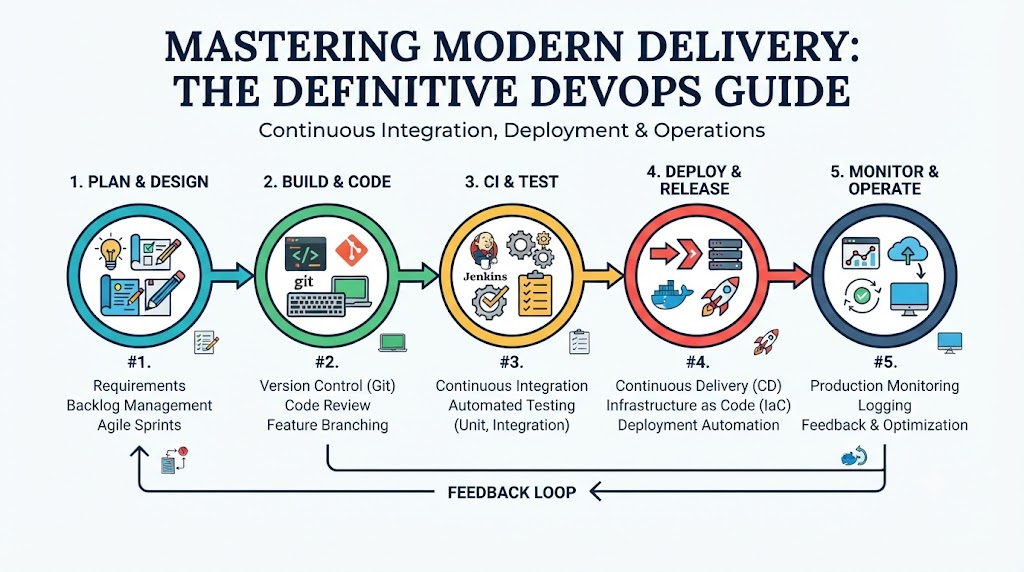
In an era where software delivery speed dictates market relevance, DevOps has evolved from a “nice-to-have” methodology into the essential nervous system of global enterprises. However, the industry is shifting. It is no longer enough to simply adopt tools like Docker or Jenkins; organizations today must balance rapid iteration with rigorous engineering performance metrics.Whether you are a developer looking to pivot, an SRE refining your craft, or a leader aiming to optimize engineering output, this guide offers a fresh perspective on mastering the DevOps ecosystem. By bridging the gap between foundational learning—provided by BestDevOps—and high-level performance analytics—powered by DevOpsIQ—you can move from managing servers to orchestrating business value.
The Philosophy of Modern DevOps
DevOps is often misconstrued as a set of software tools. In reality, it is a high-velocity feedback loop. It is the practice of aligning human intent with machine performance. By removing the traditional friction between “writing code” and “running code,” organizations create an environment where failure is treated as a learning opportunity rather than a disaster.
Navigating the DevOps Landscape: A Strategic Roadmap
Rather than attempting to learn every tool at once, approach your development in logical phases:
- The Foundation: Master the Linux shell, networking basics, and version control (Git). You cannot troubleshoot a cloud environment if you don’t understand the underlying OS.
- The Containerization Layer: Transition from virtual machines to containers. Docker is the unit of delivery; Kubernetes is the control plane for scale.
- The Orchestration & IaC Phase: Infrastructure must be treated as versioned code. If you are configuring servers manually in 2026, you are creating technical debt.
- The Reliability Horizon: Learn to define Service Level Objectives (SLOs) and understand how observability tools like Prometheus and Datadog tell the “story” of your application.
Toolchain Selection: The Architect’s View
Every tool in your stack should solve a specific problem rather than just adding complexity.
Essential DevOps Tooling Comparison
| Tool | Category | Primary Purpose | Ideal For |
| GitHub | Source Control | Collaboration | Distributed Team Workflows |
| GitLab | DevSecOps | Integrated CI/CD | End-to-end Pipeline Security |
| Kubernetes | Orchestration | Container Scheduling | Large-scale Microservices |
| Terraform | IaC | Resource Provisioning | Multi-Cloud Standardization |
| Ansible | Config Mgmt | Automated Server Setup | Configuration Drift Reduction |
| Datadog | Monitoring | Full-stack Observability | Real-time Performance Data |
Professional Validation: The Value of Certifications
Certifications are more than just badges; they act as a curriculum framework. They force you to understand the “why” behind the “how.”
Certification Comparison Matrix
| Certification | Focus Area | Recommended Level | Career Impact |
| CKA | Kubernetes Admin | Advanced | Essential for K8s Roles |
| AWS DevOps Pro | Cloud Architecture | Advanced | High-Level Cloud Design |
| DevOps Foundation | Culture & Theory | Beginner | Industry Vocabulary |
| CKS | K8s Security | Expert | Security-First Engineers |
| Azure DevOps Expert | MS Ecosystem | Advanced | Corporate Cloud Adoption |
Learning Through Execution
Theory is fragile; projects are robust. To truly understand DevOps, you need to build systems that break.
- Beginner: Automate a deployment using a CI/CD pipeline triggered by a Git push.
- Intermediate: Deploy a high-availability application on a managed Kubernetes cluster with auto-scaling.
- Advanced: Implement a “GitOps” workflow where infrastructure state is continuously reconciled against a Git repository.
The Metrics That Matter: Introducing DORA
If you cannot measure it, you cannot improve it. The DORA metrics provide an objective lens into your team’s health:
- Deployment Frequency: How often do you deliver value to users?
- Lead Time for Changes: How long from code commit to production?
- Change Failure Rate: What percentage of deployments require a rollback?
- Mean Time to Recovery (MTTR): How long does it take to restore service after an incident?
Engineering Intelligence: The DevOpsIQ Difference
While traditional monitoring tools alert you when something is “down,” engineering intelligence platforms like DevOpsIQ tell you why your team’s velocity or reliability is fluctuating.
By correlating your deployment data with incident history, DevOpsIQ helps managers:
- Identify bottlenecks in the CI/CD pipeline.
- Monitor “Error Budgets” to ensure a balance between feature speed and system stability.
- Track service reliability trends over time, moving from reactive firefighting to proactive optimization.
Looking Ahead: The Future of the Engineer
The role of the DevOps engineer is shifting toward Platform Engineering. As AI tools begin to handle routine debugging and script generation, the engineer’s value will shift toward System Architecture, FinOps (Cloud Cost Management), and Developer Experience.The most successful engineers in 2026 and beyond will be those who can act as “translators”—taking complex business requirements, mapping them to stable infrastructure, and using data-driven insights to advocate for more reliable, scalable code.
Conclusion
DevOps is a marathon, not a sprint. It requires a commitment to continuous education and the humility to acknowledge that the tools we use today will be replaced by better ones tomorrow. By utilizing BestDevOps to solidify your technical foundation and DevOpsIQ to quantify your performance, you position yourself not just as a tool-user, but as a strategic asset to your organization.Remember that a successful DevOps culture isn’t built on the number of tools installed, but on the ability of the team to ship code with confidence and recover from failure with grace. Keep learning, keep measuring, and keep iterating. The future of software delivery is data-driven, automated, and human-centric.