Introduction
In large-scale IT environments, managing operations manually is no longer practical. Systems are becoming more dynamic, and issues can arise at any time. Certified AIOps Manager prepares professionals to handle these challenges using intelligent and automated solutions.This guide is designed to help you understand how AIOps can improve operational efficiency and reduce downtime. It explains how this certification aligns with modern DevOps and SRE practices.It also provides clarity on how you can use this certification to build a strong and future-ready career in IT operations.
What is the Certified AIOps Manager?
The Certified AIOps Manager is a professional designation that proves an individual can lead the deployment of machine learning within IT operations. It is not just about understanding algorithms; it is about knowing how to apply them to logs, metrics, and traces to solve real problems. This certification emphasizes the practical application of AI to improve system uptime and reduce the cognitive load on engineering teams. It aligns with enterprise standards by focusing on measurable outcomes like reduced Mean Time to Repair (MTTR).
Who Should Pursue Certified AIOps Manager?
This certification is a strategic choice for DevOps Leads, Site Reliability Engineer specialists, and Engineering Managers. It is also highly relevant for Platform Engineers who are building the next generation of internal developer portals. Beginners who want to specialize early in high-demand automation fields will find this curriculum accessible and valuable. It carries significant weight for professionals working in global tech hubs and the expanding Indian enterprise market.
Why Certified AIOps Manager is Valuable
In a world where downtime can cost millions per minute, the ability to predict and prevent failures is incredibly valuable. The Certified AIOps Manager program teaches you how to turn raw data into actionable intelligence, making you an indispensable asset to your organization. It allows you to stay relevant in a job market that is increasingly moving toward “No-Ops” and highly automated environments. For the individual, it opens doors to senior leadership and specialized architecture roles that command higher salaries.
Certified AIOps Manager Certification Overview
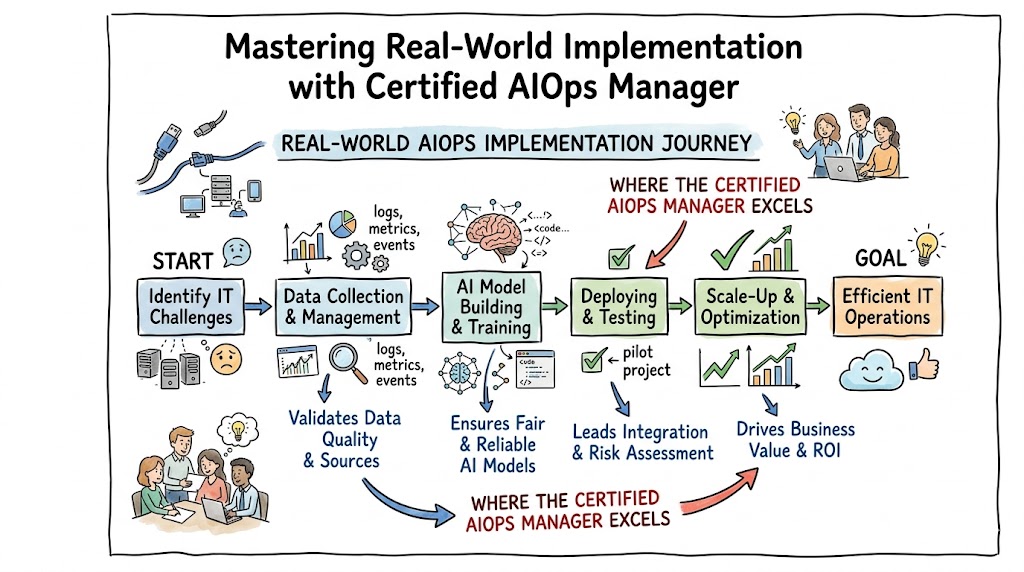
The program is officially delivered via the Certified AIOps Manager course on the AIOpsSchool platform. The training is structured around the full lifecycle of AIOps implementation, from data ingestion strategy to automated remediation workflows. It includes a rigorous assessment process designed to verify that you can manage the complex relationship between AI tools and human operations teams. The focus is always on production-grade reliability and scalability.
Complete AIOps Certification Table
| Track | Level | Who it’s for | Prerequisites | Skills Covered | Recommended Order |
| Foundation | Core | New Engineers | General IT Basics | AIOps Vocabulary, Data Types | 1st |
| Architect | Technical | Senior SREs | Foundation Cert | System Design, ML Integration | 2nd |
| Manager | Strategic | IT Directors | Architect Level | Business Alignment, Team Scaling | 3rd |
Detailed Guide for AIOps Certifications
What it is
This advanced certification validates your expertise in designing the underlying architecture for an AIOps ecosystem. It focuses on how to build reliable data pipelines that feed machine learning models with high-quality operational data.
Who should take it
Solutions architects and senior platform engineers who are responsible for designing the observability and automation strategy for their company.
Skills you’ll gain
- Designing multi-cloud data collection frameworks.
- Building automated incident suppression and correlation logic.
- Integrating AI models into existing ticketing and notification systems.
Real-world projects you should be able to do
- Designing a self-healing cluster that automatically scales based on predictive demand.
- Implementing a global monitoring strategy that correlates events across diverse regions.
Preparation plan
- 7–14 days: Deep dive into the architectural requirements of big data in operations.
- 30 days: Study common failure patterns and how AI-driven correlation solves them.
- 60 days: Implement a full-scale observability pilot using AIOps principles.
Common mistakes
- Neglecting the security and compliance requirements of operational data.
- Attempting to automate complex tasks before mastering simple ones.
Best next certification after this
- Same-track: Certified AIOps Manager.
- Cross-track: Certified Site Reliability Engineer – Foundation.
- Leadership: Technical Project Management.
Choose Your Learning Path
DevOps Path
This path focuses on injecting intelligence into the continuous integration and delivery process. You will learn how to use AI to analyze build logs and test results to find bugs faster. This leads to shorter release cycles and more stable software deployments.
DevSecOps Path
In the DevSecOps path, you learn how to use AIOps to secure your cloud-native infrastructure. This involves using machine learning to identify abnormal traffic patterns or unauthorized configuration changes. It is a vital path for those protecting sensitive enterprise data.
SRE Path
The SRE path focuses on system availability and the reduction of manual intervention. You will learn how to use AI to manage Service Level Objectives (SLOs) and automate the response to common system failures. This is the most technical and data-heavy path available.
AIOps / MLOps Path
This specialized route focuses on the infrastructure and pipelines that support machine learning. You will learn how to monitor the health of AI models and ensure that the infrastructure is optimized for heavy data processing tasks.
DataOps Path
DataOps focuses on the quality and delivery of the data that drives your automation. You will learn how to build resilient data pipelines that ensure your AIOps tools are always working with the most accurate and up-to-date information.
FinOps Path
The FinOps path uses AIOps to manage cloud financial health. You will learn how to use predictive modeling to identify cloud waste and suggest cost-saving measures without impacting system performance.
Role → Recommended Certifications
| Role | Recommended Certifications |
| DevOps Engineer | AIOps Foundation & CI/CD Specialist |
| SRE | AIOps Architect & Reliability Expert |
| Platform Engineer | AIOps Manager & Kubernetes Architect |
| Cloud Engineer | AIOps Foundation & Multi-cloud Architect |
| Security Engineer | AIOps Foundation & Security Specialist |
| Data Engineer | AIOps DataOps Specialization |
| FinOps Practitioner | AIOps FinOps Specialist |
| Engineering Manager | AIOps Manager & Leadership Professional |
Next Certifications to Take
1. Same Track: Deep Tech Specialization
Keep advancing your technical edge by pursuing certifications in advanced machine learning and data engineering to refine your AIOps implementation skills.
2. Cross-Track: Skill Diversification
Expand your knowledge by getting certified in Site Reliability Engineering or Advanced Cloud Networking. This helps you understand the systems you are automating more deeply.
3. Leadership: Strategic Management
Move toward the executive level by pursuing certifications in Digital Strategy and IT Leadership. These prepare you for high-level decision-making and organizational transformation.
Training and Certification Support Providers
DevOpsSchool
This institution is known for its practical, laboratory-heavy approach to training. They provide students with access to real production environments where they can practice AIOps implementation under expert guidance.
Cotocus
Cotocus focuses on delivering architectural-level training for senior professionals. Their courses are designed to help you understand the complex integration of AI tools within a large-scale enterprise framework.
Scmgalaxy
Scmgalaxy provides a wealth of community-based resources and specialized training for automation. They are a go-to source for learning how to integrate various DevOps and AIOps tools into a unified pipeline.
BestDevOps
BestDevOps offers focused, fast-track training for busy professionals. They prioritize the most important skills needed to successfully deploy AIOps in a modern production setting.
Devsecopsschool
This school focuses on the critical security aspects of automation. Their training shows you how to use AI to not only improve performance but also to proactively defend your infrastructure from threats.
Sreschool
Sreschool is dedicated to the methodology of Site Reliability Engineering. Their courses demonstrate how AIOps can be used to meet and exceed service level agreements in high-scale environments.
Aiopsschool is the home of the Certified AIOps Manager program. They offer specialized learning tracks that cover every level of the AIOps journey, from beginner to manager.
Dataopsschool
Dataopsschool focuses on the data lifecycle and pipeline management. Their training is essential for ensuring that your AIOps implementation is supported by clean, high-quality operational data.
Finopsschool
Finopsschool teaches the intersection of cloud engineering and financial management. They show how AI can be used to optimize cloud spend and improve the financial efficiency of technical teams.
Frequently Asked Questions
- Is the AIOps certification exam difficult?
It is a professional-level exam that requires a solid grasp of both technical architecture and management strategy, making it moderately challenging. - How long should I prepare for the test?
Most professionals find that 30 to 60 days of consistent study allows them to fully understand the material and pass the assessment. - Are there any formal requirements to start?
There are no strict prerequisites for the foundation level, but some experience in cloud or IT operations is highly beneficial. - What is the best sequence to take these certifications?
We recommend starting with the Foundation, moving to the Architect level, and finishing with the Manager certification. - Does this certification help with salary growth?
Yes, professionals with AIOps expertise are in high demand, often leading to better job opportunities and increased compensation. - Is the certification recognized by major companies?
Yes, it is based on global industry standards and is recognized by top tech firms and service providers worldwide. - Do I need a strong background in data science?
You don’t need to be a data scientist, but you should understand how machine learning models use operational data to make predictions. - Can I take the certification exam online?
Yes, the exam is available through a secure online platform, allowing you to get certified from anywhere in the world. - How does AIOps benefit my day-to-day work?
It reduces the amount of time you spend on manual troubleshooting, allowing you to focus on high-impact architectural projects. - Is there a practical lab component?
Advanced tracks usually include hands-on projects where you must demonstrate your ability to implement an AIOps strategy. - How often should I renew my certification?
It is recommended to renew or advance your certification every two to three years to keep up with the latest technological changes. - Is this certification suitable for non-coders?
The Manager track is suitable for non-coders, focusing on strategy and ROI, while the Architect track requires more technical knowledge.
FAQs on Certified AIOps Manager
- What is the core responsibility of an AIOps Manager?
An AIOps Manager leads the strategic deployment of AI within IT operations, ensuring that the technology delivers business value and team efficiency. - Does the program cover a specific set of tools?
The focus is on the underlying frameworks and principles that can be applied to any AIOps tool or platform in the market. - How does AIOps help in reducing “Noise”?
It uses intelligent algorithms to group multiple related alerts into a single incident, helping engineers focus on the root cause rather than symptoms. - Is this certification relevant for small startups?
Yes, because automation allows small teams to scale their operations efficiently without needing to hire a massive number of engineers. - How does AIOps integrate with SRE practices?
AIOps provides the predictive analytics that SREs need to manage error budgets and automate incident response more effectively. - What is the most critical skill for an AIOps Manager?
The most important skill is “Data Literacy”—the ability to understand and interpret operational data to drive better technical decisions. - What is the structure of the certification exam?
The Certified AIOps Manager exam uses scenario-based questions to test your leadership and implementation capabilities. - Who manages the certification standards?
The program is governed and delivered by the industry-leading experts at AIOpsSchool.
Conclusion
Successfully implementing AIOps is about more than just software; it is about having a clear strategy and a trained leadership team. The Certified AIOps Manager program provides the structured approach needed to turn operational data into a competitive advantage. By mastering these principles, you position yourself as a leader who can navigate the complexities of modern, high-scale infrastructure with precision. Whether your goal is technical mastery or organizational leadership, this certification is a vital step in your professional development.