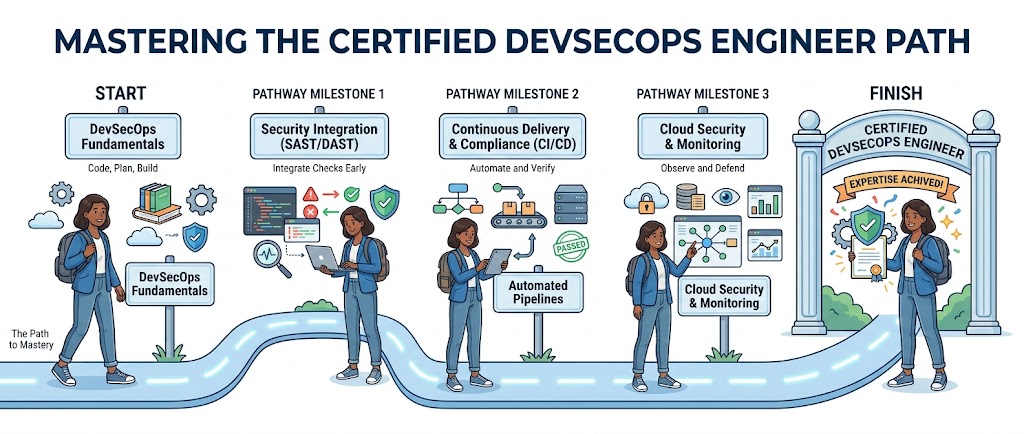
Introduction
Modern software moves fast. Teams ship code many times a day, use microservices, containers, and cloud. At the same time, cyber attacks are growing and regulations are becoming stricter.If security is not built into the pipeline from day one, it becomes slow, painful, and expensive. DevSecOps solves this by adding security into every step of DevOps, from planning and coding to deployment and monitoring.The Certified DevSecOps Engineer program from DevSecOpsSchool is designed to help engineers and managers learn how to build secure CI/CD pipelines, automate security checks, and deliver safe software at speed.
Why This Guide and Who It’s For
This guide is for working professionals who want clear, practical advice in simple language:
- Software Engineers and Developers
- DevOps Engineers and SREs
- Security Engineers and AppSec professionals
- Cloud and Platform Engineers
- Technical Leads and Engineering Managers
As a mentor who has worked across DevOps, Security, and SRE for over 20 years, I have seen one pattern: teams that treat security as an afterthought always struggle later. DevSecOps skills are now “must-have”, not “nice-to-have”.
What You Learn in Certified DevSecOps Engineer
The program focuses on real-world DevSecOps skills you can use in projects and production environments.
Key themes include:
- DevOps culture and DevSecOps basics
- Secure software development lifecycle (SSDLC)
- Securing CI/CD pipelines (build, test, release)
- SAST, DAST, SCA and container security tools
- Vulnerability management and patching
- Secrets management and configuration security
- Infrastructure as Code and policy as code
- Continuous compliance and audits
You do not just learn concepts; you practice them through tools and labs so that you can apply them at work.
Certified DevSecOps Engineer
What It Is
Certified DevSecOps Engineer is a focused certification that teaches you how to integrate security into DevOps workflows and CI/CD pipelines.
It is designed to make you comfortable with tools, processes, and patterns that keep code secure without slowing teams down.
Who Should Take It
- DevOps Engineers who want strong security skills
- Security Engineers who want to work closer with DevOps teams
- SREs and Platform Engineers responsible for reliability and risk
- Cloud Engineers managing Kubernetes and cloud-native workloads
- Developers who ship code frequently and own services end-to-end
Skills You’ll Gain
- Understanding DevOps and DevSecOps culture and principles
- Designing secure CI/CD pipelines for apps and infrastructure
- Implementing SAST, DAST, SCA, container and image scanning tools
- Managing secrets (keys, tokens, passwords) safely in pipelines
- Applying security to Infrastructure as Code and cloud resources
- Automating compliance checks and security policies as code
- Setting up monitoring, logging, and security alerts for production systems
Real-World Projects You Should Be Able To Do After It
After completing Certified DevSecOps Engineer, you should be able to:
- Design and implement a secure CI/CD pipeline for a microservices application
- Integrate static, dynamic, and dependency security scanners into builds
- Build a container security workflow (image scanning, policies, registry rules)
- Implement secrets management using vaults or cloud-native services
- Add security checks to Infrastructure as Code (for example, Terraform policies)
- Create basic policies for continuous compliance and evidence collection
- Work with Dev, Ops, and Security teams to define secure release practices
Preparation Plan – 7–14 / 30 / 60 Days
You can choose a plan based on your background and time:
- 7–14 Days (Fast Track)
- For experienced DevOps/SRE/Security professionals.
- 3–4 hours per day.
- Focus on: DevSecOps concepts, pipeline design, tools, and practice tests.
- 30 Days (Standard Path)
- For working engineers with some DevOps or Security exposure.
- 1–2 hours per day.
- Week 1: DevOps + DevSecOps basics, threat modeling, SSDLC.
- Week 2: SAST, DAST, SCA, secrets management, container security.
- Week 3: IaC security, policy as code, compliance, monitoring.
- Week 4: Hands-on practice, mini-project, mock assessments.
- 60 Days (Career Switch Path)
- For people from traditional development, testing, or IT support.
- 1–2 hours per day, plus weekend practice.
- Phase 1: Linux, Git, CI/CD basics, cloud and containers.
- Phase 2: DevSecOps concepts, security in pipelines, scanning tools.
- Phase 3: Projects and labs, mapping skills to your current role.
Common Mistakes to Avoid
- Treating DevSecOps as “just tools” and not changing culture or process
- Adding scanners without fixing or prioritizing findings
- Ignoring secrets management and hardcoding tokens or passwords
- Running security checks only in production, not earlier in the pipeline
- Focusing only on app security and ignoring infrastructure and IaC
- Studying theory but not doing hands-on labs and real pipelines
Best Next Certification After This
Once you complete Certified DevSecOps Engineer, good next steps are:
- Same track (Deeper DevSecOps): Advanced DevSecOps/Cloud Security certification
- Cross-track (Ops and Reliability): SRE or Master in DevOps Engineering (MDE)
- Leadership: DevOps/DevSecOps Manager or Architect-level certification for engineering leaders
Certification Overview Table
Below is a simple mapping table that places Certified DevSecOps Engineer in a broader learning roadmap based on DevOpsSchool-style master certification mapping.
You can adjust the table labels to better match your own program stack.
Choose Your Path: 6 Learning Paths
DevSecOps connects with many roles. Here are six clear learning paths you can follow.
1. DevOps Path
- Start with core DevOps skills (Linux, Git, CI/CD, containers, cloud).
- Add Certified DevSecOps Engineer to build security directly into your pipelines.
- Grow into architect-level roles with Master in DevOps Engineering (MDE) and related professional-level certifications.
2. DevSecOps Path
- Begin with DevOps basics (or your current DevOps/SRE experience).
- Take Certified DevSecOps Engineer as your primary security-in-DevOps credential.
- Add specializations in cloud security, container security, and compliance over time.
3. SRE Path
- Start with DevOps + monitoring and incident management.
- Take Certified DevSecOps Engineer to understand security risks in production and pipelines.
- Then move into SRE professional-level programs focused on SLOs, error budgets, and reliability.
4. AIOps / MLOps Path
- Build a foundation in DevOps and observability.
- Use DevSecOps knowledge to secure your data pipelines, models, and automation workflows.
- Move into AIOps/MLOps certifications that apply ML to operations and security events.
5. DataOps Path
- Start from data engineering and analytics systems.
- Use Certified DevSecOps Engineer concepts to secure ETL pipelines, APIs, and data services.
- Add DataOps professional programs for pipeline reliability, quality, and governance.
6. FinOps Path
- Begin with cloud platforms and cost management basics.
- Use DevSecOps practices to ensure secure, compliant, and cost-aware environments.
- Add FinOps certifications for cost strategy, budgeting, and stakeholder communication.
Role → Recommended Certifications Mapping
Based on the DevOpsSchool Master in DevOps Engineering career roadmap, here is a simple mapping for roles and suggested certifications.
Next Certifications To Take
Once you complete Certified DevSecOps Engineer, think in three directions.
1. Same Track
- Go deeper into DevSecOps with advanced cloud security, container security, or compliance-focused programs offered by the same ecosystem.
- This is ideal if you want to become the “go-to” security person in DevOps teams.
2. Cross-Track
- Move into SRE, AIOps, or DataOps to combine security with reliability and analytics.
- This helps you handle both risk and reliability of large systems.
3. Leadership
- For tech leads and engineering managers, combine Certified DevSecOps Engineer with Master in DevOps Engineering and managerial certifications.
- This supports roles where you define standards, roadmaps, and cross-team practices.
Top Institutions for Certified DevSecOps Engineer Training
These institutions work together in the same ecosystem and provide structured training, projects, and mentoring around DevOps, DevSecOps, SRE, AIOps, DataOps, and FinOps.
- DevOpsSchool
- Cotocus
- ScmGalaxy
- BestDevOps
- devsecopsschool
- sreschool
- aiopsschool
- dataopsschool
- finopsschool
FAQs – Certified DevSecOps Engineer
Here are 12 general FAQs about DevSecOps-focused certification journeys.
- Is DevSecOps only for security experts?
No. DevSecOps is for developers, DevOps engineers, SREs, and security experts who work together. The goal is to share security responsibilities across the team. - How hard is Certified DevSecOps Engineer for a DevOps engineer?
If you already know CI/CD and basic cloud, the concepts are not difficult. The challenge is in practice—building real secure pipelines and fixing findings regularly. - Do I need strong coding skills?
You do not need to be a full-time developer, but you should be comfortable reading code, scripts, and YAML, and making small changes for security checks. - How long does it take to prepare?
Most working engineers can prepare in 30–60 days with 1–2 hours per day, depending on their DevOps and security background. - Is prior security experience required?
No, but basic security ideas (OWASP Top 10, vulnerabilities, least privilege) are helpful. The course itself introduces DevSecOps concepts and pipelines step by step. - How does this help my career?
DevSecOps skills are in high demand because every company wants secure software without slowing delivery. This certification signals that you understand both DevOps and security. - Can managers benefit from this certification?
Yes. Managers learn how to design processes, choose tools, and set expectations so that teams can deliver secure software at scale. - Where does Certified DevSecOps Engineer fit in a larger roadmap?
It usually sits after or alongside a core DevOps/MDE certification and before deeper security or SRE/AIOps programs. - Will this help me move into security from development?
Yes. It is a practical bridge into security for developers and DevOps engineers who want to focus more on risk, compliance, and secure design. - Does it cover only tools, or also culture and process?
It covers both: culture, collaboration, and process; and tools like scanners, secrets managers, and CI/CD integrations. - Is DevSecOps relevant if my company is just starting DevOps?
Yes. It is better to build security in from the beginning, instead of adding it later when processes are already fixed. - What types of projects should I do while preparing?
Focus on 2–3 small projects: securing a CI/CD pipeline for an app, adding scanners and secrets management, and securing IaC or container builds.
FAQs
- What is the main focus of Certified DevSecOps Engineer?
The certification focuses on integrating security into DevOps pipelines, covering planning, coding, building, testing, releasing, and monitoring with security in mind. - Who should enroll in Certified DevSecOps Engineer?
DevOps engineers, security engineers, SREs, cloud and platform engineers, and developers who work with CI/CD and cloud-native systems. - What are the key skills I will learn?
You learn DevSecOps culture, secure CI/CD design, SAST/DAST/SCA, container security, secrets management, IaC security, and continuous compliance. - What kind of hands-on work will I do?
You will work on securing pipelines, integrating scanners, managing secrets, and building security checks for code, images, and infrastructure. - How should I plan my study time?
Choose a 7–14, 30, or 60-day plan based on your background, and mix theory with labs and small real-world projects. - What are typical mistakes candidates make in this certification?
Over-focusing on tools without understanding workflows, skipping labs, ignoring IaC and cloud security, and not practising handling scan results. - What should I do after finishing Certified DevSecOps Engineer?
Apply the skills in your live projects, then move to advanced DevSecOps, SRE, or leadership-oriented DevOps certifications. - Is this certification recognized in industry?
Yes, DevSecOps-focused certifications are widely valued, especially in cloud-native and regulated environments where secure, fast delivery is critical.
Conclusion
DevSecOps is not a one-time project. It is a way of working where security becomes part of daily development and operations. Certified DevSecOps Engineer gives you a structured path to learn these skills and apply them in real pipelines and teams.If you are a DevOps Engineer, SRE, Cloud or Platform Engineer, Security Engineer, Data or FinOps professional, or an Engineering Manager, this certification can significantly increase your value in the market. With clear goals, the right preparation plan, and practical projects, you can use DevSecOps to build safer systems and stronger careers.