Introduction
Modern IT environments have evolved into highly complex, distributed ecosystems. With the rapid adoption of cloud-native architectures, Kubernetes clusters, and microservices, traditional monitoring tools are struggling to keep pace. Today, an average enterprise environment generates massive volumes of telemetry data, leading to “alert fatigue” where teams are overwhelmed by thousands of notifications daily.This complexity often masks the root cause of critical incidents, turning what should be a ten-minute fix into a multi-hour outage. To bridge this gap, organizations are shifting toward Artificial Intelligence for IT Operations (AIOps). Whether you are an SRE, a DevOps engineer, or an IT leader, mastering these intelligent systems is no longer optional—it is a career necessity. By leveraging platforms like AIOpsSchool, professionals can gain the technical edge required to manage, automate, and optimize modern infrastructure. In this guide, we explore how AIOps certification and structured training programs provide the foundation for sustainable operational excellence.
Featured Snippet
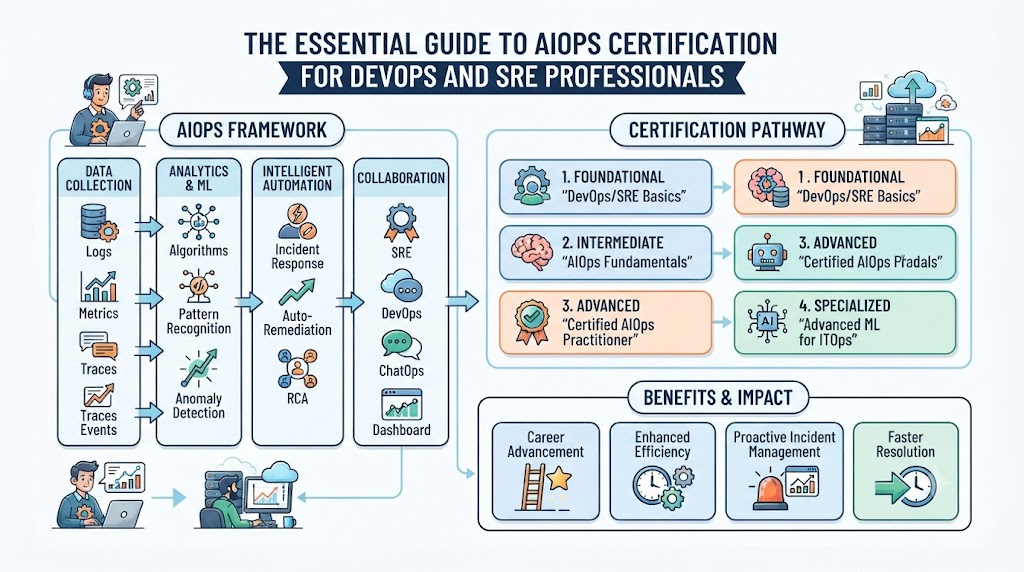
What Is AIOps? AIOps (Artificial Intelligence for IT Operations) is the application of machine learning, data analytics, and automation to IT operations. It collects, correlates, and analyzes massive volumes of telemetry data (logs, metrics, and traces) to identify patterns, detect anomalies, automate root cause analysis, and enable proactive incident management in complex, cloud-native environments.
Understanding AIOps
What Is Artificial Intelligence for IT Operations?
AIOps represents the marriage of big data and machine learning. It moves beyond static threshold-based alerting to dynamic, context-aware analysis, allowing systems to “understand” normal behavior and identify deviations before they impact users.
Why Traditional IT Operations Are No Longer Enough
Traditional operations rely on manual rules. In a microservices environment, those rules break. If a service dependencies change, your manual alerts become obsolete, leading to false positives and missed incidents.
How AI and Machine Learning Improve Operations
Machine learning algorithms analyze historical incident data to predict future failures. They can suppress duplicate alerts and group related signals into a single “incident,” helping engineers focus on the root cause rather than symptoms.
Evolution from Monitoring to Intelligent Operations
| Traditional Operations | AIOps-Driven Operations |
| Manual threshold setup | Dynamic, self-learning baselines |
| Alert-centric (too many alerts) | Incident-centric (contextual insights) |
| Reactive troubleshooting | Proactive prediction |
| Siloed data analysis | Unified data observability |
Why AIOps Skills Are Becoming Essential
In Simple Terms
Imagine trying to read a million pages of documentation to find one typo. That is traditional monitoring. AIOps is like an AI assistant that instantly highlights the typo for you.
Real-World Example
A global e-commerce company experiences a latency spike. Without AIOps, engineers manually check five different dashboards. With AIOps, the system correlates the latency with a recent deployment and a specific database deadlock, suggesting a rollback instantly.
Why It Matters
- Operational Efficiency: Drastically reduces MTTR (Mean Time To Resolution).
- Talent Retention: Reduces burnout by cutting down on repetitive, manual alert triage.
- Business Continuity: Minimizes downtime, protecting revenue and brand reputation.
Key Takeaways
- Cloud-native growth demands intelligent automation.
- AIOps is the only way to manage distributed systems at scale.
- Skills in AI/ML for operations are currently in high demand globally.
AIOps Certification Explained
What Is an AIOps Certification?
It is a formal validation of a professional’s ability to design, implement, and manage AIOps solutions within an enterprise. It verifies competency in data correlation, predictive modeling, and automation toolsets.
Who Should Pursue AIOps Certification?
- DevOps Engineers: To build self-healing pipelines.
- SREs: To enhance service reliability and incident response.
- IT Managers: To lead digital transformation initiatives.
- Monitoring Specialists: To evolve from managing tools to managing outcomes.
AIOps Training and Courses
What Learners Typically Study
- Machine Learning for IT: Understanding anomaly detection and clustering.
- Event Correlation: Grouping disparate alerts into single incidents.
- Observability: Mastering the “three pillars”—logs, metrics, and traces.
- OpenTelemetry: Standardizing data collection across hybrid clouds.
AIOps Engineer Certification Path
| Level | Skills | Outcome |
| Beginner | Monitoring basics, CLI, YAML | Understanding the AIOps landscape |
| Intermediate | ML fundamentals, Scripting, API integration | Designing automated workflows |
| Advanced | Predictive analytics, Custom model training | Leading enterprise-wide AIOps adoption |
AIOps for SRE and DevOps Engineers
In Simple Terms
AIOps is the “force multiplier” for DevOps. It takes the heavy lifting out of daily operations, allowing engineers to focus on building features instead of fixing broken alerts.
Real-World Example
An SRE team uses AIOps to suppress “noisy” alerts during a routine Kubernetes deployment. The system identifies that the temporary increase in memory usage is normal behavior, saving the team from a middle-of-the-night page.
Why It Matters
- Allows SREs to define higher SLOs (Service Level Objectives).
- Enables “Shift Left” operations by identifying errors in staging.
Enterprise AIOps Consulting and Implementation
Organizations often struggle with where to start. Consulting services provide a roadmap to assess operational maturity—moving from ad-hoc reactive monitoring to a mature, automated observability model.
Implementation Workflow
- Assessment: Audit existing data sources and tooling.
- Strategy: Define KPIs (e.g., reducing MTTR by 30%).
- Tooling: Select the right AIOps platform.
- Integration: Connect data sources (OpenTelemetry, Cloud APIs).
- Optimization: Continuous feedback loops for model accuracy.
Future of AIOps
The future lies in Autonomous Operations. We are moving toward “Self-Healing Infrastructure,” where the system not only identifies the root cause but executes the remediation script (e.g., restarting a pod, scaling a cluster) without human intervention. AIOps-certified professionals will be the architects of these autonomous environments.
Why Learn with AIOpsSchool
AIOpsSchool bridges the gap between academic theory and the harsh realities of production environments. By focusing on practical, hands-on learning, the programs prepare you for real-world enterprise challenges. Whether you are seeking certification to advance your career or consulting services to modernize your infrastructure, AIOpsSchool provides the expertise necessary to succeed in the AI-driven future of IT.
FAQ SECTION
- What is AIOps Certification? A formal validation of expertise in applying AI to IT operations.
- Who should learn AIOps? DevOps, SREs, and IT operations leaders.
- What skills are required? Python, Cloud, Kubernetes, and Observability concepts.
- How does AIOps help DevOps? It automates incident triage and reduces noise.
- What is AI Observability? Using AI to make sense of complex system telemetry.
- What is OpenTelemetry? A framework for collecting traces, metrics, and logs.
- How long does it take? Varies by depth; foundational courses take weeks.
- What are Implementation Services? Guided consulting to adopt AIOps in enterprises.
- Is AIOps a good career? Yes, it is one of the fastest-growing IT specializations.
- What is the future? Autonomous, self-healing infrastructure.
FINAL SUMMARY
AIOps is fundamentally changing how we manage technology. By adopting intelligent operations, professionals can move from fighting fires to engineering resilience. Whether you are looking for professional certification, comprehensive training, or enterprise consulting, investing in these skills is the best way to future-proof your career.