Introduction
Software delivery has changed, but operations pressure has grown even faster. Teams now manage containers, cloud platforms, APIs, distributed services, CI/CD pipelines, observability tools, and business-critical applications at the same time. As systems become more connected, they also become harder to monitor with manual effort alone. That is why AIOps is getting more attention across engineering and leadership teams. AIOpsSchool presents its AIOps track around AI-driven IT operations, anomaly detection, predictive analytics, event correlation, and self-healing systems.Certified AIOps Professional is one of the key certifications in that path. It is meant for professionals who want to understand how artificial intelligence and machine learning can improve IT operations in practical environments. Rather than staying limited to simple alerting or basic dashboards, it focuses on how teams can reduce noise, detect patterns earlier, automate responses carefully, and improve production decision-making.
What is Certified AIOps Professional?
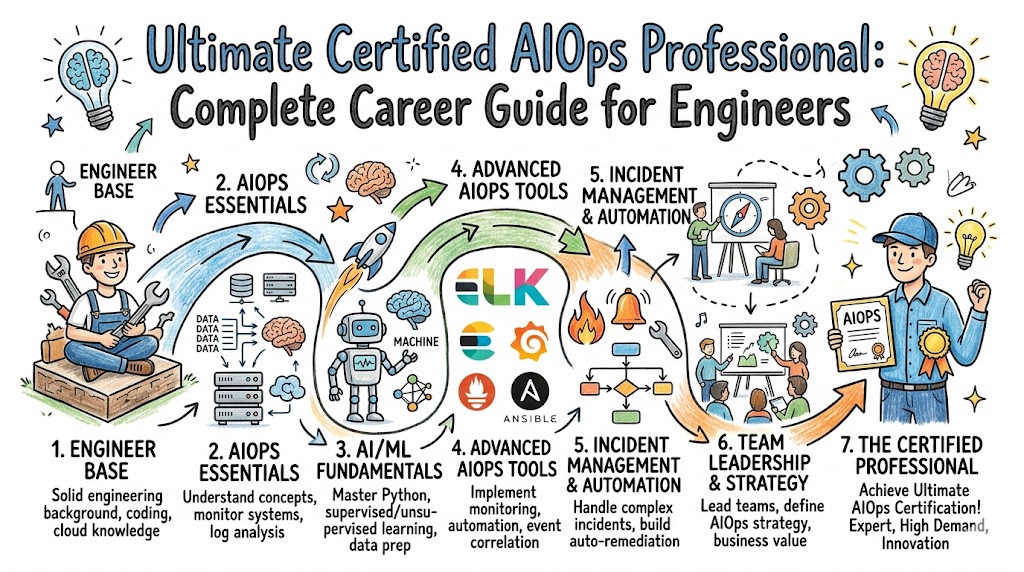
Certified AIOps Professional is a professional-level certification in the AIOpsSchool ecosystem. On the official site, AIOpsSchool lists a visible learning path that includes AIOps Foundation Certification, Certified AIOps Engineer, Certified AIOps Professional, Certified AIOps Architect, and Certified AIOps Manager. That makes Certified AIOps Professional part of a structured progression rather than an isolated course.AIOpsSchool describes the Professional level as focused on anomaly detection, predictive analytics, and self-healing IT systems. That wording matters because it shows the certification is not just a general overview. It is positioned as a deeper step for professionals who want practical and production-relevant understanding of intelligent operations.In plain language, this certification is about learning how operational data can be used more intelligently. Logs, metrics, traces, events, and alerts all produce valuable signals, but teams often struggle to understand which signals matter first. AIOps helps by improving correlation, prioritization, anomaly recognition, and response workflow efficiency.
Why Certified AIOps Professional Matters
Certified AIOps Professional matters because engineering systems have become too complex for traditional operational methods alone. A single incident can involve cloud services, network layers, microservices, APIs, queues, logs, traces, and external dependencies. When teams receive dozens or hundreds of alerts with incomplete context, time is lost before the real problem is even understood. AIOps is meant to improve that.This certification also matters because it teaches skills that remain relevant even when tools change. Platforms and vendors may evolve, but the need for better anomaly detection, predictive insight, event correlation, and self-healing workflows will remain. The underlying operational thinking is durable, which makes the learning more useful over time than narrow product-only training.
Certified AIOps Professional Certification Overview
AIOpsSchool publicly presents a ladder of AIOps certifications. The Foundation level introduces the basics of AI-driven IT operations. The Engineer level focuses more on implementation around monitoring and operations workflows. The Professional level goes deeper into advanced operational intelligence. After that, the path extends into Architect and Manager levels for enterprise design and leadership growth.Within this structure, Certified AIOps Professional sits in the middle as a strong working-professional milestone. It is advanced enough to feel meaningful, but still close enough to hands-on operations that it remains useful for engineers in active delivery and support environments. That makes it a strong fit for people who already know the basics of operations and want higher-value capability.
Complete Certification Table
| Track | Level | Who it’s for | Prerequisites | Skills covered | Recommended order |
|---|---|---|---|---|---|
| AIOps Foundation Certification | Foundation | Beginners, IT professionals, operations teams, DevOps engineers | Basic awareness of IT operations, monitoring, cloud, or support workflows | AI-driven IT operations, anomaly detection, predictive analytics, event correlation, self-healing basics | 1 |
| Certified AIOps Engineer | Intermediate | Engineers implementing AI-powered operations monitoring | Foundation-level understanding or practical monitoring experience | AI models for IT operations monitoring, monitoring workflows, operational analytics, implementation-oriented use cases | 2 |
| Certified AIOps Professional | Professional | Working engineers and managers who want deeper AIOps capability | Foundation knowledge or hands-on experience in observability, operations, DevOps, cloud, or incident response | Anomaly detection, predictive analytics, self-healing IT systems, proactive operations, intelligent signal handling | 3 |
| Certified AIOps Architect | Advanced | Senior engineers, architects, platform leaders | Strong AIOps knowledge and production-scale experience | Enterprise-grade AIOps architecture, scalable design, platform-level strategy | 4 |
| Certified AIOps Manager | Leadership | Team leads, managers, transformation leaders | Professional-level understanding plus leadership responsibility | Leading AIOps teams and projects, organizational adoption, delivery alignment | 5 |
Detailed Guide for Certified AIOps Professional
What it is
Certified AIOps Professional is the professional-level step in AIOpsSchool’s certification path. It is positioned as a deeper learning program around anomaly detection, predictive analytics, and self-healing IT systems, which clearly places it beyond introductory operations knowledge.
It validates practical understanding of how AI and ML can enhance IT operations. In real environments, that means helping teams work with alerts, events, monitoring data, and incident patterns more intelligently instead of depending only on manual observation and repeated troubleshooting habits.
Who should take it
This certification is a strong fit for DevOps engineers, SREs, platform engineers, cloud engineers, observability specialists, operations analysts, NOC teams, support engineers, and software engineers involved in production ownership. It is especially useful for people who already see noisy operational environments and want a more structured way to interpret and improve them.
It also makes sense for engineering managers and technical leaders. They may not configure operational tooling themselves every day, but they need to understand where intelligent operations helps, where automation becomes valuable, and how operational maturity affects service quality and team performance.
Skills you’ll gain
- Understanding of anomaly detection in IT operations
- Better interpretation of operational signals such as alerts and events
- Awareness of predictive analytics in support and monitoring workflows
- Knowledge of self-healing system concepts
- Stronger incident-response and signal-prioritization thinking
- Better understanding of proactive operations versus reactive operations
- Clearer view of how AIOps aligns with DevOps, SRE, cloud, and platform engineering
Real-world projects you should be able to do after it
- Review a noisy alert environment and identify where correlation can reduce duplication
- Design a proactive operations workflow using anomaly-detection ideas
- Map incident patterns to earlier warning signals
- Suggest a self-healing or auto-remediation scenario for repetitive operational tasks
- Create an improvement plan for intelligent operations in a support or platform team
- Assess where predictive signals could shorten detection or response time in a real service environment
These outcomes are grounded in the official focus areas AIOpsSchool uses to describe the certification.
Preparation plan
7–14 days
This works best for professionals who already operate in monitoring, cloud, DevOps, SRE, or incident-response roles. Use this short window for focused revision. Review anomaly concepts, predictive operations, event correlation, and practical production examples from your own experience. The goal is to connect what you already know with the certification’s language and structure.
30 days
This is the strongest plan for most working professionals. Spend the first week on monitoring, observability, and signal basics. Use the second week for anomaly detection, predictive analytics, and event correlation. Use the third week for self-healing patterns and proactive operations thinking. Use the final week for revision, applied examples, and explanation practice.
60 days
This is ideal for learners entering from adjacent roles or for managers who want deeper context. Use the longer timeline to study operational signals carefully, review real incident patterns, compare reactive and proactive support models, and build strong conceptual understanding before revision. This often leads to better long-term retention than rushing through the material.
Common mistakes
- Treating AIOps as only an AI subject
- Ignoring observability and monitoring fundamentals
- Memorizing terms without linking them to actual incidents
- Focusing too much on tools instead of operational outcomes
- Assuming all automation improves operations
- Studying without real examples from production systems
Best next certification after this
Same track: Certified AIOps Architect
Cross-track: Reliability-focused certification path
Leadership: Certified AIOps Manager
The same-track and leadership options come directly from AIOpsSchool’s published path. The cross-track recommendation is practical because AIOps and reliability engineering naturally overlap in incident quality, proactive operations, and service health improvement.
Choose Your Path
DevOps Path
DevOps engineers should see AIOps as a practical extension of automation and delivery maturity. DevOps improves how software is built and shipped. AIOps improves how that software is observed and supported after release. This makes it especially useful for teams that want better post-deployment visibility and faster learning from incidents.
DevSecOps Path
For DevSecOps professionals, AIOps helps improve signal interpretation and prioritize meaningful behavior across complex systems. Security-aware teams also struggle with alert overload and operational noise. AIOps knowledge supports more structured analysis and better cross-functional response between operations and security.
SRE Path
SRE is one of the most natural adjacent paths because both SRE and AIOps focus on service health, incident quality, and proactive improvement. AIOps strengthens signal handling and anomaly awareness, while SRE strengthens service-level and reliability discipline. Together they create a strong production-focused profile.
AIOps / MLOps Path
This path works well for professionals who want to stay close to intelligent automation, data-driven operations, and production intelligence. AIOps improves operational awareness, while MLOps strengthens model-related operational workflows. In cloud-native environments, the overlap can be very useful.
DataOps Path
DataOps professionals can benefit because AIOps depends on trustworthy operational data. If logs, events, and metrics are inconsistent or low quality, intelligent operations becomes weak. This path helps data-aware engineers understand how operational data quality affects real-world service outcomes.
FinOps Path
FinOps practitioners should care about AIOps where operations intelligence affects cloud efficiency, waste, and service cost. Better signal clarity can reduce time spent on avoidable issues and improve how teams interpret operational inefficiency. This makes AIOps useful as a supporting skill in cloud-heavy cost-aware environments.
Role → Recommended Certifications
| Role | Recommended certifications |
|---|---|
| DevOps Engineer | AIOps Foundation Certification, Certified AIOps Engineer, Certified AIOps Professional |
| SRE | AIOps Foundation Certification, Certified AIOps Professional, reliability-focused certification path |
| Platform Engineer | Certified AIOps Engineer, Certified AIOps Professional, Certified AIOps Architect |
| Cloud Engineer | AIOps Foundation Certification, Certified AIOps Engineer, Certified AIOps Professional |
| Security Engineer | AIOps Foundation Certification, Certified AIOps Professional where operational visibility is central |
| Data Engineer | AIOps Foundation Certification, Certified AIOps Professional, data-focused adjacent path |
| FinOps Practitioner | AIOps Foundation Certification, Certified AIOps Professional, FinOps-focused adjacent path |
| Engineering Manager | Certified AIOps Professional, Certified AIOps Manager |
Next Certifications to Take After Certified AIOps Professional
Same Track Progression
The strongest same-track step is Certified AIOps Architect. This is the right move for professionals who want deeper technical specialization and enterprise-scale design responsibility in intelligent operations. AIOpsSchool presents it as the architecture-focused advanced step in the official ladder.
Cross-Track Expansion
A reliability-focused certification path is the best cross-track move because it complements AIOps directly. AIOps improves how signals are detected and interpreted. Reliability-focused learning improves how systems are designed and operated sustainably. Together, they make a stronger production engineer.
Leadership Track
Certified AIOps Manager is the natural leadership step. It is useful for professionals moving from hands-on technical growth into team, project, or transformation leadership around intelligent operations. AIOpsSchool explicitly positions it around leading AIOps teams and projects.
List of Top Institutions Which Provide Help in Training cum Certifications for Certified AIOps Professional
DevOpsSchool
DevOpsSchool can be useful for learners who prefer structured mentoring and practical training support. For a topic like AIOps, guided learning can help professionals connect abstract ideas with real operations problems.
Cotocus
Cotocus can be considered by professionals looking for applied technical guidance. It is especially useful for learners who want a training style that feels close to industry delivery.
Scmgalaxy
Scmgalaxy is relevant for those who prefer implementation-minded preparation. AIOps becomes easier when the learning style connects concepts with actual incidents and operational patterns.
BestDevOps
BestDevOps can help professionals who want curated preparation and career-oriented technical support. This matters for working engineers who need a clear and efficient learning path.
devsecopsschool
This can be useful for professionals who want adjacent security-aware learning while growing in operations and automation maturity.
sreschool
This is a strong adjacent option for learners who want to pair AIOps with reliability-focused growth.
aiopsschool
This is the main official home for the Certified AIOps Professional program and the most direct source for the certification track itself.
dataopsschool
This is useful for learners who want to understand how data quality and data workflows support intelligent operations.
finopsschool
This can complement AIOps for professionals working in cost-aware cloud and operations environments.
Frequently Asked Questions
1. Is Certified AIOps Professional difficult?
It is moderate to challenging depending on your experience. AIOpsSchool’s guide describes it as a professional-level certification, so it is designed to stretch working professionals rather than serve as a basic introduction. People with DevOps, SRE, or operations exposure usually find it more approachable.
2. How much time should I set aside?
AIOpsSchool’s guide says a 30-day steady-learner path is ideal for many working professionals, while experienced DevOps or SRE practitioners may complete it in about 14 days with focused effort.
3. Are there strict prerequisites?
The official guide says there are no formal degree requirements, though familiarity with Linux command line, server communication basics, and some Python awareness can help learners get more from the program.
4. What order should I take certifications in?
AIOpsSchool publicly shows the AIOps path as Foundation, Engineer, Professional, Architect, and Manager. Its blog also suggests AIOps fits well after a solid DevOps-style base and before deeper specialization in reliability or MLOps.
5. Is this certification useful for software engineers?
Yes. It is relevant for software engineers who participate in production support, release health, observability, or reliability work. Modern software roles often include operational ownership, and AIOps improves that capability.
6. Does it have real-world value?
AIOpsSchool’s guide says the real-world value comes from helping professionals reduce operational noise and downtime with modern tools and practices. That makes the certification useful beyond resume value alone.
7. What career outcomes are possible?
AIOpsSchool’s blog lists likely outcomes such as AIOps Engineer, Site Reliability Engineer, Cloud Architect, and leadership-oriented roles like DevOps Manager or Platform Lead.
8. Is the exam practical or theory-based?
According to AIOpsSchool’s guide, it is a mix. The exam includes knowledge checks, but the training itself is described as heavily project-oriented, with learners expected to demonstrate applied skills.
9. Do I need a data science background?
No. The official guide says the program is designed for IT professionals and focuses on applying ML tools to IT data, not on deep AI mathematics.
10. Is this only for large enterprises?
No. Large enterprises may feel the need more strongly, but the underlying issues of noise, incident overload, and reactive support also exist in smaller cloud-native teams. This is an inference from the operational problems the certification is built to address.
11. Can managers benefit from it?
Yes. Managers gain useful understanding of operational maturity, automation value, and how modern teams can improve service stability with more intelligent operations practices.
12. What should I study first?
Start with observability basics, monitoring signals, incident workflows, and the difference between reactive and proactive operations. These topics make the AIOps-specific parts much easier to understand. This is consistent with the official Foundation-to-Professional progression.
FAQs on Certified AIOps Professional
1. What is the core objective of this certification?
AIOpsSchool says the core goal is to move beyond traditional monitoring and implement intelligent operations using AI and ML for noise reduction, automated root-cause analysis, and self-healing infrastructure.
2. Does it focus more on AI or operations?
It focuses on operations improved by AI and ML ideas. The emphasis is on using intelligent methods to improve IT operations, not on training data scientists.
3. Can support engineers take it?
Yes. Support engineers often work closest to early symptoms and recurring operational pain, so the certification can help them move into more advanced operational roles. This is a practical inference supported by the certification’s operations focus.
4. Will it help reduce alert fatigue?
It helps professionals understand the concepts behind reducing alert fatigue, especially through correlation, anomaly detection, and prioritization. AIOpsSchool’s own framing around noise reduction supports this directly.
5. Is observability knowledge required?
It is not formally required, but it helps a lot. Learners with background in logs, metrics, and alerting usually absorb the material more quickly. This follows directly from the operational focus of the curriculum.
6. Should I take AIOps before SRE?
That depends on your role. If you already work close to incident signals and monitoring, AIOps first can make sense. If your role is more focused on service reliability discipline, SRE may come earlier. The official blog supports both as adjacent growth paths.
7. Is this useful in India and global markets equally?
Yes. The operational complexity this certification addresses is common across service organizations, product companies, and global delivery environments. That makes its relevance broad rather than regional. This is an inference supported by the problems and roles described in the official guide.
8. What is the biggest mistake learners make?
The biggest mistake is treating the program as a theory-only course and ignoring real production examples. AIOpsSchool’s guide repeatedly emphasizes projects and practical application, which shows that applied understanding matters most.
Conclusion
Certified AIOps Professional matters because it addresses a real engineering problem: teams have more operational data than they can handle manually, but they still need faster and better decisions. AIOpsSchool positions the certification around anomaly detection, predictive analytics, self-healing systems, and intelligent operations, which makes it highly relevant for modern production environments.For engineers, it strengthens operational judgment and helps move beyond basic monitoring toward smarter and more proactive support. For managers, it improves understanding of what modern operational maturity looks like. For careers, it fits naturally into wider growth across DevOps, SRE, cloud, platform engineering, and leadership. That is why Certified AIOps Professional is not just another certification. It is a practical learning step for engineers who want to stay useful in how real systems are operated today.