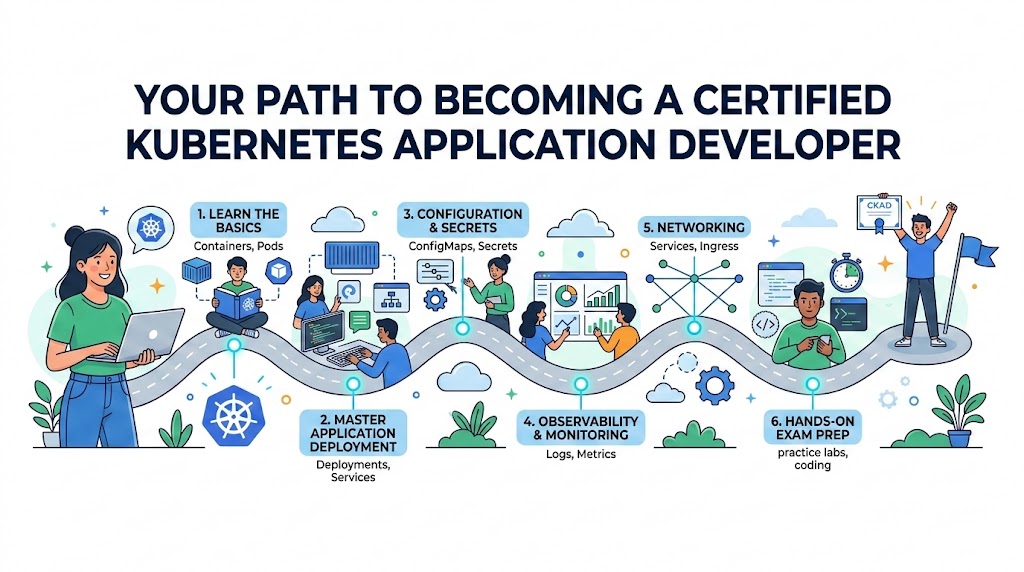
Introduction
The Certified Kubernetes Application Developer (CKAD) certification is a globally recognized credential that demonstrates your expertise in developing and managing applications in Kubernetes environments. Kubernetes, an open-source container orchestration platform, has revolutionized how applications are deployed and scaled in the cloud. As the demand for cloud-native applications grows, so does the need for skilled professionals who can effectively use Kubernetes. This certification will validate your abilities to design, build, and deploy applications using Kubernetes and container technology, making you an essential asset to any organization.
What is the Certified Kubernetes Application Developer Certification?
The Certified Kubernetes Application Developer (CKAD) certification, offered by the Cloud Native Computing Foundation (CNCF), tests your knowledge and skills in building, deploying, and maintaining applications on Kubernetes. It is ideal for professionals looking to demonstrate their Kubernetes application development skills, and it covers a wide range of topics including container management, deployment strategies, monitoring, scaling, and debugging Kubernetes applications.
As Kubernetes has become the backbone of modern cloud-native applications, this certification allows you to showcase your ability to work with Kubernetes at a deeper, more practical level.
Who Should Take It?
The CKAD certification is perfect for professionals who are:
- Software Engineers: If you work with cloud-native technologies and Kubernetes in your development processes, this certification will enhance your ability to deploy and manage Kubernetes applications.
- DevOps Engineers: Professionals who work in continuous integration/continuous deployment (CI/CD) pipelines can benefit from this certification as Kubernetes plays a central role in automating deployments.
- Cloud Engineers: With the growing use of Kubernetes in cloud computing, this certification helps cloud engineers manage applications effectively in a Kubernetes environment.
- Platform Engineers: As Kubernetes becomes the standard for application deployment, platform engineers will need to master Kubernetes to support cloud-native application development.
If you are working with containerized applications, microservices architectures, or in DevOps, the CKAD will help you establish a solid foundation for developing applications within Kubernetes.
Skills You’ll Gain
By achieving the CKAD certification, you’ll gain practical, in-demand skills such as:
- Kubernetes Resource Management: Learn how to define and manage Kubernetes resources like Pods, Deployments, ReplicaSets, StatefulSets, and more.
- Application Deployment and Scaling: Master deploying applications in Kubernetes and scaling them horizontally or vertically based on demand.
- Networking in Kubernetes: Understand how services and networking work within Kubernetes environments, enabling communication between various components in a containerized application.
- Configuration Management: Manage configuration using ConfigMaps and Secrets to store and retrieve sensitive data securely.
- Persistent Storage Management: Learn how to work with Kubernetes volumes and persistent storage to ensure data persists in stateful applications.
- Troubleshooting and Debugging: Gain experience in identifying and resolving issues within Kubernetes clusters, including examining logs and resource statuses.
- Monitoring and Logging: Implement effective logging and monitoring for applications running within Kubernetes clusters.
- Security: Apply security best practices in Kubernetes environments, ensuring applications and infrastructure are secure.
These skills are vital for anyone building, deploying, or maintaining containerized applications in Kubernetes environments.
Real-World Projects You Should Be Able to Do After It
With CKAD certification, you will be equipped to tackle several real-world projects:
- Deploying a Microservices-based Application: Build a multi-container application, split across microservices, and deploy it using Kubernetes. You’ll be able to define services, ingress controllers, and ensure that the application is scalable.
- CI/CD Pipeline Integration with Kubernetes: Implement Kubernetes within your CI/CD pipeline, automating the build, deployment, and testing of applications in a Kubernetes cluster.
- Scaling an Application in Kubernetes: Use Kubernetes Horizontal Pod Autoscaler to automatically scale applications based on traffic and load.
- Logging and Monitoring: Set up logging and monitoring tools like Prometheus and Grafana to track application performance and resolve issues proactively.
- Securing Application Deployments: Configure RBAC, Network Policies, and Secrets to ensure that Kubernetes applications are secure.
- Troubleshooting and Debugging Kubernetes Clusters: Resolve common issues such as Pod failures, networking issues, and resource exhaustion.
These projects give you the hands-on experience necessary to excel as a Kubernetes application developer.
Preparation Plan
7–14 Days Preparation Plan (For Experienced Developers)
- Day 1-3: Familiarize with Kubernetes architecture. Learn about Pods, Deployments, Services, and the fundamental components that form Kubernetes.
- Day 4-7: Study services, networking, and ConfigMaps. Learn how to store configuration and manage sensitive data using Kubernetes Secrets.
- Day 8-10: Focus on persistent storage and managing stateful applications. Understand how to use Persistent Volumes (PVs) and Persistent Volume Claims (PVCs).
- Day 11-12: Work on Kubernetes deployment strategies such as rolling updates and canary deployments.
- Day 13-14: Spend time troubleshooting and debugging Kubernetes clusters. Ensure you’re familiar with using logs and diagnostic tools to resolve issues quickly.
30 Days Preparation Plan (For Intermediate Learners)
- Week 1: Understand Kubernetes architecture, Pods, and Deployments. Set up a Kubernetes cluster using tools like Minikube.
- Week 2: Study Kubernetes networking, ConfigMaps, Secrets, and ingress controllers. Configure networking between services in your Kubernetes environment.
- Week 3: Dive into persistent storage, StatefulSets, and Stateful applications.
- Week 4: Focus on application scaling, debugging, and security best practices. Troubleshoot common application deployment issues.
60 Days Preparation Plan (For Beginners)
- Week 1-2: Learn the basic concepts of Kubernetes. Understand how Kubernetes orchestrates containers and how Pods are used for deployment.
- Week 3-4: Study Kubernetes networking, services, ConfigMaps, and Secrets. Get hands-on with setting up and managing Pods and Deployments.
- Week 5-6: Focus on application scaling, managing persistent storage, and learning troubleshooting techniques for Kubernetes clusters.
Common Mistakes to Avoid
- Skipping Hands-On Practice: While reading about Kubernetes is essential, hands-on practice is crucial to mastering it. Ensure you spend time experimenting with Kubernetes setups.
- Overlooking Security Best Practices: Security is often an afterthought, but it’s critical to ensure you’re setting up proper Role-Based Access Control (RBAC), Network Policies, and Secrets management from the start.
- Misunderstanding Kubernetes Networking: Networking can be tricky in Kubernetes, and a lack of understanding can lead to communication failures between components. Take time to fully grasp networking concepts.
- Failing to Use Kubernetes Documentation: The Kubernetes documentation is a critical resource. Don’t hesitate to use it, especially during the exam.
Best Next Certifications After CKAD
- Same Track: Certified Kubernetes Administrator (CKA) – If you’re looking to expand your skills beyond application development, the CKA certification focuses on Kubernetes administration.
- Cross-Track: Certified DevOps Professional (CDP) – For those interested in DevOps practices, this certification will complement your Kubernetes knowledge in the context of DevOps pipelines.
- Leadership: Certified Kubernetes Security Specialist (CKS) – This is ideal for those interested in securing Kubernetes environments, offering deep insights into Kubernetes security.
Choose Your Path
1. DevOps
- Description: DevOps is focused on bridging the gap between software development and IT operations. With Kubernetes becoming a core tool in many DevOps workflows, a DevOps learning path will deepen your understanding of container orchestration, automation, and CI/CD pipelines.
- Certifications:
- Certified Kubernetes Administrator (CKA)
- AWS Certified DevOps Engineer – Professional
- Google Cloud Professional Cloud DevOps Engineer
- Docker Certified Associate (DCA)
- Ideal For: Professionals looking to work on the automation and integration of Kubernetes in cloud-native application development.
2. DevSecOps
- Description: DevSecOps integrates security into the DevOps process, focusing on building secure software pipelines. A path in DevSecOps ensures you can deploy Kubernetes applications while adhering to security best practices.
- Certifications:
- Certified Kubernetes Security Specialist (CKS)
- Certified Cloud Security Professional (CCSP)
- Certified DevSecOps Professional
- Ideal For: Security engineers and DevOps professionals looking to secure Kubernetes clusters and containerized applications.
3. Site Reliability Engineering (SRE)
- Description: SREs focus on the reliability, availability, and performance of applications and infrastructure. Kubernetes is widely used to ensure the scalability and resilience of applications, making it a crucial tool in the SRE toolbox.
- Certifications:
- Certified Kubernetes Administrator (CKA)
- Google Cloud Professional Cloud DevOps Engineer
- Site Reliability Engineer Certification
- Ideal For: Engineers responsible for managing highly reliable, scalable, and available Kubernetes applications in production.
4. AIOps/MLOps
- Description: AIOps/MLOps leverages AI and machine learning to automate and optimize Kubernetes environments. With Kubernetes supporting the management of AI/ML workloads, this path helps you manage data pipelines, machine learning models, and AI-driven applications.
- Certifications:
- Certified Kubernetes Application Developer (CKAD)
- Google Cloud Professional Data Engineer
- AWS Certified Machine Learning – Specialty
- Ideal For: Professionals focusing on automating Kubernetes environments for machine learning models and AI applications.
5. DataOps
- Description: DataOps focuses on streamlining the lifecycle of data management and analytics. As Kubernetes becomes more widely used for managing data pipelines and big data workloads, this path equips professionals with skills for handling containerized data applications.
- Certifications:
- Certified Kubernetes Application Developer (CKAD)
- Data Engineering Certification
- Google Cloud Professional Data Engineer
- Ideal For: Engineers who manage and deploy data pipelines and analytics workloads in a Kubernetes environment.
6. FinOps
- Description: FinOps focuses on managing the financial aspects of cloud-based infrastructure. Kubernetes and cloud-native applications can incur significant costs, and FinOps ensures that organizations use Kubernetes resources efficiently and cost-effectively.
- Certifications:
- FinOps Foundation Certification
- Kubernetes for FinOps
- Certified Kubernetes Administrator (CKA)
- Ideal For: Professionals responsible for cloud cost management, optimizing Kubernetes deployments for cost efficiency.
Role → Recommended Certifications Mapping
| Role | Recommended Certifications |
|---|---|
| DevOps Engineer | – Certified Kubernetes Application Developer (CKAD) – Certified Kubernetes Administrator (CKA) – AWS Certified DevOps Engineer – Professional – Google Cloud Professional Cloud DevOps Engineer |
| SRE (Site Reliability Engineer) | – Certified Kubernetes Administrator (CKA) – Certified Kubernetes Application Developer (CKAD) – Google Cloud Professional Cloud DevOps Engineer – Site Reliability Engineer Certification |
| Platform Engineer | – Certified Kubernetes Application Developer (CKAD) – Certified Kubernetes Administrator (CKA) – Cloud Engineering Certification – AWS Certified Solutions Architect |
| Cloud Engineer | – Certified Kubernetes Administrator (CKA) – Certified Kubernetes Application Developer (CKAD) – AWS Certified DevOps Engineer – Professional – Google Cloud Professional Cloud DevOps Engineer |
| Security Engineer | – Certified Kubernetes Security Specialist (CKS) – Certified Cloud Security Professional (CCSP) – Certified Kubernetes Administrator (CKA) |
| Data Engineer | – Certified Kubernetes Application Developer (CKAD) – Data Engineering Certification – Google Cloud Professional Data Engineer |
| FinOps Practitioner | – FinOps Foundation Certification – Kubernetes for FinOps – Certified Kubernetes Administrator (CKA) |
| Engineering Manager | – Certified Kubernetes Application Developer (CKAD) – Certified Kubernetes Administrator (CKA) – AWS Certified DevOps Engineer – Professional – Google Cloud Professional Cloud DevOps Engineer |
Comparison Table: Kubernetes Certifications
| Certification | Track | Level | Who It’s For | Prerequisites | Skills Covered | Recommended Order |
|---|---|---|---|---|---|---|
| Certified Kubernetes Administrator (CKA) | Kubernetes & DevOps | Intermediate | Cloud Engineers, DevOps Engineers, SysAdmins | Basic knowledge of Linux & containers | Kubernetes cluster setup, networking, storage, monitoring, troubleshooting, security | CKA is ideal for those starting Kubernetes admin roles |
| Certified Kubernetes Application Developer (CKAD) | Kubernetes & DevOps | Intermediate | Developers, DevOps Engineers | Basic knowledge of containers and Kubernetes | Application development, configuration, services, networking, security within Kubernetes | Best followed after CKA or for developers focusing on Kubernetes apps |
| Certified Cloud Security Professional (CCSP) | Cloud Security | Advanced | Security Engineers, Cloud Professionals | Knowledge of cloud security concepts | Cloud security practices, risk management, cloud architecture security | Ideal for professionals in cloud security after CKA |
| Google Cloud Professional Cloud DevOps Engineer | Cloud Engineering | Advanced | Cloud Engineers, DevOps Engineers | Knowledge of cloud platforms | Google Cloud Platform services, CI/CD pipelines, GCP security, incident management | Best for professionals working with Google Cloud and Kubernetes |
| AWS Certified DevOps Engineer – Professional | Cloud & DevOps | Advanced | DevOps Engineers, Cloud Engineers | AWS Certified Solutions Architect – Associate | CI/CD pipelines, automation, monitoring, security, scalability in AWS | Suitable after AWS Certified Solutions Architect or CKA |
| Docker Certified Associate (DCA) | Containerization | Beginner/Intermediate | Developers, SysAdmins, DevOps Engineers | Basic understanding of containers | Docker installation, containerization, orchestration, networking with Docker | Can complement CKA for deeper container knowledge |
FAQs on Certified Kubernetes Application Developer
- What is the CKAD exam format?
- The exam is performance-based, with practical questions that require solving real-world Kubernetes problems.
- How long should I prepare for the CKAD exam?
- It depends on your experience level. You can expect to take anywhere from 7–60 days for preparation.
- What tools can I use to practice for the exam?
- Minikube, Google Kubernetes Engine (GKE), AWS EKS, Azure AKS, and on-premise Kubernetes clusters are excellent options.
- What is the passing score for the CKAD exam?
- The passing score is 66%.
- How much does the CKAD exam cost?
- The exam costs $300 USD, with the option for a free retake within a year.
- Can I use Kubernetes documentation during the exam?
- Yes, the exam allows you to access Kubernetes documentation during the test.
- How do I register for the CKAD exam?
- You can register for the CKAD exam directly on the CNCF website.
- What resources should I study for the CKAD exam?
- The official Kubernetes documentation and online courses like those offered by DevOpsSchool, Cotocus, and others.
Top Institutions Offering CKAD Training and Certification
1.FinOpsSchool
FinOpsSchool focuses on the financial aspects of Kubernetes deployments, with a special emphasis on cloud cost management. Their CKAD course includes lessons on optimizing Kubernetes applications for cost efficiency, managing cloud resources, and implementing financial operations in Kubernetes environments. This training program is ideal for professionals in financial operations who are responsible for managing the costs associated with cloud-native applications. FinOpsSchool’s courses are designed to help professionals understand how to balance performance and cost, ensuring that Kubernetes applications are both scalable and cost-effective.
2.DevOpsSchool
DevOpsSchool is a prominent name in the world of DevOps and Kubernetes training. They offer specialized courses for the Certified Kubernetes Application Developer (CKAD) certification, designed to equip developers and DevOps engineers with the knowledge needed to build and deploy applications using Kubernetes. The training at DevOpsSchool is not only focused on theoretical knowledge but also emphasizes practical hands-on experience. With expert trainers guiding students through real-world projects, learners can expect to gain in-depth insights into application deployment, configuration management, networking, and Kubernetes security. The institution provides lifetime access to study materials and 24/7 support, ensuring that candidates are well-prepared for the certification exam and beyond.
3.Cotocus
Cotocus is another leading institution offering comprehensive CKAD training that is specifically tailored for developers and professionals looking to master Kubernetes. Their training program focuses on hands-on labs and real-world scenarios, making it easier for learners to grasp the concepts of Kubernetes. The courses offered by Cotocus are flexible, with options for both self-paced and instructor-led learning, allowing individuals to choose a mode that suits their schedule. Personalized coaching is provided to ensure that learners understand each concept in depth. Whether you’re a beginner or an experienced professional, Cotocus ensures you are ready for the CKAD exam through practical training and expert-led sessions.
4.Scmgalaxy
Scmgalaxy offers an in-depth training program for CKAD, providing students with a detailed understanding of Kubernetes application development. This institution focuses on teaching essential Kubernetes components, from Pods and Services to ConfigMaps and persistent storage. The training includes hands-on exercises to ensure learners can apply their knowledge to real-world Kubernetes environments. Scmgalaxy is known for its strong track record in DevOps education and provides high-quality content that prepares students not just for the certification exam, but also for working in production environments. Their support system and certification assistance ensure that students are fully prepared for the exam.
5.BestDevOps
BestDevOps provides expert-led training in Kubernetes, focusing on the CKAD certification. Their courses are designed for professionals who wish to specialize in Kubernetes application development. The training covers a broad range of topics, including application deployment, scaling, networking, and security within a Kubernetes environment. BestDevOps provides practical exposure to Kubernetes using live case studies and real-world examples. Students can also benefit from personalized feedback and support, ensuring that they understand every aspect of the certification curriculum. BestDevOps aims to create skilled professionals who are ready to handle the complexities of Kubernetes application development in production.
6.DevSecOpsSchool
DevSecOpsSchool focuses on integrating security into Kubernetes application development. Their CKAD certification course is ideal for professionals looking to specialize in both Kubernetes application development and security practices. The training includes best practices for securing Kubernetes applications, managing role-based access control (RBAC), and understanding security policies. DevSecOpsSchool’s training program is comprehensive, covering both the foundational aspects of Kubernetes as well as advanced topics in security, making it an excellent choice for those who wish to gain expertise in securing cloud-native applications in Kubernetes environments.
7.SRESchool
SRESchool offers a specialized CKAD training program with a focus on Site Reliability Engineering (SRE). This unique approach ensures that students not only learn to develop Kubernetes applications but also understand how to manage and scale these applications in production environments for high reliability. The course includes in-depth coverage of Kubernetes application management, scaling, and monitoring, all while emphasizing uptime, performance, and reliability. SRESchool is known for providing a comprehensive curriculum that blends Kubernetes application development with SRE best practices, making it an excellent choice for those who want to specialize in maintaining highly reliable and scalable applications.
8.AIOpsSchool
AIOpsSchool’s CKAD training is perfect for those interested in integrating AI and machine learning (ML) with Kubernetes. The training program is designed to help students deploy, manage, and scale AI/ML workloads within Kubernetes environments. AIOpsSchool covers everything from the basics of Kubernetes to advanced topics like managing AI/ML pipelines and workflows using Kubernetes. With a strong emphasis on automation and data-driven applications, this program is ideal for data scientists, ML engineers, and AI-focused professionals who want to leverage Kubernetes for their projects.
9.DataOpsSchool
DataOpsSchool provides a specialized CKAD course for data engineers and professionals working in data-centric fields. Their curriculum focuses on using Kubernetes for managing data pipelines, big data applications, and cloud-native data solutions. DataOpsSchool’s program covers key aspects of deploying and managing stateful applications in Kubernetes, handling persistent storage, and integrating Kubernetes with various data management tools. This training is ideal for professionals in the data operations field who want to learn how to deploy scalable, reliable, and secure data applications within a Kubernetes environment..
FAQs on Certified Kubernetes Application Developer (CKAD)
- What is the CKAD exam format?
- The CKAD exam is performance-based, consisting of real-world tasks that test your ability to solve Kubernetes-related problems in a live environment. The exam is conducted online, and you will have 2 hours to complete it.
- What topics are covered in the CKAD exam?
- The CKAD exam tests your knowledge in several areas including Kubernetes architecture, application deployment, configuration management, networking, security, persistent storage, troubleshooting, and scaling of applications.
- How long should I prepare for the CKAD exam?
- Preparation time depends on your experience with Kubernetes. If you’re already familiar with Kubernetes, 7-14 days of focused preparation might be enough. For beginners, it’s recommended to spend 30-60 days preparing for the exam.
- What resources can I use during the exam?
- You are allowed to use the official Kubernetes documentation during the exam. It’s recommended to become familiar with the documentation as it is a critical part of solving tasks efficiently.
- Is there a passing score for the CKAD exam?
- The passing score for the CKAD exam is 66%. The exam consists of multiple practical tasks, and you need to complete them within the allotted time.
- How much does the CKAD exam cost?
- The CKAD exam costs $300 USD. This price includes the exam attempt and the certification. You also have the option to retake the exam within 1 year if needed.
- What is the validity of the CKAD certification?
- The CKAD certification is valid for three years. After that, you will need to recertify by taking the exam again to stay up-to-date with the latest Kubernetes features and practices.
- Can I take the exam without prior Kubernetes experience?
- While prior Kubernetes experience is recommended, you can take the exam without it. However, it’s highly beneficial to have hands-on experience with Kubernetes, especially in the areas of deployment, configuration, and management of applications.
- How can I schedule the CKAD exam?
- You can schedule the CKAD exam through the CNCF’s exam platform. After registering and paying for the exam, you will be able to choose a suitable date and time for the exam.
- What should I do if I fail the CKAD exam?
- If you fail the CKAD exam, you can retake it within a year. Many candidates use their first attempt to understand the exam format better and refine their skills before retaking the exam.
- Can I use any Kubernetes tool for the exam?
- The exam environment provides you with a Kubernetes cluster and necessary tools, so you don’t need to worry about setting up your own environment. You can also access the Kubernetes documentation and use command-line tools for managing the cluster.
- How do I enhance my skills after passing the CKAD exam?
- After passing the CKAD, you can deepen your Kubernetes expertise by pursuing advanced certifications like the Certified Kubernetes Administrator (CKA) or the Certified Kubernetes Security Specialist (CKS). Additionally, gaining hands-on experience through real-world projects will help solidify your knowledge.
Conclusion
Achieving the Certified Kubernetes Application Developer (CKAD) certification is a significant milestone for any professional looking to enhance their Kubernetes skills. It not only validates your ability to work with Kubernetes but also positions you as a key contributor to any organization’s cloud-native and containerized application development efforts. Whether you’re a developer, DevOps engineer, or cloud professional, CKAD opens new career opportunities by showcasing your ability to manage, scale, and secure Kubernetes applications.To succeed in the CKAD exam, thorough preparation, hands-on practice, and familiarity with the official Kubernetes documentation are essential. Remember that Kubernetes is an evolving platform, so continuous learning and practical application of your skills are key to staying relevant in the industry. Once certified, you’ll join a community of skilled professionals who are shaping the future of cloud-native application development and deployment.