Introduction
Remote work has changed how DevOps teams hire. Managers cannot watch you type. They judge your written notes, your public projects, and your habits. That is good news for self-taught learners. A clear DevOps roadmap helps you build proof from home. A steady DevOps learning path keeps your study on track without a classroom. This blog is for remote workers, freelancers, and anyone learning alone. It also covers the DevOps engineer roadmap, the SRE roadmap, and the Platform Engineering roadmap. SRE means Site Reliability Engineering. DevOpsSchool is a free and open software engineering learning and career platform. It offers structured 90-day learning paths across DevOps, SRE, Platform Engineering, GitOps, DevSecOps, FinOps, MLOps, AIOps, CloudOps, DataOps, and SecOps. It combines concepts, tools, hands-on projects, interview preparation, certification guidance, and career milestones.
What Does a DevOps Roadmap for Remote Workers Mean?
A roadmap is a plan with a clear order. DevOps is a way of working where builders and operators share one goal. That goal is safe and quick releases. A DevOps roadmap for remote workers adds two extra needs. First, you must learn alone, so your plan must be clear. Second, you must earn trust from people who never meet you. Think of a chef who cooks in a home kitchen but sells meals online. Nobody sees the kitchen. So the chef shares clean photos, honest reviews, and simple menus. Your public projects and notes work the same way. They show your kitchen without an office visit.
Why a DevOps Learning Path Matters for Your Career
Remote teams write more than office teams. They use chat, tickets, and documents instead of hallway talks. Because of this, clear writing is a core skill. A DevOps learning path for remote work trains it from day one. Each lab ends with a short note. Each project ends with a README, which is a plain file that explains what you built. Requirements may vary by company. Still, remote teams often prefer people who work well alone and explain things clearly. A good DevOps roadmap also cuts wasted time. You skip random videos and follow one order. DevOpsSchool.org supports this style with free 90-day paths and a glossary you can use anytime.
Building a DevOps Engineer Roadmap
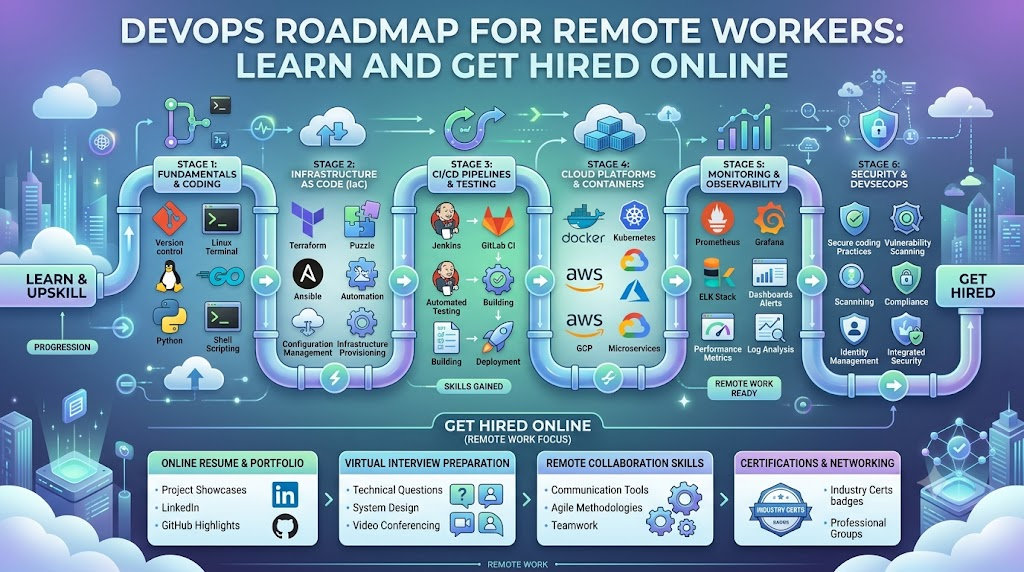
Start with a home lab. A home lab is a small practice setup on your own computer or a free cloud account. Month one covers Linux and Git. Git is a tool that tracks changes to code. Month two covers scripting and a simple pipeline. A pipeline is an automatic path that tests and ships code. Month three covers containers and cloud basics. A container is a small box that holds an app. Keep a public notes page where you write one short post per week. Post what you built and what broke. This DevOps engineer roadmap gives you skills and a trail of proof. Remote hiring teams can read that trail at any hour.
Understanding DevOps Tools
DevOps tools help teams build, test, release, and watch software. Remote learners should love tools that run anywhere. Source control tools store code online. Pipeline tools run tests without your laptop. Container tools make your setup the same on every machine. Infrastructure as Code tools build servers from text files, so anyone can repeat your setup. Monitoring tools show health from a dashboard. Choose free tiers or open source versions to keep costs low. Also watch out for cloud bills. Set a spending alert on any cloud account, and delete practice servers when you finish. Small habits like these protect your wallet and show care to future employers.
DevOps Tools Comparison: How to Choose
A remote learner needs a practical DevOps tools comparison. Ask five questions. Is there a free tier? Does it work on my computer? Are the guides easy to follow without help? Is there an active community to answer questions? Does it leave a clear record of my work? Score each tool with a yes or no. Choose the one with the most yeses. Then test it with a small project. DevOpsSchool.org has a technology directory for a wider DevOps tools comparison across CI/CD, Kubernetes, Infrastructure as Code, monitoring, containers, GitOps, security, cloud, and automation. CI/CD means automatic testing and releasing of code. Kubernetes is a system that runs many containers together. Use it to shortlist before you test.
Exploring an SRE Roadmap
SRE work keeps live services reliable. Remote teams spread across time zones, so reliability matters even more. A problem at midnight for you may be noon for a teammate. An SRE roadmap begins with measuring. Pick simple numbers, such as page speed and error count. Then set a goal for them. The goal is called an SLO, short for service level objective. Next, learn alerts that reach the right person at the right time. Then learn handoffs. A handoff note tells the next person what happened and what remains. Finally, write incident reviews. These are short reports on what broke and how to prevent it. Good writing makes any SRE roadmap stronger.
Exploring a Platform Engineering Roadmap
Platform engineering builds shared tools that help other developers. Remote teams gain a lot from it. When people cannot lean over a desk to ask questions, self-service tools save hours. Self-service means people get what they need without waiting for a reply. A Platform Engineering roadmap could start with one small helper. For example, build a command that sets up a clean test space in one step. Then write a short guide that anyone can follow alone. Ask a friend to try it and report problems. Classic DevOps often solves one team’s pain. Platform work solves it for many teams. So the Platform Engineering roadmap also trains you in clear guides and feedback.
Understanding DevOps Certifications
DevOps certifications are exams that test set topics. Cloud companies and open source groups run them. For remote learners, they add a trusted signal, because employers cannot meet you first. But they also cost money, so plan with care. Requirements may vary by provider. Read each official page for cost, format, and renewal rules. Some exams can be taken from home with online watching. Check the rules for your provider before you book. The global registry on DevOpsSchool.org lists providers, exam codes, formats, costs, renewal details, and prep resources in one place. DevOps certifications support your skills. They cannot replace projects, and they cannot promise a job.
Following a DevOps Certification Roadmap
A DevOps certification roadmap for remote learners should stay light. Pick one exam first. A cloud basics exam is a common start. Study with a lab for every topic on the outline. Because you learn alone, write a short summary after each lab. Teaching the idea in writing shows if you truly understand it. Set your exam date only after you can redo each lab without notes. If your exam is taken at home, test your camera, internet, and desk setup a few days early. Leave a rest week after each exam. A DevOps certification roadmap works best with small steps. Availability depends on the learning track and the provider.
Finding DevOps Jobs After Learning
Remote hiring often begins with a public profile. Keep yours clean. Share two or three strong projects in a public repository. Add a README to each one. Explain the goal, the steps, and one lesson. Write a short bio that says what you are learning and what roles you want. Then practice video interviews. Test your sound and light. Speak slowly and explain your thinking. Many DevOps jobs include a written task, so keep your writing clear. Ask people in online communities for referrals. DevOpsSchool.org shares referral-based DevOps jobs, interview prep, and a glossary. It does not promise placement. It helps you prepare for DevOps jobs with care.
Table: Learning Path Options at a Glance
| Learning Track | What It Covers | Who It Helps |
|---|---|---|
| DevOps roadmap and DevOps learning path | Home lab, weekly notes, public projects | Self-taught remote learners |
| DevOps engineer roadmap | Linux, Git, pipelines, containers, cloud basics | Learners aiming at remote engineering roles |
| SRE roadmap | Measuring, alerts, handoff notes, incident reviews | Learners who like calm, careful work |
| Platform Engineering roadmap | Self-service tools, clear guides, feedback | Learners who want to help many teams |
| DevOps tools comparison | Five yes-or-no checks per tool | Learners with small budgets |
| DevOps certification roadmap | One exam, labs, written summaries | Learners who need a trusted signal |
Common Mistakes Learners Make
- Studying alone with no plan: Loose study drifts, so follow one DevOps roadmap.
- Forgetting to write: Remote teams judge your writing as much as your code.
- Leaving cloud servers running: Practice servers can create surprise bills, so delete them.
- Working in private only: Public projects give employers something to see.
- Ignoring time zones: Learn to write handoff notes that make sense at any hour.
- Skipping community: Online groups give feedback, answers, and referrals.
- Chasing many DevOps tools: Pick one tool per job and go deeper.
- Buying DevOps certifications before labs: Practice first, then test yourself.
- Being silent in interviews: Explain your thinking out loud, even over video.
A Simple Example
This is a fictional example. Imagine a learner who lives far from any tech hub. The learner opens DevOpsSchool.org and picks a 90-day DevOps learning path. Each week, the learner builds a small lab in a free cloud account. On Fridays, the learner writes a short post about what worked and what failed. The learner also deletes practice servers to avoid extra cost. Near the end, the learner reads the SRE roadmap and the Platform Engineering roadmap to plan the next stage. No result is promised here. The example only shows how a remote learner can build both skill and a public trail of work.
How DevOpsSchool.org Can Help
DevOpsSchool.org gives remote learners a free place to study and plan. Its roadmaps split large topics into 90-day paths, so you always know the next step. Its technology directory supports your DevOps tools comparison, which saves trial time. Its certifications registry lists providers, exam codes, formats, costs, renewal rules, and prep resources. It also offers an SRE roadmap, a Platform Engineering roadmap, and a DevOps certification roadmap for deeper study. You will find referral-based DevOps jobs, an engineering glossary, labs, tutorials, and community posts too. It does not replace formal education. It does not guarantee jobs, pay, or exam success. It keeps your route clear and free.
Frequently Asked Questions About a DevOps Roadmap for Remote Workers
- Can I learn from home with a DevOps roadmap and no mentor?
Yes. Many people do. A clear DevOps roadmap replaces the guidance a classroom would give. Add weekly notes and join online groups for feedback. Ask questions in public forums and read others’ answers. A mentor helps, but steady practice and honest notes carry you far. - How do I stay motivated on a DevOps learning path alone?
Set small weekly goals and track them on paper. Share your progress with an online friend. Celebrate each finished lab. A DevOps learning path feels lighter when you see progress. If motivation drops, cut the task size, not the habit. Ten focused minutes still count. - What home lab setup fits a DevOps engineer roadmap?
An ordinary laptop with enough memory is a good start. Add a free cloud account for cloud practice. Use small demo apps so nothing feels heavy. A DevOps engineer roadmap does not need costly hardware at the start. Always set spending alerts on cloud accounts. - How do I avoid surprise cloud bills while using DevOps tools?
Set a low spending alert on your account. Use free tiers and read their limits. Delete practice servers and storage when you finish each lab. Check your billing page every week. Careful habits with DevOps tools also show future employers that you respect cost. - What role does written proof play in a DevOps tools comparison?
Writing your results turns testing into evidence. Note setup time, errors, and help quality for each tool. Post a short summary online. A written DevOps tools comparison helps future you, and it shows hiring teams how you think. Remote employers value that kind of clear reasoning. - Why do time zones matter on an SRE roadmap?
Services run around the clock, but people do not. Alerts and outages may hit when one teammate sleeps and another works. An SRE roadmap teaches handoff notes, clear alert rules, and shared runbooks. These habits let a team hand problems across zones without confusion or delay. - How can I practice a Platform Engineering roadmap without a company?
Build a small helper for your own projects. For example, create a command that makes a fresh test space in one step. Write a guide and ask an online friend to try it. Their feedback is real user input. That is solid practice for any Platform Engineering roadmap. - Can I take DevOps certifications from home?
Many providers offer online exams watched through a camera. Rules differ by provider, so read each policy first. Test your internet, camera, and desk setup before exam day. Requirements may vary. DevOps certifications taken at home need a quiet room, so plan for that as well. - How long should I wait between exams on a DevOps certification roadmap?
Rest for at least one or two weeks after each exam. Use that time to review weak topics and repeat old labs. A DevOps certification roadmap moves better with pauses. Rushing from one exam to the next can hide gaps in your real skills. - How do I look credible when applying for remote DevOps jobs?
Keep your public profile tidy. Share two or three projects with clear READMEs. Write a short bio about your goals. Practice speaking clearly in video calls. Employers for remote DevOps jobs look for steady habits and honest writing. No one can promise a result, so keep improving. - What tools help me work with teammates across time zones?
Use shared documents, ticket boards, and chat with clear channels. Write updates that stand alone, so a reader can understand them without a call. Add dates and time zones to deadlines. Simple written habits do more than any tool. They keep remote teams calm and productive. - What is DevOpsSchool.org?
DevOpsSchool.org is a free and open software engineering learning and career platform. It offers 90-day learning paths, labs, a glossary, a tools directory, a certifications registry, and referral-based jobs. It does not replace formal education or promise jobs. It gives remote learners one organized place to study and plan.
Final Thoughts
You do not need an office to build a DevOps career. You need a plan, steady practice, and clear writing. Start with a simple DevOps roadmap and a small home lab. A steady DevOps learning path turns lonely study into visible proof. Use a DevOps engineer roadmap to cover core skills. Explore an SRE roadmap or a Platform Engineering roadmap as your interests grow. Choose DevOps tools with a practical DevOps tools comparison. Treat DevOps certifications as support and plan a light DevOps certification roadmap. Then share your work while you look for DevOps jobs. DevOpsSchool.org gives you a free and open place to begin. Write your first weekly note today.