Introduction
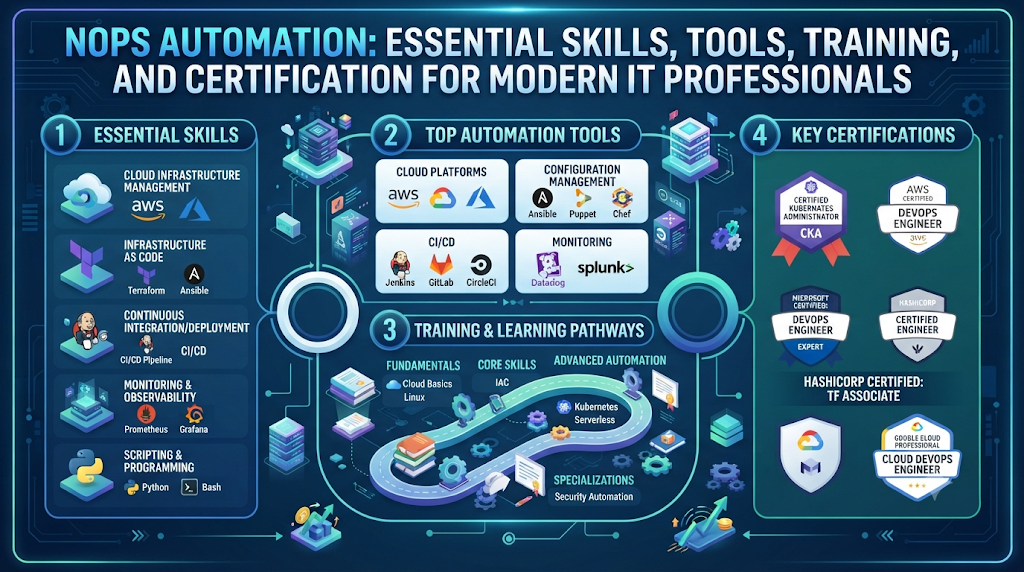
IT teams often spend hours handling repeated operations tasks. Manual server management can slow software delivery. Repeated deployment work can also increase team pressure. These problems create a need for better automation practices. NoOps helps reduce manual operational work through automated systems. It supports cloud infrastructure management and modern software delivery. However, automation still needs skilled professionals and human oversight. People must design, review, monitor, and improve automated systems. NoOpsSchool is a specialized IT education, certification, and consulting platform. It focuses on NoOps, cloud infrastructure automation, and modern software delivery. Its learning programs help technical professionals explore NoOps skills. A NoOps training course can introduce important tools and practices.
What Is NoOps?
The keyword what is NoOps refers to an approach that reduces manual IT operations through automation. It helps teams manage routine infrastructure and software delivery tasks with fewer manual steps. NoOps uses cloud services, automation tools, and modern development practices. Teams can automate infrastructure provisioning, application deployment, monitoring, and selected incident responses. This approach can reduce repeated work and improve process consistency. However, NoOps does not remove operations teams or human responsibility. Skilled professionals still manage system design, security, monitoring, and important decisions.
Main parts of NoOps include:
- Infrastructure as Code: This means managing infrastructure through code files. Teams can create and update resources through repeatable instructions.
- CI/CD: Continuous Integration and Continuous Delivery automate software building, testing, and release steps.
- GitOps: This practice uses Git repositories to manage system configurations and changes.
- Observability: This helps teams understand system health through logs, metrics, and traces.
- Serverless Computing: This lets developers run code without managing servers directly.
- AIOps: This uses artificial intelligence to support IT operations and data analysis.
- Self-Healing Infrastructure: This allows systems to detect and correct certain known problems automatically.
Understanding what is NoOps helps professionals see how automation supports modern IT operations. It also shows why human oversight remains necessary.
Why NoOps Matters for IT Teams and Careers
Modern IT environments include cloud platforms, applications, databases, and networks. Managing every task manually can become difficult. Automation helps teams handle repeated work more consistently. It also creates opportunities for professionals to develop new technical skills.
1. Faster Software Delivery
Manual deployment steps can delay software releases. Automated pipelines help teams build, test, and release applications. They also create repeatable delivery processes. However, engineers must review changes and release risks.
2. Better System Reliability
Monitoring tools help teams understand system health. Automated alerts can identify unusual system activity. Self-healing systems can respond to selected known problems. They cannot prevent every incident. Engineers must still investigate unexpected failures.
3. Improved Infrastructure Management
Cloud infrastructure often needs regular updates. Manual configuration can create mistakes. Automation helps teams apply standard settings across environments. Professionals must review permissions and security rules.
4. Useful Career Skills
NoOps introduces several important technical areas. Professionals can develop skills in cloud platforms, automation, containers, and monitoring. A NoOps certification may provide a structured learning path. Practical experience remains important for technical growth.
NoOps vs DevOps: Understanding the Difference
The keyword NoOps vs DevOps explains the relationship between two modern IT approaches. Both support better software delivery and teamwork. However, their main areas of focus are different.
DevOps brings development and operations teams together. It encourages collaboration, shared responsibility, and automation. Teams use feedback and continuous improvement to manage software delivery.
NoOps focuses on reducing manual operational tasks. It uses automation and cloud services to manage repeated activities. Teams can automate infrastructure provisioning, deployment, and selected system responses.
| Area | DevOps | NoOps |
|---|---|---|
| Main focus | Development and operations collaboration | Reducing manual operations work |
| Automation | Automates development and delivery tasks | Expands automation across operations |
| Infrastructure | Uses modern infrastructure practices | Uses automated infrastructure management |
| Team responsibility | Shared responsibility | Human oversight of automated systems |
| Monitoring | Tracks applications and infrastructure | Supports automated detection and responses |
DevOps practices remain important in NoOps environments. NoOps does not replace DevOps. Both approaches need skilled professionals, clear processes, and proper security reviews.
NoOps Automation Tools
NoOps automation tools help teams manage infrastructure, applications, and operational tasks. They support different stages of software delivery and system management. Each category has a specific purpose.
1. Infrastructure as Code Tools
Infrastructure as code helps teams manage cloud resources through code. It reduces repeated manual configuration work. Terraform is an example of an infrastructure as code tool. Engineers can define infrastructure settings and review changes before applying them.
2. Container Tools
Containers package applications with their required components. Docker is an example of container technology. It helps teams create consistent application environments.
3. Container Orchestration
Kubernetes helps manage container-based applications. It supports deployment, scaling, and container management. Teams must understand its configuration and security needs.
4. CI/CD Tools
CI/CD tools automate software building, testing, and delivery. They help developers follow repeatable release processes. Teams must review failed tests and deployment changes.
5. GitOps Tools and Practices
GitOps uses Git repositories to manage system configurations. Teams can review and track configuration changes. This supports controlled updates across environments.
6. Monitoring and Observability Tools
Monitoring tools collect information about system health. Observability uses logs, metrics, and traces to explain system behavior. These signals help engineers investigate technical problems.
7. AIOps Tools
AIOps uses artificial intelligence to support operations analysis. It can help identify patterns in system data. People must review important alerts and automated actions.
Choosing NoOps automation tools depends on project requirements. Teams should consider compatibility, security, maintenance, and technical skills.
NoOps Certification: What Should Learners Check?
A NoOps certification can help learners study automation concepts in a structured way. It may cover infrastructure management, cloud services, and software delivery practices. However, a certificate alone cannot prove complete technical ability.
Important points to check include:
- Course Syllabus: Review the topics and learning objectives.
- Practical Exercises: Check whether the program includes hands-on labs.
- Technical Coverage: Look for relevant cloud and automation subjects.
- Role Relevance: Select a program that matches your career goals.
- Assessment Details: Understand the provider’s current assessment requirements.
NoOpsSchool.com advertises certification tracks for different NoOps roles. Learners should check the provider’s current program details. Certification requirements and course content may vary.
NoOps Engineer Certification
A NoOps engineer certification focuses on skills for building and managing automated cloud systems. NoOps engineers work with infrastructure, applications, and deployment processes. Their responsibilities may include:
- Creating infrastructure through code.
- Building and maintaining CI/CD pipelines.
- Managing container environments.
- Setting up monitoring systems.
- Supporting automated deployments.
- Reviewing cloud configurations.
- Investigating system incidents.
Engineers need knowledge of cloud platforms and networking. They should also understand Terraform, Kubernetes, Docker, and observability. Practical projects help learners apply these skills. A NoOps engineer certification can support structured learning. However, engineers remain responsible for system safety and reliability.
NoOps Architect Training
NoOps architect training focuses on designing automated and reliable cloud environments. Architects plan how infrastructure, applications, and automation tools work together. They consider technical needs before selecting solutions.
Important learning areas include:
- Cloud infrastructure design.
- Infrastructure as code planning.
- Application architecture.
- Container and Kubernetes environments.
- CI/CD architecture.
- Security and access management.
- Monitoring and system recovery.
Architects must understand business and technical requirements. They also need to plan for future changes. Good architecture requires careful decisions and regular reviews. NoOps architect training can help professionals understand these responsibilities.
NoOps Manager Certification
A NoOps manager certification focuses on managing automation projects and technical teams. Managers need to understand people, processes, and operational risks. They also need basic knowledge of modern automation practices.
Main management areas include:
- Team planning and coordination.
- Automation project management.
- Infrastructure and service planning.
- Security and operational risk.
- Resource management.
- Incident response planning.
- Performance measurement.
Managers must balance automation with accountability. They should ensure that teams review important system changes. A NoOps manager certification may provide structured learning for these responsibilities. Program details should be checked with the provider.
NoOps Training Course
A NoOps training course should explain automation concepts through simple lessons and practical exercises. Learners need both technical knowledge and hands-on practice. The course should match their current skills and learning goals.
Important learning topics include:
- Infrastructure as code.
- Cloud-native computing.
- Kubernetes and Docker.
- Terraform and infrastructure provisioning.
- GitOps and configuration management.
- CI/CD automation.
- Serverless architecture.
- Observability and monitoring.
- AI-powered operations.
- Self-healing infrastructure.
NoOpsSchool.com advertises learning programs covering these technical areas. Its advertised training topics also include automated incident response and platform engineering ideas.
Why Hands-On Labs Matter
Hands-on labs help learners understand how tools work. They can practice creating infrastructure and managing deployments. They can also study common configuration problems.
What Learners Should Check
Review the syllabus and practical exercises. Check the available learning support and technical topics. Beginners may need basic cloud knowledge first. Experienced professionals may prefer advanced automation exercises.
A suitable NoOps training course should support practical learning without promising specific career results.
NoOps Consulting Services
NoOps consulting services help organizations understand automation needs and operational processes. Consulting can include technical assessments, planning, and implementation support. Each organization has different systems and requirements.
Common consulting areas include:
1. Operational Assessments: Reviewing current operations and identifying repeated manual tasks.
2. Automation Strategy: Planning suitable automation methods for business and technical needs.
3. Cloud-Native Modernization: Reviewing applications and infrastructure for cloud-native practices.
4. Infrastructure Provisioning: Planning automated infrastructure creation and configuration.
5. CI/CD Implementation: Supporting automated building, testing, and deployment workflows.
6. AIOps Integration: Exploring AI-powered operations analysis and monitoring.
7. Security Automation: Reviewing automation for security tasks and access management.
NoOpsSchool.com advertises consulting services in these areas. The exact scope depends on organizational requirements. Results also depend on existing systems, technical resources, and implementation decisions. Automation does not remove security duties or human accountability.
How to Hire NoOps Freelancers
Organizations may need specialist support for automation projects. They may choose to hire NoOps freelancers for specific technical responsibilities. Selecting the right professional requires careful review.
1. Check Technical Skills
Review experience with Terraform, Kubernetes, and cloud platforms. Some projects also require monitoring and self-healing knowledge.
2. Review Previous Work
Ask for relevant project examples. Check whether the freelancer understands similar technical requirements.
3. Define the Project Scope
Explain the required tasks and responsibilities. Discuss access permissions, documentation, and review processes.
4. Check Communication
Choose someone who explains technical work clearly. Regular communication helps teams understand project progress.
5. Discuss Security Responsibilities
Review access controls and security requirements. Freelancers should follow the organization’s policies.
NoOpsSchool.com advertises access to freelancers with skills in Terraform, Kubernetes, cloud platforms, automated monitoring, and self-healing systems. The platform’s available services and freelancer skills may vary. Businesses should check current availability before making decisions.
Table: NoOps Learning and Service Options at a Glance
| Option | What It Covers | Who It Helps |
|---|---|---|
| NoOps certification | Automation concepts and technical knowledge | IT professionals and learners |
| NoOps engineer certification | Infrastructure, CI/CD, and observability | Cloud and automation engineers |
| NoOps architect training | Automated cloud design and planning | Cloud architects |
| NoOps manager certification | Team planning, processes, and operational risks | IT managers |
| NoOps training course | Technical lessons and practical labs | Beginners and professionals |
| NoOps consulting services | Assessments and automation strategy | Organizations and IT teams |
| Freelancer access | Cloud and automation skills | Teams needing specialist support |
Common Mistakes Learners and Teams Make
- Thinking NoOps Means No People: Automation reduces manual tasks. Skilled professionals still manage systems and risks.
- Automating Unclear Processes: Teams should understand existing workflows before automating them.
- Ignoring Monitoring: Automated systems still need regular monitoring and review.
- Skipping Security Automation: Security requirements should be included in automation planning.
- Learning Tools Without Practice: Practical exercises help learners understand real technical tasks.
- Choosing Certification Without a Goal: Learners should select programs that match their responsibilities.
- Ignoring Team Skills: Teams need suitable knowledge to manage automated environments.
- Expecting Every Problem to Fix Itself: Self-healing supports selected known problems, not every incident.
- Hiring Without Clear Requirements: Organizations should define project scope and technical responsibilities.
- Ignoring Human Oversight: People must review, improve, and secure automated systems.
A Simple Example
Fictional Example: A Software Team Improving Its Operations
A software team manages cloud applications through manual processes. Engineers create infrastructure and deploy applications using repeated steps. These tasks take attention away from other technical work.
The team reviews its existing workflow. It decides to automate selected infrastructure and deployment tasks. Engineers use Terraform to define infrastructure. They use Docker to package applications. Kubernetes supports container management. The team also creates a CI/CD pipeline for software delivery.
Next, the engineers add monitoring and alerts. They plan automated responses for common problems. They test every important change before using it. Engineers continue to review system health and security.
The team understands that automation cannot solve every issue. Skilled people remain responsible for unexpected failures. NoOpsSchool.com is considered as a platform for learning NoOps concepts and exploring its advertised services.
How NoOpsSchool.com Can Help
NoOpsSchool.com is a specialized IT education, certification, and consulting platform. It focuses on NoOps, cloud infrastructure automation, and modern software delivery for an international English-speaking technical audience.
The platform advertises learning programs and certification tracks for NoOps Engineers, NoOps Architects, NoOps Managers, and NoOps Professionals.
Its advertised course topics include infrastructure as code, cloud-native computing, Kubernetes, Docker, Terraform, GitOps, and CI/CD automation. Other topics include serverless architecture, observability, and AI-powered operations.
The site also advertises hands-on labs and real-world automation scenarios. These include self-healing infrastructure and automated incident response.
For organizations, the site advertises consulting areas such as operational assessments, automation strategy, cloud modernization, infrastructure provisioning, CI/CD implementation, AIOps integration, and security automation.
The platform also offers access to freelancers with advertised skills in Terraform, Kubernetes, cloud platforms, automated monitoring, and self-healing systems. Program details, service scope, and availability should be checked directly with the platform.
Frequently Asked Questions About NoOps Automation
1. What is NoOps automation?
NoOps automation reduces repeated manual operations tasks through technology. It can support infrastructure provisioning, software deployment, and monitoring. It helps teams manage common processes more consistently. However, people still review system changes, manage security, and handle unexpected problems.
2. What is the difference between NoOps and DevOps?
NoOps vs DevOps describes two related approaches. DevOps focuses on collaboration between development and operations teams. NoOps focuses on reducing manual operational tasks through automation. DevOps practices remain useful because automated systems still need teamwork and shared responsibility.
3. Which NoOps automation tools should beginners learn?
NoOps automation tools include infrastructure as code, container management, CI/CD, and monitoring technologies. Beginners can explore Terraform, Docker, and Kubernetes. They should first understand basic cloud and networking concepts. Practical exercises can help them learn how these tools support automated environments.
4. What does a NoOps certification cover?
A NoOps certification may cover cloud infrastructure, automation, and modern software delivery. Its syllabus depends on the provider. Learners should check practical exercises and assessment details. They should also select a program that matches their technical knowledge and professional goals.
5. Who should consider a NoOps engineer certification?
A NoOps engineer certification may suit cloud engineers, system administrators, and DevOps professionals. It focuses on infrastructure automation, CI/CD, and observability. Learners should also understand networking and security. Hands-on practice helps engineers apply these concepts in technical environments.
6. What is the purpose of NoOps architect training?
NoOps architect training focuses on automated cloud architecture and infrastructure planning. It helps learners understand system design, security, scalability, and reliability. Architects also study how different tools and services connect. Practical design exercises can support better technical understanding.
7. What skills are covered in NoOps manager certification?
NoOps manager certification focuses on team planning and operational management. Topics may include project coordination, risk management, resource planning, and performance measurement. Managers also need to understand automation goals. They remain responsible for people, processes, and important operational decisions.
8. What should a NoOps training course include?
A NoOps training course should include simple lessons and hands-on exercises. Useful subjects include Terraform, Kubernetes, Docker, GitOps, and CI/CD. It may also cover monitoring and cloud infrastructure. Learners should check the syllabus, practical work, and support before enrolling.
9. What are NoOps consulting services used for?
NoOps consulting services help organizations review their operational needs. They may cover assessments, automation strategies, cloud modernization, and CI/CD implementation. AIOps and security automation may also be included. NoOpsSchool.com advertises these services. Actual scope and results depend on each organization.
10. How can businesses hire NoOps freelancers through NoOpsSchool.com?
Businesses looking to hire NoOps freelancers should review technical skills and previous work. They should also define project scope and communication needs. NoOpsSchool.com advertises freelancer access for automation-related skills. Availability may vary, so businesses should check current platform details.
Final Thoughts
NoOps helps IT teams reduce repeated manual operations work. It supports infrastructure automation and modern software delivery. Tools such as Terraform, Docker, and Kubernetes support different automation tasks. Training and certification can help professionals understand these technologies. However, practical knowledge remains important. NoOps does not remove skilled people or human responsibility. Teams must continue reviewing security, monitoring systems, and handling unexpected incidents. Organizations should understand their requirements before adopting automation. NoOpsSchool.com advertises education programs, certification tracks, consulting, and freelancer access. Learning the right skills can help professionals understand modern NoOps practices and their role in IT operations.