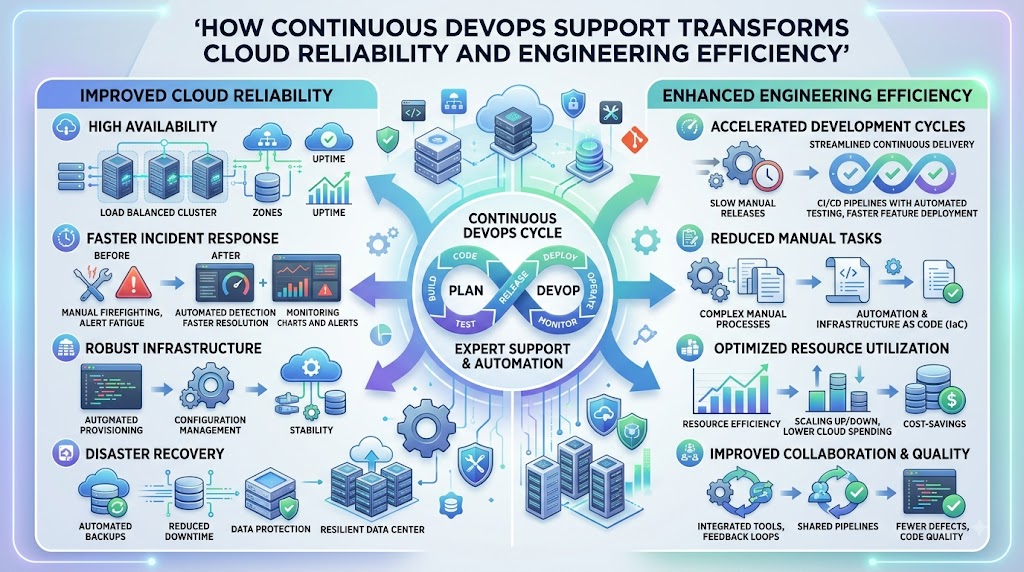
Modern software development moves at an unprecedented pace. Product teams are under constant pressure to deliver features faster, scale infrastructure on demand, and maintain flawless service availability. However, as cloud architectures evolve from simple virtual machines into distributed microservices, multi-cloud deployments, and containerized clusters, the operational burden on engineering teams grows exponentially.This article explores how ongoing DevOps support bridges the gap between software delivery and cloud stability. By examining managed operations, Kubernetes administration, cloud-specific strategies, security integration, Site Reliability Engineering (SRE), and MLOps, this guide provides a practical framework for technology leaders seeking to build resilient, scalable technical environments.
What Are DevOps Support Services?
DevOps Support Services provide continuous technical assistance, infrastructure maintenance, automation management, and operational troubleshooting for application environments. Rather than focusing solely on application logic, DevOps support addresses the underlying platform on which software runs.
These services cover critical operational domains, including:
- Infrastructure Operations: Managing virtual networks, storage, compute instances, and load balancers.
- Pipeline Maintenance: Constructing, optimizing, and repairing Continuous Integration and Continuous Deployment (CI/CD) workflows.
- Monitoring and Observability: Implementing metrics, centralized logging, and distributed tracing to maintain platform visibility.
- Incident Management: Investigating system degradation, performing root-cause analysis, and restoring service functionality.
- Automation and Infrastructure as Code (IaC): Writing and maintaining repeatable deployment scripts using tools like Terraform or Ansible.
One-Time Implementation vs. Ongoing Support
A common misconception among technical teams is that DevOps is a single project with a defined end date. Organizations often hire external consultants to build a platform, migrate workloads to the cloud, or establish initial CI/CD pipelines. However, once the initial design is deployed, day-to-day operations begin.
Cloud environments are dynamic. Security vulnerabilities emerge, software dependencies drift, cloud providers release API updates, and application usage fluctuates. A static setup rapidly degrades without active maintenance. While initial implementation establishes the framework, ongoing support provides continuous operational maintenance, capacity planning, security patching, and platform optimization over time.
Why Organizations Need Ongoing DevOps Support
As software infrastructure scales, operational demands change. System updates, framework changes, and user growth create continuous operational workload. Without dedicated operational focus, teams encounter progressive system debt and operational friction.
       +-------------------------------------------------------+
       |             Increasing Platform Complexity            |
       |  (Microservices, Multi-Cloud, Kubernetes, Pipelines)  |
       +---------------------------+---------------------------+
                                   |
                                   v
       +-------------------------------------------------------+
       |             Internal Team Friction & Fatigue          |
       |  (Context Switching, On-Call Burnout, Deployment Friction) |
       +---------------------------+---------------------------+
                                   |
                                   v
       +-------------------------------------------------------+
       |            Continuous DevOps Support Model            |
       |  (24/7 Monitoring, Managed Automation, SRE Practices)  |
       +---------------------------+---------------------------+
                                   |
                                   v
       +-------------------------------------------------------+
       |             Stable Operational Outcomes               |
       |  (High Availability, Secure Pipelines, Rapid Recovery) |
       +-------------------------------------------------------+
Key Operational Pressures
- Context Switching: Developers forced to juggle writing feature code with resolving infrastructure tickets experience decreased productivity and elevated error rates.
- Skill Coverage Gaps: Modern cloud platforms require deep knowledge across disparate domains, including network routing, IAM policy management, container orchestration, and secrets management. Expecting a single developer to master all these areas is unrealistic.
- Alert Fatigue: Improperly configured monitoring systems fire constant false alarms, causing operational teams to miss critical system warnings.
- Configuration Drift: Manual fixes applied during emergencies cause staging and production environments to diverge, leading to unexpected deployment failures.
Continuous support complements internal engineering groups. By offloading recurring platform maintenance, operational monitoring, and baseline infrastructure tasks, internal engineers can focus on building core application features that drive business growth.
24/7 DevOps Support Services
In a globalized economy, application downtime does not conform to traditional business hours. A database deadlock, memory leak, or cloud gateway outage at 2:00 AM can cause significant financial and reputational harm before local engineering teams start their workday.
24/7 DevOps Support Services provide continuous infrastructure monitoring, automated alerting, and immediate incident intervention to ensure operational continuity regardless of time zone.
+-----------------------------------------------------------------------------------+
|                        24/7 Operational Support Lifecycle                         |
+---------------------+-----------------------+---------------------+---------------+
| Proactive Detection | Immediate Triage      | Escalation Routing  | Remediation   |
| (Metrics, Logs)     | (Severity Evaluation) | (On-Call Engineers) | (Restoration) |
+---------------------+-----------------------+---------------------+---------------+
Core Components of Round-the-Clock Support
- Real-Time Monitoring: Tracking infrastructure health metrics (CPU, memory, disk I/O, network throughput) and application-level performance indicators.
- Triage and Incident Response: Acknowledging system alerts instantly, determining incident severity, and applying runbooks to restore service function.
- Structured Escalation Policies: Routing persistent or complex platform issues to designated senior architects according to strict Service Level Agreements (SLAs).
- Availability Tracking: Continuously testing public endpoints and synthetic transactions to identify service degradation before end consumers are impacted.
By establishing structured monitoring and on-call response workflows, organizations protect their teams from burnout while maintaining dependable service availability.
Managed DevOps Services
As platforms expand, managing individual tasks often evolves into managing entire platform ecosystems. Managed DevOps Services provide a comprehensive operational model where external specialists assume functional responsibility for cloud infrastructure, automation pipelines, and delivery systems.
Unlike traditional project-based consulting, where engineers complete a specific deliverable and depart, a managed services framework operates as an ongoing extension of the client’s technology department.
+-----------------------------------------------------------------------+
|                    Managed DevOps Operational Areas                   |
+------------------+------------------+---------------+-----------------+
| CI/CD & Releases | Infrastructure   | Observability | Security &      |
| Management       | as Code          | & Logging     | Compliance      |
+------------------+------------------+---------------+-----------------+
| Automated Build  | Terraform State  | Prometheus /  | IAM Audit       |
| Deploy Verification | Configuration Sync | Grafana Setup | Vulnerability   |
| Rollback Triggers| Resource Scaling | Log Aggregation | Patching      |
+------------------+------------------+---------------+-----------------+
When to Consider Managed DevOps
Organizations typically adopt managed services when:
- In-House Capacity is Limited: Small or mid-sized teams lack the bandwidth to manage complex platform workloads internally.
- Rapid Scaling Requires Standardization: Fast-growing businesses need to deploy standardized environments quickly across multiple regions.
- Operational Overheads Must Be Predictable: Transitioning from reactive, emergency repairs to structured operational support stabilizes technical expenditure.
By assigning baseline operations—such as backup verification, routine upgrades, and pipeline maintenance—to dedicated professionals, engineering managers maintain high operational standards without inflating internal team overhead.
Kubernetes Support Services
Container orchestration with Kubernetes has become the industry standard for running microservice architectures at scale. However, Kubernetes introduces significant operational complexity that can overwhelm engineering teams without specialized container expertise.
Common Kubernetes Challenges
Running Kubernetes in production involves far more than launching a cluster. Engineers must manage pod networking, ingress controllers, persistent storage volumes, role-based access controls (RBAC), and node auto-scaling. Furthermore, Kubernetes releases updates every four months, making cluster upgrade paths a recurring operational challenge.
       +-------------------------------------------------------+
       |             Production Kubernetes Cluster             |
       +-------------------------------------------------------+
                                   |
      +--------------------+-------+-------+--------------------+
      |                    |               |                    |
      v                    v               v                    v
+-----------+        +-----------+   +-----------+        +-----------+
| Ingress & |        | Pod       |   | Storage & |        | Upgrade & |
| Routing   |        | AutoScale |   | Volumes   |        | Patching  |
+-----------+        +-----------+   +-----------+        +-----------+
Kubernetes support services cover critical operational requirements across cloud provider environments such as AWS EKS, Azure AKS, and Google GKE:
- Cluster Lifecycle Management: Performing blue-green cluster upgrades, managing node pool transitions, and ensuring API compatibility.
- Resource Optimization: Configuring pod resource requests and limits to maximize hardware utilization and avoid unnecessary compute spending.
- Container Security: Enforcing pod security standards, scanning container images for vulnerabilities, and maintaining strict network policies.
- Troubleshooting and Observability: Resolving persistent crashes (
CrashLoopBackOff), network ingress bottlenecks, and DNS resolution failures within the cluster.
Dedicated container management allows development teams to package and deploy applications seamlessly without needing to debug low-level cluster control planes.
AWS DevOps Support Services
Amazon Web Services (AWS) offers a vast ecosystem of cloud infrastructure tools. While this breadth enables high customizability, configuring and maintaining AWS environments securely requires specialized cloud architecture knowledge.
AWS-focused support helps organizations structure, automate, and monitor their Amazon cloud services efficiently.
+-------------------------------------------------------------------+
|                  AWS Infrastructure & DevOps Workflows            |
+--------------------+--------------------+-------------------------+
| Compute Platform   | Infrastructure/IaC | Delivery & Deployment   |
+--------------------+--------------------+-------------------------+
| EC2, EKS, ECS,     | CloudFormation,    | AWS CodePipeline,       |
| AWS Lambda         | Terraform          | GitHub Actions          |
+--------------------+--------------------+-------------------------+
Operational Management Areas in AWS
- Compute and Serverless Platforms: Monitoring EC2 auto-scaling groups, managing container execution on ECS and EKS, and optimizing AWS Lambda functions for performance and cost.
- Infrastructure Provisioning: Utilizing Infrastructure as Code (IaC) via AWS CloudFormation or Terraform to manage resources declaratively, preventing manual configuration mistakes in the AWS Management Console.
- Pipeline Integration: Configuring automated deployment paths using native services like AWS CodePipeline or integrating external runners with AWS IAM and security rules.
- Cloud Observability: Centralizing logs through Amazon CloudWatch, configuring actionable metric alarms, and tracing microservices using AWS X-Ray.
Selecting appropriate AWS configurations requires evaluating specific application needs rather than relying on default settings, ensuring both cost efficiency and cloud performance.
Azure DevOps Support Services
For enterprise environments built on Microsoft architectures or utilizing hybrid infrastructure, Azure provides a robust ecosystem. Maintaining Azure workloads requires expertise in Microsoft’s specific identity management, deployment automation, and networking paradigms.
Support for Azure environments focuses on creating continuous software delivery channels and reliable cloud infrastructure.
+-------------------------------------------------------------------+
|               Azure Infrastructure & Delivery Ecosystem           |
+---------------------+-----------------------+---------------------+
| Deployment Pipeline | Compute & Containers  | Observability       |
+---------------------+-----------------------+---------------------+
| Azure Pipelines     | Azure Kubernetes (AKS)| Azure Monitor       |
| Release Management  | Virtual Machines      | Log Analytics       |
+---------------------+-----------------------+---------------------+
Operational Scope in Azure Environments
- Azure Pipelines Management: Designing, optimizing, and securing build and release pipelines to support complex environment progressions.
- Azure Kubernetes Service (AKS): Managing container orchestration, ingress endpoints, node pool scaling, and identity integration via Microsoft Entra ID.
- Infrastructure Administration: Automating Virtual Network (VNet) peering, managing storage accounts, and applying Bicep or Terraform templates for repeatable resource creation.
- Platform Observability: Configuring Azure Monitor, Application Insights, and Log Analytics workspaces to track operational performance and diagnose latency issues.
Structured operational management helps teams leverage Azure’s technical capabilities without encountering service misconfigurations.
DevSecOps Support Services
Historically, security testing occurred at the end of the development cycle. This delayed model often created severe launch blockers when vulnerabilities were discovered right before production releases. DevSecOps shifts security left, integrating automated controls directly into every phase of the software delivery lifecycle.
  +--------------+     +--------------+     +--------------+     +--------------+
  |  Code Commit | --> |  Build/Scan  | --> | Image Audit  | --> | Deploy/Audit |
  +--------------+     +--------------+     +--------------+     +--------------+
  | Secret Check |     | SAST Check   |     | Vulnerability|     | DAST & IAM   |
  | (Pre-commit) |     | (Dependency) |     | Container    |     | Policies     |
  +--------------+     +--------------+     +--------------+     +--------------+
Core Security Practices in DevSecOps
- Static and Dynamic Code Analysis: Running automated Static Application Security Testing (SAST) and Dynamic Application Security Testing (DAST) within CI/CD pipelines to catch vulnerabilities during development.
- Dependency & Container Scanning: Auditing open-source dependencies and base container images for known Common Vulnerabilities and Exposures (CVEs) before deployment.
- Secrets Management: Replacing hardcoded passwords and API keys with secure secret managers such as HashiCorp Vault, AWS Secrets Manager, or Azure Key Vault.
- Automated Compliance Checks: Enforcing policy-as-code controls to verify that cloud configurations comply with regulatory benchmarks (e.g., CIS, SOC 2, HIPAA).
Integrating continuous automated security auditing enables organizations to deploy software quickly without compromising system integrity.
SRE Support Services
Site Reliability Engineering (SRE) applies software engineering principles to infrastructure and operational tasks. Rather than managing systems manually, SRE focuses on creating automated, self-healing platforms while balancing rapid feature delivery with system stability.
+-----------------------------------------------------------------------+
|                    Core SRE Operational Framework                     |
+------------------+------------------+---------------+-----------------+
| Metrics & Goals  | Error Budgets    | Observability | Incident Mgmt   |
+------------------+------------------+---------------+-----------------+
| SLIs & SLOs      | Allowable Margin | Tracing, Logs,| Root-Cause      |
| Definition       | of Disruption    | Metrics       | Analysis (RCA)  |
+------------------+------------------+---------------+-----------------+
Critical SRE Methodologies
- Service Level Indicators (SLIs) and Objectives (SLOs): Defining quantifiable performance metrics (e.g., API latency < 200ms) and establishing target reliability thresholds.
- Error Budget Management: Using error budgets to evaluate risk objectively. If a system remains well within its error budget, deployment teams can push updates rapidly. If the budget is depleted, release velocity slows down to prioritize stability.
- Observability Architecture: Moving beyond basic uptime monitoring by analyzing metrics, logs, and traces to understand internal system state.
- Root-Cause Analysis (RCA): Conducting blameless post-mortems after service disruptions to identify system weaknesses and prevent incident recurrence.
By implementing SRE practices, organizations transition from reactive emergency response to proactive platform engineering.
MLOps Support Services
As artificial intelligence and machine learning models move from research labs into commercial applications, the challenge shifts from training algorithms to operating ML infrastructure in production. Machine Learning Operations (MLOps) adapts traditional DevOps concepts to the unique requirements of data science workflows.
+-----------------------------------------------------------------------+
|                      Continuous MLOps Pipeline                        |
+-------------------+-------------------+-------------------+-----------+
| Data Ingestion    | Model Training    | Deployment        | Drift     |
| & Validation      | & Registry        | & Serving         | Tracking  |
+-------------------+-------------------+-------------------+-----------+
Key Differences Between DevOps and MLOps
While standard DevOps handles code and infrastructure updates, MLOps must simultaneously manage three moving parts: Code, Data, and Models. A change in underlying data distribution can degrade model performance even if the application code remains completely unchanged.
MLOps Support Domain Focus
- Pipeline Automation: Building automated pipelines for data ingestion, feature extraction, and continuous model retraining.
- Model Serving Infrastructure: Configuring scalable inference endpoints capable of handling variable request volumes with low latency.
- Data and Model Drift Monitoring: Tracking model predictions over time to detect accuracy degradation caused by changing real-world data patterns.
- Resource Management: Optimizing GPU/CPU compute node usage during model training to avoid unnecessary cloud expenditures.
Dedicated MLOps support connects data science output with reliable production infrastructure, ensuring machine learning systems remain stable and performant.
DevOps Support Technology Areas
The following matrix provides a summary of core operational domains, common toolsets, and their primary technical purpose in modern software delivery:
| Area | Common Technologies / Practices | Primary Purpose |
| CI/CD | Jenkins, GitHub Actions, GitLab CI/CD, Azure Pipelines | Automating continuous software build, test, and deployment pipelines. |
| Cloud | AWS, Microsoft Azure, Google Cloud Platform | Operating flexible, scalable, and distributed compute platforms. |
| Containers | Docker, Kubernetes, Helm, Containerd | Ensuring consistent application runtime environments across environments. |
| Infrastructure as Code | Terraform, OpenTofu, AWS CloudFormation, Ansible | Managing infrastructure using version-controlled, repeatable code. |
| Monitoring | Prometheus, Grafana, Datadog, AWS CloudWatch | Maintaining system visibility through real-time metrics, logs, and traces. |
| Security | Vault, SonarQube, Trivy, Aqua Security | Embedding continuous security audits into build and run environments. |
| SRE | OpenTelemetry, Chaos Mesh, PagerDuty | Measuring reliability using SLIs/SLOs and automating operational recovery. |
| MLOps | Kubeflow, MLflow, Feature Stores, Model Servers | Operating scalable data pipelines and hosting machine learning inference endpoints. |
Benefits of Continuous DevOps Support
Investing in structured DevOps support offers significant operational advantages for engineering organizations:
- Faster Time-to-Market: Automated CI/CD pipelines allow teams to ship new code continuously without manual release friction.
- Reduced Mean Time to Resolution (MTTR): Centralized observability and round-the-clock monitoring accelerate incident detection and troubleshooting.
- Standardized Infrastructure: Managing configurations through code eliminates environment drift between staging and production platforms.
- Improved Cloud Cost Optimization: Active monitoring of infrastructure usage prevents over-provisioning and identifies idle cloud resources.
- Enhanced System Security: Continuous scanning, automated patching, and strict identity management minimize platform vulnerability surface area.
- Minimized Operational Burnout: Dedicated platform specialists relieve developers from persistent on-call pressures, improving team retention and productivity.
Common DevOps Support Challenges
Implementing or outsourcing operational support is not without potential hurdles. Organizations must actively manage common execution risks:
- Poor Documentation: Inadequate platform documentation leads to prolonged troubleshooting delays during active incidents.
- Unclear Ownership: Ambiguity regarding which team handles specific platform components causes critical operational tasks to be overlooked.
- Inadequate Observability: Running environments without sufficient metrics or centralized logs hampers root-cause analysis.
- Configuration Drift: Applying unverified manual changes directly to production creates unpredictable system behaviors.
- Inefficient Communication: Siloed workflows between internal developers and external operational specialists delay resolution times.
- Knowledge Transfer Deficits: Failing to cross-train internal teams on platform changes creates long-term external dependencies.
- Over-Reliance on Manual Interventions: Relying on manual runbooks instead of investing in platform automation increases operational risk.
- Weak Access Controls: Overly broad administrative privileges compromise infrastructure security hygiene.
- Alert Noise: Uncalibrated alert systems create notification fatigue, increasing the likelihood that critical warnings are ignored.
- Inflexible Support SLAs: Rigorous, non-adaptable service contracts can restrict responsiveness to evolving business needs.
How to Choose a DevOps Support Provider
Selecting an operational partner requires thorough evaluation of technical capabilities, communication protocols, and security practices.
       +-------------------------------------------------------+
       |           DevOps Support Selection Criteria           |
       +-------------------------------------------------------+
                                   |
      +--------------------+-------+-------+--------------------+
      |                    |               |                    |
      v                    v               v                    v
+-----------+        +-----------+   +-----------+        +-----------+
| Technical |        | Security  |   | Support   |        | Knowledge |
| Expertise |        | Hygiene   |   | SLA/Scope |        | Transfer  |
+-----------+        +-----------+   +-----------+        +-----------+
Evaluation Checklist
- Technical Expertise: Does the provider demonstrate hands-on experience across your specific tech stack (e.g., Kubernetes, AWS, Azure, Terraform)?
- Security Standards: How does the organization manage access credentials, key rotation, and regulatory compliance requirements?
- Incident Escalation Procedures: Are there clear, structured SLAs for acknowledging and resolving P1 critical production outages?
- Monitoring Capabilities: Does the team rely on modern observability tools (Prometheus, Grafana, OpenTelemetry) rather than basic ping tests?
- Communication Channels: How easily do support engineers integrate with your existing workflows (e.g., Slack, Teams, Jira)?
- Knowledge Transfer Philosophy: Does the partner document platform configurations and train your internal team, or do they lock operational knowledge away?
DevOps Support Area and Business Need
Matching operational capabilities with specific technical goals helps organizations select the appropriate support model:
| Support Area | Typical Business Need |
| DevOps Support | Requiring ongoing platform optimization, automation maintenance, and delivery pipeline support. |
| 24/7 DevOps Support | Needing continuous infrastructure coverage and immediate response for business-critical platforms. |
| Managed DevOps | Offloading full-scale platform management to reduce recurring operational workload on internal staff. |
| Kubernetes Support | Resolving complex cluster administration, ingress, scaling, and upgrade challenges in production. |
| AWS DevOps Support | Optimizing AWS cloud architectures, managing serverless stacks, and automating IaC deployments. |
| Azure DevOps Support | Structuring Azure Pipelines, managing AKS environments, and integrating enterprise directory security. |
| DevSecOps Support | Embedding automated security scanning, secrets management, and compliance checks into pipelines. |
| SRE Support | Implementing formal error budgets, SLI/SLO tracking, and advanced observability to boost uptime. |
| MLOps Support | Operating scalable data pipelines and hosting inference endpoints for production machine learning models. |
Frequently Asked Questions
1. What are DevOps Support Services?
DevOps Support Services provide technical assistance for cloud infrastructure, CI/CD pipelines, container environments, and system monitoring. They focus on maintaining operational stability, automating deployments, and resolving production incidents to keep software platforms running smoothly.
2. Why do companies need ongoing DevOps support?
Cloud platforms continuously evolve through software updates, traffic scaling, and security patches. Ongoing support ensures systems remain secure, optimized, and reliable over time, allowing internal developers to focus on building features rather than managing platform overhead.
3. What do 24/7 DevOps Support Services include?
24/7 support includes round-the-clock infrastructure monitoring, immediate triage of platform alerts, emergency incident response, availability checks, and structured escalation protocols to minimize system downtime regardless of when incidents occur.
4. What is the difference between managed DevOps and traditional DevOps consulting?
Traditional DevOps consulting typically involves short-term, project-based engagements like migrating infrastructure or building a pipeline. Managed DevOps provides continuous, long-term operational coverage, handling day-to-day platform maintenance, monitoring, and updates indefinitely.
5. When is Kubernetes support useful?
Kubernetes support is valuable when teams run containerized production workloads but face operational friction with cluster upgrades, ingress networking, resource management, auto-scaling, or persistent debugging across environments like EKS, AKS, or GKE.
6. What does AWS DevOps support involve?
AWS support covers the administration and automation of Amazon cloud services. Key areas include provisioning infrastructure via Terraform/CloudFormation, managing EC2/EKS compute platforms, configuring CloudWatch observability, and maintaining secure deployment pipelines.
7. How does DevSecOps support improve platform security?
DevSecOps integrates automated security tools directly into software delivery pipelines. By automating dependency checks, static code analysis, container scanning, and secrets management, security vulnerabilities are caught and remediated early in the development lifecycle.
8. What is the role of SRE and MLOps support?
SRE support focuses on platform reliability through observability, error budget management, and automated incident recovery. MLOps support extends these operational practices to machine learning systems, managing data pipelines, model registries, and inference endpoints in production.
Conclusion
Modern software delivery demands a delicate balance between speed and system stability. As technical architectures grow increasingly complex—incorporating distributed microservices, multi-cloud platforms, container orchestration, and artificial intelligence—maintaining platform reliability through manual processes is no longer viable.
Structured operational models bridge this gap. By combining continuous monitoring, automated infrastructure management, robust security practices, and reliable incident response, organizations can maintain resilient technical environments without overwhelming their internal development teams.Ultimately, selecting the right support model depends on an organization’s specific technical maturity, infrastructure scale, business requirements, and long-term engineering goals. Whether through round-the-clock incident coverage, targeted cloud optimization, or full-scale platform management, establishing strong operational foundations ensures that technology remains an engine for growth rather than a source of operational friction.