Introduction
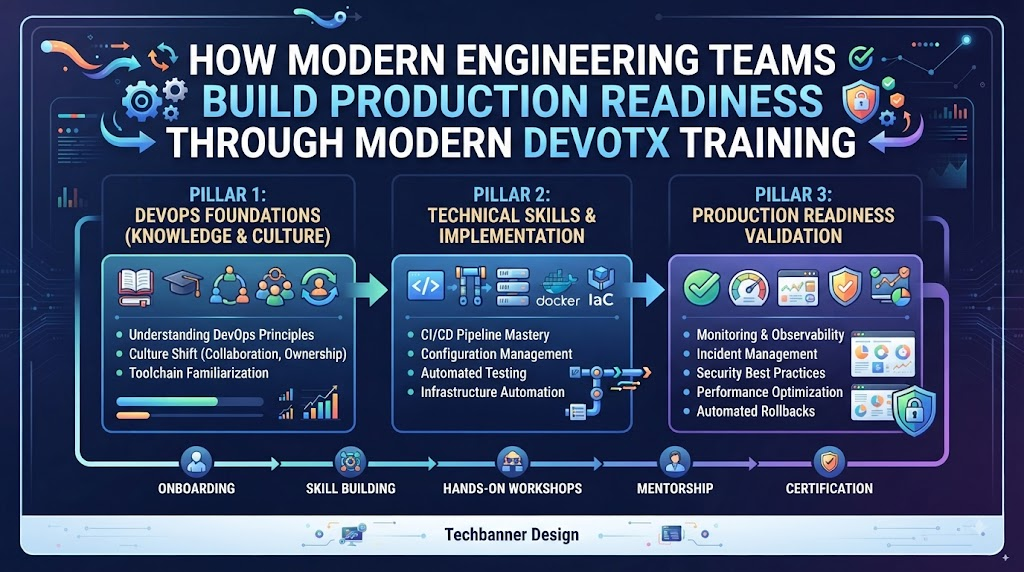
Software delivery has evolved from periodic, manual releases to continuous, automated deployments. As organizations migrate to the cloud, adopt microservices, and implement containerized architectures, the complexity of managing infrastructure increases significantly. Engineering teams face daily challenges surrounding infrastructure automation, continuous integration and continuous delivery (CI/CD) pipelines, cloud cost management, container orchestration, and security integration.Building modern delivery capability involves understanding how toolchains integrate into a coherent operational ecosystem. Effective technical training helps engineers and technical leaders build practical confidence, navigate real-world cloud complexity, and establish sustainable development and operational workflows.
What Does a DevOps Trainer Do?
A DevOps Trainer acts as a mentor and guide who connects software development methodologies with operational execution. Rather than simply reading through documentation or lecturing on individual tools, an effective instructor focuses on workflows, architecture, and real-world problem-solving.
       [ Modern DevOps Technical Focus Areas ]
                         │
    ┌────────────────────┼────────────────────┐
    ▼                    ▼                    ▼
[ CI/CD Pipelines ]  [ Cloud & IaC ]  [ Containers & Orchestration ]
(Jenkins/GitHub)     (Terraform/AWS)       (Docker/Kubernetes)
    │                    │                    │
    └────────────────────┼────────────────────┘
                         ▼
        [ Observability & Security ]
         (Prometheus/Vault/SAST)
The core responsibility of an instructor is to teach concepts through practical execution. This involves leading tool demonstrations, configuring hands-on lab environments, and guiding engineers through realistic production scenarios. Key areas covered during instruction include:
- Designing robust CI/CD pipelines for automated testing and deployment.
- Writing modular Infrastructure as Code (IaC) to manage cloud resources reproducibly.
- Configuring container engines and orchestration frameworks.
- Setting up central logging, metrics collection, and alerting systems.
- Implementing automated security scans within release pipelines.
- Executing troubleshooting exercises that simulate system outages and configuration drifts.
The essential difference between generic theoretical training and practical learning lies in the application. Theoretical training explains what a tool does; practical training demonstrates how that tool behaves inside a distributed architecture during a deployment failure or traffic spike.
Why DevOps Training Matters for Modern Engineering Teams
Modern tech organizations rarely suffer from a lack of tools. Instead, they struggle with tool fragmentation, inconsistent practices, and architectural bottlenecks. When teams adopt cloud technologies without structured guidance, they often replicate legacy on-premises anti-patterns in cloud environments.
Investing in structured learning addresses critical operational challenges:
Addressing the Skills Gap
Engineering roles now demand overlapping capabilities. Developers need to understand how their applications run in containerized environments, while operations engineers must adopt software engineering practices like version control, code reviews, and testing for infrastructure.
Accelerating Cloud Adoption and Automation
Cloud platforms offer hundreds of services. Without clear architectural guidance, teams can misconfigure network topologies, neglect identity management, or overspend on resources. Structured education provides clarity on best practices for cloud infrastructure.
Improving Production Reliability and Developer Productivity
When release pipelines are slow or fragile, engineering velocity drops. Training helps teams build reliable automated testing and deployment mechanisms, allowing developers to focus on writing feature code rather than manual release steps.
While technical training provides foundational knowledge and hands-on experience, it complements—rather than replaces—real-world engineering experience. Practical execution in real environments remains the ultimate test of engineering capability.
Corporate DevOps Training
Corporate DevOps Training focuses on the specific organizational context of an enterprise, whereas generic public courses cater to individual learners looking for broad knowledge. Every enterprise operates with unique security mandates, legacy systems, compliance regulations, and delivery pipelines.
  Generic Public Training            Corporate DevOps Training
┌──────────────────────────┐       ┌──────────────────────────┐
│ Broad, fixed curriculum  │       │ Tailored to tech stack   │
│ Standard public labs     │  vs.  │ Internal workflow labs   │
│ Individual focus         │       │ Team-wide alignment      │
└──────────────────────────┘       └──────────────────────────┘
A one-size-fits-all syllabus often fails to address enterprise requirements because it ignores existing technical debt and organizational workflows. Effective corporate training programs are customized around specific engineering environments.
Key Elements of Corporate Programs
- Stack-Specific Curriculum: Training is designed around the exact cloud provider, CI/CD engine, and container platform used by the company.
- Workflow Integration: Labs reflect the enterprise’s actual branching strategies, approval gates, and environment progression patterns.
- Skill Assessments: Pre-training evaluations identify skill baselines across teams to ensure instruction starts at the appropriate technical level.
- Practical Workshops: Teams work together during training to build deployment pipelines or infrastructure templates that mimic internal production systems.
- Knowledge Transfer: Sessions focus on removing team silos by bringing developers, QA engineers, system administrators, and security specialists into the same learning environment.
Online DevOps Trainer
The rise of distributed teams has changed how technical education is delivered. An Online DevOps Trainer conducts live, interactive virtual sessions that allow geographically dispersed teams to learn together without travel overhead.
Modern remote learning relies on interactive environments:
- Live Interactive Sessions: Direct communication allows learners to ask questions and clarify complex architectural patterns in real time.
- Remote Cloud Labs: Pre-configured cloud environments give students individual sandboxes to experiment without risking production infrastructure.
- Screen Sharing and Pair Troubleshooting: Instructors can review student code, inspect broken pipeline runs, and guide debugging sessions live.
- Recorded Learning Materials: Video archives allow engineers to revisit complex setup procedures and technical demonstrations after live sessions conclude.
Advantages and Considerations
Online training offers flexibility, reduced cost, and easy access for global teams. However, it requires self-discipline from participants and stable remote lab infrastructure. Classroom training, by contrast, provides face-to-face focus, which can be useful for intensive onboarding bootcamps. Neither model is universally superior; the right format depends on team distribution and schedule constraints.
How to Choose a DevOps Trainer in India
Selecting an instructor requires looking beyond resume titles. Technical mastery of software tools does not automatically make someone an effective educator. A capable instructor must possess both production engineering experience and strong communication skills.
When evaluating a DevOps Trainer in India or globally, technical leaders and L&D managers can use the following criteria:
[ Evaluation Criteria ] ──┬──► Real-World Production Experience
                          ├──► Pedagogy & Communication
                          ├──► Cloud & Container Mastery
                          └──► Hands-On Lab Architecture
- Real-World Engineering Background: The instructor should have direct experience building, deploying, and maintaining production systems, rather than relying solely on theoretical course material.
- Instructional Ability: They must be capable of breaking down complex system concepts—such as distributed consensus, container networking, or ingress routing—into digestible, step-by-step explanations.
- Breadth Across Domains: Modern delivery spans cloud platforms, container orchestrators, IaC, security, and observability. The instructor should understand how these components interact.
- Emphasis on Hands-On Labs: Quality instruction prioritizes real-world terminal work, code authoring, and system configuration over slide presentation length.
- Focus on Troubleshooting: The trainer should teach engineers how to inspect logs, debug failed builds, and diagnose broken cluster configurations, as troubleshooting is a core operational skill.
Kubernetes Trainer: What Should Kubernetes Training Cover?
Container orchestration has become a foundation of modern cloud infrastructure. However, Kubernetes introduces high conceptual complexity, abstracting networking, storage, and workload scheduling behind declarative configuration APIs.
A qualified Kubernetes Trainer should guide engineers through basic concepts to production management techniques:
Essential Kubernetes Learning Topics
- Core Architecture: Understanding the control plane components (API server, etcd, scheduler, controller manager) and worker node processes (kubelet, kube-proxy, container runtime).
- Workload Resources: Deploying and managing Pods, Deployments, StatefulSets, DaemonSets, and Jobs.
- Networking and Service Discovery: Configuring ClusterIP, NodePort, LoadBalancer services, Ingress controllers, and NetworkPolicies.
- Storage Abstractions: Managing PersistentVolumes, PersistentVolumeClaims, StorageClasses, and dynamic provisioning.
- Configuration Management: Using ConfigMaps, Secrets, and tools like Helm to manage multi-environment configurations.
- Production Operations: Cluster scaling, node maintenance, rolling updates, rollbacks, and cluster monitoring using Prometheus and Grafana.
- Managed Cloud Offerings: Working with managed Kubernetes engines across major cloud providers, including AWS EKS, Azure AKS, and Google GKE.
Focusing on these practical concepts ensures engineers learn how to run workloads safely in production rather than simply deploying single-node local instances.
AWS DevOps Trainer
Amazon Web Services offers a deep collection of cloud infrastructure and delivery services. An AWS DevOps Trainer helps teams translate general delivery principles into AWS-specific configurations.
Training should emphasize real-world service integration:
  [ Developer Code ] ──► [ AWS CodePipeline / GitHub ] ──► [ Terraform / CloudFormation ]
                                                                   │
                                                                   ▼
                                                          [ Amazon EKS / ECS ]
                                                                   │
                                                                   ▼
                                                          [ Amazon CloudWatch ]
- Compute Platforms: Setting up workloads on EC2, Elastic Container Service (ECS), AWS Fargate, and Amazon Elastic Kubernetes Service (EKS).
- Infrastructure Automation: Writing declarative templates using Terraform or AWS CloudFormation to manage AWS VPCs, IAM roles, and security groups.
- CI/CD Implementations: Building release automation using AWS CodePipeline, AWS CodeBuild, or external tools integrated with AWS target environments.
- Serverless Workflows: Automating event-driven tasks using AWS Lambda and serverless integration patterns.
- Cloud Observability: Setting up monitoring, log aggregation, and metrics tracking using Amazon CloudWatch and AWS X-Ray.
The goal of AWS-focused training is to show engineers how to build scalable, automated, and secure cloud environments using cloud-native architectures.
Azure DevOps Trainer
For organizations operating within the Microsoft ecosystem, Azure provides an integrated set of cloud services and development pipelines. An Azure DevOps Trainer helps teams structure end-to-end delivery models on Azure infrastructure.
Key areas covered in Azure-focused instruction include:
- Azure Pipelines: Designing YAML-based build and release pipelines for multi-stage software deployments with manual approval gates.
- Azure Kubernetes Service (AKS): Deploying, scaling, and securing enterprise Kubernetes clusters on Azure.
- Azure Infrastructure as Code: Automating cloud environments using Bicep, ARM templates, or Terraform.
- Identity and Access Management: Configuring Microsoft Entra ID (formerly Azure Active Directory) for role-based access control across subscriptions and pipelines.
- Azure Monitor and Application Insights: Setting up telemetry, application performance monitoring, and centralized logging across cloud resources.
Learning these Azure workflows helps teams optimize software delivery, improve resource management, and enforce consistent configuration policies across environments.
DevSecOps Trainer
Historically, security testing occurred at the end of the software development lifecycle, often creating deployment bottlenecks or leading to unaddressed vulnerabilities in production. A DevSecOps Trainer focuses on shifting security practices left, integrating automated security checks directly into early stage CI/CD pipelines.
[ Code ] ──► [ SAST / Dependency Scan ] ──► [ Build ] ──► [ Container Scan ] ──► [ Deploy ] ──► [ DAST ]
Practical DevSecOps training covers key security capabilities across the pipeline:
- Static Application Security Testing (SAST): Scanning source code for security vulnerabilities during the build process.
- Dynamic Application Security Testing (DAST): Automated vulnerability scanning against running test environments.
- Software Composition Analysis (SCA): Identifying open-source vulnerabilities and license compliance issues in third-party libraries.
- Container Security: Scanning container base images for known vulnerabilities before deployment to registries.
- Secrets Management: Preventing plain-text credentials in source code using tools like HashiCorp Vault, AWS Secrets Manager, or Azure Key Vault.
- Compliance Automation: Enforcing policy-as-code rules using tools like Open Policy Agent (OPA) to audit infrastructure configurations automatically.
By embedding security checks into automated workflows, engineering teams can maintain release velocity without compromising system security.
SRE Trainer
While DevOps emphasizes delivery velocity and cross-team automation, Site Reliability Engineering (SRE) applies software engineering discipline to operations and system reliability. An SRE Trainer teaches engineers how to manage production systems using quantitative metrics and engineering practices.
Essential concepts in SRE training include:
Reliability Metrics
Defining Service Level Indicators (SLIs) to measure system performance and setting Service Level Objectives (SLOs) to define acceptable service quality thresholds.
Error Budgets
Using error budgets as a tool to balance release velocity against system stability. If an error budget is exhausted, releases halt until reliability is restored.
Observability Architecture
Moving beyond simple uptime monitoring to deep observability using metrics, distributed tracing, and centralized log management.
Incident Management and Post-Mortems
Structuring incident response workflows, conducting blameless post-mortems, and writing automated fixes to prevent recurrence.
Eliminating Toil
Identifying manual, repetitive operational work and replacing it with automated code and self-healing systems.
MLOps Trainer
As machine learning models move from research sandboxes into production software systems, engineering teams require specialized operational practices. An MLOps Trainer bridges data science and operational engineering.
[ Data Ingestion ] ──► [ Model Training ] ──► [ Model Registry ] ──► [ Deployment ] ──► [ Drift Monitoring ]
MLOps training adapts traditional software delivery workflows to the machine learning lifecycle:
- Automated Data and ML Pipelines: Managing reproducible data processing pipelines and training workflows.
- Model Deployment and Serving: Containerizing ML models and serving them via REST or gRPC APIs on cloud infrastructure.
- Model Versioning and Registries: Tracking code, training data, and model artifacts over time using tools like MLflow or DVC.
- Model Monitoring and Data Drift: Detecting performance degradation, feature drift, and data distribution shifts in running production models.
- Scalable ML Infrastructure: Managing distributed training clusters and GPU resource allocation on platforms like Kubernetes.
This specialized training helps data science and platform teams build stable, repeatable, and scalable machine learning operations.
DevOps Training Technology Areas
The following matrix provides an overview of technical training domains, relevant industry tools, and core learning objectives:
| Training Area | Common Technologies / Practices | Learning Focus |
| CI/CD | Jenkins, GitHub Actions, GitLab CI/CD, Azure Pipelines | Automated build, test, and delivery workflows |
| Cloud | AWS, Azure, Google Cloud | Cloud computing operations and architecture |
| Containers | Docker, Kubernetes, Containerd | Containerized workloads and orchestration |
| Infrastructure as Code | Terraform, CloudFormation, Ansible, Bicep | Automated and reproducible infrastructure |
| Security | SAST, DAST, HashiCorp Vault, Trivy | Shift-left security and automated compliance |
| Monitoring | Prometheus, Grafana, OpenTelemetry, ELK | System observability, logging, and metrics |
| SRE | SLI, SLO, Error Budgets, PagerDuty | System reliability engineering and operations |
| MLOps | MLflow, Kubeflow, DVC, Model Serving | Production machine-learning lifecycle management |
Benefits of Practical DevOps Training
Investing in hands-on, scenario-driven learning delivers tangible operational benefits across engineering organizations:
- Improved Workflow Understanding: Engineers gain an end-to-end view of software delivery, from source control to cloud production monitoring.
- Increased Technical Confidence: Working through real-world terminal exercises reduces deployment errors in enterprise environments.
- Consistent Automation Practices: Teams adopt standardized Infrastructure as Code patterns, eliminating manual server configuration.
- Enhanced Cloud Infrastructure Management: Engineers learn to design cost-effective, scalable, and secure cloud architectures.
- Faster Incident Diagnosis: Troubleshooting labs give engineers hands-on experience identifying and fixing broken infrastructure.
- Stronger Dev-Ops Collaboration: Shared training breaks down communication barriers between developers, security specialists, and operational teams.
Common DevOps Training Mistakes
Organizations frequently encounter pitfalls when designing or purchasing technical training programs. Recognizing these mistakes helps teams avoid wasted time and budget:
[ Training Anti-Patterns ]
 ├── 1. Heavy Theory, Zero Terminal Time
 ├── 2. Tool Overload Without Context
 ├── 3. Ignoring Real-World Troubleshooting
 └── 4. Static Standard Syllabi
- Focusing Exclusively on Theory: Lecturing on architectural concepts without terminal work leaves engineers unprepared for practical execution.
- Tool Overload Without Architectural Context: Teaching long lists of tools without showing how they fit into an integrated delivery pipeline creates confusion.
- Skipping Hands-On Labs: Without practical exercises, retention drops, and engineers struggle to apply concepts back on the job.
- Using Outdated Materials: Teaching legacy tool versions or obsolete practices reduces the real-world value of training.
- Ignoring Learner Baselines: Delivering advanced Kubernetes or SRE concepts to teams struggling with basic scripting or Linux administration leads to frustration.
- Omitting Cloud Environments: Training on isolated local laptops fails to reflect the security and networking realities of multi-tenant cloud platforms.
- Neglecting Security Controls: Treating security as an optional module rather than integrating it across pipeline stages encourages insecure coding habits.
- Omitting Troubleshooting Scenarios: Instructing only on “happy path” setups leaves engineers unequipped to debug production failures.
- Relying on Unrealistic Synthetic Examples: Using oversimplified demo apps fails to prepare engineers for complex enterprise microservices.
- Treating Training as a One-Time Event: Expecting a single week-long workshop to fix long-standing technical debt without ongoing practice.
How to Evaluate a DevOps Training Program
Organizations evaluating technical courses can use the following verification checklist before selecting a provider or curriculum:
[ Evaluation Checklist ]
 [ ] Trainer hands-on production background verified
 [ ] Curriculum balances core architecture with hands-on exercises
 [ ] Labs use real cloud sandboxes, not just local slide demos
 [ ] Exercises cover pipeline failures and troubleshooting
 [ ] Course materials updated for modern software versions
 [ ] Post-training documentation and references provided
- Instructor Qualifications: Verify that the instructor has real-world production engineering experience.
- Lab Quality: Ensure labs provide dedicated cloud environments where students write, test, and debug configurations independently.
- Curriculum Currency: Confirm that the technical content reflects current industry practices and modern tool versions.
- Troubleshooting Content: Check whether exercises include broken scenario recovery alongside standard setup workflows.
- Relevance to Organizational Stack: Confirm that the technology stack covered in training matches the software engines used internally.
- Post-Training Support: Review what reference materials, code samples, and lab access remain available after training sessions complete.
Training Area and Learning Need
Matching specific organizational challenges with the appropriate training domain ensures targeted skill development:
| Training Area | Typical Learning Need |
| DevOps Training | Understand modern release automation and infrastructure delivery practices. |
| Corporate DevOps Training | Build consistent, team-wide automated deployment capabilities tailored to company tech stacks. |
| Online DevOps Training | Provide flexible remote learning opportunities for geographically distributed engineering teams. |
| Kubernetes Training | Master container orchestration, cluster administration, and workload management in production. |
| AWS DevOps Training | Implement cloud-native CI/CD pipelines, infrastructure automation, and monitoring on AWS. |
| Azure DevOps Training | Automate enterprise pipelines, cloud deployment workflows, and resource security on Azure. |
| DevSecOps Training | Integrate automated security scanning, policy compliance, and secrets management into software pipelines. |
| SRE Training | Apply quantitative engineering practices to measure and maintain system reliability and uptime. |
| MLOps Training | Manage, deploy, and monitor production machine-learning pipelines and model infrastructures. |
FAQ
1.What does a DevOps Trainer teach?
A trainer teaches engineers how to automate software delivery, configure Infrastructure as Code, manage cloud environments, set up container orchestration, implement observability tools, and manage release pipelines. Instruction focuses on both tools and operational methodologies.
2.What is Corporate DevOps Training?
Corporate training is a customized program designed for enterprise teams. Unlike generic public courses, it tailors the curriculum, toolchain, and lab scenarios to match an organization’s specific software stack, security requirements, and internal release workflows.
3.How do I choose a DevOps Trainer in India?
Look for instructors with verifiable production engineering experience, strong instructional communication skills, and a practical hands-on approach. Evaluate their ability to explain complex distributed systems concepts and their emphasis on real-world troubleshooting labs.
4.Is an Online DevOps Trainer suitable for corporate teams?
Yes. Virtual training offers live instructor-led learning, real-time screen sharing, interactive pair debugging, and remote cloud lab access. It provides an efficient way to upskill geographically distributed teams without incurring travel costs.
5.What should Kubernetes training include?
Comprehensive training should cover core cluster architecture, workload abstractions (Pods, Deployments, StatefulSets), networking, storage management, Helm chart packaging, cluster security, monitoring, and practical troubleshooting on cloud platforms like EKS or AKS.
6.What does an AWS DevOps Trainer teach?
An AWS instructor covers cloud-native delivery workflows using AWS tools alongside cloud-agnostic technology. Key topics include Amazon EKS, ECS, Terraform/CloudFormation, AWS CodePipeline, Lambda, IAM policies, and CloudWatch monitoring.
7.Why is DevSecOps training important?
It teaches engineering teams to integrate automated security checks early in the delivery pipeline. By automating SAST, DAST, container scans, and secrets management, teams can identify vulnerabilities early without slowing down release cadences.
8.What is the difference between DevOps, SRE, and MLOps training?
DevOps training focuses on delivery velocity, pipeline automation, and developer-operations collaboration. SRE training emphasizes system reliability, availability metrics (SLIs/SLOs), and production incident management. MLOps training adapts operational and delivery practices to machine learning models, data pipelines, and model deployment infrastructure.
Conclusion
Building modern engineering capability requires a continuous investment in skill development. As infrastructure becomes more complex, software engineering teams must adapt by mastering continuous integration, cloud architecture, Infrastructure as Code, container orchestration, shift-left security, and reliability engineering.Whether an organization is looking to streamline cloud workflows, adopt Kubernetes, strengthen application security, or build reliable production systems, choosing the right training path is critical. The ideal learning approach depends on the team’s current skill levels, specific technology stack, and broader operational objectives.